
A single vial of unverified peptide can invalidate six months of laboratory data and thousands of dollars in research funding. In an era where the EMA’s June 2026 guidelines now mandate reporting impurities above 0.1%, the margin for error has vanished. You recognize that inconsistent batch quality is more than a nuisance. It’s a threat to the structural integrity of your entire project. Establishing a rigorous peptide purity verification protocol is the only way to ensure the validity of your data.
This article provides the technical framework to master HPLC and Mass Spectrometry for reagent validation. You’ll learn to identify critical red flags in a Certificate of Analysis and ensure your reagents meet the 98% purity threshold required for modern analytical standards. We’ll examine the current USP chapters and the July 2026 FDA review of bulk substances. This information provides the precision needed to protect your research from preventable failure. This is the roadmap for moving beyond standard industry norms into a higher tier of laboratory execution.
Key Takeaways
- Define the role of High-Performance Liquid Chromatography (HPLC) in establishing the baseline for peptide sequence isolation and purity assessment.
- Distinguish between organic synthesis by-products and inorganic salts to ensure experimental dosing precision and reagent integrity.
- Master the interpretation of Certificates of Analysis by identifying essential data points, including lot numbers and specific analytical profiles.
- Establish a standardized peptide purity verification process through the integration of independent, third-party validation to eliminate manufacturer bias.
- Evaluate the impact of domestic manufacturing on logistical transparency and the consistent quality of laboratory-grade research reagents.
The Analytical Foundation of Peptide Purity Verification
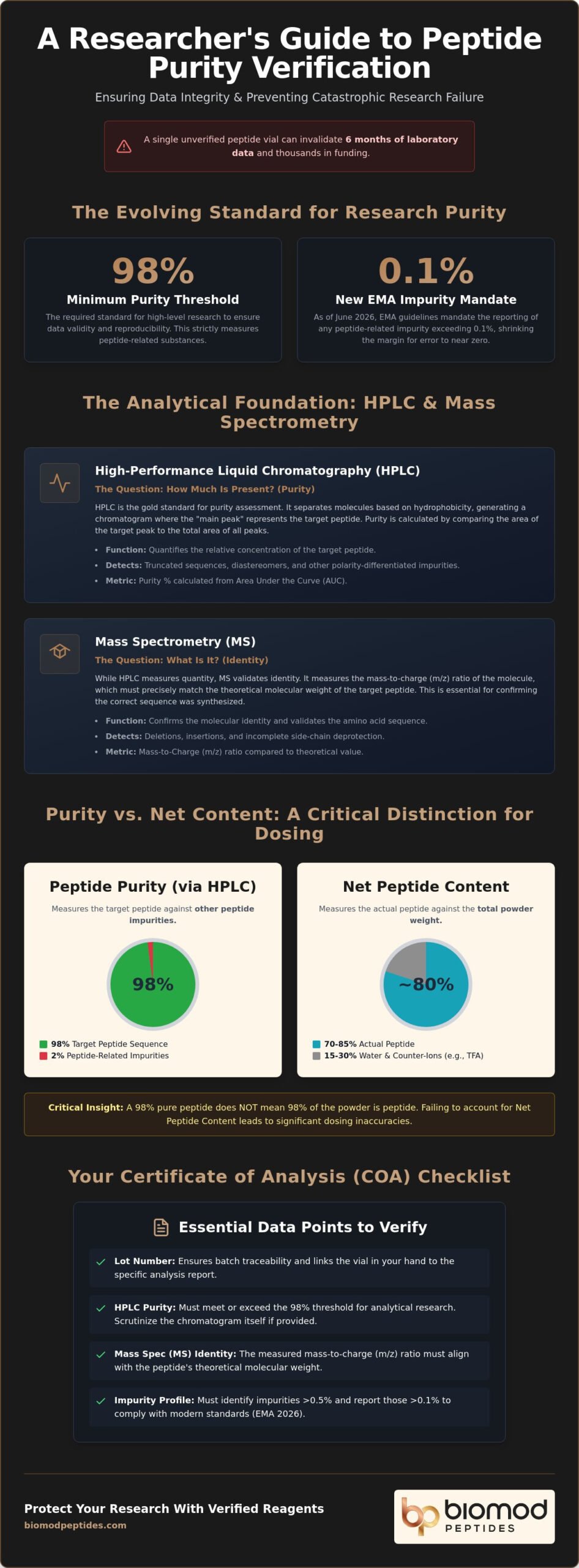
Peptide purity represents the relative concentration of the target peptide sequence compared to the total sum of all peptide impurities. It’s a critical metric. High-level research requires a 98% threshold to ensure data validity. This percentage strictly measures peptide-related substances. It excludes water, residual solvents, and counterions like trifluoroacetic acid (TFA), which are accounted for in peptide content analysis rather than purity. Achieving this benchmark requires a multi-stage peptide purity verification protocol that pairs separation technology with molecular identification.
Quantification relies on baseline resolution in chromatograms. If the peaks for the target peptide and its impurities overlap, the purity calculation becomes an estimate rather than a fact. Precision in this area is non-negotiable for reproducible research results. A valid Certificate of Analysis (COA) must provide the empirical data to support these findings, moving beyond the manufacturer’s self-reported claims.
High-Performance Liquid Chromatography (HPLC) Mechanism
Reverse-phase HPLC utilizes a non-polar stationary phase, typically C18, and a polar mobile phase to separate molecules based on hydrophobicity. As the sample passes through the column, chemical species elute at specific retention times. The detector generates a chromatogram where the “main peak” represents the target molecule. Researchers calculate the Area Under the Curve (AUC) for every detected peak to determine the relative abundance of each species. HPLC purity is the ratio of the target peak area to the total integrated area. This method is the gold standard for detecting truncated sequences or diastereomers that differ in polarity.
Mass Spectrometry and Sequence Validation
HPLC confirms how much of a substance is present, but it doesn’t confirm the identity of the molecule. Mass Spectrometry (MS) provides the necessary sequence validation by measuring the mass-to-charge (m/z) ratio. This value must align precisely with the theoretical molecular weight of the peptide. MS is essential for detecting critical synthesis errors. It identifies amino acid deletions, insertions, or incomplete deprotection of side chains that might elute closely with the target peak in HPLC. Electrospray Ionization (ESI) is the preferred technique. It preserves structural integrity during the transition to the gas phase, allowing for the accurate verification of complex, long-chain peptides. Understanding how peptide science in 2026 has advanced these analytical methods is essential for laboratories seeking to meet the most current verification standards.
Decoding the Certificate of Analysis (COA) and Impurity Profiles
A Certificate of Analysis (COA) is the definitive record of a batch’s chemical profile. It validates the peptide purity verification process through empirical evidence. A standard COA must detail the lot number, physical appearance, and solubility. It distinguishes between organic impurities and inorganic salts. Under the EMA guidelines effective June 2026, peptide-related impurities must be reported if they exceed 0.1% and identified if they surpass 0.5%. Researchers should prioritize verified peptide certificates of analysis to ensure every reagent meets these baseline requirements. Adhering to USP Peptide Quality Standards ensures that these documents meet international benchmarks for identity and quality.
Purity vs. Net Peptide Content
Confusion often exists regarding purity versus net peptide content. A 98% purity rating (HPLC) does not mean 98% of the powder weight is peptide. Lyophilized reagents naturally contain water and counter-ions like trifluoroacetic acid (TFA). Actual peptide content typically ranges from 70% to 85% of the total mass. You must account for this variance when calculating precise molar concentrations for your research protocol. Failure to distinguish between these metrics leads to significant dosing inaccuracies. It’s a fundamental step in maintaining laboratory accountability. Sourcing analytical grade peptides that meet verified chemical standards is the most reliable way to minimize these variables from the outset.
Identifying Contaminants and Degradation By-products
Organic synthesis frequently produces truncated sequences and diastereomers. These molecules elute closely with the target peak. Residual solvents and catalysts from the manufacturing process also require monitoring. Storage conditions in Las Vegas laboratories are a critical factor. High temperatures or improper handling can trigger post-verification degradation, compromising the integrity of verified batches. Maintaining a controlled environment is as important as the initial peptide purity verification. Reviewing our commitment to transparency provides further insight into how these rigorous standards are maintained across every lot.
Standardizing Accountability in Research Peptide Procurement
Accountability in procurement requires moving beyond vendor-supplied data. Independent verification is the standard. Manufacturer bias remains a systemic risk in the global supply chain. Prioritizing US manufactured research peptides provides a layer of logistical transparency that offshore sources can’t match. This alignment with domestic quality controls ensures that your peptide purity verification data remains defensible during peer review or regulatory audits. Integrating this empirical evidence into a Laboratory Information Management System (LIMS) creates a permanent record of reagent integrity. It’s a foundational requirement for reproducible science.
Modern laboratories utilize online verification portals to cross-reference lot numbers with original laboratory reports. This eliminates the risk of document tampering or batch substitution. Precision. Accountability. Empirical proof. These are the pillars of professional research procurement in 2026.
The Role of Third-Party Laboratory Accountability
Selecting an ISO-certified analytical laboratory is the first step in objective validation. These facilities must operate independently of the manufacturer to eliminate conflicts of interest. Implementing blind testing protocols, where the lab is unaware of the expected sequence, provides the most reliable results. Sourcing third party tested peptides that have been evaluated against a rigorous verification checklist ensures your materials meet the analytical benchmarks required for defensible research in 2026. For deeper insights into these evolving benchmarks, review our analysis of high purity research peptides and their role in current analytical standards. Objective data is the only shield against experimental failure.
Verification Across Specialized Delivery Formats
Specialized delivery formats introduce unique analytical hurdles. Verifying peptide softgels requires complex extraction protocols to separate the active peptide from the lipid matrix without inducing degradation. Similarly, maintaining sequence integrity in spray products involves testing for stability in aqueous environments. Whether dealing with liquid or lyophilized formats, concentration verification must be batch-specific. Cross-referencing lot numbers ensures that the physical vial in your lab matches the original peptide purity verification report. The latest advancements in peptide science synthesis and delivery offer critical guidance on how these format-specific challenges are being addressed across the industry in 2026.
Securing Laboratory Integrity Through Analytical Precision
Research reproducibility depends on the precision of your starting materials. You now have the technical framework to distinguish between surface-level purity percentages and actual net peptide mass. You understand how HPLC and Mass Spectrometry work together to confirm both chemical isolation and molecular identity. Rigorous peptide purity verification is no longer a secondary concern. It’s the baseline for credible scientific inquiry in a shifting regulatory landscape.
Biomod Peptides maintains this clinical accountability through a disciplined manufacturing process. Every batch is US-manufactured and finished to ensure total logistical transparency. We don’t rely on self-reported data. Instead, we subject every lot to independent third-party testing to eliminate bias. This commitment to documentation provides the empirical proof required for high-tier research applications. It’s about moving beyond industry norms to achieve a higher standard of execution.
Access the Biomod Peptides Verification Portal to cross-reference your lot numbers with our dedicated database of original laboratory reports. Secure the integrity of your next study with reagents that meet the most demanding analytical benchmarks. Your research deserves the certainty of verified data.
Frequently Asked Questions
What is the difference between peptide purity and peptide content?
Peptide purity measures the ratio of the target sequence to other peptide impurities. Peptide content measures the actual mass of the peptide relative to the total powder weight. A vial with 98% purity might only have 80% peptide content due to the presence of counter-ions like TFA and residual water. This distinction is critical for calculating precise molar concentrations in research protocols. Researchers must account for both metrics to ensure experimental accuracy and reproducibility.
Why is HPLC used as the primary method for peptide purity verification?
HPLC is the primary method for peptide purity verification because it effectively separates chemical species based on their hydrophobic properties. By passing the sample through a C18 column, researchers isolate the main peak from synthesis by-products like truncated sequences or diastereomers. The detector then integrates the area under these peaks to determine the relative percentage of the target molecule. It remains the gold standard for quantifying the chemical isolation of a specific sequence.
How do I read a peptide mass spectrometry report?
Reading a peptide mass spectrometry report requires comparing the observed mass-to-charge (m/z) ratio against the theoretical molecular weight of the sequence. The primary peak on the spectrum should correspond to the calculated mass of the target peptide. Significant secondary peaks often indicate synthesis errors. These include amino acid deletions or incomplete deprotection. These findings invalidate the batch’s identity even if the HPLC report shows high purity levels.
What are common impurities found in research-grade peptides?
Common impurities include truncated sequences, deletion sequences, and diastereomers formed during solid-phase synthesis. Other contaminants include residual trifluoroacetic acid (TFA), organic solvents like acetonitrile, and inorganic salts. Identifying these species is essential for rigorous peptide purity verification. It ensures that experimental results aren’t compromised by chemical artifacts or unintended biological interactions from synthesis by-products.
Disclaimer
BIOMOD products are sold strictly for laboratory, analytical, and scientific research use only. They are not intended for human or animal consumption, administration, application, ingestion, injection, or any therapeutic, diagnostic, or cosmetic use.
The statements made on this website have not been evaluated by the United States Food and Drug Administration. BIOMOD products are not intended to diagnose, treat, cure, mitigate, or prevent any disease or medical condition.
BIOMOD is a research chemical supplier. BIOMOD is not a compounding pharmacy or chemical compounding facility as defined under Section 503A of the Federal Food, Drug, and Cosmetic Act. BIOMOD is not an outsourcing facility as defined under Section 503B of the Federal Food, Drug, and Cosmetic Act.
By accessing this site, you confirm you are at least 21 years of age and that you have read and accepted the BIOMOD Terms of Sale, Privacy Policy, and Research Use Only Policy. BIOMOD does not provide dosing, medical, therapeutic, diagnostic, veterinary, or use guidance under any channel.

119 Responses