
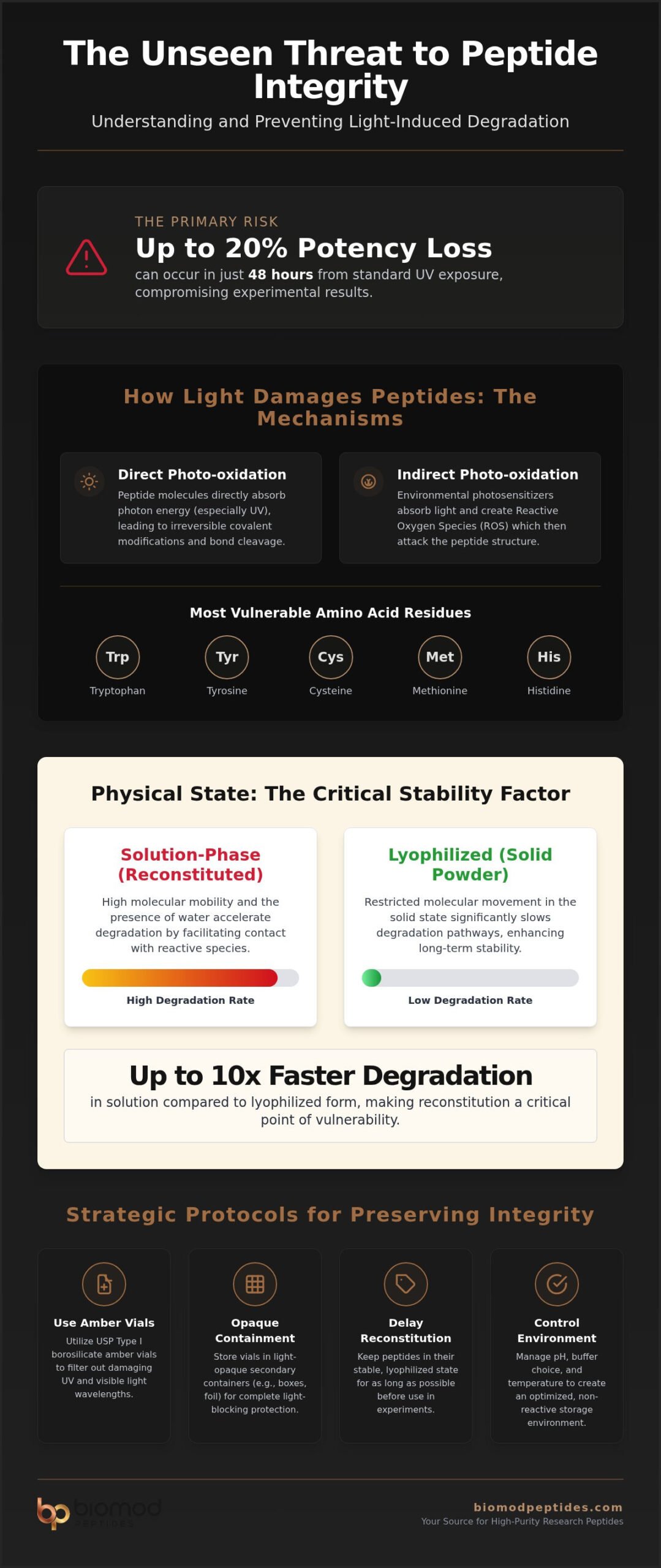
A 2019 study in the Journal of Peptide Science revealed that just 48 hours of UV exposure can slash the potency of certain lyophilized peptides by up to 20 percent. This degradation often occurs invisibly, resulting in experimental inconsistency and the loss of high-purity samples. You likely manage temperature and humidity with precision, yet ambient light remains a volatile catalyst for irreversible covalent modifications. Understanding how light exposure affects peptide stability is essential for maintaining the structural integrity of sequences containing residues like tryptophan, tyrosine, and cysteine.
We’ll provide a rigorous examination of the photochemical mechanisms that compromise peptide integrity and the laboratory protocols required to mitigate these risks. This guide details the specific pathways of photo-oxidation and the implementation of ICH Q1B photostability standards. You’ll learn to establish storage protocols that ensure the long-term stability of your analytical samples. We’ll move beyond basic handling to explore the verification methods and third-party testing benchmarks necessary for maintaining a laboratory-grade environment.
Key Takeaways
- Identify the specific chemical pathways of photolysis and the role of reactive oxygen species in catalyzing side-chain modifications.
- Analyze how light exposure affects peptide stability across different physical states, specifically why solution-phase samples degrade up to ten times faster than lyophilized powders.
- Evaluate the influence of pH on photolytic sensitivity to establish optimized storage environments for specific amino acid sequences.
- Implement rigorous mitigation protocols using USP Type I borosilicate amber vials and light-opaque secondary containment for long-term sample preservation.
Chemical Mechanisms of Light-Induced Peptide Degradation
Photolysis defines the chemical breakdown of molecules via photon absorption. In peptide science, this process targets the backbone and side-chain structures. Light exposure triggers irreversible covalent modifications. These changes render the sequence analytically invalid. Unlike thermal degradation, which may involve reversible unfolding, photo-damage creates new chemical species. You can’t recover a peptide once its primary structure is compromised. The degradation is permanent and cumulative.
Direct photo-oxidation occurs when the peptide absorbs energy directly. Indirect pathways involve photosensitizers in the buffer or environment that generate reactive oxygen species (ROS). These ROS, such as singlet oxygen and hydroxyl radicals, then attack the peptide. While Photoactivated peptides are engineered for controlled, light-triggered release, unintended exposure leads to uncontrolled fragmentation. This distinction is critical for researchers maintaining high-purity samples.
Vulnerable Amino Acid Side Chains
Certain residues act as internal chromophores, absorbing light and initiating degradation. Aromatic residues like Tryptophan (Trp), Tyrosine (Tyr), and Phenylalanine (Phe) are highly sensitive to UV radiation. Trp absorbs most strongly at 280 nm, often leading to indole ring cleavage. Sulfur-containing residues, specifically Cysteine (Cys) and Methionine (Met), undergo rapid oxidation. Met converts to methionine sulfoxide, while Cys forms unintended disulfide bridges or cysteic acid. Histidine (His) is also at risk, as irradiation often produces peroxide intermediates that further accelerate the degradation of the surrounding sequence.
Energy Absorption and Wavelength Sensitivity
Wavelength dictates the severity of structural damage. UVC (200-280 nm) carries the highest energy, but UVB (280-320 nm) is the primary culprit in most laboratory settings. Standard fluorescent lighting emits low-level UV that degrades samples during long-term storage. Breaking a typical carbon-nitrogen peptide bond requires approximately 445 kJ/mol of energy. Photons in the UV spectrum provide sufficient energy to exceed this threshold, causing immediate backbone cleavage. Understanding how light exposure affects peptide stability requires recognizing that even visible light can catalyze ROS formation in the presence of trace impurities. Precision in storage is the only defense against these high-energy interactions.
Variables Influencing the Rate of Photolytic Decomposition
Photolytic rates are not constant. Environmental variables dictate the speed and severity of degradation. Understanding how light exposure affects peptide stability requires a multifactorial analysis of the sample’s physical and chemical environment. Primary factors include the physical state, pH levels, and the presence of dissolved gases.
Physical state is the most significant determinant of stability. Solution-phase peptides often degrade up to 10x faster than their solid counterparts. In a liquid medium, molecular mobility is high. This facilitates the diffusion of reactive oxygen species (ROS) and free radicals. Conversely, high-density or high-concentration samples may exhibit self-shielding properties. In these cases, the outer layer of the sample absorbs the incident photons, effectively protecting the internal volume from irradiation. Temperature also plays a synergistic role. While photolysis is a light-driven process, thermal energy increases the kinetic energy of the system. This accelerates the chemical reactions initiated by photon absorption. A 2022 study in Pharmaceutics noted that room temperature storage led to 30 to 40 percent degradation in some peptides within six months, a process frequently compounded by ambient light exposure.
Lyophilized vs. Reconstituted Stability
Lyophilization removes the aqueous medium required for rapid radical diffusion. This restriction of movement significantly enhances photostability. Using lyophilized research peptides ensures the sequence remains in a rigid, low-energy state. Once reconstituted, the sample’s vulnerability increases immediately. Water acts as a medium that facilitates the collision of photons and reactive intermediates with the peptide backbone. Researchers must handle reconstituted sequences in amber or opaque glassware to prevent rapid decomposition. Maintaining samples in a solid state for as long as possible is a fundamental requirement for analytical consistency.
Buffer Composition and Excipient Interference
The chemical makeup of your buffer can either quench or catalyze degradation. Specific buffers like Tris or PBS interact differently with UV light. Some excipients act as photosensitizers, absorbing energy and transferring it to the peptide structure. Dissolved oxygen levels also influence the rate of photo-oxidation. High oxygen concentrations facilitate the formation of peroxide radicals, which aggressively attack sulfur-containing residues. As detailed in the study Ultraviolet Photoreactions in Therapeutic Peptides, the interplay between light and buffer chemistry is a primary cause of experimental inconsistency. Researchers should verify initial purity through a validated supply chain before initiating any stability-sensitive protocols.
Strategic Mitigation: Protocols for Preserving Peptide Integrity
Mitigating the impact of photons requires a multi-layered defensive strategy. Primary containment is your first line of defense. USP Type I borosilicate amber glass is the industry standard for filtering high-energy UV radiation. It prevents the initiation of the radical chains that lead to backbone cleavage. For long-term archiving, secondary containment is non-negotiable. Utilize light-opaque boxes or vacuum-sealed sleeves to ensure zero photon penetration. These protocols are essential for maintaining analytical validity when considering how light exposure affects peptide stability over extended durations.
Handling during analysis requires equal precision. Laboratory preparation areas should utilize low-actinic lighting, such as red-shifted filters, to minimize exposure during reconstitution. If you suspect accidental irradiation, perform peptide purity verification immediately. This step confirms whether the sequence still meets the baseline standards established in your initial HPLC data. Don’t rely on visual inspection; chemical changes often precede any physical discoloration.
Laboratory Storage Standards
In high-UV environments like Las Vegas, standard refrigeration is often insufficient for sensitive reagents. Cryogenic storage must occur in light-shielded containers. While aluminum foil wrapping is a common laboratory stopgap, it’s prone to tearing and inconsistent coverage. Dedicated dark-room storage or opaque cryo-boxes provide more reliable protection. Verify your storage benchmarks and initial certificate data through the Biomod verification portal to ensure a stable research baseline. This accountability ensures that environmental factors haven’t compromised your data before the experiment begins.
Procurement and Quality Assurance
Select vendors that prioritize US-manufactured, light-protected finishing processes. This ensures the peptide hasn’t been compromised during the final stages of production or packaging. When reviewing HPLC reports, identify degradation peaks associated with oxygen gain. Photo-oxidation often manifests as small secondary peaks near the main sequence, indicating the presence of oxidized sulfur or aromatic rings. The gold standard for light-sensitive peptide storage involves lyophilization in USP Type I amber borosilicate vials followed by secondary light-opaque containment at -20°C.
Advancing Analytical Integrity Through Standardized Photostability Protocols
Maintaining the structural integrity of your research reagents requires more than basic temperature control. Photolysis and the generation of reactive oxygen species create irreversible covalent modifications that compromise primary sequence data. By implementing USP Type I amber borosilicate storage and restricting exposure during reconstitution, you mitigate the most volatile environmental risks. Understanding how light exposure affects peptide stability is the baseline for achieving reproducible results in any analytical setting. Precision in storage is as critical as precision in synthesis.
Analytical precision begins with verified starting materials. Biomod Peptides ensures your research starts with high-purity sequences that haven’t been compromised by improper handling or environmental stressors. Our products are US manufactured and finished under rigorous quality control benchmarks. We provide independent third-party HPLC/MS testing for every batch, with documentation accessible through our COA verification portal. This transparency allows you to track initial purity levels before initiating stability-sensitive protocols. Don’t let avoidable degradation compromise your experimental outcomes.
Secure Analytical Grade Research Peptides at Biomod Peptides to ensure your laboratory standards remain uncompromising. Reliable data starts with a verified foundation.
Frequently Asked Questions
Is amber glass sufficient to prevent all light-induced peptide degradation?
Amber glass is not a total barrier against all forms of light-induced degradation. While USP Type I amber borosilicate glass effectively filters wavelengths below 450 nm, it doesn’t block the entire visible spectrum. High-energy visible light can still catalyze reactive oxygen species formation in sensitive sequences. Secondary containment in light-opaque packaging remains a laboratory requirement for comprehensive protection and long-term analytical stability.
How can I tell if my peptide sample has been compromised by light exposure?
Visual inspection is an unreliable metric for assessing peptide integrity. Chemical degradation typically occurs without detectable changes in color or texture. The only definitive method for detecting light damage is through HPLC or mass spectrometry. Comparing current analytical results against the original COA via a verification portal ensures the sequence maintains its structural integrity and intended purity.
Do lyophilized peptides require light protection if they are stored in a freezer?
Lyophilized peptides require light protection even when stored at cryogenic temperatures. While the solid state restricts radical diffusion, photon absorption still triggers surface-level covalent modifications. Freezer lights and ambient laboratory exposure provide enough energy to initiate these reactions. Understanding how light exposure affects peptide stability requires acknowledging that degradation is cumulative. Use light-shielded containers for all sub-zero archiving.
Which specific amino acids are most susceptible to damage from laboratory lighting?
Aromatic and sulfur-containing residues are the most susceptible to laboratory lighting. Tryptophan, Tyrosine, and Phenylalanine absorb UV radiation directly, which often leads to ring cleavage. Cysteine and Methionine undergo rapid indirect photo-oxidation, resulting in the formation of cysteic acid or methionine sulfoxide. Even standard fluorescent bulbs emit enough energy to catalyze these modifications over time, rendering the sequence analytically invalid.
Disclaimer
BIOMOD products are sold strictly for laboratory, analytical, and scientific research use only. They are not intended for human or animal consumption, administration, application, ingestion, injection, or any therapeutic, diagnostic, or cosmetic use.
The statements made on this website have not been evaluated by the United States Food and Drug Administration. BIOMOD products are not intended to diagnose, treat, cure, mitigate, or prevent any disease or medical condition.
BIOMOD is a research chemical supplier. BIOMOD is not a compounding pharmacy or chemical compounding facility as defined under Section 503A of the Federal Food, Drug, and Cosmetic Act. BIOMOD is not an outsourcing facility as defined under Section 503B of the Federal Food, Drug, and Cosmetic Act.
By accessing this site, you confirm you are at least 21 years of age and that you have read and accepted the BIOMOD Terms of Sale, Privacy Policy, and Research Use Only Policy. BIOMOD does not provide dosing, medical, therapeutic, diagnostic, veterinary, or use guidance under any channel.