
A single degraded peptide lot can quietly dismantle months of analytical progress and invalidate high-throughput research data. You recognize that experimental reproducibility relies entirely on the structural integrity of your starting materials. However, maintaining absolute transparency over lot numbers, HPLC data, and degradation timelines remains a primary friction point in modern laboratory environments. This guide establishes a clinical framework for peptide inventory management best practices to eliminate these operational blind spots. We’ll examine how to integrate COA verification data directly into your inventory workflow using centralized portals and deploy automated alerts for reordering and expiration. You’ll gain a strategic protocol for maintaining real-time visibility into reagent stability and analytical accountability. By implementing these advanced protocols, your lab can ensure that every sequence used is verified, documented, and ready for rigorous scientific application.
Key Takeaways
- Transition from basic storage to an analytical safeguard model by prioritizing lot-specific stability tracking and digital audit trails.
- Reduce logistical friction and manual documentation errors in high-throughput environments through automated barcode and RFID integration.
- Implement peptide inventory management best practices by centralizing COA verification data to ensure reagent integrity before experimental initiation.
- Minimize lead times and secure cold chain transparency by leveraging US-based manufacturing and localized finishing protocols.
The Architecture of Modern Peptide Inventory Systems
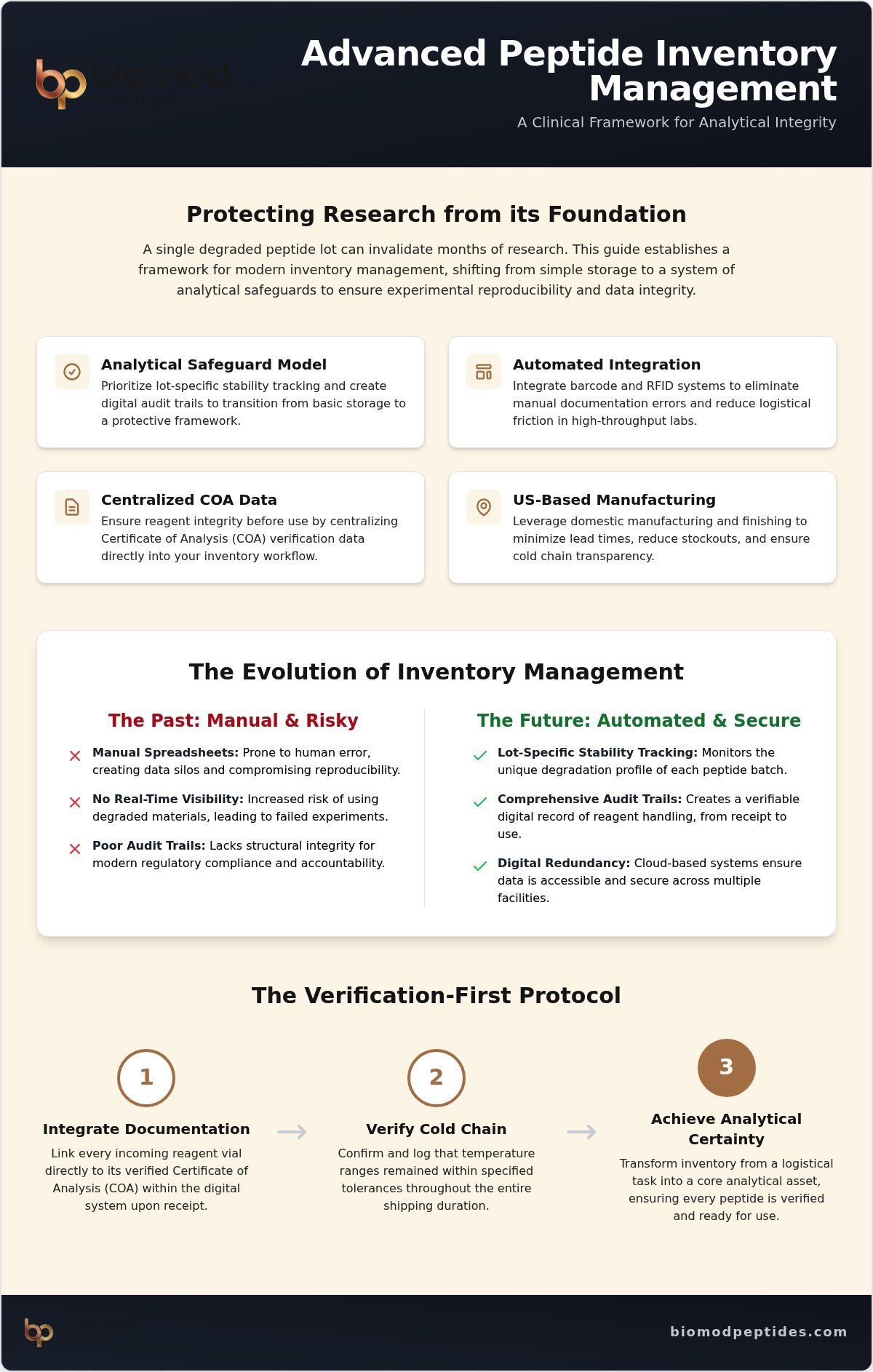
Modern peptide inventory management best practices redefine the storeroom as an analytical safeguard. It isn’t just about storage. It’s about protecting data integrity. A 2026 system relies on three pillars: lot-specific stability tracking, comprehensive audit trails, and digital redundancy. Traditional manual spreadsheets compromise experimental reproducibility. They lack the structural integrity required for modern regulatory compliance. Relying on static documents creates data silos. It increases the risk of using degraded materials. These errors often lead to failed experiments and lost research funding.
Labs are shifting toward sophisticated inventory management software to automate these processes. These platforms provide real-time visibility into reagent status. They ensure that every sequence used is backed by empirical verification. Biomod Peptides facilitates this through a dedicated COA verification portal. This allows researchers to integrate third-party testing data directly into their internal workflows. By utilizing US-manufactured reagents, labs can also reduce logistical friction. This proximity ensures shorter lead times and more reliable stock levels for critical research projects.
Mitigating Degradation Through Systematic Aliquoting
Effective protocols must address the freeze-thaw problem. Repeated temperature fluctuations accelerate peptide degradation. Implementing systematic aliquoting within your inventory system is essential. Digital tracking monitors the specific usage history of each vial. It differentiates between reconstituted and lyophilized stocks. This granular visibility prevents the inadvertent use of compromised reagents. It maintains the analytical accountability necessary for high-throughput research environments. By logging every entry and exit, you create a verifiable record of reagent handling. This level of precision is the benchmark for modern laboratory operations.
Digital Solutions for Reagent Tracking and Accountability
Digital infrastructure determines the speed of analytical recovery. Choosing between a Laboratory Information Management System (LIMS) and dedicated inventory software depends on your facility’s scale. LIMS provides a broad operational view. In contrast, dedicated software offers the specific agility needed for precise reagent tracking. Integrating barcode and RFID systems is essential for high-throughput workflows. These tools eliminate manual entry errors. They provide a direct link between the physical vial and its digital twin. Following Chemical Inventory best practices ensures your lab maintains an accurate, real-time registry of all active sequences. This level of oversight is critical for maintaining experimental reproducibility.
Effective peptide inventory management best practices require automated expiration alerts. These shouldn’t be generic. They must reflect peptide-specific stability profiles. For instance, sequences containing cysteine or methionine are prone to oxidation. These require tighter monitoring windows than more stable sequences. Digital systems can now track cold chain variables from the moment of receipt. This prevents the use of compromised materials that may have deviated from required temperature ranges. If your current system lacks these integrated features, you can verify reagent purity through external portals to bridge the documentation gap and ensure analytical truth.
Software Selection Criteria for Analytical Reagents
Prioritize API compatibility when evaluating platforms. Your software must pull data seamlessly from third-party testing portals and COA repositories. Cloud-based systems are mandatory for multi-facility teams, particularly in research hubs like Las Vegas. These platforms ensure data redundancy across disparate locations. They allow for centralized oversight of lot numbers and stability data. Verification and documentation are not optional. They are the primary justification for a lab’s market standing. This connectivity is the foundation of a modern, accountable research environment.
Verification-First Inventory: Integrating COA and Procurement
Verification-first protocols transform inventory from a logistical burden into a core analytical asset. Effective peptide inventory management best practices require that every reagent entry links directly to its source documentation. This includes verified peptide certificates of analysis. Without this link, a vial is merely an unverified chemical. Cold chain integrity must be documented from the manufacturer’s facility to the laboratory bench. This prevents structural degradation during transit. Documentation should confirm that temperature ranges remained within specified tolerances throughout the shipping duration. It’s the only way to guarantee that the primary sequence hasn’t been compromised before arrival.
Optimizing procurement cycles is equally vital for maintaining operational momentum. Leveraging US-manufactured supply chains minimizes lead times and mitigates stockout risks. It reduces the window for potential temperature excursions that occur during international transit. Domestic finishing processes provide a layer of logistical transparency that international shipping often lacks. This proximity ensures that high-purity reagents arrive with their analytical profiles intact. Adhering to these peptide inventory management best practices allows labs to maintain leaner inventories without sacrificing experimental readiness. It ensures that analytical truth is never compromised by logistical failures.
Streamlining Analytical Grade Logistics in Las Vegas
Research facilities in Nevada benefit from localized distribution networks. Utilizing a local laboratory peptide supply significantly reduces transit-related stability risks. Shorter shipping durations preserve the peptide’s primary structure and prevent oxidation in sensitive sequences. Biomod Peptides facilitates this through their dedicated COA verification portal for every research lot. This integration allows for real-time accountability. It ensures your inventory data reflects the actual purity of the reagent on the shelf. By centralizing this data, labs can verify lot-specific stability before any work begins.
Advancing Laboratory Standards through Analytical Accountability
Implementing peptide inventory management best practices is no longer a logistical choice; it’s a requirement for data integrity. Transitioning from manual spreadsheets to automated, digital tracking ensures that every sequence remains within its stability profile. By integrating COA verification directly into the procurement workflow, labs eliminate the risk of using degraded reagents. This methodology secures the bridge between raw materials and reproducible research. Supply chain consistency and independent validation provide the structural foundation for high-throughput success.
Procure high-purity research reagents with verified analytical standards at Biomod Peptides. Our US-manufactured reagents undergo independent third-party testing for every lot. We provide Red Dot-level precision in softgel and spray delivery formats to ensure your research meets the highest industry benchmarks. Precise documentation is the vanguard of scientific progress.
Frequently Asked Questions
What is the most effective way to track peptide lot numbers in a LIMS?
Effective tracking requires assigning unique alphanumeric identifiers linked to parent lot records for absolute traceability. You must map every aliquot back to its specific synthesis batch and HPLC validation data. This ensures that any analytical deviations are traceable to the source material. Automated barcode scanning at the point of entry reduces transcription errors and maintains a rigorous audit trail for compliance.
How does inventory software help in maintaining cold chain protocols for research reagents?
Inventory software maintains cold chain protocols by integrating real-time temperature monitoring with reagent records. Systems trigger immediate alerts if storage conditions deviate from required -20°C or -80°C parameters. This prevents the use of thermally degraded sequences in sensitive assays. By logging every door opening and transit duration, the software creates a verifiable history of thermal stability for each research vial.
Can I integrate third-party HPLC reports directly into my lab inventory system?
Yes, modern systems allow for the direct integration of third-party HPLC and MS reports through API connections or centralized COA portals. This is a core component of peptide inventory management best practices. Digital redundancy ensures that analytical verification data remains attached to the reagent throughout its lifecycle. Biomod Peptides facilitates this by providing accessible, lot-specific COA data that researchers can link to internal entries.
What are the risks of using manual spreadsheets for tracking high-purity peptides?
Manual spreadsheets lack the structural integrity and version control required for high-purity reagent tracking. They are prone to data corruption and a lack of real-time visibility. These vulnerabilities often result in failed experiments due to expired or degraded materials. Transitioning to dedicated software is one of the essential peptide inventory management best practices to ensure experimental reproducibility and maintain analytical accountability.
Disclaimer
BIOMOD products are sold strictly for laboratory, analytical, and scientific research use only. They are not intended for human or animal consumption, administration, application, ingestion, injection, or any therapeutic, diagnostic, or cosmetic use.
The statements made on this website have not been evaluated by the United States Food and Drug Administration. BIOMOD products are not intended to diagnose, treat, cure, mitigate, or prevent any disease or medical condition.
BIOMOD is a research chemical supplier. BIOMOD is not a compounding pharmacy or chemical compounding facility as defined under Section 503A of the Federal Food, Drug, and Cosmetic Act. BIOMOD is not an outsourcing facility as defined under Section 503B of the Federal Food, Drug, and Cosmetic Act.
By accessing this site, you confirm you are at least 21 years of age and that you have read and accepted the BIOMOD Terms of Sale, Privacy Policy, and Research Use Only Policy. BIOMOD does not provide dosing, medical, therapeutic, diagnostic, veterinary, or use guidance under any channel.