
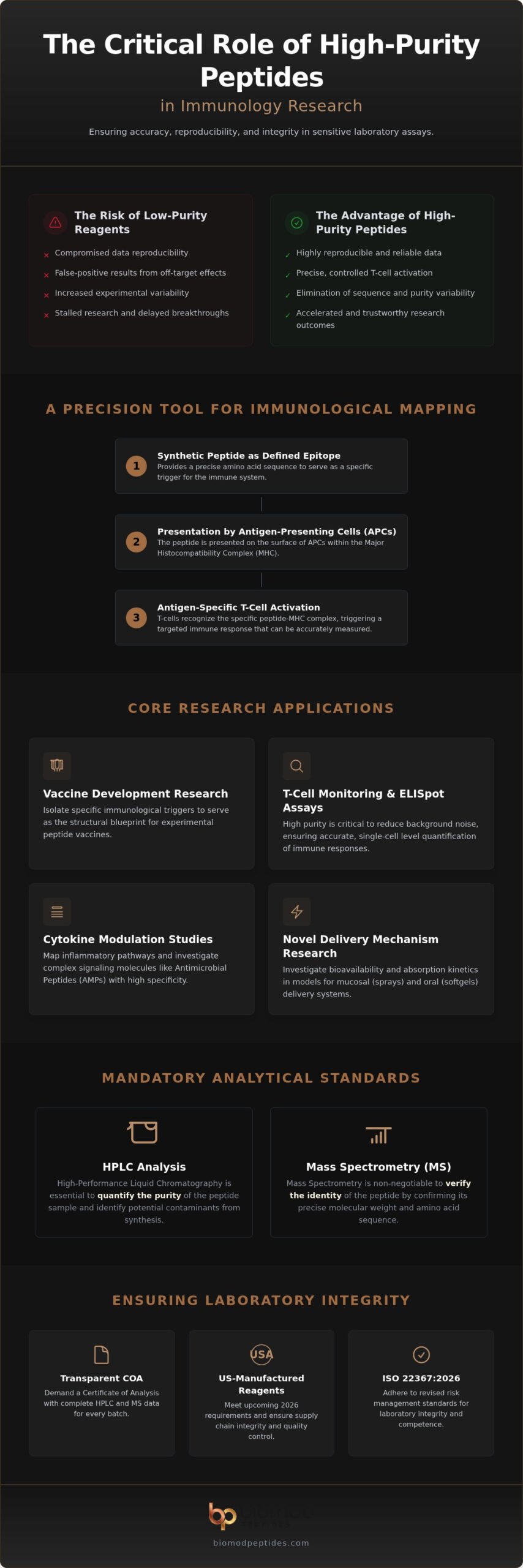
In the high-stakes environment of immunology research, the peptide is the probe. Its utility depends entirely on analytical-grade purity and verified sequence accuracy. Using sub-standard reagents in sensitive assays doesn’t just risk accuracy; it compromises the reproducibility of your entire data set. High-purity peptides in immunology research applications are the foundational tools required for precise epitope mapping and vaccine development research.
You’ve likely faced the frustration of experimental variability caused by low-purity reagents or a lack of transparent COA documentation. It’s a common bottleneck that stalls T-cell monitoring and delays critical breakthroughs. This technical analysis explores how high-purity synthetic peptides function as essential reagents for modern laboratory protocols. We’ll examine the specific requirements for US-manufactured laboratory reagents in 2026. You’ll learn how to secure verified sequences and implement rigorous verification methods to ensure highly reproducible data in every T-cell activation assay. We’ll also detail the importance of independent third-party testing and the role of standardized risk management, such as the revised ISO 22367:2026, in maintaining laboratory integrity and professional standards.
Key Takeaways
- Learn how peptides in immunology research applications serve as defined epitopes for antigen-presenting cells to ensure controlled T-cell activation.
- Explore the application of synthetic peptides in experimental vaccine development and the investigation of cellular cytokine modulation pathways.
- Identify the essential analytical standards, including HPLC and Mass Spectrometry, required to eliminate sequence variability in sensitive immunological assays.
- Understand the strategic importance of US-manufactured reagents and transparent COA documentation for maintaining laboratory-grade data integrity and reproducibility.
Synthetic Peptides as Precision Tools in Immunological Mapping
Synthetic peptides function as defined epitopes for antigen-presenting cells (APCs). They provide the precise chemical structure required to trigger specific immune pathways. By using synthetic variants, researchers study T-cell activation within highly controlled environments. This level of control isn’t possible with complex, non-purified biological extracts. Peptides in immunology research applications serve as the primary reagents for Major Histocompatibility Complex (MHC) binding studies. These studies determine the affinity with which a peptide sits in the MHC groove. High-purity reagents are mandatory. Impurities can induce off-target inflammatory responses in vitro, leading to false-positive data. Every reagent must undergo rigorous validation to maintain the structural integrity of the assay.
Epitope Identification and MHC Binding Affinity
Researchers use peptides to map the minimal amino acid sequences required for immune recognition. Overlapping peptide libraries allow for comprehensive antigen scanning across the entire protein sequence. This methodical approach identifies dominant and subdominant epitopes with high resolution. Epitope mapping identifies the specific amino acid sequences within an antigen that trigger an immune response, providing the structural blueprint for peptide vaccines.
Antigen-Specific T-Cell Activation Assays
Accurate T-cell monitoring requires the stimulation of peripheral blood mononuclear cells (PBMCs) followed by cytokine analysis. Synthetic peptides act as the specific stimulus in these assays. Reagent stability is a critical factor for long-term incubation protocols, especially in Las Vegas labs where environmental variables must be strictly managed. When utilizing peptides in immunology research applications, sequence verification is the only way to ensure that cytokine profiles reflect true biological responses rather than reactions to synthesis byproducts.
Core Research Applications: From Vaccine Development to Delivery Systems
Synthetic peptides serve as primary components in experimental vaccine formulation research. They allow for the isolation of specific immunological triggers without the interference of whole-cell lysate components. Scientific literature, such as the review on Peptides and Peptidomimetics as Immunomodulators, highlights how these sequences facilitate the investigation of cytokine modulation. Researchers use these molecules to map inflammatory pathways in cellular models with high specificity. This precision is vital when analyzing antimicrobial peptides (AMPs) as innate immune defense mechanisms. AMPs aren’t just simple antibiotics; they’re recognized as complex signaling molecules that bridge innate and adaptive immunity. Investigating these pathways requires reagents that maintain structural integrity throughout the duration of the assay.
T-Cell Monitoring and ELISpot Assay Optimization
Enzyme-linked immunosorbent spot (ELISpot) assays remain the gold standard for quantifying antigen-specific immune responses at the single-cell level. Success in these assays depends on the signal-to-noise ratio. Peptide purity is the deciding factor in reducing background noise. Residual synthesis contaminants can cause non-specific activation, leading to skewed data. Utilizing high purity research peptides ensures that the spots counted represent true T-cell responses. This reliability is essential for longitudinal studies where baseline consistency is mandatory.
Investigating Novel Delivery Mechanisms: Sprays and Softgels
Delivery format significantly impacts bioavailability and absorption kinetics in laboratory environments. Researchers are increasingly using peptide spray products to investigate mucosal immunology. These formats allow for localized application in respiratory or nasal mucosa models. Similarly, the comparative analysis of peptide softgels provides insights into oral delivery experimental models. These formats protect the peptide cargo from premature enzymatic degradation. Understanding these kinetics is a core part of advancing peptides in immunology research applications. For researchers requiring verified reagents, Biomod Peptides provides the analytical transparency needed for these complex delivery studies.
Analytical Standards for Immunological Reagents
High-Performance Liquid Chromatography (HPLC) and Mass Spectrometry (MS) are the mandatory benchmarks for sequence verification. These analytical methods provide the empirical proof required for high-stakes research. US-manufactured peptides offer superior logistical and quality control compared to international alternatives. Domestic manufacturing ensures that reagents aren’t subjected to the regulatory gaps common in offshore production. The most significant objection researchers face is the presence of unidentified impurities. These synthesis byproducts can interfere with receptor binding and skew cellular responses. Independent third-party testing solves this. It provides a layer of accountability that ensures experimental reproducibility across different laboratory environments.
Utilizing COA Verification Portals for Data Integrity
Data integrity depends on the transparent link between the reagent and its documentation. Matching lot numbers to comprehensive analytical reports is a foundational step in laboratory validation. This verification process confirms that the material in the vial matches the intended molecular design. Rigorous peptide purity verification prevents the introduction of experimental noise. It’s the only way to ensure that downstream immunological data reflects the actual biological activity of the sequence. For those utilizing peptides in immunology research applications, a COA portal is an essential tool for objective verification.
Procurement for Las Vegas Research Facilities
Logistical transparency is a core part of the professional research voice. For Nevada-based institutions, the advantages of a local laboratory peptide supply include faster transit times and reduced exposure to environmental stress. Cold chain integrity is non-negotiable for sensitive immunological probes. Even minor temperature deviations can lead to peptide degradation. This stability is critical in fields like Antimicrobial Peptide Research, where the peptide’s structural conformation dictates its interaction with bacterial membranes. Maintaining these standards ensures that peptides in immunology research applications remain the high-tier reagents required for the advancement of the niche.
Advancing Immunological Precision through Verified Analytical Standards
The reliability of immunological data rests on the structural integrity of the reagents used. Precise epitope mapping and T-cell activation assays require synthetic probes that are free from synthesis byproducts. As regulatory scrutiny increases in 2026, maintaining experimental reproducibility becomes a function of analytical transparency. Utilizing high-purity peptides in immunology research applications ensures that cellular responses are specific and measurable rather than artifacts of reagent contamination. This technical discipline is the only way to move from experimental variability to verified breakthroughs.
Achieving this level of precision requires a commitment to rigorous verification protocols. Biomod Peptides provides the infrastructure for this certainty. Our reagents are US Manufactured and Finished, ensuring logistical transparency and adherence to domestic quality benchmarks. Every lot undergoes independent third-party testing for purity to confirm sequence accuracy before it reaches your bench. You can access our COA Verification Portal to match lot numbers with specific analytical reports for every order, ensuring full data integrity for your assays.
Secure Analytical Grade Peptides for Your Laboratory Research and ensure your data meets the highest institutional standards. We look forward to supporting your next advancement with uncompromising quality.
Frequently Asked Questions
How are peptides used in epitope mapping for immunology research?
Peptides act as discrete antigenic determinants that bind to MHC molecules for T-cell recognition. Researchers utilize overlapping peptide libraries to scan entire proteins, identifying the exact amino acid sequences that trigger immune responses. This process is fundamental for designing epitope-based vaccines and understanding the structural basis of antigenicity in various disease models. It allows for high-resolution identification of dominant and subdominant immune targets.
Why is peptide purity critical for T-cell activation assays?
High purity is essential to eliminate non-specific cellular activation caused by synthesis contaminants like truncated sequences or residual solvents. These impurities can mask true biological signals or induce off-target cytokine release. In peptides in immunology research applications, 95% or higher purity is the standard to ensure that observed T-cell responses are a direct result of the intended peptide sequence. It ensures data reproducibility and assay reliability.
Can research-grade peptides be used for delivery system studies in Las Vegas labs?
Yes, research-grade peptides are utilized in specialized formats like sprays and softgels to investigate localized and systemic delivery kinetics. These delivery formats allow Las Vegas research facilities to model mucosal or oral absorption in controlled laboratory settings. Ensuring cold chain integrity during transit to Nevada is vital for maintaining the structural stability of these sensitive immunological probes. Local procurement helps mitigate the risks associated with long-duration shipping stress.
What analytical methods are used to verify immunology research peptides?
High-Performance Liquid Chromatography (HPLC) and Mass Spectrometry (MS) are the primary methods used to verify sequence identity and quantify purity levels. HPLC separates the target peptide from synthesis byproducts; meanwhile, MS confirms the exact molecular weight of the sequence. These standards are critical for peptides in immunology research applications to ensure that reagents meet the stringent benchmarks required for publishing high-impact scientific data and maintaining laboratory accountability.
Disclaimer
BIOMOD products are sold strictly for laboratory, analytical, and scientific research use only. They are not intended for human or animal consumption, administration, application, ingestion, injection, or any therapeutic, diagnostic, or cosmetic use.
The statements made on this website have not been evaluated by the United States Food and Drug Administration. BIOMOD products are not intended to diagnose, treat, cure, mitigate, or prevent any disease or medical condition.
BIOMOD is a research chemical supplier. BIOMOD is not a compounding pharmacy or chemical compounding facility as defined under Section 503A of the Federal Food, Drug, and Cosmetic Act. BIOMOD is not an outsourcing facility as defined under Section 503B of the Federal Food, Drug, and Cosmetic Act.
By accessing this site, you confirm you are at least 21 years of age and that you have read and accepted the BIOMOD Terms of Sale, Privacy Policy, and Research Use Only Policy. BIOMOD does not provide dosing, medical, therapeutic, diagnostic, veterinary, or use guidance under any channel.