
The cheapest reagent on the market is often the most expensive line item in your laboratory’s annual budget. When low-purity materials lead to failed assays or inconsistent data, the fiscal loss far exceeds the initial savings. Understanding how to get budget approval for research reagents requires a shift from discussing price points to demonstrating risk mitigation. You likely find it difficult to translate complex scientific needs into the rigid fiscal language that procurement departments demand. It’s a common frustration; technical precision is frequently sidelined by short-term cost-cutting measures that ultimately threaten project timelines and data integrity.
This article provides a clinical framework to master the technical and fiscal justification required to secure funding for high-purity laboratory reagents and peptides. We will detail the specific verification protocols and documentation standards, including alignment with the mandatory QMSR requirements that became effective in February 2026, that turn a simple purchase request into a sophisticated procurement strategy. Our focus remains on objective evidence. By prioritizing analytical verification and the prevention of laboratory downtime, you can ensure your research remains both compliant and productive.
Key Takeaways
- Quantify the fiscal impact of experimental failure by calculating lost man-hours and wasted consumables.
- Master how to get budget approval for research reagents by framing high-purity requirements as essential risk-mitigation for data integrity.
- Execute a 5-step protocol to identify critical purity needs and conduct comparative vendor analyses based on structural integrity.
- Enhance longitudinal study efficiency by evaluating bulk procurement benefits and the stability of specialized formats like research-grade peptide softgels.
Building the Scientific Justification for High-Purity Reagents
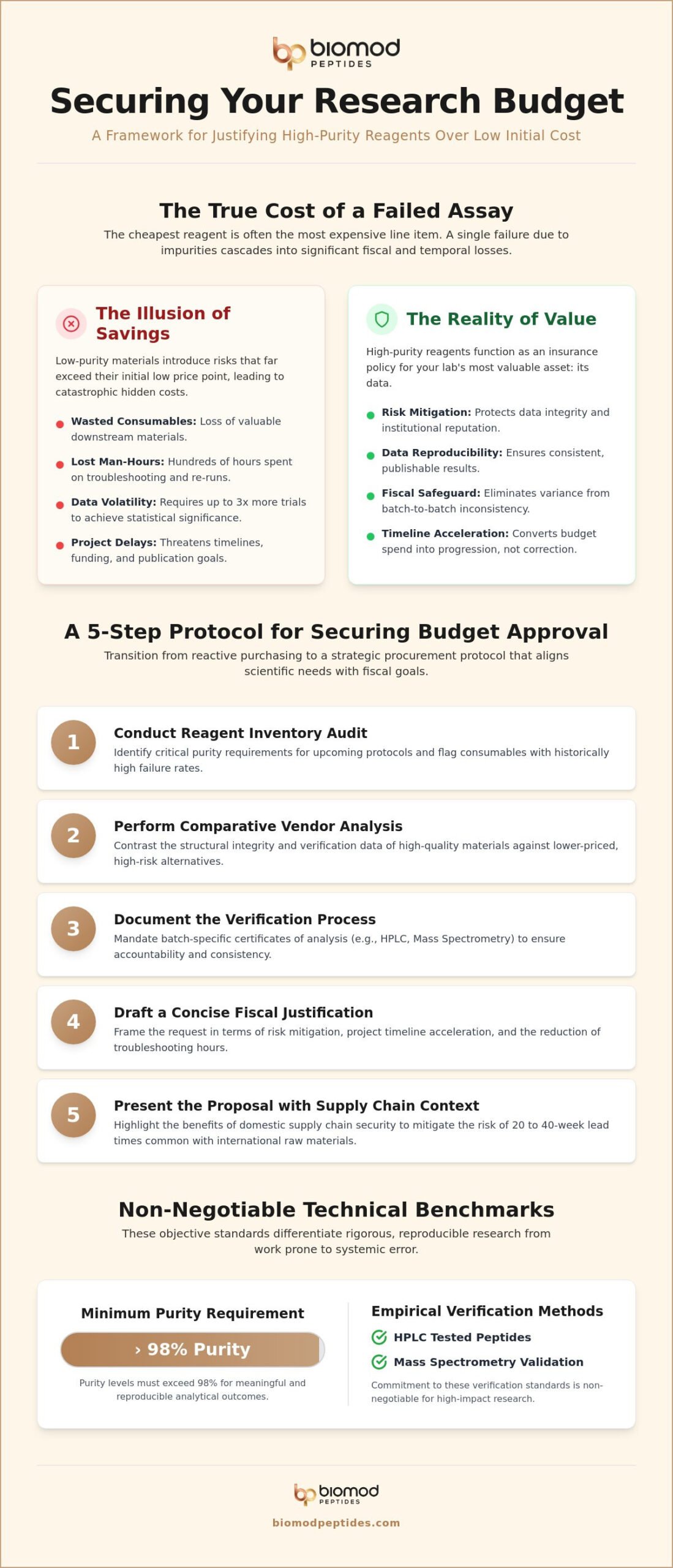
Fiscal efficiency in the laboratory isn’t found in the lowest purchase price. It’s found in the success rate of the assay. To understand how to get budget approval for research reagents, you must first quantify the catastrophic cost of experimental failure. A single failed trial due to reagent degradation or impurity doesn’t just waste the material. It consumes hundreds of man-hours and thousands of dollars in downstream consumables. When high-purity reagent-grade chemical substances are replaced with substandard alternatives, the resulting data volatility often necessitates triple the number of trials to achieve statistical significance.
The “Preliminary Work” fallacy suggests that low-grade reagents are acceptable for early-phase exploration. This is a strategic error. Introducing impurities during initial screening creates artifacts that propagate throughout the entire project lifecycle. These errors are expensive to rectify once a study moves into validation phases. Mastering how to get budget approval for research reagents requires you to define technical benchmarks early. Insist on HPLC and Mass Spectrometry validation for every batch. This isn’t just a technical preference; it’s a fiscal safeguard against data corruption.
The ROI of Analytical Grade Peptides
High-purity peptides drastically reduce the requirement for repeat trials and redundant testing. The value of verified peptide certificates of analysis lies in their ability to provide an empirical baseline for every experiment. We define reagent ROI as the ratio of successful data points to total procurement spend. By utilizing validated materials, you eliminate the variance caused by batch-to-batch inconsistency. This ensures that every dollar spent on procurement translates directly into publishable results rather than troubleshooting sessions.
Risk Mitigation and Data Integrity
Impurity-induced artifacts represent a direct threat to research credibility. In the context of peer-reviewed publication, data reproducibility is the ultimate currency. Position high-purity reagents as an insurance policy for your laboratory’s primary asset: its data. This rigorous approach to selection demonstrates a commitment to structural integrity that procurement officers can easily justify. It’s about protecting the institution’s reputation and ensuring that funding is allocated to progression, not correction.
A 5-Step Protocol for Securing Internal Budget Approval
Securing funding requires a methodical approach that mirrors your experimental design. To effectively manage your research group budget, you must transition from a reactive purchasing model to a strategic procurement protocol. Learning how to get budget approval for research reagents involves demonstrating how domestic quality control prevents costly delays and data corruption. Follow this 5-step sequence to align your scientific requirements with institutional fiscal goals.
- Step 1: Conduct a reagent inventory audit. Identify critical purity requirements for upcoming protocols and flag consumables with high failure rates.
- Step 2: Perform a comparative vendor analysis. Contrast the structural integrity of US-manufactured materials against the lower price points of overseas alternatives.
- Step 3: Document the verification process. Utilize third party tested peptides to ensure accountability and batch-to-batch consistency.
- Step 4: Draft a concise fiscal justification. Focus on project timeline acceleration and the reduction of troubleshooting hours.
- Step 5: Present the proposal. Emphasize logistical reliability and domestic supply chain security to mitigate the risk of 20 to 40 week lead times often seen with international raw materials.
Drafting the Technical Justification
Precision is the primary metric for approval. State your purity requirements clearly; levels must exceed 98% for meaningful analytical outcomes. Commitment to empirical verification via HPLC tested peptides is non-negotiable for high-impact research. This documentation proves to procurement officers that you’re prioritizing data reproducibility over temporary cost savings. It’s a professional standard that differentiates rigorous laboratories from those prone to systemic errors.
Leveraging Vendor Transparency
Verification portals reduce the administrative burden of internal quality control. When a vendor provides real-time access to batch-specific data, it streamlines the audit trail. US-based manufacturing and finishing offer a budget safety net by ensuring compliance with the latest ISO standards. This transparency is a powerful tool for anyone determining how to get budget approval for research reagents in a competitive funding environment. For those seeking standardized excellence, Biomod Peptides provides the necessary verification infrastructure to support complex procurement requests.
Optimizing Procurement for Long-Term Laboratory Efficiency
Long-term laboratory efficiency requires more than batch-to-batch verification. It demands a logistical strategy that accounts for the entire project lifecycle. When determining how to get budget approval for research reagents, you should emphasize the stability of specialized delivery systems. For instance, peptide softgels for research offer superior handling characteristics compared to traditional lyophilized powders. This format reduces the risk of contamination during reconstitution and ensures precise dosing across longitudinal studies. It’s a method for stabilizing the fiscal investment by protecting the chemical integrity of the material.
Domestic shipping is a critical factor in maintaining the cold chain. Overseas transit often involves multiple hand-offs; this increases the probability of thermal excursions that compromise reagent integrity. By prioritizing US-based logistics, you incorporate a layer of structural transparency into your budget proposal. This mitigates the risk of supply chain disruptions that lead to expensive laboratory downtime. A secure supply chain is the foundation of a predictable research schedule. It prevents the fiscal waste associated with stalled projects and expired reagents.
Regional Supply Advantages for Las Vegas Labs
Las Vegas facilities benefit significantly from regionalized procurement. Reduced transit times directly correlate with improved reagent stability and lower logistical overhead. Utilizing US manufactured research peptides ensures that your laboratory remains compliant with institutional standards while avoiding the bottlenecks associated with international customs. This regional focus provides a predictable supply schedule. It’s essential for maintaining strict experimental timelines in high-output environments.
Specialized Formats and Research Efficiency
Innovative delivery systems like peptide spray for laboratory use streamline specific experimental delivery protocols. These pre-formulated reagents eliminate the need for manual preparation. This reduces technician labor and potential prep-time errors. When you explain how to get budget approval for research reagents to your PI, highlight these labor-saving benefits. The reduction in manual handling doesn’t just save time; it enhances the overall reliability of the data set by removing human variance from the preparation phase.
Advancing Laboratory Standards Through Strategic Procurement
Securing funding for high-purity materials is a matter of technical necessity rather than administrative preference. By quantifying the fiscal impact of experimental failure and prioritizing analytical verification, you transform purchase requests into rigorous scientific justifications. Mastering how to get budget approval for research reagents requires a shift toward risk mitigation and long-term data integrity. This protocol ensures that every procurement decision supports consistent, reproducible results.
Logistical transparency and domestic supply chain security remain the final pillars of a successful budget proposal. Leveraging specialized formats and regional supply chains minimizes the risk of laboratory downtime. To support these standards, ensure your reagents are backed by independent third-party testing for every lot and US-based manufacturing. Access to a dedicated COA verification portal provides the objective evidence required for institutional accountability.
Explore Analytical Grade Peptides for Your Next Research Protocol and establish a baseline of precision in your laboratory. Your commitment to high-purity standards is the most reliable path to breakthrough discovery.
Frequently Asked Questions
How do I justify the higher cost of US-manufactured peptides?
Justify the expenditure by highlighting logistical transparency and the mitigation of supply chain volatility. US-based manufacturing ensures adherence to the FDA’s Quality Management System Regulation (QMSR) which became mandatory in February 2026. This domestic oversight eliminates the 20 to 40 week lead times common with international raw materials. It also guarantees that the structural integrity of the material hasn’t been compromised by unregulated overseas transit conditions.
What technical documentation is most effective for budget approval?
High-resolution HPLC chromatograms and Mass Spectrometry reports are the most persuasive documents for procurement review. These data points provide empirical proof of purity levels, typically requiring >98% for analytical precision. When determining how to get budget approval for research reagents, presenting a batch-specific Certificate of Analysis from an independent third-party laboratory demonstrates a commitment to objective verification. This documentation serves as a technical safeguard against experimental artifacts.
Can I include reagent verification costs in a grant application?
Reagent verification and validation costs are eligible expenses under the Materials and Supplies category of most major grant applications. Funding bodies increasingly prioritize data reproducibility; therefore, including the cost of high-purity peptides and independent lot testing strengthens the proposal’s technical merit. Explicitly listing these costs demonstrates a proactive approach to quality control. It ensures that requested funds are allocated toward generating high-fidelity data rather than troubleshooting contaminated samples.
How does reagent purity affect the long-term ROI of a laboratory?
Reagent purity directly dictates the ratio of successful data points to total procurement expenditure. Substandard materials increase the frequency of failed assays, which necessitates additional man-hours and consumable spend to rectify. Long-term laboratory ROI improves when high-purity reagents eliminate batch-to-batch variance. This stability allows for faster project completion and higher publication output. Understanding how to get budget approval for research reagents is essential for maximizing the productivity of the laboratory’s human capital.
Disclaimer
BIOMOD products are sold strictly for laboratory, analytical, and scientific research use only. They are not intended for human or animal consumption, administration, application, ingestion, injection, or any therapeutic, diagnostic, or cosmetic use.
The statements made on this website have not been evaluated by the United States Food and Drug Administration. BIOMOD products are not intended to diagnose, treat, cure, mitigate, or prevent any disease or medical condition.
BIOMOD is a research chemical supplier. BIOMOD is not a compounding pharmacy or chemical compounding facility as defined under Section 503A of the Federal Food, Drug, and Cosmetic Act. BIOMOD is not an outsourcing facility as defined under Section 503B of the Federal Food, Drug, and Cosmetic Act.
By accessing this site, you confirm you are at least 21 years of age and that you have read and accepted the BIOMOD Terms of Sale, Privacy Policy, and Research Use Only Policy. BIOMOD does not provide dosing, medical, therapeutic, diagnostic, veterinary, or use guidance under any channel.