
A single microbial colony can dismantle months of rigorous research in hours. You know that even the most sophisticated assay is worthless if the underlying stock is compromised by enzymatic degradation or metabolic byproducts. Maintaining absolute reagent integrity is a non-negotiable standard. However, preventing microbial contamination in peptide stocks remains a frequent point of failure in high-precision laboratories. These failures lead to inconsistent data and the unnecessary loss of expensive reagents.
This article provides the analytical protocols and storage standards necessary to maintain 99% purity throughout your study duration. You’ll master the aseptic techniques required to eliminate microbial interference and ensure long-term stock stability. We will examine updated 2026 filtration benchmarks, including the selection between 0.22-micron and 0.1-micron membranes for specific peptide types. We also preview the critical documentation workflows and cold-chain disciplines required to meet current USP and FDA quality expectations for laboratory-grade materials.
Key Takeaways
- Identify how exogenous proteases from bacteria and fungi enzymatically cleave peptide bonds, leading to irreversible reagent degradation and compromised data.
- Implement rigorous aseptic techniques within Class II Biosafety Cabinets as the foundational strategy for preventing microbial contamination in peptide stocks.
- Optimize reconstitution protocols by utilizing bacteriostatic water with 0.9% benzyl alcohol to inhibit microbial proliferation in multi-use research vials.
- Establish precise storage parameters, including the use of vacuum desiccators and -80°C environments, to maintain long-term structural integrity and prevent moisture accumulation.
- Utilize third-party verified starting materials and comprehensive Certificates of Analysis (COA) to ensure baseline purity before beginning sensitive analytical workflows.
Vectors of Contamination and Impact on Peptide Stability
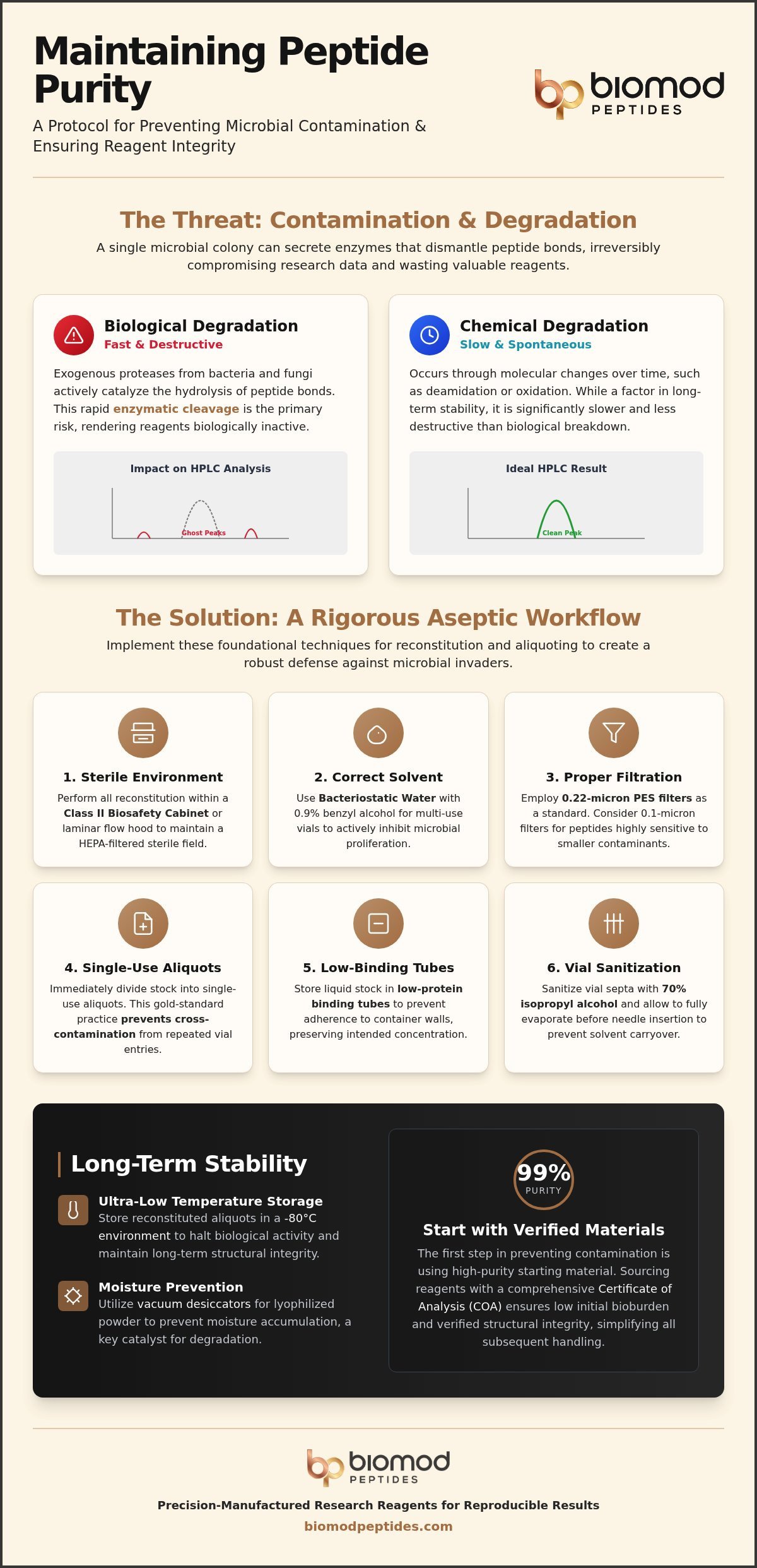
Microbial contamination involves the unintentional introduction of bacteria, yeast, or fungi into the peptide environment. This typically occurs during reconstitution, aliquoting, or storage. These organisms aren’t inert; they actively secrete exogenous proteases into the solution. These enzymes catalyze the hydrolysis of peptide bonds. This process, known as enzymatic cleavage, is the primary risk of microbial presence. It renders the reagent biologically inactive and analytically useless.
The “Bioburden Threshold” is a critical metric for any researcher. Even low-level contamination can skew HPLC purity results. Microbes consume the peptide as a carbon source, producing metabolic byproducts that appear as “ghost peaks” or baseline noise in chromatographic analysis. High-purity reagents offer greater resilience. They contain fewer organic impurities that might otherwise serve as a growth medium for opportunistic microbes. Therefore, preventing microbial contamination in peptide stocks begins with minimizing the initial nutrient availability within the vial.
Chemical vs. Biological Degradation
Chemical degradation, such as deamidation or oxidation, occurs through spontaneous molecular changes over time. Biological degradation is faster and more destructive. Proteolysis involves the rapid breakdown of the primary sequence by microbial enzymes. Enzymatic cleavage is the primary risk of microbial presence. This contamination skews mass spectrometry peaks and creates a fragmented data profile. Utilizing rigorous Aseptic Protocols is the only way to prevent this data loss and ensure the integrity of the target analyte.
The Role of HPLC-Verified Starting Materials
Quality control starts with the raw material. Sourcing from Biomod Peptides ensures you begin with a low bioburden and verified structural integrity. Their products undergo rigorous third-party testing to meet stringent benchmarks. For detailed analytical requirements, refer to The Protocol for Peptide Purity Verification. Starting with verified 99% purity reduces the risk profile of your stock. It simplifies the task of preventing microbial contamination in peptide stocks by removing the organic precursors that microbes require to colonize the solution.
Aseptic Protocols for Reconstitution and Aliquoting
Establishing a controlled environment is the first line of defense. All reconstitution procedures should occur within a Class II Biosafety Cabinet or a laminar flow hood. These systems provide HEPA-filtered air to maintain a sterile field. It’s a discipline that’s vital for preventing microbial contamination in peptide stocks. Without this physical barrier, airborne contaminants can easily compromise the lyophilized powder during the first exposure to the laboratory atmosphere.
Solvent selection dictates stock longevity. Bacteriostatic water, containing 0.9% benzyl alcohol, is essential for multi-use vials to inhibit growth. For high-sensitivity assays, 0.22-micron polyethersulfone (PES) filters provide a physical barrier against microbes. Current 2026 standards suggest 0.1-micron filtration for specific peptide types sensitive to smaller bacterial contaminants. Implementing rigorous Endotoxin Contamination Control measures during these steps prevents the introduction of pyrogens that can invalidate biological results.
Divide the stock into single-use aliquots immediately after reconstitution. This strategy is the gold standard for preventing microbial contamination in peptide stocks, as it eliminates the need for repeated vial entries. This is particularly critical for maintaining integrity in Las Vegas laboratories and other high-throughput research environments. You’ll find precision-manufactured research reagents designed to support these rigorous aseptic workflows.
Step-by-Step Sterile Reconstitution
Sanitize vial septa using 70% isopropyl alcohol. Wait for full evaporation before needle insertion to prevent alcohol carryover into the stock. Use pressure equalization techniques to avoid the aerosolization of lyophilized powder, which can lead to sample loss and environmental exposure. Store the resulting liquid in low-protein binding tubes. This prevents the peptide from adhering to the container walls, which preserves the intended concentration and ensures data reproducibility.
Specialized Delivery Formats and Handling
Advanced delivery systems offer inherent protection against environmental exposure. For instance, peptide softgels minimize the risks associated with manual reconstitution by providing pre-measured, encapsulated doses. This reduction in manual handling steps significantly lowers the contamination risk profile. Regarding peptide spray products, maintaining nozzle sterility is paramount. Researchers should clean the actuator with sterile wipes after each use and ensure the protective cap remains secured to prevent cross-contamination between sessions.
Advanced Storage Solutions and Integrity Verification
Analytical precision requires unwavering temperature discipline. Short-term preservation of reconstituted stocks necessitates a consistent -20°C environment. For long-term stability, -80°C is the mandatory benchmark. These temperatures effectively arrest microbial metabolism. They also minimize the rate of spontaneous chemical degradation. Maintaining these standards is a critical component of preventing microbial contamination in peptide stocks over extended study durations.
Peptides are inherently hygroscopic. They readily absorb moisture from the atmosphere. This is a primary vector for contamination in lyophilized powders. Using vacuum desiccators with fresh silica gel or molecular sieves prevents moisture accumulation. Moisture acts as a catalyst for both chemical hydrolysis and microbial proliferation. A dry environment ensures that the peptide remains in a stable, dormant state until reconstitution.
Repeated temperature fluctuations are a significant risk factor. Every freeze-thaw cycle introduces the possibility of condensation inside the vial. This moisture can harbor opportunistic microbes and lead to irreversible aggregation. Aliquoting remains the most effective way to mitigate this risk. You can verify the stability benchmarks for specific lots through the Biomod Peptides COA verification portal. This transparency ensures that your starting materials meet rigorous institutional standards.
Cold Chain Management in Laboratory Settings
Reliable research depends on continuous monitoring. Implementing automated temperature logging systems provides a verifiable audit trail for your reagents. These systems alert researchers to freezer failures before the bioburden threshold is exceeded. For laboratories operating in high-temperature regions, such as those in Las Vegas, these protocols are essential for maintaining the integrity of analytical-grade materials. Adhering to established quality control standards ensures that environmental variables don’t compromise your data.
Periodic Integrity Testing
Integrity verification shouldn’t stop at the point of receipt. Perform regular visual inspections of your liquid stocks. The presence of turbidity or precipitation often serves as an early indicator of microbial colonization or advanced degradation. For critical long-term studies, secondary HPLC testing is recommended. This confirms that the primary sequence remains intact and free from the enzymatic cleavage products described in the initial sections of this protocol. Consistent verification is the final step in preventing microbial contamination in peptide stocks and ensuring the validity of your research outcomes.
Upholding Standards for Analytical Precision
Analytical precision is a direct result of procedural discipline. You’ve identified how exogenous proteases can dismantle a study and why Class II Biosafety Cabinets are essential. You’ve integrated -80°C storage and desiccation into your daily workflow. Preventing microbial contamination in peptide stocks isn’t just about avoiding growth. It’s about protecting the molecular sequence from the moment of synthesis to the final assay.
Every analytical outcome depends on the starting material’s purity. Biomod Peptides supports your methodology with US-manufactured reagents and rigorous third-party verification. We ensure all lots meet 99% purity benchmarks. Our dedicated COA portal provides instant, lot-specific transparency for every batch you receive. This level of documentation is the baseline for modern, high-stakes research. It ensures your variables remain controlled and your results remain valid.
Secure High-Purity Reagents for Your Research at Biomod Peptides. Maintain total control over your stock integrity and achieve the reproducible data your work demands.
Frequently Asked Questions
Can I use regular distilled water for peptide reconstitution?
No, regular distilled water is unsuitable for reconstitution. It lacks the sterility and bacteriostatic properties required for analytical-grade research. Distilled water often contains trace minerals and organic matter that support microbial proliferation. Researchers must utilize bacteriostatic water with 0.9% benzyl alcohol or sterile water for injection. These solvents are essential for preventing microbial contamination in peptide stocks and ensuring the stability of the molecular sequence during long-term assays.
How long do reconstituted peptide stocks remain sterile at 4°C?
Reconstituted stocks at 4°C have a very limited sterile window. Refrigeration only slows microbial metabolism; it does not arrest it. Without bacteriostatic agents, contamination can reach detectable levels within 24 to 48 hours. This temperature is only appropriate for immediate experimental use. For any duration exceeding a few days, aliquoting and freezing at -20°C or -80°C is mandatory to maintain microbiological integrity and prevent enzymatic degradation of the peptide bonds.
What are the signs of microbial contamination in a clear peptide solution?
Visible turbidity or cloudiness is the most common indicator of advanced colonization. However, significant degradation often occurs before the solution becomes opaque. Subtle signs include the formation of fine precipitates or unexpected shifts in the solution’s pH. Analytically, contamination manifests as “ghost peaks” or an increased baseline in HPLC chromatograms. These artifacts indicate that exogenous proteases have already begun cleaving the peptide, rendering the stock unreliable for high-precision research applications.
Does freezing a contaminated peptide stock kill the bacteria?
Freezing does not eliminate microbial presence. It typically acts as a cryopreservative for many bacterial strains and fungal spores. While metabolic activity ceases at -80°C, the organisms remain viable. They will resume enzymatic activity immediately upon thawing. Relying on freezing to “clean” a compromised sample is a fundamental error. Once a stock exceeds the bioburden threshold, preventing microbial contamination in peptide stocks is no longer possible; the reagent must be discarded to protect data integrity.
Disclaimer
BIOMOD products are sold strictly for laboratory, analytical, and scientific research use only. They are not intended for human or animal consumption, administration, application, ingestion, injection, or any therapeutic, diagnostic, or cosmetic use.
The statements made on this website have not been evaluated by the United States Food and Drug Administration. BIOMOD products are not intended to diagnose, treat, cure, mitigate, or prevent any disease or medical condition.
BIOMOD is a research chemical supplier. BIOMOD is not a compounding pharmacy or chemical compounding facility as defined under Section 503A of the Federal Food, Drug, and Cosmetic Act. BIOMOD is not an outsourcing facility as defined under Section 503B of the Federal Food, Drug, and Cosmetic Act.
By accessing this site, you confirm you are at least 21 years of age and that you have read and accepted the BIOMOD Terms of Sale, Privacy Policy, and Research Use Only Policy. BIOMOD does not provide dosing, medical, therapeutic, diagnostic, veterinary, or use guidance under any channel.

One Response