
The $150,000 capital expenditure for a high-tier automated peptide synthesizer represents only the surface of internal production costs. Hardware is the starting point. It isn’t the finish line. Beyond the machine, researchers must account for specialized reagents that comprise up to 70% of total goods costs and the logistical burden of hazardous solvent waste. You likely recognize that internal synthesis offers immediate control, but it’s often a source of inconsistent purity and high labor overhead. Conducting a rigorous cost analysis of in-house vs sourced peptides is essential to determine if your laboratory is truly optimized for technical progression.
We agree that the decision to internalize production is a complex calculation of risk and resource allocation. This guide evaluates the financial and operational trade-offs between internal synthesis and external procurement to help you optimize your laboratory budget. We provide a clear breakdown of CapEx versus OpEx and a framework for selecting the most cost-effective path based on your specific sequence complexity and volume requirements.
Key Takeaways
- Quantify the operational overhead of internal synthesis, focusing on the costs of specialized technician labor and rigorous training requirements.
- Assess the advantages of US-based manufacturing in securing high-purity reagents and reducing logistical lead times.
- Apply a strategic framework for a cost analysis of in-house vs sourced peptides based on sequence complexity and synthesis frequency.
- Utilize analytical documentation and COA verification portals to ensure laboratory-grade standards without internal testing bottlenecks.
- Distinguish between CapEx-heavy internal builds and OpEx-driven procurement to optimize long-term research budgets.
The Economics of In-House Synthesis: CapEx vs. Operational Reality
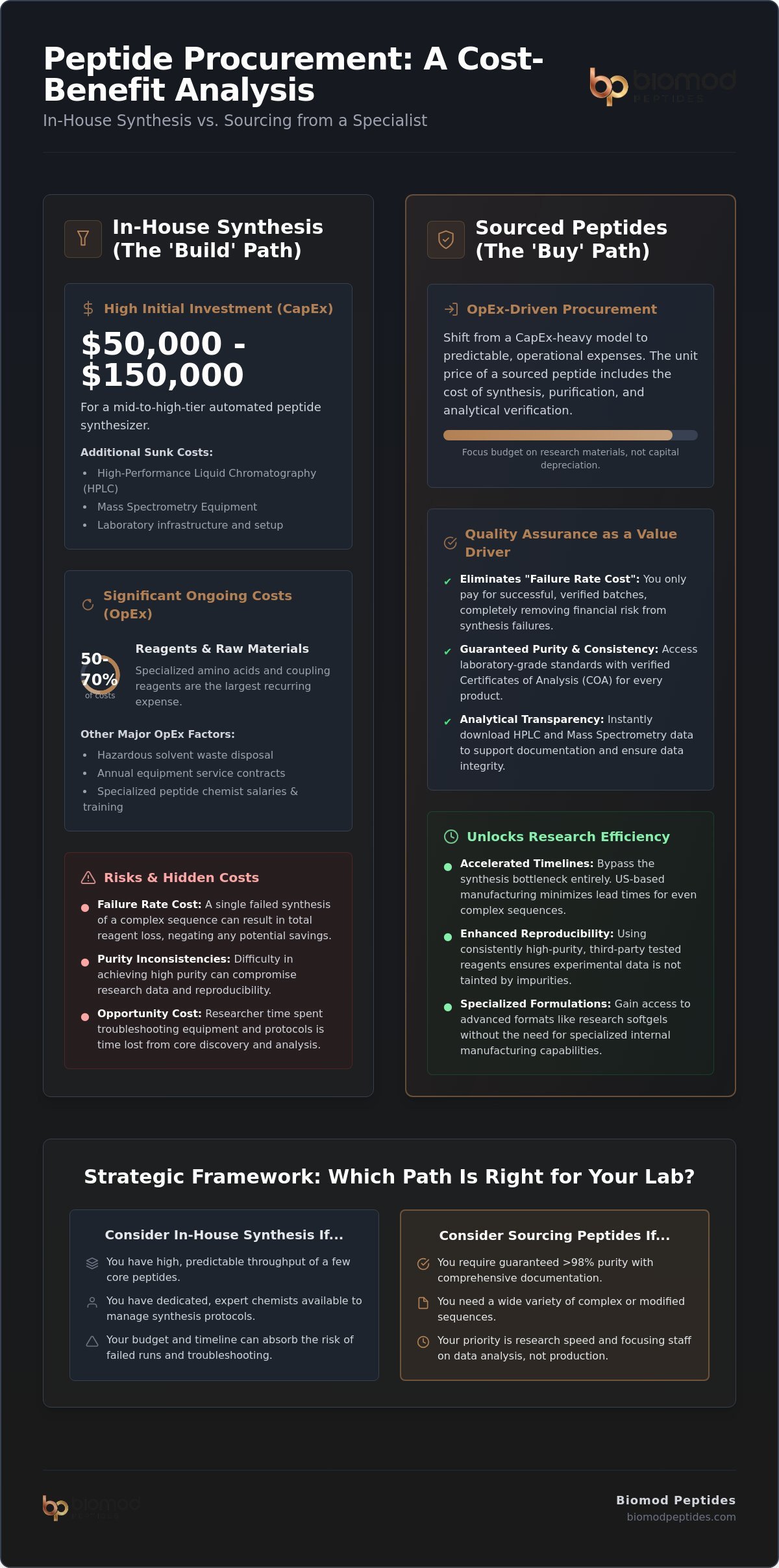
Establishing an internal synthesis facility requires a significant capital commitment. A mid-tier automated peptide synthesizer currently commands a price range between $50,000 and $150,000. This initial investment only secures the primary hardware. Comprehensive laboratory functionality also necessitates high-performance liquid chromatography (HPLC) systems for purification and mass spectrometry equipment for verification. When conducting a cost analysis of in-house vs sourced peptides, laboratories must view these figures as sunk costs that require high-volume throughput to justify the depreciation.
Operational expenses often eclipse the initial CapEx. Most internal laboratories utilize Solid-phase peptide synthesis (SPPS) as their foundational methodology. This process is resource-intensive. Raw materials, such as specialized amino acids and coupling reagents, account for 50% to 70% of the total cost of goods. Beyond reagents, the logistical burden of hazardous waste disposal adds a recurring financial layer. Solvents used in SPPS require strict environmental management, which increases the price per milligram synthesized internally.
The “Failure Rate Cost” is a critical but frequently overlooked metric. Internal synthesis is not a guaranteed outcome. Purity inconsistencies or coupling failures in complex sequences result in total reagent loss. A single unsuccessful run on a specialized sequence can negate the projected savings of several successful batches. These technical setbacks disrupt research timelines and inflate the true total cost of ownership.
Equipment Lifecycle and Maintenance Costs
Precision hardware demands rigorous upkeep. Annual service contracts for synthesizers and HPLC systems are non-negotiable for maintaining analytical integrity. For Las Vegas laboratories, equipment downtime is particularly costly. Sourcing specialized technicians for on-site repairs in the local market can lead to extended delays. Laboratories must calculate the cost of these idle periods when assessing the viability of internal production versus external procurement.
Labor and Opportunity Costs
Qualified peptide chemists are essential for managing complex synthesis protocols. The local Las Vegas market remains highly competitive for these specialized roles. High salaries and ongoing training requirements represent a fixed operational burden. More importantly, every hour a researcher spends troubleshooting a synthesizer is an hour lost to active data collection and discovery. This opportunity cost often shifts the financial balance toward sourcing from established US-based manufacturers.
Evaluating Sourced Peptides: Quality Assurance as a Value Driver
Procurement offers an immediate bypass of the synthesis bottleneck. While some researchers explore cost-effective in-house peptide production through recombinant methods, the logistical reality for most facilities favors external sourcing. Sourcing shifts the burden of quality control (QC) from the laboratory to the manufacturer. This transfer of risk is a primary component of a cost analysis of in-house vs sourced peptides. The unit price of a sourced reagent includes the cost of analytical verification, which often exceeds the labor costs of an internal run.
US-based manufacturing and finishing provide critical accountability. Domestic facilities operate under standardized logistical protocols that minimize lead times for specialized sequences. This reliability mitigates the “Failure Rate Cost” discussed in the previous section. By outsourcing, laboratories eliminate the financial impact of unsuccessful internal runs. They gain access to verified peptide certificates of analysis that serve as empirical proof of structural integrity.
Analytical Transparency and Verification
Reproducibility is the benchmark of rigorous research. Utilizing third party tested peptides ensures that experimental data remains untainted by reagent impurity. Advanced verification portals allow researchers to download mass spectrometry and HPLC data instantly. This transparency streamlines documentation and supports institutional compliance without additional internal labor. For laboratories prioritizing data integrity, sourcing from verified US vendors remains the most efficient path forward.
Specialized Formulations and Delivery Systems
Complexity increases exponentially with advanced delivery formats. Manufacturing peptide softgels for research requires specialized encapsulation hardware that most academic or private labs don’t possess. Similarly, formulating intranasal peptide research sprays involves precise concentration and stability testing. Sourcing these finished formats is significantly more cost-effective than attempting internal formulation, which often leads to significant material waste and sub-optimal delivery profiles.
Build vs. Buy: A Strategic Framework for Research Facilities
The decision to internalize production or outsource hinges on specific laboratory throughput and technical requirements. A rigorous cost analysis of in-house vs sourced peptides reveals that CapEx recovery typically requires consistent, high-volume synthesis runs over a three-to-five-year period. Facilities performing sporadic or low-volume research rarely achieve the economies of scale necessary to offset the $150,000 entry price of modern synthesizers. If your facility doesn’t maintain near-constant hardware utilization, the price per milligram synthesized internally will inevitably exceed market procurement rates.
Technical limits also dictate the strategic framework. Standard benchtop synthesizers often struggle with high-complexity sequences or hydrophobic residues that require specialized coupling reagents. In these instances, relying on a professional laboratory peptide supply ensures that research isn’t stalled by synthesis failure. It allows the provider to act as a technical extension of the internal team, absorbing the risk of complex methodologies while the laboratory focuses on data interpretation.
The “Agility” Metric in Peptide Procurement
Research agility is a measurable financial asset. Sourcing reagents reduces the time-to-data, which is a critical factor for securing competitive research grants. It eliminates the lead time required for internal method development and purification validation. Managing inventory through bulk research peptides allows facilities to scale operations rapidly. They can pivot between sequences without carrying the massive overhead of raw amino acid stock or managing the shelf-life of volatile coupling reagents.
Final Recommendation: The Hybrid Approach
The most resilient laboratories often adopt a hybrid model. They maintain basic synthesis capabilities for routine, low-stakes screening while sourcing high-purity or specialized items from external partners. This approach balances internal control with external technical precision. US-manufactured reagents remain the gold standard for institutions requiring logistical transparency and verified analytical benchmarks. By utilizing third-party verification portals, these facilities maintain a rigorous audit trail that supports long-term research integrity and institutional accountability.
Optimizing Laboratory Resource Allocation for Technical Progression
Precision research requires an uncompromising approach to reagent procurement. A rigorous cost analysis of in-house vs sourced peptides reveals that the true financial burden of internal synthesis lies in operational overhead and technical risk. While hardware represents a fixed asset, the ongoing labor and material waste of unsuccessful runs create unpredictable budget volatility. Transitioning to a verified procurement model eliminates these variables; it allows your facility to prioritize data discovery over hardware maintenance.
Biomod Peptides provides a streamlined alternative to the synthesis bottleneck. We prioritize analytical transparency through US-based manufacturing and finishing. Every lot undergoes independent third-party testing to ensure structural integrity. Our dedicated COA verification portal allows your team to access mass spectrometry and HPLC data instantly. This methodology ensures that your documentation remains as precise as your research.
Secure the reagents necessary for high-tier research today. Explore Biomod Peptides analytical grade catalog and experience a higher tier of execution in laboratory supply.
Frequently Asked Questions
What is the typical ROI for a peptide synthesizer in a mid-sized lab?
Return on investment for an automated synthesizer typically requires three to five years of high-volume throughput. A mid-sized laboratory must account for the $50,000 to $150,000 entry cost alongside annual service contracts and specialized labor. If hardware utilization isn’t constant, the depreciation and operational overhead often exceed the savings of internal production.
How does the cost of HPLC verification impact the price of in-house peptides?
HPLC verification adds a substantial layer of operational expense to every internal run. Beyond the initial hardware investment, laboratories must budget for high-purity solvents and specialized technician time for peak integration and purity analysis. These analytical steps are mandatory for data integrity; however, they inflate the per-milligram price of in-house reagents when compared to bulk procurement from established vendors.
Why is third-party testing more cost-effective than internal QC?
Independent third-party testing is more cost-effective because it leverages specialized infrastructure and economies of scale. Maintaining internal quality control requires dedicated analytical chemists and frequent equipment recalibration. By utilizing external verification, a cost analysis of in-house vs sourced peptides shows a significant reduction in fixed labor costs while increasing objective data transparency.
Are US-manufactured peptides significantly more expensive than imported options?
US-manufactured peptides often carry a higher initial price point than imported alternatives, but the total cost of ownership is frequently lower. Domestic production minimizes lead times and reduces the risk of batch failure or purity inconsistencies. When laboratories factor in the value of US-based finishing and dedicated COA verification portals, the reliability of domestic supply justifies the premium over low-cost imports.
Disclaimer
BIOMOD products are sold strictly for laboratory, analytical, and scientific research use only. They are not intended for human or animal consumption, administration, application, ingestion, injection, or any therapeutic, diagnostic, or cosmetic use.
The statements made on this website have not been evaluated by the United States Food and Drug Administration. BIOMOD products are not intended to diagnose, treat, cure, mitigate, or prevent any disease or medical condition.
BIOMOD is a research chemical supplier. BIOMOD is not a compounding pharmacy or chemical compounding facility as defined under Section 503A of the Federal Food, Drug, and Cosmetic Act. BIOMOD is not an outsourcing facility as defined under Section 503B of the Federal Food, Drug, and Cosmetic Act.
By accessing this site, you confirm you are at least 21 years of age and that you have read and accepted the BIOMOD Terms of Sale, Privacy Policy, and Research Use Only Policy. BIOMOD does not provide dosing, medical, therapeutic, diagnostic, veterinary, or use guidance under any channel.