
The global peptide synthesis market is valued at approximately $1.9 billion in 2026, yet a substantial percentage of that investment vanishes through mechanical degradation and improper laboratory handling. You recognize that reagent loss isn’t just a procurement hurdle. It’s a direct threat to experimental reproducibility and budgetary efficiency. Mastering how to reduce waste when using expensive peptides requires a transition from casual handling to rigorous, analytical protocols.
This laboratory protocol provides the technical framework for reconstitution, storage, and aliquotting necessary to maximize research yield. We’ll outline precise SOPs for maintaining thermal stability and structural integrity while minimizing exposure to degradative environments. You’ll learn how to implement verification-driven workflows that extend reagent shelf-life and eliminate the complex mathematical errors that often lead to costly reagent loss. We’ll also examine how starting with third-party verified materials ensures your data remains beyond reproach. By the end of this guide, your laboratory will have the standardized tools to ensure every milligram of material translates into valid, actionable results.
Key Takeaways
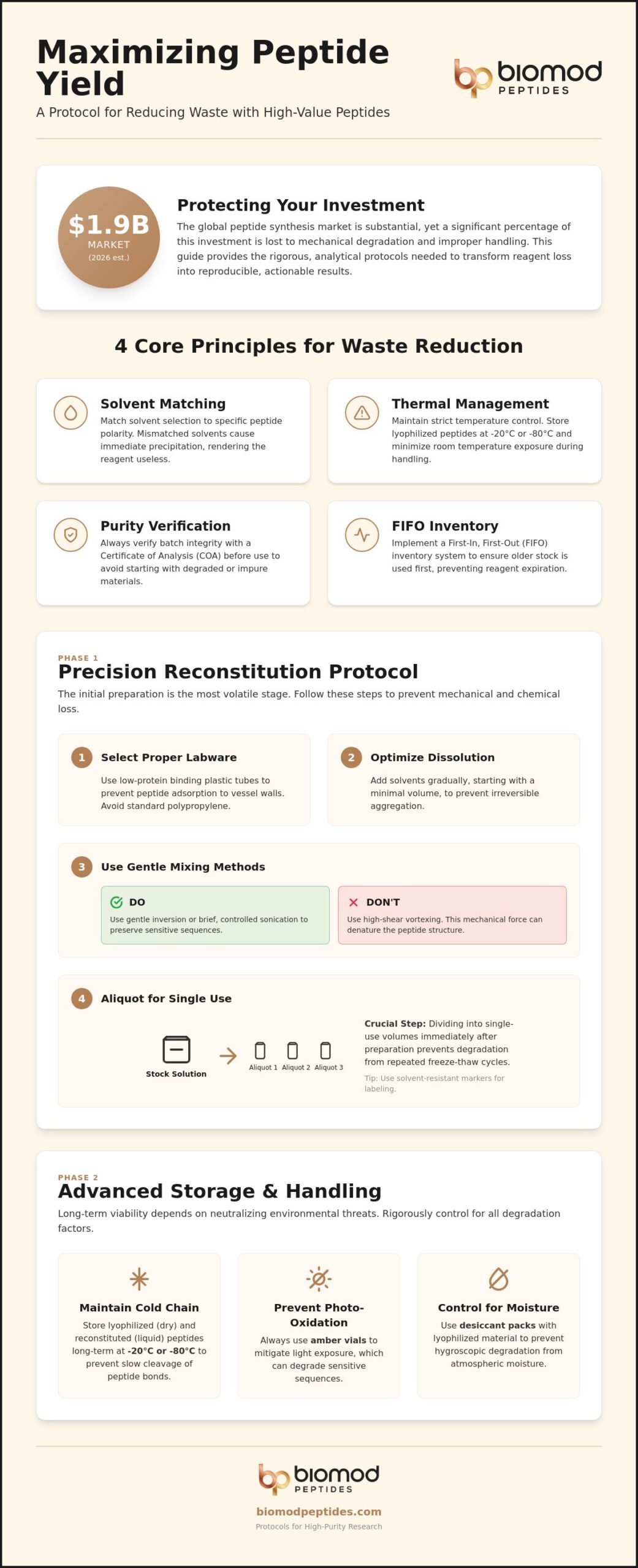
- Match solvent selection to specific peptide polarity to prevent precipitation and avoid high-shear vortexing that causes mechanical denaturation.
- Implement strict thermal stability management by maintaining lyophilized peptides at -20°C or -80°C while using amber vials to neutralize photo-oxidation.
- Master technical protocols for purity verification to understand how to reduce waste when using expensive peptides by avoiding degraded starting materials.
- Establish a First-In, First-Out (FIFO) inventory rotation system to prevent reagent expiration and ensure maximum research yield.
Precision Reconstitution: Minimizing Loss During Initial Preparation
Initial preparation is the most volatile phase of reagent handling. Most researchers overlook the mechanical and chemical stressors introduced during the first minutes of hydration. Understanding how to reduce waste when using expensive peptides begins with standardized solvent selection. Because Solid-phase peptide synthesis results in specific C-terminal and N-terminal modifications, the resulting polarity must be matched exactly to the solvent. Failure to do so causes immediate precipitation or “crashing out,” rendering the reagent useless for high-precision assays.
Precision requires more than just the right chemistry. It demands the right hardware. Standard polypropylene tubes often lead to peptide adsorption, where molecules stick to the vessel walls. Use only specialized low-protein binding plastics to ensure maximum recovery. Combine this with calibrated micropipettes to maintain exact molarity and prevent over-dilution. Avoid high-shear vortexing at all costs. These mechanical forces can denature sensitive sequences. Instead, utilize gentle inversion or brief, controlled sonication if the specific sequence allows for it.
Solubility Optimization for High-Yield Research
Achieving total dissolution is mandatory for experimental consistency. We recommend reviewing our specific protocol for improving peptide solubility to identify the optimal pH for your specific sequence. Always add solvents gradually. Start with a minimal volume of the primary solvent before slowly introducing the aqueous buffer. This incremental approach prevents the irreversible aggregation that often occurs with rapid, high-volume dilution.
The Aliquotting Strategy
Divide the reconstituted solution into single-use volumes immediately after preparation. Repeated freeze-thaw cycles are the primary cause of peptide degradation in a laboratory setting. By aliquotting, you isolate the bulk of your material from destructive thermal fluctuations. Use solvent-resistant markers for all labeling. Standard ink often dissolves in the presence of DMSO or ethanol; this leads to the loss of batch identification and subsequent reagent waste. This meticulous approach is the only way to ensure every milligram of your research material remains viable for downstream applications.
Advanced Storage Protocols: Neutralizing Environmental Degradation
Storage represents the second frontier in the battle against molecular degradation. To understand how to reduce waste when using expensive peptides, you must rigorously control for photo-oxidation and hydrolysis. Lyophilized peptides require long-term preservation at -20°C or -80°C to prevent the slow cleavage of peptide bonds. Use amber vials and desiccant packs to mitigate light exposure and moisture ingress. According to the NIBSC peptide handling guidelines, even brief exposure to atmospheric moisture can initiate hygroscopic degradation, which compromises the molar accuracy of your stock.
Short-term handling during experimental setup is equally critical. Minimize the time reagents spend at room temperature. Every minute of thermal exposure accelerates the decay of sensitive sequences. If you don’t maintain strict thermal limits, the structural integrity of the sequence will fail before the assay begins. Before committing to large-scale studies, verify batch integrity using the Biomod COA portal. This verification step ensures that your starting material meets the rigorous purity standards required for reproducible data.
Cold Chain Integrity in High-Heat Environments
Laboratories in extreme climates, such as Las Vegas, face unique logistical challenges. High ambient temperatures increase the risk of freezer failure and thermal spikes during reagent transfer. Implement redundant cooling systems and alarm-monitored freezers to protect your inventory. For a detailed analysis of environmental risk factors, consult our guide on peptide stability for research.
Alternative Delivery Formats for Stability
Traditional lyophilized vials aren’t the only option for maintaining structural integrity. For research requiring pre-measured, encapsulated stability, peptide softgels offer a standardized format that reduces manual handling errors. Similarly, peptide spray products provide precision dosing for intranasal applications, effectively bypassing the risks associated with manual reconstitution. Utilizing these formats is a strategic method for ensuring consistent results while reducing the potential for reagent loss.
Strategic Procurement: Leveraging Analytical Stability for Long-Term Yield
Procurement is the final pillar of institutional yield management. Significant reagent waste occurs before a vial is even opened because of poor vendor selection or batch-to-batch variability. Learning how to reduce waste when using expensive peptides requires a shift toward analytical verification at the point of purchase. You must validate purity before use by implementing a rigorous peptide purity verification protocol. This ensures that the material meets the 98% or higher purity thresholds required for sensitive research, preventing the use of sub-standard reagents that lead to failed assays.
Inventory rotation is equally vital for maintaining a high-yield laboratory environment. Implement a First-In, First-Out (FIFO) system to prevent reagents from reaching their expiration dates on the shelf. While bulk procurement offers benefits for longitudinal studies by ensuring sequence consistency across multiple phases, it only works if the storage protocols mentioned previously are followed. Prioritize suppliers who provide transparent, third-party HPLC/MS data for every batch. This supplier accountability eliminates the guesswork that often leads to discarded materials and budgetary loss.
Auditing Reagent Purity
Interpreting HPLC reports allows you to identify potential degradation products before they ruin an experiment. Look for secondary peaks or broad elution profiles that indicate impurities. Mass spectrometry (MS) provides the necessary verification of sequence identity, ensuring that the molecular weight matches the theoretical value exactly. Without this data, you risk using incorrect or degraded sequences that compromise your research integrity.
Procurement Efficiency for Las Vegas Labs
For laboratories operating in specific geographic hubs like Las Vegas, utilizing local US-manufactured supply chains is a strategic advantage. This reduces transit time and minimizes thermal exposure during shipping. You can learn more about Biomod and our commitment to US-based laboratory standards. These logistical refinements ensure that the cold chain remains intact from manufacturing to final delivery, further demonstrating how to reduce waste when using expensive peptides through superior supply chain management.
Standardizing Analytical Integrity for Maximum Research Yield
Precision in the laboratory is a requirement, not a suggestion. By implementing standardized reconstitution protocols and rigorous thermal management, you eliminate the mechanical and chemical variables that lead to reagent loss. You’ve seen that mastering how to reduce waste when using expensive peptides requires a holistic approach. It spans from the initial solvent addition to the final inventory audit. Adopting low-protein binding plastics and single-use aliquotting strategies ensures that your molecular sequences remain structurally intact for every assay.
Scientific progress depends on the reliability of your starting materials. Biomod provides the foundational security your research demands through US-based manufacturing and finishing. Every batch undergoes third-party HPLC/MS validation to ensure absolute purity before it reaches your bench. You can verify these standards through our secure COA verification portal to maintain total transparency in your supply chain. Uncompromising quality control is the only path to reproducible results.
Secure High-Purity, US-Manufactured Research Peptides from Biomod and ensure your laboratory operates at the highest tier of analytical execution. Your data deserves nothing less than total precision.
Frequently Asked Questions
How many freeze-thaw cycles can a peptide survive before degrading?
Peptides typically begin to show measurable degradation after a single freeze-thaw cycle. The formation of ice crystals and localized pH fluctuations during the phase transition cause significant structural instability. These mechanical stressors can break delicate peptide bonds or lead to irreversible aggregation.
To maintain maximum research yield, you should implement the aliquotting strategy to ensure each vial is only thawed once. This protocol eliminates the cumulative damage caused by repeated thermal cycling. If a sample must be refrozen, expect a reduction in molar accuracy and potential loss of biological activity.
What is the best solvent for reconstituting expensive research peptides?
The optimal solvent depends entirely on the amino acid sequence and its resulting polarity. While sterile water or PBS are standard for many hydrophilic sequences, hydrophobic peptides often require a small percentage of DMSO or 10% acetic acid to achieve total dissolution. Matching the solvent to the peptide’s chemical profile is a fundamental step in how to reduce waste when using expensive peptides.
Always consult the specific solubility data provided with your batch before adding any liquid. Starting with a minimal volume of the primary solvent before slowly introducing the aqueous buffer prevents the “crashing out” that ruins expensive reagents. Proper solvent selection ensures the reagent remains in a stable, monomeric state for your assays.
How do I know if my peptide has degraded during storage?
Degradation is often signaled by physical changes such as precipitation, cloudiness, or a change in the solution’s color. However, molecular decay can occur without visible alterations. Analytical methods like HPLC are required to identify shifts in retention time or the appearance of secondary peaks that indicate the presence of truncated sequences.
If you suspect your material is compromised, compare your current results against the original HPLC/MS data. Utilizing a secure COA verification portal allows you to audit the initial purity levels of your batch. This baseline data is essential for determining if a reagent is still viable for high-precision research applications.
Can I store reconstituted peptides in a standard refrigerator?
Reconstituted peptides should stay in a standard 4°C refrigerator for no longer than 24 to 48 hours. This temperature range is insufficient to prevent hydrolysis or microbial growth, both of which rapidly destroy the integrity of the sequence. Storing liquid peptides at 4°C for extended periods is a leading cause of preventable reagent waste.
For any research timeline exceeding two days, you must store aliquots at -20°C or -80°C. Frozen storage significantly slows the kinetic energy responsible for chemical degradation. Always ensure your freezer is alarm-monitored to protect your inventory from thermal spikes that can occur during defrost cycles or equipment failure.
Disclaimer
BIOMOD products are sold strictly for laboratory, analytical, and scientific research use only. They are not intended for human or animal consumption, administration, application, ingestion, injection, or any therapeutic, diagnostic, or cosmetic use.
The statements made on this website have not been evaluated by the United States Food and Drug Administration. BIOMOD products are not intended to diagnose, treat, cure, mitigate, or prevent any disease or medical condition.
BIOMOD is a research chemical supplier. BIOMOD is not a compounding pharmacy or chemical compounding facility as defined under Section 503A of the Federal Food, Drug, and Cosmetic Act. BIOMOD is not an outsourcing facility as defined under Section 503B of the Federal Food, Drug, and Cosmetic Act.
By accessing this site, you confirm you are at least 21 years of age and that you have read and accepted the BIOMOD Terms of Sale, Privacy Policy, and Research Use Only Policy. BIOMOD does not provide dosing, medical, therapeutic, diagnostic, veterinary, or use guidance under any channel.