
Why do 99% of oral peptide sequences fail to reach systemic circulation in standard laboratory models? The gastrointestinal tract remains a formidable barrier. Gastric acid and proteolytic enzymes rapidly degrade complex amino acid chains. Intestinal permeability is frequently too low for effective absorption. Most researchers accept these limitations as the baseline reality of the field.
This analysis details the specific mechanisms used in modern oral peptide delivery research to overcome these physiological hurdles. We examine the transition from simple sequence modification to sophisticated delivery formats like lipid-based softgels and chemical permeation enhancers. You’ll gain a technical understanding of how advanced systems preserve structural integrity during the first pass. We also define the rigorous verification standards, including HPLC and mass spectrometry, necessary to ensure laboratory-grade purity. Understanding these delivery vectors is essential for translating preclinical data into viable outcomes. Precision in delivery is as critical as the purity of the sequence itself.
Key Takeaways
- Identify the specific physiological hurdles, including enzymatic proteolysis and gastric pH fluctuations, that compromise peptide stability in laboratory models.
- Analyze how modern oral peptide delivery research utilizes lipid-based delivery systems (LBDDS) to shield amino acid sequences from premature degradation.
- Understand the function of chemical permeation enhancers in facilitating efficient transcellular and paracellular transport across the intestinal epithelium.
- Verify the necessity of rigorous analytical standards, such as HPLC and mass spectrometry, to ensure the structural integrity and purity of research-grade formats.
Physiological Barriers to Oral Peptide Delivery Research
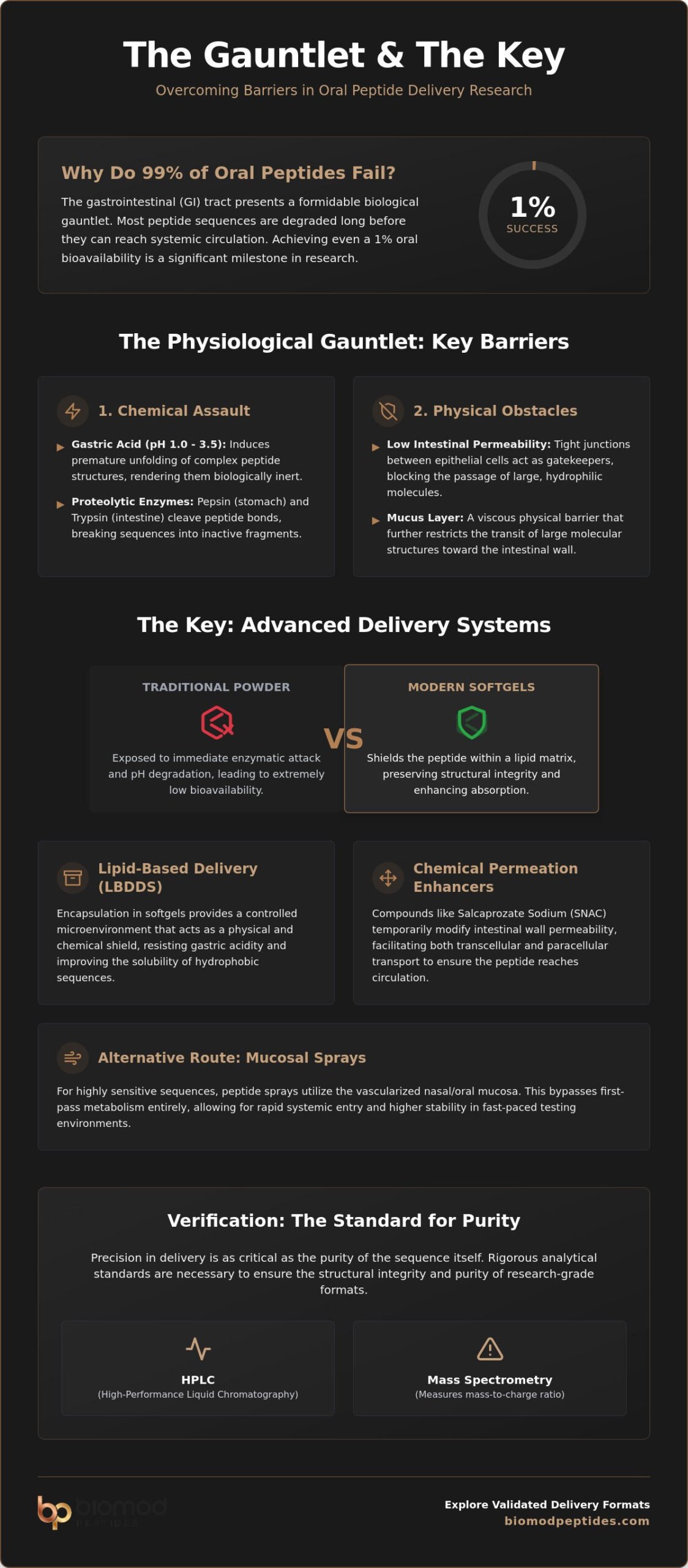
Oral peptide delivery research focuses on bypassing the harsh gastrointestinal (GI) environment to achieve systemic absorption. This field is defined by the effort to navigate a biological gauntlet designed to degrade dietary proteins. By 2026 industry standards, oral bioavailability in peptide research represents the specific percentage of an intact peptide sequence that survives first-pass metabolism to reach the systemic circulation in a bioactive state. Achieving even a 1% threshold is a significant milestone for many experimental sequences.
The primary challenge remains proteolysis. Stomach enzymes and extreme pH fluctuations act as aggressive chemical filters. Secondary obstacles include the mucus layer and epithelial cell junctions. These physical barriers restrict the transit of larger molecular structures. Understanding the mechanics of Peptide therapeutics requires a granular analysis of how these barriers function in vivo. Researchers must account for both chemical degradation and physical exclusion during laboratory modeling.
Enzymatic Degradation and pH Sensitivity
Pepsin in the stomach and trypsin in the small intestine represent the most significant enzymatic threats. These proteases target specific peptide bonds, cleaving sequences into inactive fragments. Gastric pH, which fluctuates between 1.0 and 3.5, induces premature unfolding of complex structures. This loss of secondary and tertiary conformation renders the peptide biologically inert. Researchers often employ pH buffering agents or specialized peptide softgels to maintain a localized microenvironment that resists these acidic shifts.
Intestinal Permeability and the Paracellular Path
Tight junctions between epithelial cells act as a gatekeeper for the paracellular path. Most peptides possess high molecular weights and hydrophilic profiles, making passive diffusion across lipid membranes difficult. Laboratory models frequently examine the relationship between molecular weight and permeability coefficients. As molecular weight increases, the probability of paracellular transport drops exponentially. Modern oral peptide delivery research explores carrier-mediated transport mechanisms to force peptides through these restrictive junctions without compromising cellular integrity.
Advanced Systems for Enhancing Peptide Bioavailability
Modern oral peptide delivery research has shifted toward Lipid-Based Delivery Systems (LBDDS) to mitigate the degradation issues discussed previously. These systems act as a physical and chemical shield. By pre-encapsulating the peptide in a lipid matrix, researchers can prevent direct contact between the amino acid sequence and gastric proteases. This approach significantly elevates bioavailability compared to traditional lyophilized powders, which remain exposed to immediate enzymatic attack. The latest advancements in peptide science confirm that innovative delivery formats are now replacing traditional methods as the benchmark for absorption efficiency.
Permeation enhancers are also critical components in contemporary delivery models. These compounds, including salcaprozate sodium (SNAC), temporarily modify the permeability of the intestinal epithelium. They facilitate both transcellular and paracellular transport by reducing the energetic barrier of the lipid bilayer. This dual-action strategy ensures that the peptide reaches the portal vein before enzymatic clearance occurs. For high-precision studies, selecting validated delivery formats is essential to ensure consistent pharmacokinetic data.
Peptide Softgels and Lipid-Based Carriers
Encapsulation in peptide softgels provides a controlled microenvironment that resists gastric acidity. Within these carriers, surfactants and co-solvents improve the solubility of hydrophobic sequences. This is a primary differentiator in delivery efficiency. For a detailed breakdown of performance metrics, see this comparative analysis of Peptide Softgels vs. Powder for Research. Softgels offer superior protection for sequences prone to premature unfolding. Researchers requiring rigorous dosage precision and atmospheric protection should also consult the technical evaluation of peptide softgels for research stability and precision, which addresses the variance introduced by traditional manual encapsulation methods.
Peptide Spray Products for Targeted Delivery
Mucosal absorption offers an alternative route for sequences that are particularly sensitive to GI transit. Peptide spray products utilize the high vascularization of the nasal and oral mucosa to bypass first-pass metabolism entirely. Liquid-grade formulations maintain higher stability in rapid testing environments compared to rehydrated solids. Researchers often reference standardized protocols for Intranasal Peptide Research Sprays when designing models for rapid systemic entry and bypass of the blood-brain barrier.
Analytical Standards for Oral Research Peptide Procurement
Scientific reproducibility in oral peptide delivery research depends entirely on the chemical integrity of the starting material. Procurement must go beyond basic synthesis. It requires a rigorous verification framework. US-manufactured and finished products provide the logistical transparency necessary for modern laboratory accountability. This geographic anchor ensures that finishing processes meet standardized internal benchmarks rather than opaque international norms. High-tier reliability starts with a transparent supply chain.
Every research lot undergoes High-Performance Liquid Chromatography (HPLC) and Mass Spectrometry (MS). HPLC quantifies the purity level by separating the peptide from any synthesis byproducts. MS confirms the molecular weight and identity of the sequence. These tests aren’t optional; they’re fundamental to ensuring that experimental outcomes aren’t skewed by truncated sequences or residual solvents. Third-party verification acts as the final layer of objective proof. It removes vendor bias and provides a data-driven foundation for advanced research. As outlined in the current peptide science 2026 synthesis and verification standards, 99% purity is now the minimum acceptable threshold for rigorous laboratory work. This threshold is especially critical when evaluating peptide softgels for research, where inconsistent dosing during manual filling can compound purity-related variance and undermine oral bioavailability modeling.
Verification Protocols and Quality Assurance
Utilizing a COA Verification Portal allows researchers to independently validate batch-specific data. This protocol identifies impurities that could compromise oral delivery experimental data. It’s critical to verify the structural stability of the delivery format itself, whether softgel or spray. All materials are provided under strict research-only terms. This maintains laboratory-grade integrity and ensures that reagents are utilized solely within controlled analytical environments.
Laboratory Storage and Stability for Delivery Systems
Maintaining structural integrity is a logistical priority, particularly in Las Vegas laboratory environments where temperature fluctuations can be extreme. Softgels and sprays require specific cold chain protocols to prevent lipid oxidation or peptide degradation. High-purity reagents remain sensitive to thermal stress. Cold storage at 2-8°C is standard for short-term use, while -20°C is required for long-term stability of the core sequence. Specialized delivery formats protect the peptide, but the carrier itself must remain stable to ensure consistent delivery kinetics during testing.
Advancing Precision in Oral Peptide Research Models
Effective oral peptide delivery research necessitates a transition from simple aqueous solutions to sophisticated, laboratory-grade delivery vectors. Overcoming the dual threats of enzymatic proteolysis and low intestinal permeability is critical for achieving systemic absorption. As analyzed, lipid-based carriers and chemical permeation enhancers provide the structural stability required to bypass gastric degradation. These advancements ensure that the biological activity of the peptide remains intact until it reaches the target epithelium. It’s the difference between failed transit and successful systemic entry.
Scientific progress relies on the integrity of the reagents used. Every lot must meet uncompromising analytical standards through HPLC and mass spectrometry. Utilizing US manufactured and finished products ensures logistical transparency and consistent quality control. With independent third-party testing and COA verification portal access, researchers can maintain the highest levels of scientific reproducibility. Precision in formulation leads directly to more reliable data. It’s time to refine your methodology with verified standards.
Explore Analytical Grade Peptide Softgels for Research to elevate your laboratory protocols with verified, high-purity delivery systems.
Frequently Asked Questions
What is the primary obstacle to oral peptide delivery in research?
The primary obstacle is the aggressive gastrointestinal environment, specifically proteolysis and extreme pH fluctuations. Gastric enzymes like pepsin and intestinal enzymes such as trypsin cleave peptide bonds before systemic absorption occurs. Physical barriers, including the mucus layer and tight epithelial junctions, further restrict the transit of high-molecular-weight sequences. These factors combined result in extremely low bioavailability in standard laboratory models.
How do peptide softgels improve bioavailability in laboratory models?
Peptide softgels improve bioavailability by providing a protective lipid-based matrix that shields the sequence from gastric acid and proteolytic enzymes. This encapsulation prevents premature unfolding and degradation during transit. Modern oral peptide delivery research utilizes these systems to incorporate surfactants that enhance solubility. These components facilitate more efficient transport across the intestinal epithelium, leading to consistent pharmacokinetic data in experimental settings.
Why is third-party testing critical for oral peptide delivery research?
Third-party testing is critical to ensure scientific reproducibility and the objective verification of analytical standards. Independent validation via HPLC and Mass Spectrometry confirms the purity and identity of each lot, removing manufacturer bias. Without this external documentation, impurities or truncated sequences could skew experimental results. Rigorous testing protocols provide the empirical proof necessary for high-stakes oral peptide delivery research, ensuring that laboratory outcomes are based on precise chemical profiles.
Are oral research peptides suitable for human consumption?
No, oral research peptides are strictly for laboratory use and aren’t intended for human consumption or clinical medical advice. These reagents are produced as analytical-grade materials for in vitro and in vivo research models. They lack FDA approval for therapeutic use in humans and are sold under research-only terms. Maintaining this distinction is essential for laboratory-grade integrity and compliance with institutional safety standards during experimental trials.
Disclaimer
BIOMOD products are sold strictly for laboratory, analytical, and scientific research use only. They are not intended for human or animal consumption, administration, application, ingestion, injection, or any therapeutic, diagnostic, or cosmetic use.
The statements made on this website have not been evaluated by the United States Food and Drug Administration. BIOMOD products are not intended to diagnose, treat, cure, mitigate, or prevent any disease or medical condition.
BIOMOD is a research chemical supplier. BIOMOD is not a compounding pharmacy or chemical compounding facility as defined under Section 503A of the Federal Food, Drug, and Cosmetic Act. BIOMOD is not an outsourcing facility as defined under Section 503B of the Federal Food, Drug, and Cosmetic Act.
By accessing this site, you confirm you are at least 21 years of age and that you have read and accepted the BIOMOD Terms of Sale, Privacy Policy, and Research Use Only Policy. BIOMOD does not provide dosing, medical, therapeutic, diagnostic, veterinary, or use guidance under any channel.

3 Responses