
Increasing the volume of a peptide synthesis is not a linear exercise in logistics. It is a high-stakes chemical recalibration. Most researchers recognize that micro-scale success rarely translates directly to gram-scale production without significant intervention. You understand the frustration of seeing a pristine HPLC trace at the 50mg level dissolve into a mess of truncated sequences and deletion mutations once the reactor volume expands. When scaling up peptide experiments, the physical dynamics of the resin bed and the kinetics of reagent diffusion change entirely. This technical guide provides the framework required to master this transition without compromising purity or sequence integrity.
Precision at scale is non-negotiable for analytical research. We’ll examine the critical adjustments needed for Solid-Phase Peptide Synthesis (SPPS) protocols, the mitigation of aggregation in hydrophobic sequences, and the necessity of rigorous HPLC/MS verification for larger cohorts. By refining your methodology and leveraging a stable US-based supply chain, you can ensure that your results remain reproducible even as your lot sizes grow.
Key Takeaways
- Identify sequence-specific risks that compromise yields when transitioning from micromole discovery to gram-scale analytical research.
- Establish robust protocols for scaling up peptide experiments by accounting for the unique chemical kinetics of larger production reactors.
- Implement strategic purification methods designed to mitigate the formation of deletion sequences and truncated peptides at higher volumes.
- Validate experimental results through independent third-party testing and rigorous COA verification to ensure structural integrity.
- Leverage US-manufactured supply chains to improve logistical transparency and maintain consistent timelines for domestic laboratory facilities.
The Transition to Gram-Scale: Identifying Sequence-Specific Risks
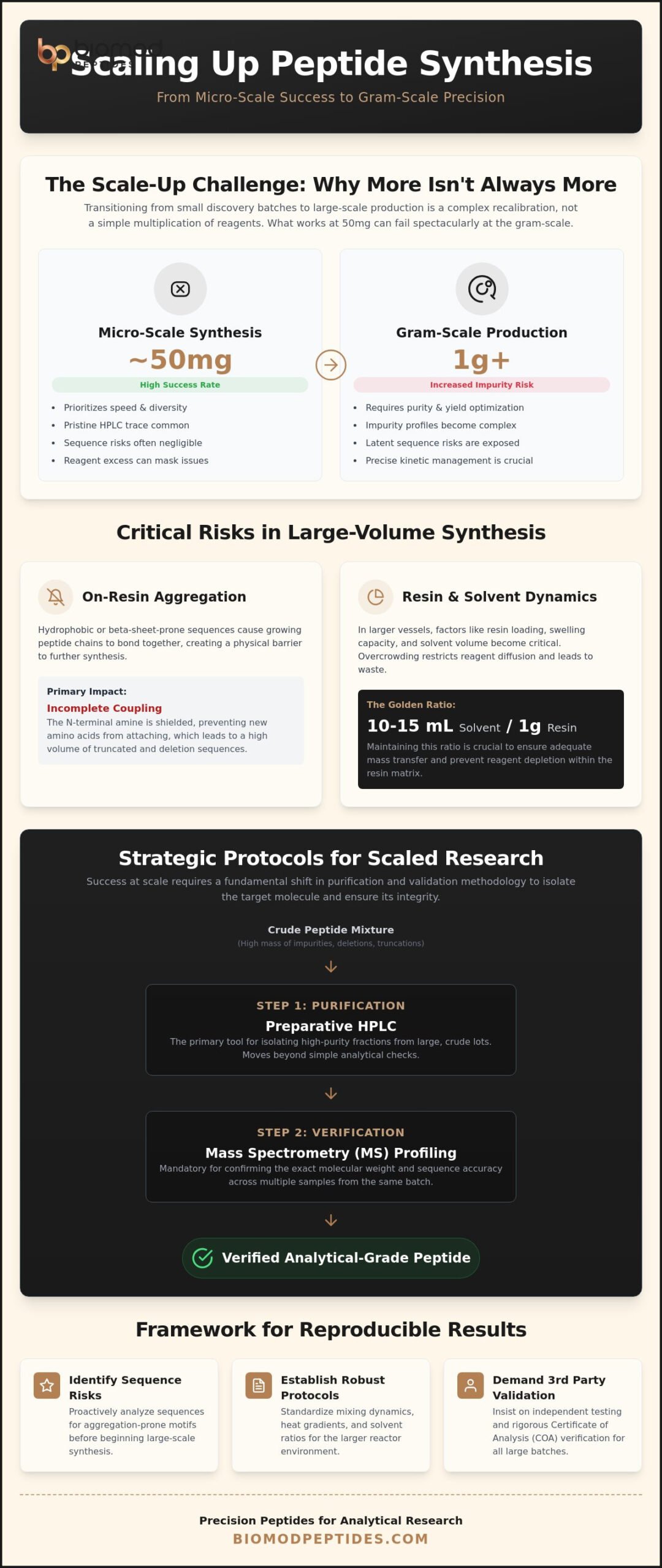
Scaling up peptide experiments demands a shift from exploratory flexibility to rigid procedural standardization. In discovery phases, researchers prioritize speed and sequence diversity over optimized yield. Moving to gram-scale analytical research changes the chemical and economic profile of the synthesis. A simple linear increase in reagent volume doesn’t guarantee a linear increase in final mass. Instead, the process uncovers latent sequence-specific risks that were negligible at the micromole level. Success at this scale relies on anticipating how molecular behavior shifts when concentration and volume expand.
Aggregation and Hydrophobic Motifs
On-resin aggregation is a primary failure mode as chain length and batch size increase. Hydrophobic stretches and beta-sheet-prone motifs trigger inter-chain hydrogen bonding. This phenomenon essentially zips the growing chains together, shielding the N-terminal amine from incoming activated amino acids. During Solid-phase peptide synthesis (SPPS), this leads to incomplete coupling and a high volume of deletion sequences. While micro-scale synthesis can sometimes overcome these barriers through extreme reagent excess, scaled experiments require precise kinetic management to maintain sequence integrity.
Resin and Solvent Dynamics
Resin loading and swelling capacity are critical variables in larger vessels. High-loading resins often lead to overcrowding within the resin bead, which restricts the diffusion of reagents as the peptide mass grows. The optimal solvent-to-resin ratio must remain consistent at approximately 10-15 mL per gram of resin to ensure adequate mass transfer and prevent reagent depletion within the resin matrix. At Biomod Peptides, we prioritize these structural benchmarks when scaling up peptide experiments to ensure that analytical grade requirements are met without the cost escalation associated with reagent waste.
Strategic Optimization of Analytical Protocols for Scaled Research
Transitioning from discovery-phase micro-scales to gram-scale production requires a fundamental shift in laboratory infrastructure. Small-flask chemistry relies on manual agitation and rapid thermal equilibration. Production reactors, however, introduce complex mixing dynamics and heat gradients. When scaling up peptide experiments, researchers must standardize these physical parameters to ensure the chemical consistency established in earlier phases. This transition is less about volume and more about the precision of the reaction environment.
Purification and Impurity Profiling
Preparative HPLC is the primary tool for isolating high-purity fractions in larger lots. While analytical HPLC suffices for micro-scale checks, scaled batches produce a higher mass of crude impurities. These often include deletion sequences and truncated peptides that share similar elution profiles with the target molecule. Effective strategies for peptide synthesis scale-up emphasize rigorous impurity profiling via mass spectrometry (MS). MS verification is mandatory for confirming sequence accuracy across multiple samples from the same lot. This ensures the entire batch meets the established peptide purity verification benchmarks required for analytical validity.
Solubility and Reconstitution at Scale
Concentrated experimental solutions frequently suffer from reduced stability and precipitation. Improving peptide solubility at scale requires precise pH adjustment and the use of specialized buffers to maintain a monomeric state. For researchers requiring consistent dosing across large cohorts, peptide softgels offer a standardized alternative to traditional benchtop reconstitution. This format bypasses the variability of manual preparation. Lyophilization also shifts from small vials to bulk processing, which requires specific shelf-loading protocols to maintain uniform moisture content. Maintaining these standards is central to the high-purity research peptides we provide for sophisticated analytical applications.
Procurement and Quality Control for Las Vegas Laboratory Facilities
Successful execution when scaling up peptide experiments requires more than chemical expertise; it demands a rigorous procurement framework. For researchers in Nevada, the transition to larger experimental cohorts introduces logistical variables that can compromise data integrity if not managed through a domestic supply chain. Maintaining Good Laboratory Practice (GLP) standards at the gram scale necessitates a move away from the opaque sourcing models common in discovery phases. Instead, analytical facilities require documented accountability and localized logistics to ensure that the transition to higher volumes remains scientifically sound.
Verification via Third-Party Testing
Internal Certificates of Analysis (COAs) are often insufficient for high-stakes scaled research. As batch sizes increase, the risk of batch-to-batch variability grows, making independent validation a mandatory checkpoint. Utilizing an external verification portal allows laboratory managers to audit raw HPLC and MS data from third-party facilities. This process ensures that every gram-scale lot adheres to strict purity benchmarks. Objective verification serves as the final safeguard against sequence errors or residual solvents that could invalidate an entire analytical cohort.
Local Supply Chain Stability
Sourcing from laboratory peptide supply providers within the United States mitigates the risks associated with international shipping and customs delays. Domestic manufacturing ensures that the time from synthesis to bench is minimized, preserving the structural integrity of temperature-sensitive sequences. “By eliminating transcontinental shipping, we reduce exposure to fluctuating temperatures, minimize cold-chain failure points, and ensure that Las Vegas facilities receive analytical-grade reagents without the degradation risks inherent in long-distance transit.” Biomod Peptides provides this level of logistical transparency, functioning as a reliable partner for researchers who prioritize sequence integrity and verifiable quality in their scaled experiments.
Achieving Analytical Precision at Scale
Successful execution when scaling up peptide experiments requires a shift from exploratory micro-scales to a disciplined, standardized methodology. Success depends on identifying sequence-specific aggregation risks before they compromise yield. It also demands optimizing purification protocols to manage the increased volume of crude impurities found in larger lots. Verification remains the essential cornerstone of this transition. Without independent third-party testing and rigorous documentation, the integrity of your analytical data remains vulnerable to batch-to-batch variability.
Biomod Peptides facilitates this transition through a commitment to structural integrity and procedural transparency. Our research peptides are US-manufactured and finished to ensure maximum stability. We provide direct access to our COA verification portal, allowing you to audit independent third-party HPLC and MS data for every batch. This level of accountability is necessary for maintaining GLP standards in sophisticated laboratory environments. Secure high-purity research peptides for your next scale-up project at Biomod Peptides to ensure your data remains reproducible and your sequences remain intact. Precision at scale is achievable with a partner focused on empirical proof.
Frequently Asked Questions
What is the primary challenge when scaling up peptide synthesis?
The primary challenge is managing the physical and chemical shifts in mass transfer and heat dissipation within the reactor. When scaling up peptide experiments, the resin bed’s expansion often leads to restricted reagent diffusion. This phenomenon triggers on-resin aggregation, particularly in hydrophobic sequences. These physical constraints make it difficult to maintain the high coupling efficiencies achieved during micro-scale discovery, necessitating precise kinetic adjustments to ensure sequence integrity.
How does batch size affect peptide purity in SPPS?
Larger batch sizes typically increase the concentration of truncated sequences and deletion mutations within the crude product. As the reactor volume expands, maintaining uniform reagent contact across the entire resin matrix becomes more complex. These inefficiencies result in a more diverse impurity profile compared to milligram lots. Rigorous analytical verification via HPLC and MS is required to ensure that the increased mass doesn’t compromise the final purity benchmarks established for the study.
Why is US-based manufacturing important for Las Vegas research labs?
US-based manufacturing is essential for Nevada facilities to ensure logistical transparency and cold-chain stability. Sourcing domestically minimizes the time peptides spend in transit, reducing the risk of thermal degradation for sensitive sequences. Localized supply chains also allow for faster turnaround times and more direct oversight of quality control protocols. This structural stability is critical for labs requiring consistent, analytical-grade reagents for large-scale research cohorts that demand long-term reproducibility.
Can I use the same purification methods for gram-scale lots as I do for milligram lots?
Standard analytical purification methods must be transitioned to preparative-scale protocols when handling gram-scale lots. While milligram scales utilize analytical HPLC for rapid verification, larger batches require preparative HPLC to effectively isolate high-purity fractions from a higher mass of crude impurities. Additionally, bulk lyophilization protocols must replace small-vial processing to ensure uniform moisture removal. These adjustments are necessary to maintain sequence integrity across the entire lot and prevent sample degradation.
Disclaimer
BIOMOD products are sold strictly for laboratory, analytical, and scientific research use only. They are not intended for human or animal consumption, administration, application, ingestion, injection, or any therapeutic, diagnostic, or cosmetic use.
The statements made on this website have not been evaluated by the United States Food and Drug Administration. BIOMOD products are not intended to diagnose, treat, cure, mitigate, or prevent any disease or medical condition.
BIOMOD is a research chemical supplier. BIOMOD is not a compounding pharmacy or chemical compounding facility as defined under Section 503A of the Federal Food, Drug, and Cosmetic Act. BIOMOD is not an outsourcing facility as defined under Section 503B of the Federal Food, Drug, and Cosmetic Act.
By accessing this site, you confirm you are at least 21 years of age and that you have read and accepted the BIOMOD Terms of Sale, Privacy Policy, and Research Use Only Policy. BIOMOD does not provide dosing, medical, therapeutic, diagnostic, veterinary, or use guidance under any channel.