
On July 31, 2026, a 100% ad valorem tariff on imported pharmaceutical ingredients will officially redefine the economics of research procurement. The debate regarding US vs international peptide suppliers has shifted from simple price comparisons to a focus on structural risk mitigation. You’ve likely faced the frustration of customs seizures or the technical uncertainty of inconsistent international batches. These variables threaten the reproducibility of your data and the long-term viability of your project timelines.
We’ve analyzed the critical differences in customs reliability, analytical standards, and procurement security to provide a clear framework for your sourcing decisions. This article breaks down how domestic cold-chain logistics and mandatory third-party HPLC/MS verification provide a level of accountability that global alternatives can’t match. You’ll learn how to secure your supply chain against upcoming regulatory shifts while ensuring every batch meets rigorous purity benchmarks. We prioritize empirical proof over marketing claims, focusing on the specific technical evidence required for precise research outcomes.
Key Takeaways
- Learn why domestic sourcing eliminates customs volatility and seizure risks by maintaining a procurement chain that avoids international border scrutiny.
- Differentiate between internal manufacturer testing and independent third-party validation to identify and avoid fraudulent international “ghost COAs.”
- Compare the logistical and analytical trade-offs of US vs international peptide suppliers to ensure long-term research reproducibility.
- Utilize a standardized procurement checklist that prioritizes domestic manufacturing, batch-specific HPLC/MS data, and secure COA verification portals.
- Analyze the technical benefits of specialized research formats, including peptide softgels and spray products, available through high-tier domestic providers.
The Logistics of Research: Why US Suppliers Eliminate Customs Risks
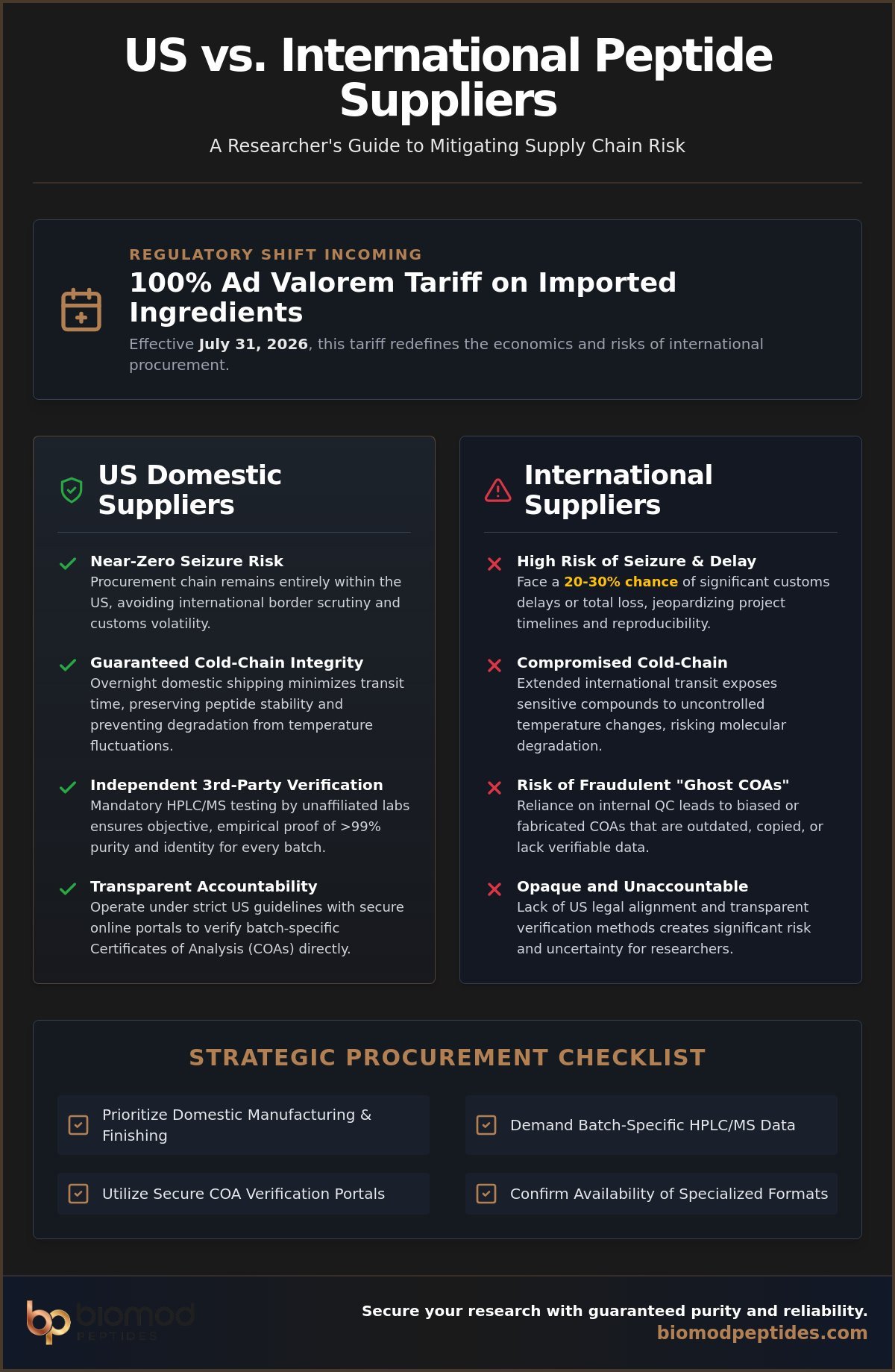
Domestic sourcing refers to the procurement of research materials that are finished, verified, and shipped entirely within the United States. This structural distinction is the primary factor in ensuring laboratory continuity. When evaluating US vs international peptide suppliers, the most immediate risk is the volatility of the border. International research shipments face unprecedented scrutiny in 2026 due to new trade proclamations and aggressive tariff structures. These regulatory shifts have increased the probability of seizure or indefinite holding at ports of entry.
The mechanism of customs volatility is often unpredictable. While a domestic shipment offers near-zero seizure risk, international imports currently face a 20% to 30% risk of significant delay or total loss. This unpredictability stems from the complex classification of laboratory reagents. Utilizing a US-based entity provides researchers with specific legal protections. Domestic providers operate under established research-only terms of sale that align with federal guidelines, ensuring that the procurement process remains transparent and legally sound.
Navigating Regulatory Alignment and Compliance
US suppliers maintain strict adherence to domestic compliance standards. This alignment provides a layer of accountability that international vendors cannot replicate. By utilizing strategic distribution hubs like Las Vegas, domestic providers can optimize the movement of materials across the country. This centralized logistics model ensures that reagents move through established, high-efficiency channels rather than getting stalled in the opaque processing centers of international couriers. It’s about precision in the supply chain.
Mitigating Lead Times and Cold-Chain Disruptions
Peptide stability depends heavily on environmental control. Extended international transit times expose lyophilized products to temperature fluctuations that can compromise structural integrity. Even with advanced peptide synthesis methods, the final product remains sensitive. Domestic procurement allows for overnight shipping, which is the gold standard for maintaining the cold chain. Short transit windows minimize the risk of degradation; ensuring that the chemical profile of the peptide remains identical from the laboratory to your facility. Reliability isn’t just about delivery; it’s about the preservation of analytical quality.
Analytical Rigor: Comparing Purity Standards in US vs. International Sources
The gap between US vs international peptide suppliers is widest in the domain of analytical verification. While international manufacturers often rely on internal quality control, US-based providers emphasize independent, third-party validation. This distinction is critical. Internal reports are subject to bias. Third-party labs provide objective empirical proof. High-Performance Liquid Chromatography (HPLC) and Mass Spectrometry (MS) are the non-negotiable tools for this process. HPLC measures purity levels by separating chemical components. MS confirms the molecular weight; ensuring the identity of the sequence is accurate.
International markets are frequently saturated with “ghost COAs.” These are fraudulent Certificates of Analysis that are either outdated, photocopied from other batches, or entirely fabricated. Identifying them requires a meticulous approach. Legitimate COAs must include a specific batch number, a recent date, and the contact information of the testing facility. Without these, the data is unverifiable. US-based finishing involves a final round of domestic testing before distribution. This acts as a secondary filter for quality.
The Role of Third-Party Verification Portals
Transparency requires structural implementation. A dedicated verification portal allows researchers to input batch numbers and retrieve original lab results directly. This system eliminates the risk of document tampering. It’s a method of cross-referencing that ensures the material in the vial matches the data on the screen. For detailed benchmarks, review the Biomod Peptides COA standards. You can view our verified catalog to see how these standards are applied in practice.
Impurity Profiles and Research Integrity
In sensitive laboratory applications, 99% purity is the standard baseline. Anything less introduces variables that can jeopardize research integrity. Impurities often include residual solvents or Trifluoroacetic acid (TFA). These contaminants can interfere with biological assays or alter experimental outcomes. Adhering to FDA guidance on synthetic peptides ensures that impurity levels remain below critical thresholds. Precision is the priority. Low-tier international batches frequently fail to meet these stringent requirements, leading to inconsistent results.
Strategic Procurement: Selecting a Reliable US Peptide Partner
Selecting a procurement partner is a foundational step in ensuring reproducible research data. The decision between US vs international peptide suppliers often determines the structural integrity of a long-term study. A rigorous evaluation checklist is necessary to mitigate risk. Prioritize suppliers that provide transparent manufacturing locations and immediate access to verification tools. The “US finished” designation serves as a primary marker for final quality control. It indicates that the material has undergone domestic lyophilization, aliquoting, and final analytical verification before it enters the supply chain.
Analytical accountability is the core of domestic procurement. Researchers should verify that a supplier offers batch-specific documentation rather than generic templates. This level of detail is essential given the evolving regulatory concerns for research peptides. Establishing a partnership with a domestic provider ensures that you have a direct line of communication for technical support and logistical troubleshooting. It’s about securing a supply chain that values empirical proof over cost-cutting measures.
Advanced Delivery Systems: Softgels and Sprays
The US market has pioneered specialized formats that enhance analytical precision. Utilizing peptide softgels for research allows for standardized dosing in specific laboratory environments where stability is paramount. Similarly, the development of peptide spray products provides a reliable method for intranasal research applications. These advanced delivery systems require sophisticated domestic finishing processes that international wholesalers often lack. They offer a tier of execution that supports complex experimental designs.
Establishing a Long-Term Research Partnership
Long-term research requires consistent material profiles. A domestic provider based in a strategic logistics hub like Las Vegas offers superior accountability and faster response times. When evaluating US vs international peptide suppliers, consider the value of technical transparency. Domestic partners operate within a clearer legal framework, providing researchers with the stability needed for multi-year projects. Choosing a US-based entity isn’t just a logistical preference. It’s a commitment to the precision and reliability of your scientific output.
Securing Analytical Integrity in Research Procurement
The shift toward domestic procurement is a strategic response to global supply chain instability. When comparing US vs international peptide suppliers, the evidence favors entities that prioritize objective verification over logistical shortcuts. Reliable data depends on structural integrity. Lyophilized purity must be confirmed through independent, batch-specific HPLC and Mass Spectrometry. These standards ensure your research remains reproducible and free from contaminants common in lower-tier international batches.
Biomod provides a rigorous infrastructure designed for high-stakes laboratory applications. Our independent third-party COA verification portal offers immediate access to empirical data for every batch. By ensuring all products are finished and shipped from the United States, we eliminate the customs risks that compromise project timelines. Our specialized softgel and spray delivery formats further advance research precision. It’s a commitment to the precision of your scientific output. Secure your research with US-finished, third-party tested peptides from Biomod. Precision in procurement is the first step toward scientific advancement.
Frequently Asked Questions
Why are international peptide shipments frequently seized by US Customs?
International shipments face increased scrutiny due to the 100% ad valorem tariff effective July 31, 2026. This mandate increases the frequency of inspections for imported pharmaceutical ingredients and research materials. Customs officials often seize shipments that lack precise documentation or those identified as bypassing regulatory frameworks. Domestic procurement avoids these international ports of entry; ensuring that materials remain within established US logistics channels without the risk of indefinite holding or loss.
Does US-manufactured always mean higher purity than international sources?
Manufacturing origin doesn’t inherently guarantee purity, but US-based finishing provides a higher tier of analytical accountability. Domestic providers operate under stringent USP rules for testing trace metals and impurities. When comparing US vs international peptide suppliers, the domestic advantage lies in mandatory third-party verification and secondary testing rounds. These protocols identify contaminants that international wholesalers might overlook. It’s about the transparency of the verification process rather than the geography of the initial synthesis.
How can I verify if a peptide supplier actually uses third-party testing?
Verification requires cross-referencing batch-specific data through a dedicated third-party portal. A legitimate supplier provides a Certificate of Analysis (COA) that includes a unique batch number and the verifiable contact information of an independent laboratory. Researchers should use these details to confirm that the HPLC and Mass Spectrometry data are authentic and current. Any supplier providing generic, redacted, or outdated documentation fails to meet the basic standards of laboratory transparency.
What are the risks of using peptides with residual solvents from international labs?
Residual solvents like acetonitrile or Trifluoroacetic acid (TFA) can trigger cytotoxic responses or interfere with sensitive biological assays. Lower-tier international labs often utilize less rigorous purification methods to reduce costs; resulting in higher impurity profiles. These contaminants introduce uncontrolled variables that can invalidate experimental data. Adhering to domestic standards ensures that impurities are identified and kept below critical thresholds, preserving the structural integrity of your research environment.
Disclaimer
BIOMOD products are sold strictly for laboratory, analytical, and scientific research use only. They are not intended for human or animal consumption, administration, application, ingestion, injection, or any therapeutic, diagnostic, or cosmetic use.
The statements made on this website have not been evaluated by the United States Food and Drug Administration. BIOMOD products are not intended to diagnose, treat, cure, mitigate, or prevent any disease or medical condition.
BIOMOD is a research chemical supplier. BIOMOD is not a compounding pharmacy or chemical compounding facility as defined under Section 503A of the Federal Food, Drug, and Cosmetic Act. BIOMOD is not an outsourcing facility as defined under Section 503B of the Federal Food, Drug, and Cosmetic Act.
By accessing this site, you confirm you are at least 21 years of age and that you have read and accepted the BIOMOD Terms of Sale, Privacy Policy, and Research Use Only Policy. BIOMOD does not provide dosing, medical, therapeutic, diagnostic, veterinary, or use guidance under any channel.