
With over 1,200 peptides currently in clinical trials as of June 2026, the margin for experimental error is effectively zero. A single impurity can invalidate months of laboratory work. You know that batch-to-batch variability isn’t just a nuisance; it’s a direct threat to the integrity of your data and the reproducibility of your findings. Relying on vague marketing labels is no longer a viable strategy for high-stakes research. Precision requires a shift toward analytical grade peptides that meet verified chemical standards.
We understand that transparent analytical documentation is the only way to mitigate the risks of impure reagents. This article provides a rigorous technical reference on the purity benchmarks and verification protocols that define modern research standards. You’ll learn how to interpret complex COA data and apply the requirements of USP <1503> and <1504> to your laboratory protocols. We’ll examine the specific criteria for HPLC verification and mass spectrometry to ensure your supply chain remains beyond reproach. By establishing a baseline of empirical proof, you can focus on the advancement of your methodology rather than the reliability of your reagents.
This technical summary defines the rigorous standards for analytical grade peptides, emphasizing the chemical benchmarks and verification protocols essential for research precision. We address the critical need for purity levels at or above 98% and the necessity of verified chemical sequences to ensure experimental reproducibility. By moving beyond marketing labels, researchers can mitigate the risks associated with batch-to-batch variability and undocumented impurities. This reference guides you through the interpretation of analytical data and the implementation of a more disciplined procurement framework. The following points summarize the procedural requirements for maintaining high-tier reliability and accountability in peptide-based research.
- Establish chemical benchmarks. Focus on ≥98% purity. Verify sequences.
- Analyze HPLC and Mass Spectrometry. Validate molecular identity. Ensure structural integrity.
- Differentiate peptide grades. Evaluate impurity profiles. Review analytical documentation.
- Standardize procurement. Use COA verification portals. Match reagents with batch data.
Defining Analytical Grade Peptides in the Research Framework
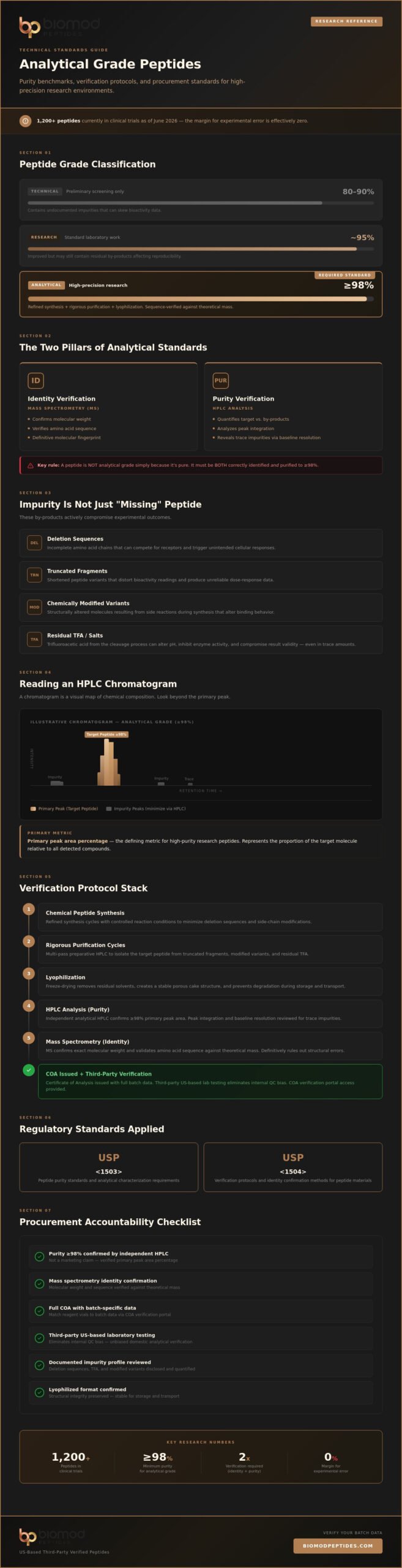
Analytical grade is a specific designation of chemical fidelity. It distinguishes itself through two non-negotiable metrics: a purity level consistently ≥98% and a sequence verified against theoretical mass. While technical or standard research grades may suffice for preliminary screening, they often harbor undocumented impurities that skew bioactivity data. Analytical grade peptides represent the baseline for high-precision laboratory environments where reproducibility is the primary objective.
The distinction between tiers rests on the impurity profile. Technical grades often contain 80-90% of the target peptide; research grades typically reach 95%. Analytical grade requires a higher tier of execution. This is achieved through refined chemical peptide synthesis and rigorous purification cycles. Following synthesis, lyophilization is employed to remove solvents and ensure structural integrity. This process creates a stable, porous cake that prevents degradation during storage and transport. For institutions like Biomod Peptides, these benchmarks aren’t optional. They’re essential for generating reliable scientific data.
Identity vs. Purity: The Two Pillars of Analytical Standards
Precision requires a dual-verification approach. Identity verification confirms the molecular weight and amino acid sequence. Mass spectrometry (MS) provides this definitive fingerprint. Conversely, purity verification quantifies the ratio of the target peptide to by-products. High-Performance Liquid Chromatography (HPLC) is the standard for this measurement. A peptide isn’t analytical grade simply because it’s pure; it must be both pure and correctly identified. Without both, analytical grade peptides cannot meet the requirements of a rigorous research framework.
The Impact of Impurity Profiles on Experimental Outcomes
Impurity isn’t just “missing” peptide. It’s the presence of deletion sequences, truncated fragments, and chemically modified variants. These by-products can compete for receptors or trigger unintended cellular responses. Residual salts or trifluoroacetic acid (TFA) from the cleavage process can also influence bioactivity. In laboratory models, even trace amounts of TFA can alter pH or inhibit enzyme activity, compromising the validity of the results. Controlling these variables is the only way to ensure that observed effects are caused by the target peptide alone.
Verification Protocols: HPLC, Mass Spectrometry, and Third-Party Standards
Purity is not a static attribute. It’s a measured state of chemical fidelity. High-Performance Liquid Chromatography (HPLC) serves as the primary tool for quantifying this state. It separates the target molecule from synthetic by-products by utilizing high pressure to pass the sample through a specialized column. Mass Spectrometry (MS) complements this by confirming the exact molecular weight and amino acid sequence. Together, these methods ensure that analytical grade peptides meet the required specifications for research integrity. Verification is the only way to transform a product claim into a scientific fact.
Relying on manufacturer-provided data introduces significant risk. Internal quality control can be subject to bias or outdated protocols. Independent third party tested peptides provide an essential layer of accountability. It validates that the product in the vial matches the data on the screen. Biomod Peptides enforces this standard by subjecting every batch to rigorous US-based analytical testing. This ensures that researchers receive materials that have been verified by unbiased, domestic laboratories. You can review our commitment to these standards by visiting our about page.
Interpreting HPLC Chromatograms for Purity Assessment
A chromatogram is a visual map of chemical composition. Researchers must look beyond the primary peak. Effective purity assessment requires analyzing peak integration and baseline resolution. These metrics reveal trace impurities that might otherwise remain hidden. The primary peak area percentage is the defining metric for high purity research peptides. It represents the proportion of the target peptide relative to all other detected substances within the sample. Researchers who need a structured methodology for interpreting these reports can consult our detailed guide on how to read a peptide certificate of analysis, which covers HPLC chromatogram analysis and mass accuracy tolerances required for modern LC-MS/MS verification.
Third-Party Accountability for Las Vegas Laboratories
Logistical transparency is a critical component of research security. Local laboratories benefit from sourcing peptides that are finished and tested within the United States. This proximity reduces the risk of degradation during transit and ensures a clear chain of custody. Specialized US laboratories provide the necessary oversight to produce verified peptide certificates of analysis. These documents serve as an objective record of quality. They allow researchers to proceed with confidence, knowing their reagents have undergone domestic verification.
Procurement and Data Integrity: Utilizing Verification Portals
The procurement process must evolve beyond the administrative act of a purchase order. In professional research, data integrity begins with a verification-first mindset. This approach treats every reagent as a variable that must be neutralized through empirical evidence. A COA Verification Portal serves as the critical link in this chain. It ensures that the batch-specific data matches the physical reagent delivered to the bench. By maintaining digital documentation and clear audit trails, institutions can safeguard the reproducibility of their findings. This level of logistical transparency is essential for high-tier laboratory operations.
Biomod Peptides facilitates this standard for Las Vegas researchers by providing accessible analytical reports. We prioritize the availability of raw data over simplified summaries. This allows for independent validation of every sample. Our system is designed to eliminate the friction between receiving a shipment and confirming its chemical fidelity.
Step-by-Step: Validating Your Peptide Batch
Precision requires active confirmation. First, locate the unique batch number printed on the vial label. Cross-reference this identifier within the COA Verification Portal to retrieve the specific analytical results for that production run. Compare the reported HPLC and MS data against your experimental requirements. Confirm that the purity percentage and molecular identity align with the standards necessary for analytical grade peptides. Discrepancies at this stage are unacceptable. They must be addressed before any laboratory protocols begin.
Long-Term Storage and Stability Protocols
Maintaining the integrity of analytical grade peptides requires strict adherence to environmental controls. Lyophilized powders are highly hygroscopic. Exposure to ambient moisture can lead to rapid enzymatic degradation or chemical hydrolysis. Always handle vials in a controlled environment to prevent condensation. Cold chain storage is mandatory. Store reagents at -20°C for short-term use or -80°C for long-term preservation. These best practices ensure that the chemical fidelity verified at the time of synthesis remains intact until the moment of reconstitution.
Advancing Research Through Empirical Verification
The path to reproducible data requires more than high-quality reagents; it demands a verifiable state of chemical precision. You’ve seen that defining analytical grade peptides involves rigorous benchmarks, specifically purity levels of 98% or higher and confirmed molecular identity. Independent third-party HPLC and mass spectrometry testing are the only ways to eliminate manufacturer bias and ensure laboratory accountability. By transitioning to a verification-first procurement model, you neutralize the variables that often compromise experimental outcomes.
Biomod Peptides provides the structural integrity your research requires. Our materials are US-manufactured and finished, ensuring logistical transparency and a clear chain of custody. Every batch is subjected to independent third-party HPLC/MS verification to provide objective proof of quality. We maintain a dedicated COA Verification Portal to deliver batch-specific data directly to your bench. Access the Biomod Peptides Verification Portal for Batch Transparency to secure the precision your methodology deserves. Your commitment to rigorous standards is the primary driver of scientific advancement.
Frequently Asked Questions
What is the difference between analytical grade and research grade peptides?
Analytical grade peptides are defined by a purity threshold of ≥98% and a confirmed molecular identity via mass spectrometry. Standard research grade materials often lack this level of stringency, sometimes permitting purity levels as low as 95%. This distinction is critical for experiments requiring high reproducibility and minimal interference from synthetic by-products. The analytical designation requires more rigorous documentation and verification than standard research grades.
How do I read a Certificate of Analysis (COA) for a research peptide?
Focus on the HPLC chromatogram and the Mass Spectrometry report provided in the documentation. The HPLC section should show a primary peak area representing at least 98% of the total integration. The MS report must confirm that the observed molecular weight matches the theoretical weight of the amino acid sequence. Always verify that the batch number on the report matches the vial in your possession to ensure data integrity. For a comprehensive breakdown of each section, our technical reference on how to read a peptide certificate of analysis provides step-by-step guidance for identifying fraudulent reports and confirming sequence verification.
Why is HPLC testing necessary if the manufacturer provides a purity guarantee?
A manufacturer’s guarantee is a commercial claim, whereas HPLC testing provides empirical evidence of chemical composition. HPLC separates the target peptide from impurities like deletion sequences or truncated fragments. This process quantifies exactly what is in the vial. It ensures that analytical grade peptides meet the required benchmarks before they reach the laboratory bench, neutralizing the risk of batch-to-batch variability.
Can analytical grade peptides be used for human consumption?
No, these materials are strictly for laboratory research and are not intended for human consumption or clinical use. Analytical grade peptides are categorized as “Research Use Only” (RUO) reagents. They lack the specific regulatory approvals and clinical-grade manufacturing oversight required for administration to humans. Using these reagents outside of a controlled laboratory environment violates safety protocols and industry standards.
How does third-party testing in the USA improve research reliability?
US-based third-party testing eliminates manufacturer bias by providing an independent layer of validation. Domestic oversight ensures that testing protocols align with high-tier industry standards. This proximity provides researchers with logistical transparency and a verifiable record of the reagent’s chemical fidelity. It minimizes the risks associated with international transit and ensures that the analytical grade peptides you receive match the documented specifications. Researchers seeking a structured audit framework can consult our verification checklist for third party tested peptides to apply laboratory-grade scrutiny to every vendor report.
What are the common impurities found in synthetic peptides?
Synthetic peptide impurities typically include deletion sequences, where amino acids are missing, and truncated peptides resulting from incomplete coupling. Residual solvents like trifluoroacetic acid (TFA) or various salts from the cleavage process can also remain in the final product. These contaminants can interfere with bioactivity and compromise the integrity of your experimental data. Identifying these profiles through mass spectrometry is essential for maintaining research precision.
Disclaimer
BIOMOD products are sold strictly for laboratory, analytical, and scientific research use only. They are not intended for human or animal consumption, administration, application, ingestion, injection, or any therapeutic, diagnostic, or cosmetic use.
The statements made on this website have not been evaluated by the United States Food and Drug Administration. BIOMOD products are not intended to diagnose, treat, cure, mitigate, or prevent any disease or medical condition.
BIOMOD is a research chemical supplier. BIOMOD is not a compounding pharmacy or chemical compounding facility as defined under Section 503A of the Federal Food, Drug, and Cosmetic Act. BIOMOD is not an outsourcing facility as defined under Section 503B of the Federal Food, Drug, and Cosmetic Act.
By accessing this site, you confirm you are at least 21 years of age and that you have read and accepted the BIOMOD Terms of Sale, Privacy Policy, and Research Use Only Policy. BIOMOD does not provide dosing, medical, therapeutic, diagnostic, veterinary, or use guidance under any channel.

3 Responses