
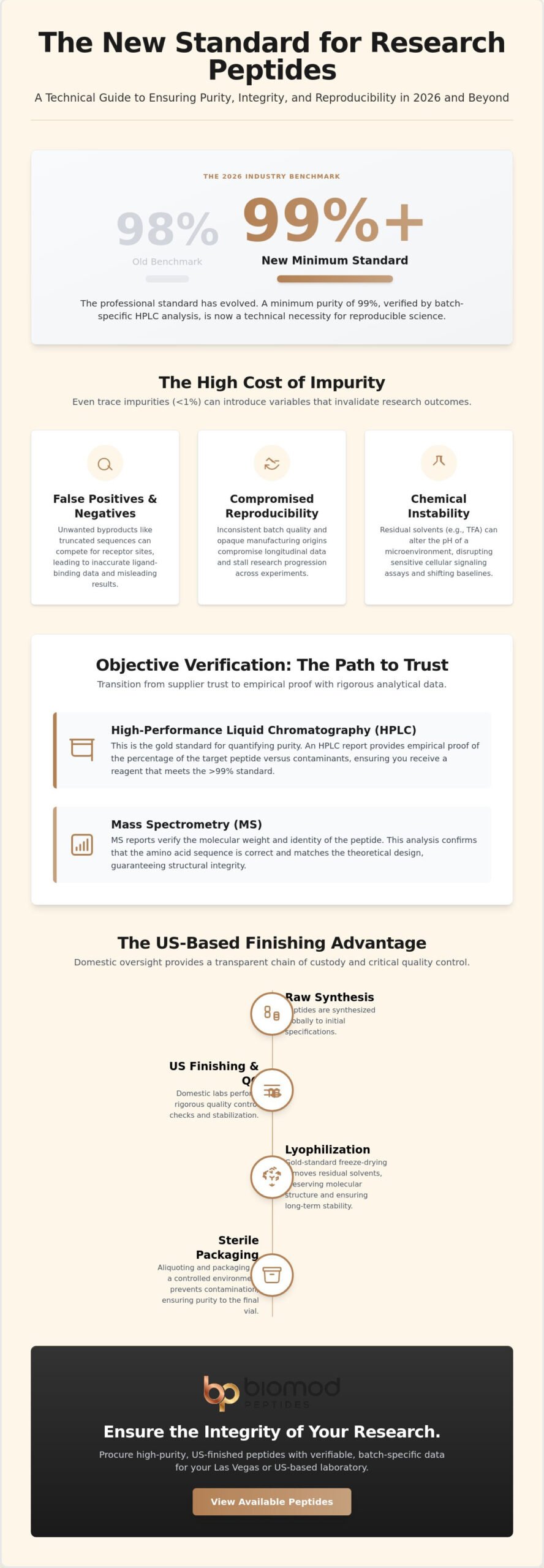
A 98% purity rating is no longer the acceptable benchmark for reproducible science. In 2026, the professional standard for high purity research peptides has moved to a minimum of 99% as verified by batch-specific HPLC analysis. Precision is a requirement, not an elective. You’ve likely faced the operational risks of inconsistent batch quality and opaque manufacturing origins. These variables compromise longitudinal data and stall research progression. Scientific integrity requires a transition from supplier trust to objective verification.
This guide serves as a technical protocol for evaluating peptide reagents through rigorous analytical verification. We provide the methodology to secure high-purity reagents and establish a disciplined supply chain for Las Vegas or US-based laboratories. We’ll analyze the necessity of verifiable HPLC and MS data, the role of US-based finishing, and the specific regulatory shifts occurring in mid-2026. The objective is total transparency through empirical proof and structural integrity. Accountability starts with the data.
Key Takeaways
- Understand why the 2026 industry benchmark for high purity research peptides has shifted to 99% and how trace impurities jeopardize experimental reproducibility.
- Evaluate the structural integrity provided by US-based finishing, including specific protocols for lyophilization and sterile packaging.
- Learn to interpret HPLC and Mass Spectrometry reports to verify peptide identity and sequence accuracy beyond surface-level claims.
- Analyze the utility of different delivery formats, such as lyophilized powders, to optimize reconstitution and titration in laboratory settings.
- Streamline procurement processes by establishing reliable supply chains with domestic providers serving Las Vegas and national research hubs.
The Critical Role of Purity in Peptide-Based Laboratory Research
Analytical chemistry defines purity as the absolute absence of contaminating species that could confound molecular interactions. In modern biochemical assays, high purity research peptides must meet a 99% threshold. This is not a marketing preference; it’s a technical necessity. Trace impurities, even at 1%, can introduce variables that render experimental data non-reproducible. When researchers utilize sub-standard reagents, they risk identifying false positives or failing to detect legitimate signaling events. Accountability in the lab starts with the chemical composition of the starting material.
Distinguishing between technical grade and analytical research grade is vital for procurement. Technical grade reagents often suffice for preliminary solubility tests or basic screening. However, sophisticated assays require analytical grade materials to ensure that the biological response observed is exclusively due to the target peptide sequence. High-purity reagents provide the structural integrity required for long-term stability and consistent titration. Using high purity research peptides ensures that the peptide’s mass and sequence are verified before the first aliquot is drawn. Precision is mandatory for any study aiming for publication in high-impact journals.
Understanding Impurity Profiles
Synthesizing these molecules involves complex Peptide Synthesis Methods that can produce unwanted byproducts. Truncated sequences, where the amino acid chain is incomplete, are common synthesis errors. These molecular mimics can compete for receptor sites, leading to inaccurate ligand-binding data. Residual solvents like trifluoroacetic acid (TFA) or acetonitrile, along with counter-ions, can alter the pH of a microenvironment. This chemical instability disrupts cellular signaling studies and shifts the baseline of sensitive assays. Identifying these profiles through High-Performance Liquid Chromatography (HPLC) is the only way to guarantee that a purity claim is empirically supported.
Research-Only Regulatory Frameworks
Maintaining compliance requires strict adherence to laboratory-use-only terms of sale. These materials are strictly for in vitro or animal model research and are never intended for human consumption. Institutional requirements often mandate specific documentation, including batch-specific HPLC and MS reports, to satisfy internal quality control audits. There’s a clear distinction between clinical-grade peptides, manufactured under cGMP for human trials, and research-grade materials designed for discovery and validation. By prioritizing transparent documentation and verifiable COAs, laboratories in Las Vegas and across the US can ensure their procurement processes meet the rigorous standards of modern science. Data integrity depends on this level of logistical transparency.
The precision required for laboratory research often parallels the high standards found in clinical aesthetics. For instance, when individuals explore Laser Tattoo Removal at Organic Skin & Body Med Spa, they rely on medical-grade technology and expertise to achieve safe and effective results.
US-Based Manufacturing and Finishing: Ensuring Structural Integrity
Domestic oversight is the primary safeguard against the degradation of high purity research peptides. While global synthesis remains common, the finishing process determines the final reagent quality. US-based finishing provides a transparent chain of custody. It allows for rigorous quality control checkpoints that international suppliers often bypass. Structural integrity is not a suggestion; it’s a requirement for valid scientific inquiry. Verification occurs at every stage of the finishing lifecycle. This ensures the primary sequence matches the theoretical design exactly.
The transition from raw synthesis to laboratory-ready reagent involves critical chemical stabilization. Lyophilization is the gold standard for this process. It removes residual solvents through sublimation under vacuum, preserving the peptide’s molecular structure. Improper finishing leads to deamidation or oxidation. These chemical shifts render the peptide useless for sensitive assays. Adhering to FDA Guidance on Peptide Impurities regarding the identification of related substances is essential for maintaining analytical standards. Precision in the finishing lab translates to precision in your data.
The Biomod Peptides Manufacturing Standard
Our standardized protocols prioritize batch-to-batch consistency. Every vial undergoes sterile packaging within a controlled environment to prevent environmental contamination. Aliquoting is performed with calibrated instrumentation to ensure exact mass delivery. We maintain strict internal benchmarks for moisture content and residual counter-ions. This methodical approach eliminates the variability common in retail-grade supplies. Researchers can verify these standards through the Biomod Peptides documentation portal. Accountability is built into the workflow.
Cold Chain Logistics and Storage
Peptide stability is highly dependent on thermal management. Cold chain logistics are mandatory for maintaining the potency of high purity research peptides from the facility to the lab. Exposure to ambient temperatures during transit can trigger rapid degradation of fragile amino acid chains. Biomod Peptides utilizes validated temperature-controlled shipping containers to mitigate this risk. Once received, laboratory storage at -20°C or -80°C is recommended for long-term preservation. Lyophilized powders offer superior shelf-life compared to liquid formulations, which are prone to hydrolysis. Proper handling is as critical as the synthesis itself. Protect your reagents to protect your research outcomes.
Comparative Analysis of Research Peptide Delivery Formats
Experimental design dictates the optimal reagent format. While lyophilized powder remains the baseline for biochemical assays, the diversification of delivery systems allows for more sophisticated modeling. High purity research peptides must maintain their structural integrity regardless of the delivery vehicle. Selecting the correct format is a technical decision that impacts both the stability of the compound and the accuracy of the resulting data. Each format serves a distinct analytical purpose in the laboratory.
Beyond chemical delivery formats, researchers are also incorporating advanced hardware into their experimental designs. For instance, the Lampa na Podczerwień MOVE+ Pro is utilized in studies investigating the synergistic effects of light therapy and peptide-based interventions on tissue recovery. Such tools allow for a multi-modal approach to observing biological responses.
Lyophilized powders are the traditional standard for a reason. They offer the highest level of molecular stability and allow researchers total control over reconstitution buffers and final concentrations. This format is essential for precise titration and longitudinal studies where shelf-life is a primary concern. However, researchers are increasingly utilizing specialized formats to simulate specific physiological environments or to streamline high-throughput workflows. The transition from powder to specialized formats requires rigorous verification to ensure that the active peptide sequence remains unaltered during the formulation process.
Peptide Softgels in Laboratory Use
Peptide softgels represent a significant advancement for oral delivery model simulations. This format utilizes a protective lipid or polymer matrix to shield high purity research peptides from enzymatic degradation in vitro. In high-throughput research settings, softgels provide a precision dosing advantage. They eliminate the variability associated with manual encapsulation or liquid measurement. This standardization is vital for observing dose-response relationships in simulated gastrointestinal environments. Softgels often exhibit superior stability compared to traditional hard-shell capsules, which are more susceptible to moisture ingress and oxidation.
Analytical Utility of Research Sprays
Peptide spray products are engineered for research involving localized biochemical applications, particularly in intranasal delivery models. These systems require a uniform distribution of the peptide within a liquid reagent to ensure consistent concentration across every actuation. Achieving this level of homogeneity is a complex technical challenge. It requires precise solubility management and the use of stabilized buffers. Biomod Peptides utilizes standardized spray delivery systems that are calibrated for volume accuracy. This ensures that the delivery mechanism doesn’t introduce mechanical stress that could denature the peptide chain. Standardized sprays from Biomod Peptides allow for reproducible data in models where traditional injection or oral dosing is inapplicable.
Quantitative Verification: Navigating HPLC and Mass Spectrometry Reports
High-Performance Liquid Chromatography (HPLC) remains the definitive analytical method for determining the purity of high purity research peptides. It operates by separating molecular components within a sample based on their interaction with a stationary phase. The resulting chromatogram provides a visual and quantitative representation of the sample’s composition. A singular, sharp peak indicates a homogeneous product. Conversely, secondary peaks or excessive baseline noise reveal the presence of synthesis byproducts or residual contaminants. High-stakes research demands that these reports are not just available but are meticulously scrutinized for baseline stability. Accountability is impossible without raw data.
Mass Spectrometry (MS) serves as the necessary counter-verification for HPLC data. While HPLC confirms the quantity of the main component, MS confirms its chemical identity. It evaluates the molecular weight of the peptide by measuring the mass-to-charge ratios of its ions. Discrepancy between the theoretical mass and the observed primary peak indicates sequence errors or structural degradation. Independent third-party testing adds a layer of objective accountability. It removes the conflict of interest inherent in self-reported data from unverified international suppliers. Data integrity is the only metric that matters in a laboratory setting.
Utilizing the COA Verification Portal
Accessing batch-specific data is streamlined through the Biomod Peptides verification portal. Researchers can correlate the batch numbers printed on physical vials directly with digital certificates of analysis. This process involves entering the unique identifier into the portal to retrieve the latest HPLC and MS reports. Real-time access is critical for institutional lab audits and ensuring that the reagents meet internal quality benchmarks before experimentation begins. You can access the COA Verification Portal to validate the analytical data for your current inventory. Transparency is the only way to ensure high purity research peptides meet their stated specifications.
Interpreting Mass Spectrometry Data
Confirming the identity of a synthesized peptide requires an analysis of mass-to-charge (m/z) ratios. The primary peak in an MS report should correspond to the calculated molecular weight of the target sequence. Minor peaks may represent salt adducts or naturally occurring isotopes; however, significant deviations suggest an incorrect amino acid sequence. Mass Spectrometry is the essential tool for molecular weight verification in peptide synthesis. Understanding the significance of the primary peak ensures that the researcher is working with the intended molecular structure. Structural accuracy is the foundation of chemical reproducibility.
Procuring High Purity Research Peptides in Las Vegas and the USA
Las Vegas has emerged as a critical hub for biotechnological advancement and clinical research. For local institutions, the procurement of high purity research peptides is no longer a matter of international guesswork. Utilizing a domestic supply chain offers a strategic advantage in oversight and logistical speed. Reduced transit times directly correlate with improved reagent stability. When a lab avoids the thermal stress of transoceanic shipping, the structural integrity of the peptide is preserved. Partnering with a provider that understands the specific needs of Nevada’s high-throughput facilities ensures that research timelines remain uninterrupted. Accountability is a logistical reality verified through a domestic presence.
Streamlining procurement for academic and private research institutions requires a transition to more disciplined supply models. Long-term study consistency depends on single-batch supply. Variability between synthesis lots can introduce subtle shifts in experimental baselines, often leading to data discrepancies that are difficult to isolate. By securing bulk lots from a single, verified production run, researchers eliminate these variables. A US-based provider offers the technical support required to manage these complex procurement schedules and provides a direct point of contact for sequence-specific inquiries. Precision in procurement is the first step toward precision in results.
Supporting the Las Vegas Research Community
Logistical efficiency is paramount for private and academic labs in the Southwest. Biomod Peptides serves as a reliable local partner for scientific reagents, offering custom procurement solutions tailored to high-volume users. We prioritize the Nevada research ecosystem by providing rapid delivery and enhanced stability through localized finishing. This regional focus minimizes the risks associated with long-distance logistics. Our approach ensures that high purity research peptides reach your bench without compromising the analytical standards established during synthesis. We understand the unique environmental challenges of the region and utilize validated thermal packaging to maintain cold chain integrity during the final mile of delivery.
Establishing a Secure Supply Chain
National research security begins with a transparent vendor network. Evaluating a supplier requires more than a review of their catalogue; it requires an assessment of their testing protocols and manufacturing transparency. US-manufactured products provide a layer of protection against the supply chain disruptions and quality variances common in the global market. Integrating a disciplined provider into your workflow is the final step in securing your data integrity. To begin this process, you may Review the Biomod Peptides Research Catalogue to evaluate our available sequences and delivery formats. Establishing a reliable supply chain is a prerequisite for sophisticated scientific discovery. Data integrity is non-negotiable.
Standardizing Scientific Integrity through Empirical Verification
Experimental precision depends on the structural integrity of your reagents. In 2026, the 99% purity threshold is the baseline for credible discovery. This standard is maintained through a disciplined combination of US-based manufacturing and finishing and rigorous analytical oversight. By prioritizing high purity research peptides, laboratories eliminate the chemical variables that compromise longitudinal data. Accountability is no longer a matter of supplier trust; it’s a result of objective documentation.
Scientific momentum requires a supply chain built on transparency. Every batch must undergo independent third-party testing to confirm sequence accuracy and molecular weight. Real-time COA verification portal access allows for immediate, audit-ready documentation. This methodology ensures that your focus remains on the research, not the reagent quality. We invite you to Explore Verified Research Peptides at Biomod Peptides and integrate these rigorous standards into your next experimental phase. Secure your data with the weight of empirical proof.
Frequently Asked Questions
What defines high purity research peptides in a laboratory setting?
In analytical chemistry, high purity research peptides are defined by a minimum purity threshold of 99% as verified by High-Performance Liquid Chromatography (HPLC). This standard ensures that experimental results aren’t confounded by truncated sequences or residual synthesis solvents. Reaching this level of refinement is essential for maintaining data integrity in sensitive biochemical assays.
Purity below this benchmark can lead to non-reproducible outcomes. It’s critical to distinguish between technical grade reagents and analytical research grade materials to prevent false positives in ligand-binding studies.
How do I use the COA Verification Portal to check my batch results?
You can access batch-specific data by entering the unique identifier found on your physical product into the Biomod verification portal. This system retrieves the original HPLC and Mass Spectrometry reports associated with that specific production run. It’s a direct method for correlating the reagent in your hand with its analytical profile.
Real-time access is vital for institutional audits and internal quality control. Digital certificates provide a permanent record of structural integrity for your laboratory’s documentation.
Are these peptides manufactured in the United States?
Yes, all finishing and analytical verification processes occur within our US-based facilities. While raw synthesis components may be sourced globally, the critical stages of lyophilization, aliquoting, and sterile packaging are anchored in the United States. This domestic oversight ensures a transparent chain of custody and rigorous quality control.
Can these research peptides be used for human consumption?
No. These products are strictly for laboratory research use only and are never intended for human or animal consumption. They haven’t been evaluated by the FDA for safety or efficacy in humans. Adhering to these research-only terms is mandatory for maintaining institutional compliance and legal standing.
What is the difference between peptide softgels and lyophilized powder for research?
Lyophilized powder is the traditional standard for research, offering maximum stability and flexibility for custom reconstitution and titration. It’s preferred for assays requiring specific buffer concentrations. In contrast, peptide softgels are designed for oral delivery model simulations, protecting high purity research peptides from enzymatic degradation in vitro.
Softgels provide a precision dosing advantage in high-throughput settings. They eliminate the variability of manual measurement during experimental modeling of gastrointestinal environments.
How should I store my research peptides to ensure maximum stability?
Store your peptides at -20°C for short-term use or -80°C for long-term preservation to prevent molecular degradation. Keeping them in a desiccated environment is equally important to avoid moisture ingress, which can trigger hydrolysis. Lyophilized powders are particularly sensitive to temperature fluctuations during storage.
Always minimize freeze-thaw cycles. Aliquoting the peptide into single-use quantities upon first reconstitution is a best practice for maintaining structural integrity throughout your study.
Why is third-party testing necessary if the manufacturer provides a COA?
Independent third-party testing provides an objective layer of accountability that eliminates the inherent conflict of interest in self-reported data. It ensures that the purity and identity claims are verified against external laboratory standards. This secondary validation is a prerequisite for high-stakes research where chemical accuracy is non-negotiable.
What delivery formats does Biomod Peptides offer for laboratory use?
Biomod Peptides provides three primary delivery formats: Research Peptides in lyophilized powder vials, Peptide Softgels for oral delivery simulations, and Peptide Spray Products for intranasal research models. Each format is finished in the US to ensure batch-to-batch consistency. All products are accessible through our COA Verification Portal for analytical confirmation.
Disclaimer
BIOMOD products are sold strictly for laboratory, analytical, and scientific research use only. They are not intended for human or animal consumption, administration, application, ingestion, injection, or any therapeutic, diagnostic, or cosmetic use.
The statements made on this website have not been evaluated by the United States Food and Drug Administration. BIOMOD products are not intended to diagnose, treat, cure, mitigate, or prevent any disease or medical condition.
BIOMOD is a research chemical supplier. BIOMOD is not a compounding pharmacy or chemical compounding facility as defined under Section 503A of the Federal Food, Drug, and Cosmetic Act. BIOMOD is not an outsourcing facility as defined under Section 503B of the Federal Food, Drug, and Cosmetic Act.
By accessing this site, you confirm you are at least 21 years of age and that you have read and accepted the BIOMOD Terms of Sale, Privacy Policy, and Research Use Only Policy. BIOMOD does not provide dosing, medical, therapeutic, diagnostic, veterinary, or use guidance under any channel.

65 Responses