
A deviation in your assay results isn’t a failure; it’s a data point. When findings contradict a Certificate of Analysis, the immediate challenge lies in interpreting unexpected results in peptide studies without draining laboratory resources. Most researchers have faced the frustration of inconsistent data while questioning if the issue resides in the reagent purity, the reconstitution protocol, or the analytical method itself. It’s a common bottleneck that stalls momentum and compromises study integrity.
This article provides the clinical framework required to diagnose these anomalies with precision. You’ll gain a systematic checklist to isolate variables and identify common synthetic impurities. We also establish a protocol for secondary verification that aligns with the 2026 FDA updates regarding peptide bioequivalence and structural assessment. You’ll move beyond troubleshooting toward a disciplined methodology for validating every result.
Key Takeaways
- Define specific analytical benchmarks by auditing HPLC and Mass Spectrometry data against theoretical mass and a 98% purity threshold.
- Evaluate the impact of Trifluoroacetic Acid (TFA) salts on net peptide content to prevent data variance during biological assays.
- Master a clinical framework for interpreting unexpected results in peptide studies by isolating variables in reconstitution protocols and storage temperatures.
- Leverage independent third-party verification and US-based manufacturing to eliminate vendor bias and ensure structural integrity in every research lot.
Dissecting Analytical Discrepancies: HPLC and Mass Spectrometry Audits
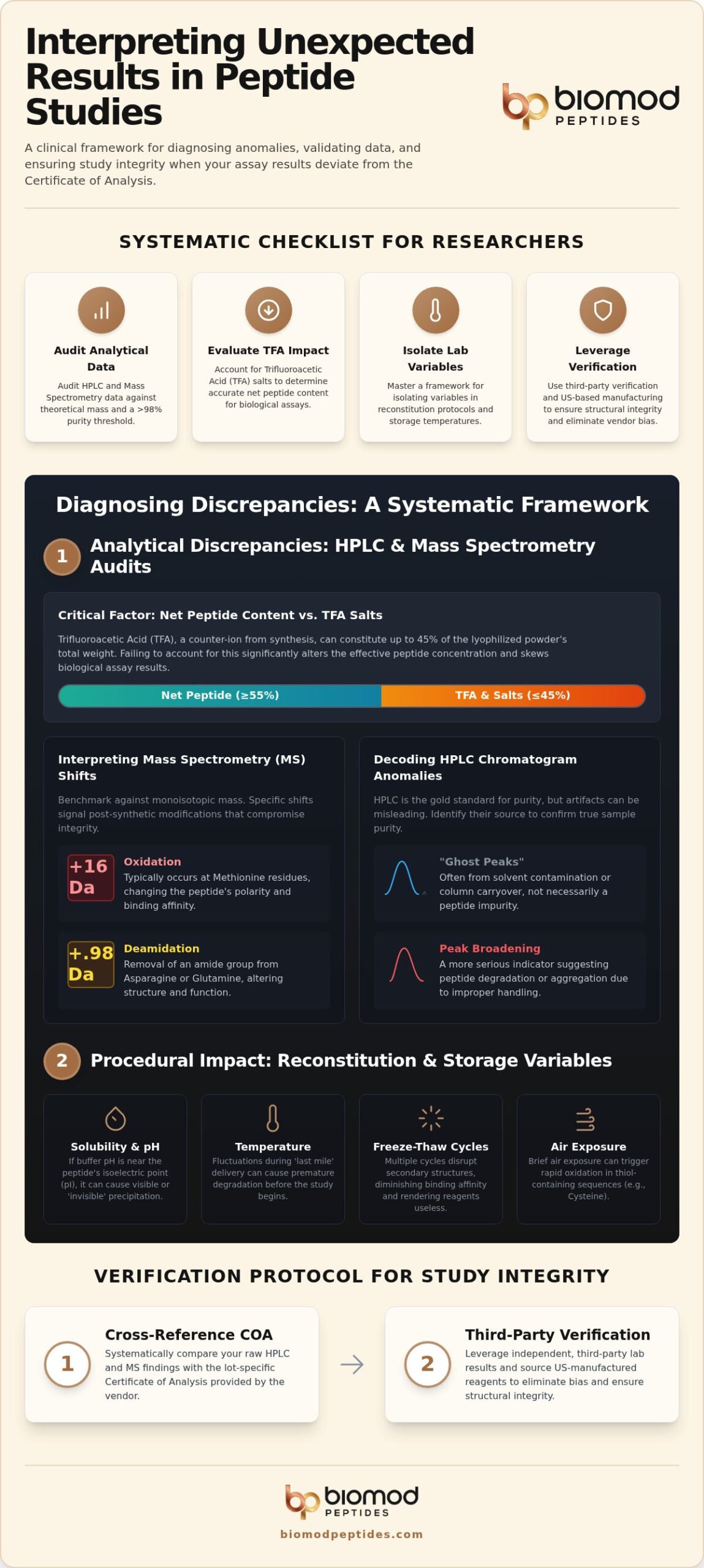
Precise data begins with a rigorous audit of the reagent’s chemical signature. In the context of interpreting unexpected results in peptide studies, an anomaly is defined as any deviation from the theoretical mass or a failure to meet the expected purity threshold of 98%. These discrepancies often stem from synthetic artifacts, such as truncated sequences where the chain fails to reach full length, or deprotection failures where side-chain protecting groups remain attached. Researchers must also quantify the impact of Trifluoroacetic Acid (TFA) salts. TFA is a common counter-ion used during solid-phase synthesis. It can constitute up to 45% of the total lyophilized weight, which significantly alters the actual net peptide content and can skew the results of biological assays if not accounted for during concentration calculations.
Interpreting Mass Spectrometry (MS) Shifts
Accurate identification requires a clear distinction between monoisotopic mass and average mass in analytical reports. Monoisotopic mass, calculated using the most abundant isotope of each element, is the benchmark for high-resolution MS. Average mass accounts for the weighted average of all natural isotopes. Specific mass shifts often signal post-synthetic modifications that compromise study integrity. A +16 Da shift typically indicates oxidation, frequently occurring at Methionine residues. A +0.98 Da shift suggests deamidation, a process where an amide group is removed from Asparagine or Glutamine. These shifts change the peptide’s polarity and binding affinity, leading to inconclusive data.
HPLC Chromatogram Anomalies
High-performance liquid chromatography (HPLC) is the standard for determining chemical purity. However, chromatogram artifacts can be misleading. “Ghost peaks” are often the result of solvent contamination or column carryover from previous analytical runs rather than impurities within the peptide itself. Peak broadening is a more serious indicator, often suggesting peptide degradation or aggregation triggered by improper handling. To maintain accountability, researchers should use the COA verification portal to cross-reference their raw findings with lot-specific data. This systematic comparison is the first step in interpreting unexpected results in peptide studies and ensuring the structural integrity of the research material.
Evaluating Procedural Impact: Reconstitution and Storage Variables
Procedural errors at the benchtop are frequently the root cause when interpreting unexpected results in peptide studies. Laboratory protocols must begin with a systematic audit of peptide reconstitution for research. Inconsistent dissolution often mirrors the complexities outlined in Regulatory Guidelines for the Analysis of Therapeutic Peptides, which emphasize that structural integrity is sensitive to solvent choice and handling. Beyond the lab, temperature fluctuations during the ‘last mile’ of delivery can induce premature degradation. Peptides are also vulnerable to multiple freeze-thaw cycles. These cycles disrupt secondary structures and diminish binding affinity, rendering the reagent useless for high-precision assays. For thiol-containing sequences like Cysteine, even brief air exposure triggers rapid oxidation, fundamentally altering the peptide’s chemical profile before the study begins.
Solubility and pH-Induced Precipitation
Selecting the correct diluent requires knowledge of the peptide’s isoelectric point (pI). If the buffer pH nears the pI, the peptide’s net charge becomes zero, leading to immediate precipitation. Researchers must also account for ‘invisible’ precipitation. In these instances, the peptide remains suspended in the solution but becomes biologically inactive or forms sub-visible aggregates. This phenomenon causes a significant drop in effective concentration, leading to the variance often seen when interpreting unexpected results in peptide studies.
Formulation Variables: Softgels and Sprays
Advanced delivery formats introduce unique analytical variables. When using peptide softgels for research, the interaction between the peptide and the lipid-based delivery matrix must be quantified. Sequestration within the lipid phase can delay release or alter bioavailability. Similarly, liquid peptide research sprays require troubleshooting for concentration consistency and plume geometry. Variations in mechanical force or nozzle design can impact the delivered dose per actuation. For researchers seeking high-tier reliability, starting with US-manufactured reagents ensures that these formulation variables are standardized from the point of origin.
Verification Protocols: Leveraging Third-Party Documentation
Establishing a “verification-first” workflow is essential for interpreting unexpected results in peptide studies. Relying solely on internal vendor data introduces systemic bias and increases the probability of experimental failure. Independent third-party testing serves as the ultimate safeguard. It provides an objective validation that the reagent meets the stringent chemical specifications required for high-resolution assays. Documenting the complete chain of custody for high purity research peptides ensures that analytical integrity remains intact from synthesis to the laboratory bench.
The Role of US-Based Quality Assurance
US-based manufacturing and finishing provide a level of traceability that overseas bulk synthesis can’t match. Domestic standards significantly reduce the risk of cross-contamination between different peptide lots. For laboratories in Las Vegas and other domestic research hubs, this logistical transparency is a critical asset. Overseas synthesis frequently lacks the granular documentation required for effective troubleshooting. US facilities maintain detailed records of purification and finishing steps, enabling a more precise methodology when interpreting unexpected results in peptide studies.
Building a Quality Control Workflow
A robust quality control workflow begins with a rigorous inspection of the incoming reagent. Researchers must verify the physical state and seal integrity of every vial before use. Integrate analytical grade peptide standards into every experimental design to establish a reliable baseline. These standards are typically validated through HPLC peptide analysis methods, which help isolate reagent-specific variables from procedural errors. This systematic approach ensures that every data point is supported by empirical proof.
Refining Analytical Precision in Peptide Research
Success in the laboratory depends on the ability to distinguish between reagent impurities and procedural artifacts. By auditing HPLC chromatograms for ghost peaks and strictly managing reconstitution pH, researchers eliminate the variables that complicate interpreting unexpected results in peptide studies. Verification isn’t a secondary step. It’s the foundation of empirical integrity. Moving from inconclusive data to validated outcomes requires a disciplined workflow that prioritizes high-resolution documentation and structural accountability.
Biomod Peptides provides the technical benchmarks necessary for sophisticated research environments. Every lot is US-manufactured and finished in our Las Vegas labs to ensure maximum traceability. We eliminate vendor bias through independent third-party testing and provide immediate access to data via our transparent COA verification portal. Secure High-Purity Reagents for Your Next Study at Biomod Peptides and establish a new standard for analytical reliability. Your research demands precision. We deliver it.
Frequently Asked Questions
What should I do if the measured mass of my peptide is 18 Daltons lower than expected?
A mass loss of 18 Daltons typically indicates the loss of a water molecule through internal cyclization. This chemical reaction often occurs at Aspartic acid or Glutamic acid residues, resulting in the formation of a succinimide or lactam ring. It’s a common synthetic artifact that fundamentally alters the peptide’s structural conformation and biological activity. Researchers must audit the synthesis report for these specific residues to determine if the peptide has undergone unplanned modification during finishing.
How do impurities in synthetic peptides affect binding affinity studies?
Synthetic impurities significantly skew binding affinity data by acting as competitive inhibitors for target receptors. Truncated sequences or peptides with residual protecting groups may occupy binding sites without triggering the intended biological response. This interference leads to an artificial increase in the dissociation constant (Kd). Maintaining a strict 98% purity threshold is essential when interpreting unexpected results in peptide studies to ensure that observed interactions represent the target sequence alone.
Can the choice of reconstitution buffer cause a peptide to appear inactive?
An incorrect reconstitution buffer can render a peptide biologically inactive by triggering sub-visible aggregation. If the buffer pH is too close to the peptide’s isoelectric point (pI), the molecule loses its net charge and precipitates. While the solution may appear clear to the naked eye, the formation of these aggregates prevents the peptide from successfully binding to its target. It’s vital to cross-reference the sequence’s pI before selecting a diluent to ensure monomeric stability.
Why is third-party testing more reliable than in-house manufacturer reports?
Independent third-party testing provides an objective layer of verification that eliminates the inherent conflict of interest found in manufacturer reports. Third-party laboratories utilize standardized protocols to validate purity and mass without vendor bias. This external documentation is a primary tool for interpreting unexpected results in peptide studies. It ensures that the reagent’s chemical signature matches the provided specifications. Relying on external validation provides the accountability required for high-precision laboratory research.
Disclaimer
BIOMOD products are sold strictly for laboratory, analytical, and scientific research use only. They are not intended for human or animal consumption, administration, application, ingestion, injection, or any therapeutic, diagnostic, or cosmetic use.
The statements made on this website have not been evaluated by the United States Food and Drug Administration. BIOMOD products are not intended to diagnose, treat, cure, mitigate, or prevent any disease or medical condition.
BIOMOD is a research chemical supplier. BIOMOD is not a compounding pharmacy or chemical compounding facility as defined under Section 503A of the Federal Food, Drug, and Cosmetic Act. BIOMOD is not an outsourcing facility as defined under Section 503B of the Federal Food, Drug, and Cosmetic Act.
By accessing this site, you confirm you are at least 21 years of age and that you have read and accepted the BIOMOD Terms of Sale, Privacy Policy, and Research Use Only Policy. BIOMOD does not provide dosing, medical, therapeutic, diagnostic, veterinary, or use guidance under any channel.