
Why does up to 99% of an oral peptide dose fail to reach its target? While the oral protein market is projected to reach $47.63 billion by 2035, the biological reality remains a significant hurdle. Addressing the challenges in oral peptide research requires a precise understanding of the barriers that limit bioavailability to a mere 1% to 5%. The scientific community recognizes that rapid enzymatic degradation and poor intestinal permeability frequently compromise reagent stability and research outcomes. These physiological factors demand a move toward more sophisticated delivery methodologies.
This article analyzes the primary physiological and chemical hurdles in oral peptide delivery and explores the formulation strategies used to maintain research integrity. We’ll examine the specific mechanisms of peptide degradation and identify how advanced formats like softgels bypass gastric barriers. This technical overview provides the data-driven foundation necessary to source high-purity reagents optimized for oral research applications.
Key Takeaways
- Identify the specific mechanisms of gastric acidity and enzymatic proteolysis that trigger rapid peptide denaturation during delivery.
- Evaluate the efficacy of permeation enhancers and enzyme inhibitors in protecting peptide bonds and facilitating intestinal absorption.
- Understand the primary challenges in oral peptide research and how innovative formats like softgels improve bioavailability.
- Master the analytical standards required for research, including the use of HPLC and Mass Spectrometry to verify sequence purity.
- Learn how to utilize third-party COA verification portals to manage impurity profiles and ensure the integrity of laboratory reagents.
Physiological and Chemical Barriers in Oral Peptide Delivery
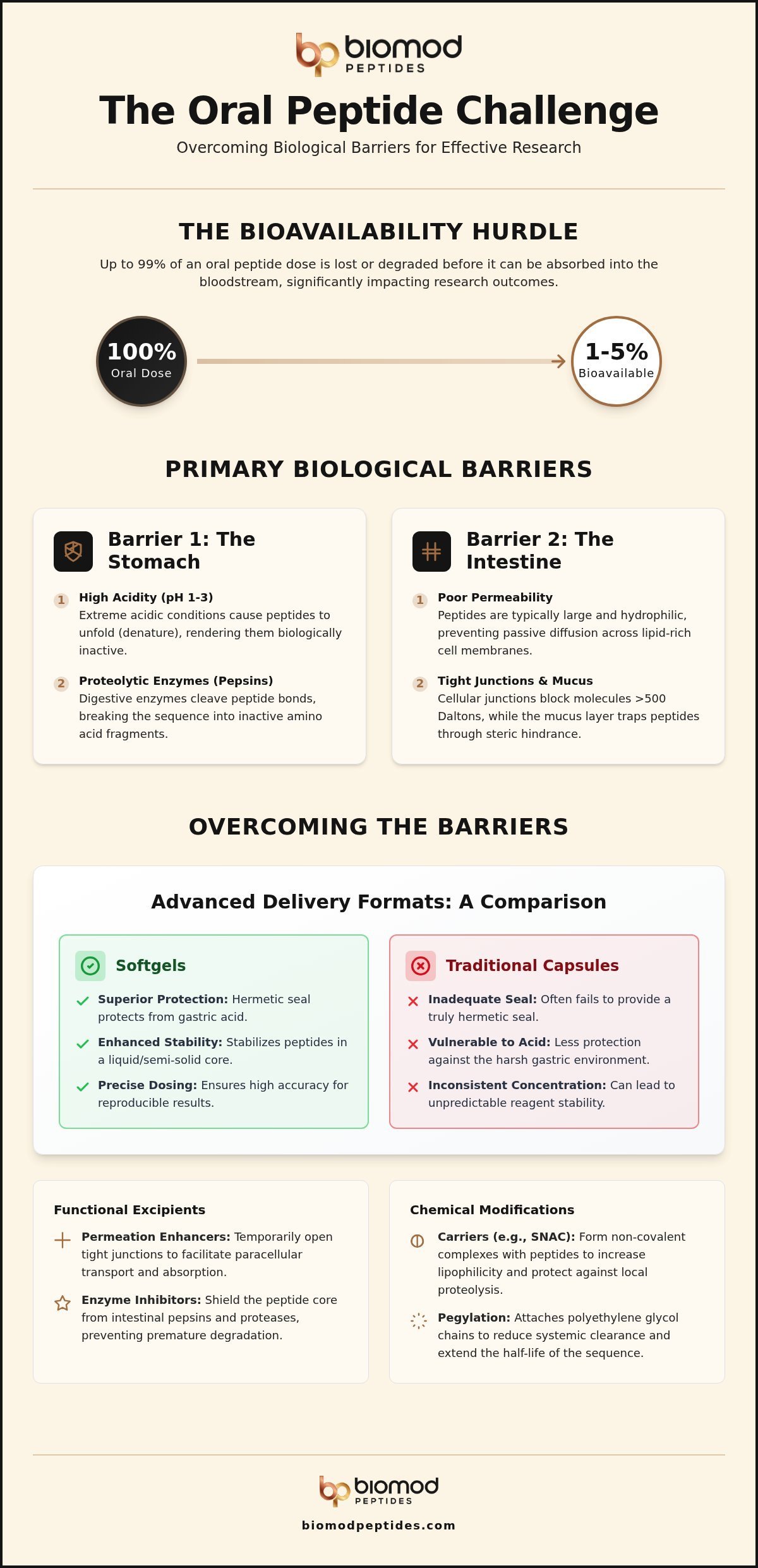
The gastrointestinal tract is a hostile environment for exogenous proteins. High acidity in the stomach, typically maintaining a pH between 1 and 3, triggers immediate denaturation of peptide secondary and tertiary structures. This structural collapse renders the molecule biologically inactive before it reaches the absorption site. Proteolytic degradation is the enzyme-mediated hydrolysis of peptide bonds that reduces a therapeutic sequence into inactive amino acid fragments. These factors contribute to the significant challenges in oral peptide research, where maintaining molecular integrity is paramount for reproducible data.
Gastric pH and Proteolytic Instability
Acidic conditions destabilize the non-covalent interactions that hold a peptide’s shape. Once unfolded, the peptide backbone becomes highly accessible to pepsins in the stomach. These endopeptidases specifically target hydrophobic and aromatic residues; for researchers, this means standard sequences often degrade within minutes. Effective drug delivery systems must account for this rapid transit through the gastric lumen. Without protective measures, the chemical identity of the reagent is lost. Laboratory results become inconsistent as the active concentration of the peptide fluctuates unpredictably.
Intestinal Permeability and the Mucosal Barrier
Peptides are generally large, hydrophilic molecules. This makes passive diffusion across the lipid-rich cell membranes of the intestinal epithelium nearly impossible. The intestinal epithelium utilizes tight junctions to regulate paracellular transport. These junctions restrict the passage of molecules larger than 500 Daltons. Most research peptides exceed this limit. The mucus layer provides an additional barrier by trapping large or charged molecules through steric hindrance and electrostatic interactions. Overcoming these challenges in oral peptide research requires specialized delivery formats. Research often utilizes peptide softgels to encapsulate reagents, providing a localized environment that mitigates these physical barriers and protects the sequence from premature breakdown.
Strategies to Enhance Bioavailability in Peptide Research
Overcoming the challenges in oral peptide research requires more than simple dosage increases. Researchers now utilize chemical permeation enhancers, such as surfactants and medium-chain fatty acids, to modulate the intestinal barrier. These agents temporarily perturb the lipid bilayer or open tight junctions to facilitate paracellular transport. Simultaneously, enzyme inhibitors are deployed to shield the peptide core from intestinal peptidases. These inhibitors neutralize pepsins and proteases, preventing the premature cleavage of peptide bonds during transit. By neutralizing these digestive enzymes, the metabolic stability of the reagent is maintained long enough for absorption to occur.
Functional Excipients and Chemical Modifications
The integration of Salcaprozate sodium (SNAC) has revolutionized transcellular transport studies. SNAC acts as a carrier, forming non-covalent complexes with peptides to increase lipophilicity and protect against local proteolysis. Additionally, chemical pegylation remains a standard method for extending the half-life of a sequence. By attaching polyethylene glycol chains, researchers can reduce systemic clearance and improve metabolic stability. These advancements in oral peptide and protein therapeutics provide the necessary framework for achieving measurable bioavailability in complex laboratory models.
Softgel vs. Traditional Capsule Formats
Traditional hard-shell capsules often fail to provide the hermetic seal required for sensitive reagents. In contrast, peptide softgels for research provide a specialized matrix that stabilizes the peptide in a liquid or semi-solid core. This format offers superior protection against the acidic gastric environment compared to conventional powders. Softgels also ensure higher precision in dosing, which is critical for maintaining standardized laboratory environments. For studies focusing on mucosal absorption, peptide spray products offer an alternative pathway by bypassing the first-pass metabolism entirely. Choosing the correct delivery format is a decisive factor in research success. For those requiring high-tier reliability, exploring US-manufactured research peptides ensures that the analytical integrity of the study remains uncompromised.
Maintaining Analytical Standards in Oral Peptide Research
Analytical precision is the cornerstone of credible scientific inquiry. High-Performance Liquid Chromatography (HPLC) and Mass Spectrometry are essential for verifying sequence accuracy and purity before beginning any protocol. These tools identify synthesis byproducts and confirm that the peptide matches its theoretical molecular weight. Researchers must prioritize verified peptide certificates of analysis to ensure that their reagents meet stringent laboratory benchmarks. Third-party testing is non-negotiable for research-grade reagents because it provides an objective, external validation of purity that eliminates manufacturer bias and ensures experimental reproducibility.
US-based manufacturing and finishing play a critical role in maintaining these standards. Local production ensures lot-to-lot consistency and logistical transparency, which are often compromised in international supply chains. These rigorous protocols help researchers enhance oral bioavailability studies by removing variables associated with reagent degradation or contamination. Reliable sourcing remains one of the most manageable challenges in oral peptide research when compared to the inherent biological barriers of the GI tract.
Verification via the COA Portal
Scientific institutions require empirical proof of quality. Utilizing an independent COA verification portal allows researchers to confirm the absence of trifluoroacetic acid (TFA) salts or residual solvents. Interpreting impurity profiles is vital when addressing challenges in oral peptide research, as even minor contaminants can interfere with cellular signaling or enzymatic assays. Every lot should be cross-referenced against third-party lab reports to maintain data integrity and prevent false positives in absorption studies.
Stability and Handling Protocols
Formulated peptides require specific environmental controls to prevent structural degradation. Softgels and sprays are sensitive to thermal fluctuations and oxidation. Cold chain protocols must be strictly followed during transit and storage to preserve the secondary structure of the peptide. Adhering to these handling standards ensures that the bioavailability data collected remains accurate and representative of the intended formulation.
- Store peptide softgels in a temperature-controlled environment (2-8°C).
- Minimize light exposure to prevent photo-oxidation of the delivery matrix.
- Verify that shipping containers utilize validated cooling systems for Las Vegas and high-temperature logistics.
Advancing Methodology through Analytical Rigor
Successfully navigating the challenges in oral peptide research requires a transition from traditional powders to stabilized, verified formats. The biological barriers of the gastrointestinal tract are formidable, but they aren’t insurmountable. By integrating permeation enhancers and utilizing delivery systems like softgels, researchers can mitigate enzymatic degradation and improve intestinal absorption. Data integrity remains the final benchmark. Verify every sequence through rigorous analytical testing to ensure experimental reproducibility.
Precision in the lab starts with the quality of the starting material. Biomod Peptides provides US-manufactured and finished reagents designed for the most demanding research environments. Every lot undergoes independent third-party testing to guarantee structural integrity and purity levels. Researchers can access our full COA verification portal to manage impurity profiles with absolute transparency. This systematic approach to quality control removes the variables that often compromise oral bioavailability studies.
Secure high-purity reagents for your oral peptide research at Biomod Peptides. Take the next step in refining your delivery methodology and achieving consistent, data-driven outcomes.
Frequently Asked Questions
What is the primary cause of low oral bioavailability in peptides?
Low bioavailability results from the aggressive environment of the gastrointestinal tract. Gastric acidity, typically between pH 1 and 3, triggers immediate denaturation, while pepsins and proteases catalyze the rapid cleavage of peptide bonds. Additionally, the large molecular size and hydrophilicity of peptides inhibit passive diffusion across the intestinal epithelium. These physiological factors combined typically limit bioavailability to less than 5% in unformulated sequences. It’s why successful delivery remains a primary objective in current research.
Can research peptides be delivered orally without specialized formulation?
Delivering research peptides orally without specialized formulation is generally ineffective. Unprotected peptides are susceptible to nearly immediate breakdown in the stomach and small intestine. This loss of structural integrity prevents the active molecule from reaching systemic circulation in meaningful concentrations. Addressing the challenges in oral peptide research necessitates the use of stabilization techniques, such as encapsulation. It’s essential to use these methods so the reagent remains chemically intact for the duration of the study.
How do softgels improve the stability of research peptides?
Softgels improve stability by providing a hermetic seal that protects the peptide core from environmental and physiological stressors. The liquid or semi-solid matrix within the softgel shields the reagent from gastric acidity and oxygen, which are primary drivers of denaturation. This format also allows for the inclusion of functional excipients like permeation enhancers. It’s an integrated approach that ensures the peptide remains biologically active until it reaches the target absorption site in the intestinal lumen.
Are US-manufactured peptides superior for oral research applications?
US-manufactured peptides offer significant advantages in terms of lot-to-lot consistency and logistical transparency. Domestic production facilitates stricter adherence to analytical standards and allows for more reliable cold chain management during shipping. Verification via a third-party COA portal ensures that reagents are free from synthesis byproducts that could skew data. It’s a vital step for mitigating the challenges in oral peptide research and maintaining high-tier reliability in laboratory outcomes.
Disclaimer
BIOMOD products are sold strictly for laboratory, analytical, and scientific research use only. They are not intended for human or animal consumption, administration, application, ingestion, injection, or any therapeutic, diagnostic, or cosmetic use.
The statements made on this website have not been evaluated by the United States Food and Drug Administration. BIOMOD products are not intended to diagnose, treat, cure, mitigate, or prevent any disease or medical condition.
BIOMOD is a research chemical supplier. BIOMOD is not a compounding pharmacy or chemical compounding facility as defined under Section 503A of the Federal Food, Drug, and Cosmetic Act. BIOMOD is not an outsourcing facility as defined under Section 503B of the Federal Food, Drug, and Cosmetic Act.
By accessing this site, you confirm you are at least 21 years of age and that you have read and accepted the BIOMOD Terms of Sale, Privacy Policy, and Research Use Only Policy. BIOMOD does not provide dosing, medical, therapeutic, diagnostic, veterinary, or use guidance under any channel.