
How much does a month of failed assays and non-reproducible data actually cost your laboratory? In the current 2026 research environment, budget scrutiny is a constant reality. You likely face skepticism when requesting premium reagents, as Principal Investigators often prioritize lower unit costs over technical specifications. However, the false economy of low-purity peptides often results in significant data noise and lost labor hours. This guide provides a rigorous framework for justifying the cost of high-purity peptides to a PI by focusing on empirical proof and risk mitigation.
You’ll learn how to present a data-driven case for analytical-grade materials that emphasizes long-term savings. We will analyze standardized verification metrics, such as HPLC and mass spectrometry; we will also discuss why factors like TFA salt removal are essential for cellular integrity. This article delivers a clear ROI strategy to ensure your procurement decisions lead to consistent, publishable results and institutional accountability.
Key Takeaways
- Quantify the financial impact of data noise and off-target effects caused by even 5% peptide impurities to demonstrate experimental risk.
- Calculate the labor-to-reagent ratio to show how the cost of one lost workweek outweighs the marginal savings of lower-tier reagents.
- Establish a rigorous framework for justifying the cost of high-purity peptides to a PI by emphasizing data integrity and alignment with high-impact journal standards.
- Implement standardized lab accountability using third-party verification portals and batch-specific Certificates of Analysis for all research peptides.
- Evaluate the efficiency gains of specialized delivery formats, such as peptide softgels and sprays, in streamlining complex laboratory workflows.
The False Economy of Low-Cost Research Peptides
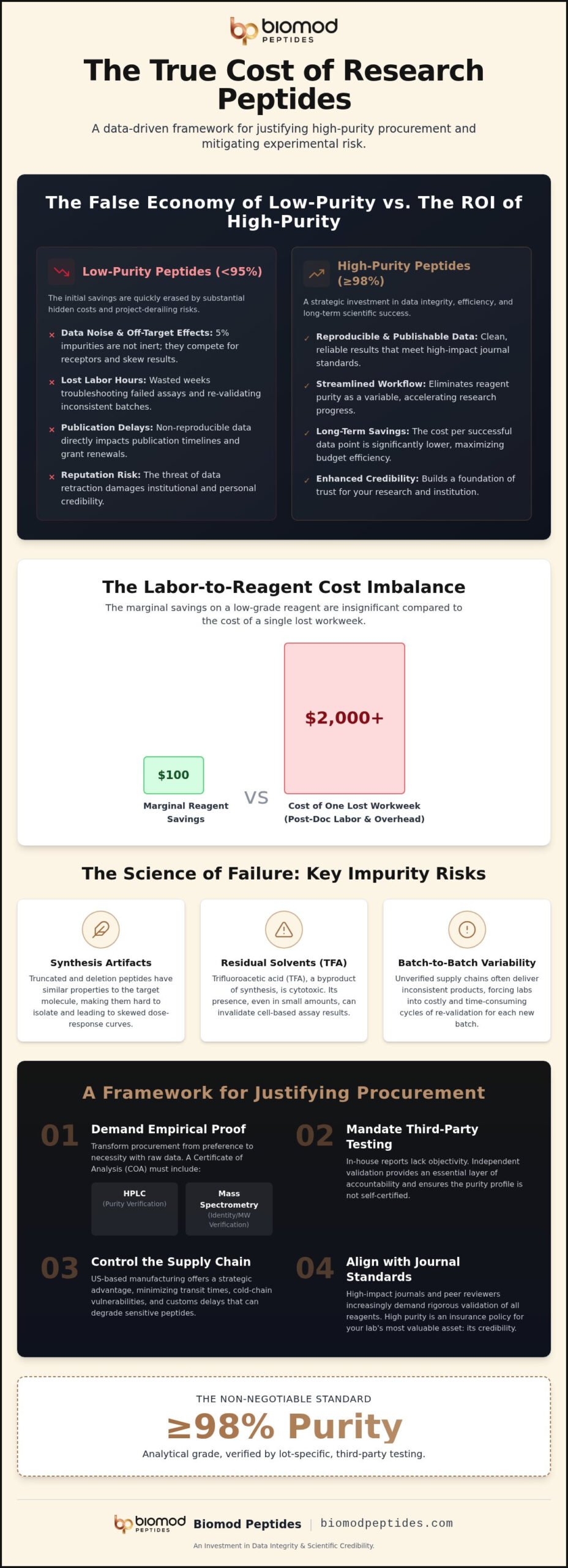
Procurement decisions often center on unit costs. This narrow focus ignores the substantial financial burden of experimental failure. If a peptide batch contains 5% impurities, those contaminants aren’t inert. They compete for receptors, create off-target effects, and skew dose-response curves. Justifying the cost of high-purity peptides to a PI requires shifting the conversation from the purchase price to the cost per successful data point.
Consider the labor-to-reagent ratio. A typical post-doctoral researcher’s week represents significant institutional investment. Saving $100 on a lower-grade reagent is mathematically unsound if it risks even three days of work. Unverified international supply chains frequently exhibit batch-to-batch variability; this inconsistency forces labs into cycles of re-validation. Such delays directly impact publication timelines and can jeopardize future grant renewals.
Identifying Impurity Profiles and Their Research Risks
Synthetic errors are inherent in how synthetic peptides are made. Truncated sequences and deletion peptides often possess similar chemical properties to the target molecule. This makes them difficult to isolate without high-resolution purification. Residual Trifluoroacetic acid (TFA) from the synthesis process is another critical factor. While TFA removal increases the base cost, it’s essential to prevent cytotoxicity in cell-based assays. Biomod Peptides addresses these risks by providing lot-specific COAs for every batch.
The Opportunity Cost of Troubleshooting
When an assay fails, the researcher must debug every component. If the reagent purity is unverified, it remains a permanent unknown variable. Labs spend dozens of hours testing equipment when the issue is actually a sub-par peptide. In the context of 2026 HPLC standards, analytical grade is defined as a peptide sequence with a verified purity of 98% or higher, confirmed by mass spectrometry identity testing.
A Framework for Justifying Analytical Grade Procurement
Data integrity is the primary currency of a research laboratory. High-impact journals increasingly demand rigorous validation of all reagents used in published studies. When justifying the cost of high-purity peptides to a PI, highlight that peer reviewers are trained to identify inconsistencies in assay results. The dangers of contaminated peptides extend beyond failed experiments; they can lead to retractions or damaged institutional reputations. High-purity reagents serve as an insurance policy for the lab’s most valuable asset: its credibility.
Domestic manufacturing offers a strategic logistical advantage that mitigates environmental risks. Peptides are highly sensitive to temperature fluctuations and atmospheric exposure. International supply chains introduce cold-chain vulnerabilities and unpredictable customs delays that can compromise structural integrity. Utilizing US-based facilities ensures shorter transit times and stricter environmental controls from synthesis to delivery. This logistical transparency reduces the risk of peptide degradation before the product reaches the bench.
Strategic procurement involves disciplined lot-size planning. Ordering in bulk from a verified provider lowers the per-unit cost of premium peptides without sacrificing analytical standards. This approach allows the lab to maintain a consistent supply of identical lots, which is crucial for multi-year longitudinal studies. You can audit these standards through the Biomod Peptides verification portal to ensure every batch meets your specific research requirements.
The Role of HPLC and Mass Spectrometry in Quality Assurance
A Certificate of Analysis (COA) must be more than a summary sheet. It should include raw data. Effective peptide purity verification relies on High-Performance Liquid Chromatography (HPLC) to confirm purity and Mass Spectrometry (MS) to verify molecular weight. Presenting these visual chromatograms to a PI provides empirical proof of sequence identity. It transforms a procurement request from a subjective preference into a technical necessity based on structural verification.
Third-Party Testing as a Non-Negotiable Standard
In-house reports from manufacturers often lack the necessary objectivity for high-stakes research. Independent third-party validation provides an essential layer of lab accountability. This external oversight ensures that the purity profile is not merely self-certified by the producer. Verification portals allow researchers to cross-reference batch numbers with independent lab results instantly. This level of transparency is now the baseline for modern laboratory procurement and experimental reproducibility.
Strategic Procurement: Selecting Verified US-Manufactured Peptides
Finalizing a procurement strategy requires moving from theoretical risk to practical implementation. Integrating high-tier analytical standards into your laboratory’s Standard Operating Procedures (SOPs) ensures long-term reproducibility and data integrity. Biomod Peptides sets the industry benchmark for high purity research peptides by aligning with these rigorous requirements. When justifying the cost of high-purity peptides to a PI, emphasize the efficiency gained through the COA Verification Portal. This digital tool allows for instant authentication of lot-specific data, removing the administrative burden of manual reagent verification.
Advancing Research with Specialized Delivery Systems
Modern bioanalytical models often require more than traditional lyophilized vials. Specialized delivery formats can significantly enhance experimental stability and precision. Peptide softgels for research provide a shielded environment that protects sensitive sequences from oxidative stress and degradation. For specific neurological or systemic absorption studies, intranasal peptide research sprays facilitate targeted delivery protocols that traditional lyophilized powders cannot replicate. These formats streamline workflows by reducing the need for complex in-house reconstitution.
Building a Long-Term Relationship with a US Vendor
Relying on domestic supply chains reduces the logistical friction that often compromises sensitive reagents. Learning more about Biomod reveals a disciplined commitment to US-based finishing and manufacturing. Operating within the Las Vegas region allows for tighter control over the chain of custody and environmental variables. This proximity eliminates the ‘shipment anxiety’ associated with international transit and customs delays. It ensures that the structural integrity of the peptide remains intact from the point of synthesis to your laboratory bench.
- Can you provide batch-specific HPLC and Mass Spectrometry raw data through a secure portal?
- Is the manufacturing and finishing performed entirely within US-based facilities?
- Does an independent third-party laboratory verify every lot for purity and identity?
- Are specialized formats like softgels or sprays available to improve experimental consistency?
- What specific measures are in place to mitigate cold-chain risks during domestic transit?
Secure the Future of Your Lab’s Data Integrity
Procurement in 2026 requires a transition from minimizing unit costs to maximizing experimental viability. You’ve identified how minor impurities jeopardize months of labor and institutional credibility. Success in justifying the cost of high-purity peptides to a PI relies on framing these reagents as essential infrastructure rather than optional upgrades. By prioritizing US-manufactured sequences and independent third-party HPLC/MS testing, you eliminate the critical variables that lead to non-reproducible results. Establish a rigorous culture of accountability by integrating real-time COA verification into your daily laboratory protocols. This disciplined approach ensures your grant funds support publishable, high-impact discoveries while mitigating the risks of international supply chain instability. Your research demands the precision of analytical-grade standards to reach its full potential. Every assay is an investment in your lab’s legacy; protect that investment with verified chemistry.
Secure high-purity reagents for your next assay at Biomod Peptides and anchor your findings in empirical proof.
Frequently Asked Questions
How do I explain the difference between 95% and 98% purity to my PI?
The difference represents a 150% increase in the concentration of unknown contaminants. A 95% pure sample contains 50,000 parts per million of impurities, while a 98% sample contains only 20,000. These impurities are often bioactive deletion sequences that compete for receptor binding. When justifying the cost of high-purity peptides to a PI, emphasize that this 3% variance is the primary cause of baseline noise and non-reproducible data.
Why is US manufacturing more expensive than international peptide synthesis?
Domestic manufacturing ensures structural integrity through rigorous environmental controls and shorter transit durations. US facilities eliminate the cold-chain vulnerabilities and unpredictable customs delays inherent in international logistics. The higher cost reflects the verification of every lot through independent third-party testing and the maintenance of a transparent chain of custody. This logistical security prevents the peptide degradation often seen in unverified global supply chains.
What are the most common impurities found in low-cost research peptides?
The most frequent contaminants include truncated sequences, deletion peptides, and residual solvents like Trifluoroacetic acid (TFA). Truncated sequences occur when amino acid coupling fails during the synthesis process. Deletion peptides lack specific residues, which can fundamentally alter the peptide’s biological activity and folding. Without high-resolution purification, these reagents remain in the sample and lead to off-target effects that invalidate your experimental conclusions.
Can high-purity peptides actually speed up my PhD or Post-doc timeline?
High-purity reagents accelerate research timelines by removing reagent quality as a variable during assay troubleshooting. When reagents are verified at 98% purity or higher, you avoid the weeks of labor lost to debugging inconsistent results caused by sub-par materials. Utilizing standardized products, such as those verified through the Biomod Peptides portal, ensures your data is publishable on the first attempt. This technical reliability is essential for meeting strict graduation and grant renewal deadlines.
Disclaimer
BIOMOD products are sold strictly for laboratory, analytical, and scientific research use only. They are not intended for human or animal consumption, administration, application, ingestion, injection, or any therapeutic, diagnostic, or cosmetic use.
The statements made on this website have not been evaluated by the United States Food and Drug Administration. BIOMOD products are not intended to diagnose, treat, cure, mitigate, or prevent any disease or medical condition.
BIOMOD is a research chemical supplier. BIOMOD is not a compounding pharmacy or chemical compounding facility as defined under Section 503A of the Federal Food, Drug, and Cosmetic Act. BIOMOD is not an outsourcing facility as defined under Section 503B of the Federal Food, Drug, and Cosmetic Act.
By accessing this site, you confirm you are at least 21 years of age and that you have read and accepted the BIOMOD Terms of Sale, Privacy Policy, and Research Use Only Policy. BIOMOD does not provide dosing, medical, therapeutic, diagnostic, veterinary, or use guidance under any channel.