
Over 1,200 peptide-based candidates currently sit in clinical trials; however, the majority of laboratory failures stem from a single, preventable factor: premature proteolytic degradation. You recognize the frustration of inconsistent data caused by rapid in vivo clearance. It’s a logistical and financial burden that stalls progress. High dosing frequencies and potency loss during handling shouldn’t be the baseline for your work. Advancing your peptide half-life extension research requires a strategic balance between increasing hydrodynamic volume and preserving native binding kinetics.
This article analyzes the mechanisms and technologies driving peptide longevity to optimize your laboratory research protocols. We examine second-generation site-specific PEGylation, lipidation, and the critical role of US-manufactured reagents in maintaining study integrity. You’ll gain the technical clarity needed to select the optimal stability technology for your specific sequence. We prioritize empirical proof and structural integrity to help you achieve repeatable results. With the global peptide market projected to reach $163.98 billion in 2026, the demand for high-purity, stable reagents is absolute. This guide provides the analytical framework to ensure your experimental data stands up to rigorous verification.
Key Takeaways
- Identify the specific enzymatic and renal clearance thresholds that compromise molecular stability in vivo.
- Evaluate the structural trade-offs between covalent PEGylation and reversible albumin-binding lipidation strategies.
- Integrate advanced peptide half-life extension research into your protocols to minimize dosing frequency and experimental variance.
- Address logistical challenges including altered viscosity and specialized storage requirements for modified sequences.
- Leverage specialized delivery formats, such as peptide softgels, to maintain potency and improve experimental reproducibility.
Mechanisms of Peptide Degradation and the Science of Half-Life Extension
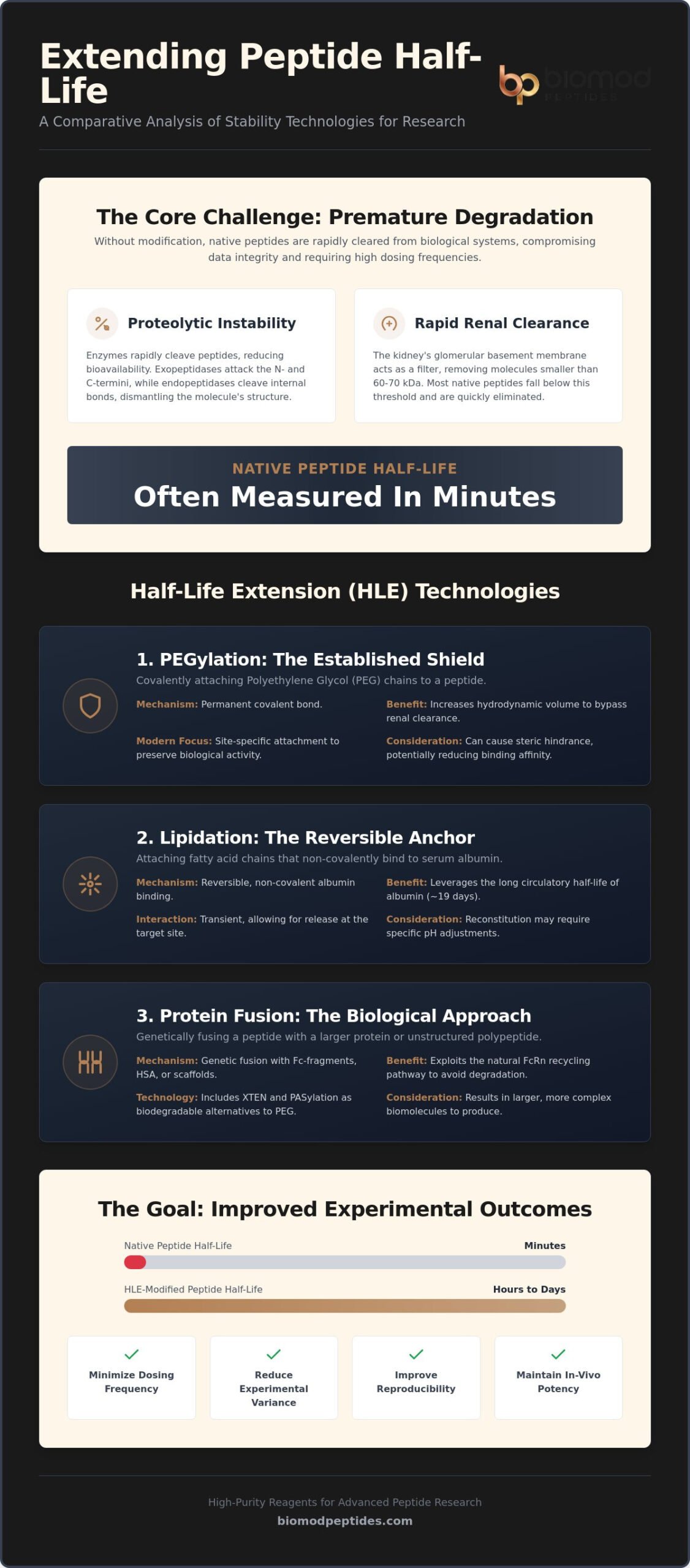
Peptides face immediate metabolic challenges upon entry into a biological system. The primary drivers of instability are proteolytic enzymes and rapid renal clearance. Without intervention, native peptides often possess half-lives measured in minutes. Modern Peptide Half-Life Extension Strategies focus on overcoming these kinetic barriers to ensure sustained exposure. A critical component of this process involves neonatal Fc receptor (FcRn) recycling. This natural mechanism diverts proteins from lysosomal degradation, extending their circulation time. The ultimate goal of peptide half-life extension research is to engineer molecules that shield vulnerable cleavage sites while maintaining the integrity of active binding domains. This requires precise chemical modifications to prevent premature clearance without compromising the molecule’s biological function.
Proteolytic Instability and Enzymatic Cleavage
Proteolysis occurs through two primary pathways. Exopeptidases target the N- and C-termini, while endopeptidases cleave internal peptide bonds. These enzymes rapidly reduce bioavailability and compromise experimental reproducibility. In 2026 analytical standards, proteolytic half-life is defined as the time required for 50% of the parent peptide to undergo enzymatic biotransformation under specific physiological conditions. Effective stabilization requires modifications that sterically hinder enzymatic access to these sensitive regions.
The Role of Hydrodynamic Volume in Renal Clearance
Renal filtration remains the dominant elimination pathway for low molecular weight peptides. The glomerular basement membrane imposes a filtration threshold typically between 60 and 70 kDa. Peptides falling below this limit are cleared rapidly through the kidneys. Increasing the hydrodynamic volume prevents this filtration. By expanding the molecular radius, researchers significantly extend systemic exposure duration. This shift in molecular weight ensures the peptide remains in circulation; it allows for lower dosing frequencies and more consistent data sets in laboratory models. Maintaining this balance is essential for achieving the necessary pharmacological profile in advanced research.
Comparative Analysis of HLE Technologies: PEGylation, Lipidation, and Fusion
Modern peptide half-life extension research has moved beyond traditional random PEGylation. While PEGylation remains a dominant technology, its traditional polydisperse nature often introduces batch-to-batch inconsistency. In 2026, researchers prioritize site-specific attachment to preserve biological activity. This method contrasts with lipidation, which utilizes non-covalent albumin binding. Lipidation offers a reversible extension strategy; it leverages the long circulatory half-life of serum albumin without the permanent structural alteration seen in synthetic polymer conjugation. High-tier research now focuses on “smart” hybrids that combine these mechanisms to achieve synergistic stability effects.
Chemical Modifications: PEGylation vs. Lipidation
The primary distinction lies in the bond architecture. PEGylation creates a permanent covalent bond. This increases the hydrodynamic radius significantly but can sometimes reduce binding affinity due to steric hindrance. Lipidation involves attaching fatty acid chains that associate with albumin in the bloodstream. This transient interaction maintains higher solubility in many aqueous buffers compared to large PEG-conjugates. Laboratory reconstitution protocols must account for these differences. Lipid-modified peptides often require specific pH adjustments to ensure complete dissolution. Sourcing these reagents from reliable US-manufactured peptide providers ensures the structural integrity of these modifications.
Protein Fusion and Scaffold-Based Extensions
Genetic fusions offer an alternative to synthetic chemistry. By fusing peptides with Fc-fragments or Human Serum Albumin (HSA), researchers exploit the FcRn recycling pathway discussed in previous sections. Technologies like XTEN and PASylation represent a leap in methodology. These are biodegradable, unstructured polypeptide sequences that mimic the biophysical properties of PEG. They eliminate the risk of anti-PEG immunogenicity while providing precise control over molecular weight and mass. Understanding these current synthesis trends is vital for optimizing delivery and verification. These scaffold-based extensions provide a disciplined approach to increasing systemic exposure without the regulatory hurdles of non-biodegradable polymers.
Implementing Extended Half-Life Peptides in Research Protocols
Implementing extended half-life peptides requires a disciplined shift in standard laboratory handling. Modified molecules often exhibit increased viscosity and altered solubility profiles compared to their native counterparts. These physical changes can complicate precise dosing and sample preparation. Successful peptide half-life extension research depends on managing these logistical variables without compromising molecular stability. Utilizing specialized delivery systems, such as peptide softgels, helps mitigate degradation during storage and handling. These formats provide a protective barrier against environmental factors that typically accelerate potency loss. It’s a method that prioritizes the structural integrity of the reagent above all else.
Impact on Bioavailability and Delivery Formats
Researchers must choose delivery formats based on the specific modification used. Lyophilized powders remain the standard for long-term stability; however, certain studies require ready-to-use spray products for consistent mucosal delivery models. US-manufactured purity is critical for modified peptide research because domestic facilities provide the rigorous oversight required to prevent cross-contamination in complex synthesis batches. The choice between formats should align with the required systemic exposure duration and the peptide’s final hydrodynamic radius.
Quality Assurance for Modified Peptides
Complex modifications demand advanced analytical verification. Standard UV-Vis spectroscopy is insufficient for confirming site-specific attachment of PEG or lipid groups. HPLC and High-Resolution Mass Spectrometry (HRMS) are mandatory to ensure the modification has occurred at the intended residue. This level of purity verification eliminates data inconsistencies caused by incomplete conjugation. As laboratories advance their peptide half-life extension research, the focus must remain on objective verification. Laboratories should utilize the Biomod COA Verification Portal to confirm lot-to-lot consistency and structural accuracy before initiating experiments.
Las Vegas laboratories evaluating new HLE peptide vendors in 2026 should utilize the following criteria:
- Verification of third-party analytical testing for every lot.
- Documented proof of US-based manufacturing and finishing processes.
- Availability of specialized formats like softgels to ensure handling stability.
- Transparent access to COA data through digital verification portals.
- Site-specific modification confirmation via high-resolution mass spectrometry.
Advancing Laboratory Standards for Peptide Longevity
Achieving experimental reproducibility in 2026 demands a meticulous approach to molecular stability. Successful peptide half-life extension research requires balancing increased hydrodynamic volume with the preservation of active binding domains. You’ve analyzed how renal filtration thresholds and proteolytic enzymes dictate the kinetic profile of your reagents. Whether you utilize site-specific PEGylation or reversible albumin-binding lipidation, the integrity of your data depends on the structural accuracy of your modifications. Verification isn’t just a step in the process; it’s the anchor of professional research. Utilizing US-manufactured reagents ensures that your protocols remain unaffected by the inconsistencies of unverified imports.
Precision begins with documentation and third-party validation. Biomod Peptides provides the analytical foundation necessary for high-stakes research environments. Our products are US-manufactured and finished; they’re supported by independent third-party laboratory verification to guarantee lot-to-lot consistency. You can access empirical proof for every lot through our dedicated verification portal for all Certificates of Analysis. Explore Analytical Grade Research Peptides at Biomod Peptides to secure the reliability your study requires. We remain committed to supporting your efforts in refining methodology and advancing scientific integrity.
Frequently Asked Questions
How does PEGylation affect the binding affinity of a research peptide?
PEGylation often reduces binding affinity through steric hindrance. The polymer chain can physically obstruct the peptide’s interaction with its target receptor. To mitigate this, modern protocols focus on site-specific attachment. Choosing a site distant from the active domain preserves biological function. This balance between stability and affinity is a central challenge in peptide half-life extension research. Precision in synthesis ensures the modification doesn’t mask the molecule’s intended binding kinetics.
What is the typical half-life increase expected from albumin-binding lipidation?
Lipidation typically extends the circulatory half-life from minutes to several days. The attached fatty acid chain associates non-covalently with serum albumin, which possesses a naturally long half-life. This interaction creates a reversible reservoir in the bloodstream. It effectively bypasses the 60-70 kDa renal filtration threshold. This method provides a disciplined approach to increasing systemic exposure without the permanent structural bulk associated with large synthetic polymers or genetic fusions.
Can extended half-life peptides be stored using standard laboratory protocols?
Extended half-life peptides generally require more specialized handling than native sequences. While standard storage at -20°C or -80°C is common, modified variants often show increased hygroscopicity. They’re more sensitive to repeated freeze-thaw cycles, which can lead to aggregation or polymer degradation. Laboratories should use desiccated storage and pre-aliquoted samples. These precautions prevent potency loss and ensure that the modified sequence remains stable for the duration of the study.
Why is third-party testing critical for modified peptides compared to standard sequences?
Third-party testing is critical because modified peptides are chemically complex. Standard in-house assays often fail to distinguish between a successfully conjugated molecule and a mixture of unreacted precursors. Independent HPLC and Mass Spectrometry provide objective verification of the site-specific attachment and total molecular weight. This rigorous quality control is essential for peptide half-life extension research. It confirms that experimental data reflects the performance of the intended modification rather than synthesis artifacts.
Disclaimer
BIOMOD products are sold strictly for laboratory, analytical, and scientific research use only. They are not intended for human or animal consumption, administration, application, ingestion, injection, or any therapeutic, diagnostic, or cosmetic use.
The statements made on this website have not been evaluated by the United States Food and Drug Administration. BIOMOD products are not intended to diagnose, treat, cure, mitigate, or prevent any disease or medical condition.
BIOMOD is a research chemical supplier. BIOMOD is not a compounding pharmacy or chemical compounding facility as defined under Section 503A of the Federal Food, Drug, and Cosmetic Act. BIOMOD is not an outsourcing facility as defined under Section 503B of the Federal Food, Drug, and Cosmetic Act.
By accessing this site, you confirm you are at least 21 years of age and that you have read and accepted the BIOMOD Terms of Sale, Privacy Policy, and Research Use Only Policy. BIOMOD does not provide dosing, medical, therapeutic, diagnostic, veterinary, or use guidance under any channel.