
Peptide impurities are not merely passive contaminants. They are active spectral disruptors that fundamentally compromise analytical sensitivity through competitive ionization. The impact of peptide impurities on mass spectrometry manifests as inconsistent m/z ratios and high background noise that masks target signals. It’s a common frustration to find synthesis deletions indistinguishable from target peptides. These analytical hurdles stall progress and jeopardize the reproducibility of data intended for publication or clinical trials.
This article details how specific synthesis byproducts degrade spectral data and provides established protocols for ensuring high-precision outcomes. We’ll examine the technical challenges of sequence identification and the advanced validation methods, such as UPLC-QTOF and Orbitrap hybrid MS, required for clear spectral resolution. By adhering to rigorous ICH Q3A(R2) standards, you can secure the empirical proof necessary for sophisticated research applications. Our focus remains on the structural integrity of the sample and the precision of the methodology.
Key Takeaways
- Identify how truncated sequences and deletion peptides create “shadow peaks” that compromise target sequence identification during analysis.
- Analyze the mechanics of competitive ionization where impurities with high proton affinity disrupt the ESI plume and suppress target signals.
- Evaluate the technical impact of peptide impurities on mass spectrometry to mitigate SNR degradation and maintain analytical precision.
- Adopt the 2026 standard of 98% purity or higher, utilizing orthogonal testing protocols to verify structural integrity.
- Implement rigorous validation using high-resolution mass spectrometry (HRMS) to ensure data reproducibility for publication or trial submission.
The Taxonomy of Peptide Impurities in Mass Spectrometry
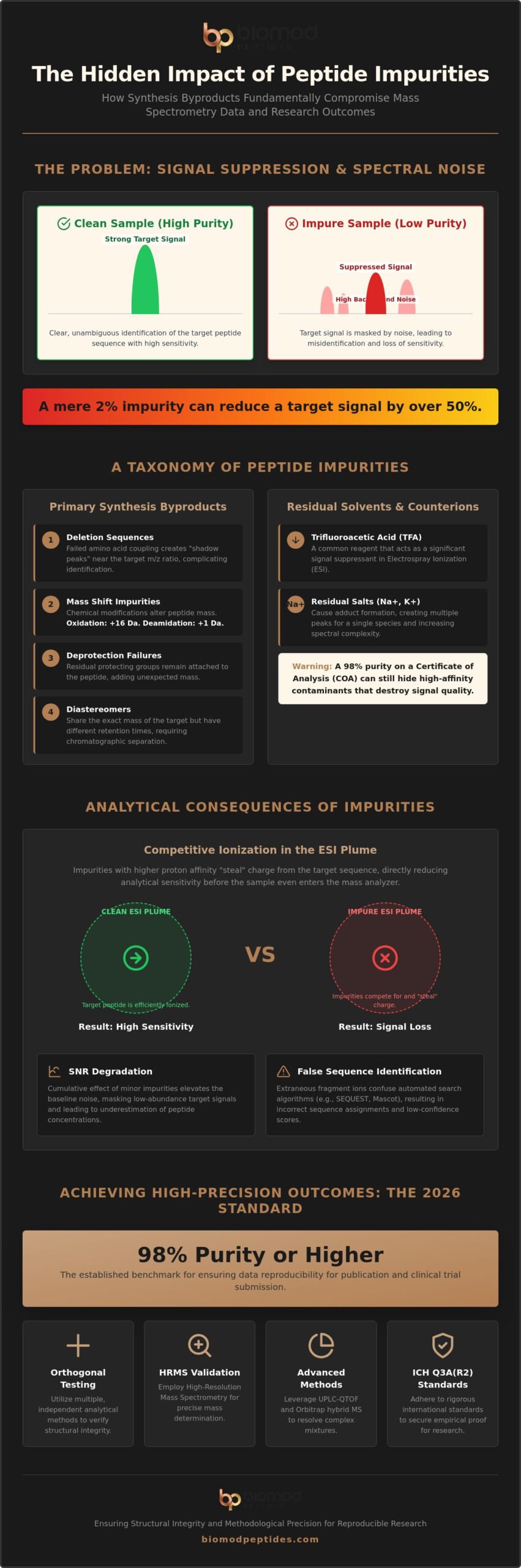
Peptide impurities are any chemical species in a sample that aren’t the target sequence. These contaminants typically arise during Solid-Phase Peptide Synthesis (SPPS). The impact of peptide impurities on mass spectrometry is profound; they introduce noise and complicate sequence verification. Truncated sequences and deletion peptides are particularly problematic. They create “shadow peaks” near the target mass-to-charge (m/z) ratio, making it difficult to distinguish the pure product from synthesis errors. These issues are critical for those sourcing research peptides where structural integrity is paramount.
Primary Synthesis Byproducts and Their Mass Signatures
Deletion sequences are the most common impurity in high-throughput peptide synthesis. These occur when an amino acid fails to couple during a specific cycle. In high-resolution Mass spectrometry, analysts identify these through specific mass shifts. For instance, oxidation adds a +16 Da shift, while deamidation results in a +1 Da shift. Side-chain deprotection failures also contribute to mass shifting by leaving residual protecting groups attached to the peptide backbone. Diastereomers present a unique challenge. These impurities share the exact mass of the target but possess different retention times, requiring chromatographic separation before MS analysis.
Residual Solvents and Counterions in the MS Matrix
The synthesis environment introduces non-peptide contaminants. Trifluoroacetic acid (TFA) is a common reagent that acts as a significant signal suppressant in Electrospray Ionization (ESI). It competes for surface space on the ESI droplet, reducing the ionization efficiency of the target peptide. Additionally, residual salts lead to adduct formation. Sodium (Na+) and potassium (K+) ions attach to the peptide, creating multiple peaks for a single species. This increases spectral complexity and can lead to the misidentification of the parent ion.
A Certificate of Analysis (COA) provides a high-level overview, but it often masks the true impact of peptide impurities on mass spectrometry. A sample reported at 98% purity may still contain high-affinity contaminants that suppress the target signal. Analytical rigor requires looking beyond the COA to the raw spectral data. Identifying these signatures is the first step toward achieving reproducible results.
Analytical Consequences: Ion Suppression and Signal Interference
The impact of peptide impurities on mass spectrometry is most visible during the ionization phase. Synthesis byproducts aren’t just background noise; they’re active competitors for charge. In the Electrospray Ionization (ESI) plume, chemical species compete for limited surface area on the droplets. Impurities with higher proton affinity effectively “steal” the charge from the target sequence. This competitive ionization causes a direct loss of analytical sensitivity, often before the ion even enters the mass analyzer.
Research published in the Characterization of Synthetic Peptide Therapeutics demonstrates how these interactions complicate data interpretation. Beyond charge competition, minor impurities contribute to cumulative Signal-to-Noise Ratio (SNR) degradation. This elevated baseline masks low-abundance target signals. Isobaric interference presents another risk, where an impurity shares a mass signature with a target fragment, leading to false-positive identifications. These factors combine to cause significant underestimation of peptide concentrations in bioanalytical assays.
Ion Suppression and the Loss of Analytical Sensitivity
Co-eluting impurities limit the number of available droplets for target ionization. This “masking effect” is non-linear; a mere 2% impurity can reduce a target signal by over 50% in specific matrices. For Las Vegas laboratories conducting sensitive high-throughput screening, this suppression can invalidate entire datasets. Utilizing ultra-pure research peptides is the primary method for maintaining low detection limits and ensuring signal clarity.
Spectral Complexity and False Sequence Identification
De-convoluting MS/MS spectra becomes significantly more difficult when precursor ions are contaminated. Impurities introduce extraneous fragment ions that confuse automated sequence search algorithms. Systems like SEQUEST or Mascot rely on clean fragmentation patterns to match theoretical databases. When the impact of peptide impurities on mass spectrometry isn’t accounted for, these algorithms frequently produce incorrect sequence assignments or low-confidence scores, stalling the progression of research trials.
Mitigating Spectral Noise: Verification Protocols for 2026
The standard for research-grade peptides has evolved. By July 2026, a purity level of 98% or higher is the benchmark for high-precision analytical work. Moving beyond the historical 95% threshold is necessary to minimize the impact of peptide impurities on mass spectrometry. High-resolution mass spectrometry (HRMS) combined with RP-HPLC provides the orthogonal verification required for complex sequence identification. This dual-method approach ensures that chemical homogeneity and molecular weight are both validated before any research begins.
Effective control strategies involve characterizing peptide impurities through rigorous documentation and batch-specific testing. Relying solely on internal vendor data isn’t sufficient for reproducible results. Utilizing the Biomod COA Verification Portal allows researchers to cross-reference batch-specific data against independent standards. This level of transparency is vital for eliminating spectral noise and ensuring data integrity in sensitive bioanalytical assays.
Standard Protocols for Purity Assessment in Research
A standardized workflow is essential for laboratory consistency and accountability. We recommend a three-step verification process:
- Step 1: Initial HPLC purity assessment to verify chemical homogeneity and identify potential diastereomers.
- Step 2: ESI-MS verification to confirm the precise molecular weight of the primary peak and detect mass shifts.
- Step 3: Third-party validation to eliminate vendor bias and confirm the impact of peptide impurities on mass spectrometry has been fully mitigated.
Procuring Analytical Grade Peptides in the United States
Sourcing US manufactured research peptides provides a distinct advantage in structural stability. Manufacturing in Las Vegas reduces transport-related degradation and ensures a transparent verification chain. Integrating these verified certificates into your laboratory’s peptide purity verification protocols protects against spectral disruption. For high-precision reagents that meet these 2026 benchmarks, researchers can rely on Biomod Peptides for structural integrity and empirical proof.
Advancing Analytical Precision in Peptide Research
Achieving reproducible data requires a meticulous approach to sample purity. We’ve examined how synthesis byproducts disrupt ionization and why 98% purity standards are now essential for minimizing spectral noise. The impact of peptide impurities on mass spectrometry is manageable only through rigorous orthogonal testing and transparent verification chains. By identifying specific mass signatures and utilizing high-resolution MS, researchers can eliminate the ambiguity of shadow peaks and signal suppression. These technical benchmarks are the foundation of reliable sequence identification.
Biomod Peptides supports these standards through disciplined quality control and professional accountability. We maintain US-based manufacturing and finishing to ensure structural stability throughout the supply chain. Every lot undergoes independent third-party testing to validate its chemical integrity. Our digital COA verification portal offers immediate access to the empirical proof your research demands. Secure High-Purity Reagents for Your Lab at Biomod Peptides to ensure your next trial produces the clear, high-resolution results necessary for publication. Precise methodology leads to breakthrough discovery.
Frequently Asked Questions
How do peptide impurities cause ion suppression in mass spectrometry?
Peptide impurities cause ion suppression by competing for limited charge and surface space within the Electrospray Ionization (ESI) plume. Species with higher proton affinity sequester available protons, preventing the target peptide from reaching the detector. This competitive mechanism directly reduces the ionization efficiency of the analyte. The impact of peptide impurities on mass spectrometry is particularly severe when co-eluting contaminants are present in the same chromatographic window as the target sequence.
Can 95% peptide purity be sufficient for most MS-based research?
While 95% purity may suffice for basic screening, it’s often inadequate for high-precision mass spectrometry. Modern research in 2026 demands purity levels of 98% or higher to ensure data reproducibility. Minor impurities can mask low-abundance target signals or produce misleading “shadow peaks” that complicate spectral interpretation. For applications requiring accurate quantification or sequence verification, higher purity levels are essential to maintain a robust Signal-to-Noise Ratio.
What are isobaric impurities and why are they dangerous for sequence verification?
Isobaric impurities share the same nominal mass as the target peptide but possess different molecular structures. They’re dangerous because they’re indistinguishable in the MS1 scan, leading to false-positive identifications. These contaminants often arise from amino acid substitutions or rearrangements during synthesis. During MS/MS fragmentation, isobaric species produce extraneous fragment ions that confuse search algorithms. This complication makes it nearly impossible to verify the primary sequence with absolute confidence without orthogonal chromatographic separation.
How does residual TFA from the synthesis process affect my MS signal?
Residual Trifluoroacetic acid (TFA) acts as a potent signal suppressant during Electrospray Ionization. It forms strong ion pairs with basic amino acid residues, which reduces the overall volatility of the peptide in the ESI droplet. Additionally, TFA molecules migrate to the droplet surface and impede the transition of the target analyte into the gas phase. This interaction significantly lowers the detected signal intensity, often requiring extensive washing or counterion exchange to restore analytical sensitivity.
Disclaimer
BIOMOD products are sold strictly for laboratory, analytical, and scientific research use only. They are not intended for human or animal consumption, administration, application, ingestion, injection, or any therapeutic, diagnostic, or cosmetic use.
The statements made on this website have not been evaluated by the United States Food and Drug Administration. BIOMOD products are not intended to diagnose, treat, cure, mitigate, or prevent any disease or medical condition.
BIOMOD is a research chemical supplier. BIOMOD is not a compounding pharmacy or chemical compounding facility as defined under Section 503A of the Federal Food, Drug, and Cosmetic Act. BIOMOD is not an outsourcing facility as defined under Section 503B of the Federal Food, Drug, and Cosmetic Act.
By accessing this site, you confirm you are at least 21 years of age and that you have read and accepted the BIOMOD Terms of Sale, Privacy Policy, and Research Use Only Policy. BIOMOD does not provide dosing, medical, therapeutic, diagnostic, veterinary, or use guidance under any channel.