
A Certificate of Analysis is often nothing more than a digital file until its data is cross-referenced against a verified laboratory database. In an industry where 98% purity claims are standard, the distinction between high-grade research reagents and substandard materials lies in the transparency of the manufacturing chain. You shouldn’t have to guess if your lot is consistent or if the documentation was fabricated. Identifying the right questions to ask a new peptide supplier is the only way to safeguard your data integrity from the start.
The global peptide synthesis market is projected to reach 1.10 billion dollars by late 2026, yet this growth has introduced significant variability in reagent quality. This article provides a clinical framework for vetting vendors through empirical proof rather than marketing claims. We will examine seven critical inquiries that separate reliable domestic supply chains from opaque resellers. You’ll gain a repeatable protocol to verify analytical data, ensuring your research is built on a foundation of verified structural integrity and laboratory-grade precision.
Key Takeaways
- Identify the markers of data integrity by requiring lot-specific HPLC and Mass Spectrometry reports for every reagent.
- Establish a secure chain of custody by mastering the specific questions to ask a new peptide supplier regarding US-based synthesis and finishing.
- Verify the concentration and stability of advanced formulations, including softgels and spray products, through standardized analytical testing.
- Implement a repeatable vetting protocol to ensure lot-to-lot consistency during large-scale bulk procurement.
- Guard against falsified documentation by utilizing third-party verification portals to cross-reference batch-specific data.
Analytical Verification: Questions Regarding Purity and Data Integrity
Data integrity is the bedrock of reproducible research. A supplier’s claim of high quality is irrelevant without a verifiable paper trail that links a specific vial to a specific laboratory analysis. When determining the questions to ask a new peptide supplier, prioritize the mechanics of their verification process. Validation isn’t a gesture of goodwill; it’s a technical requirement.
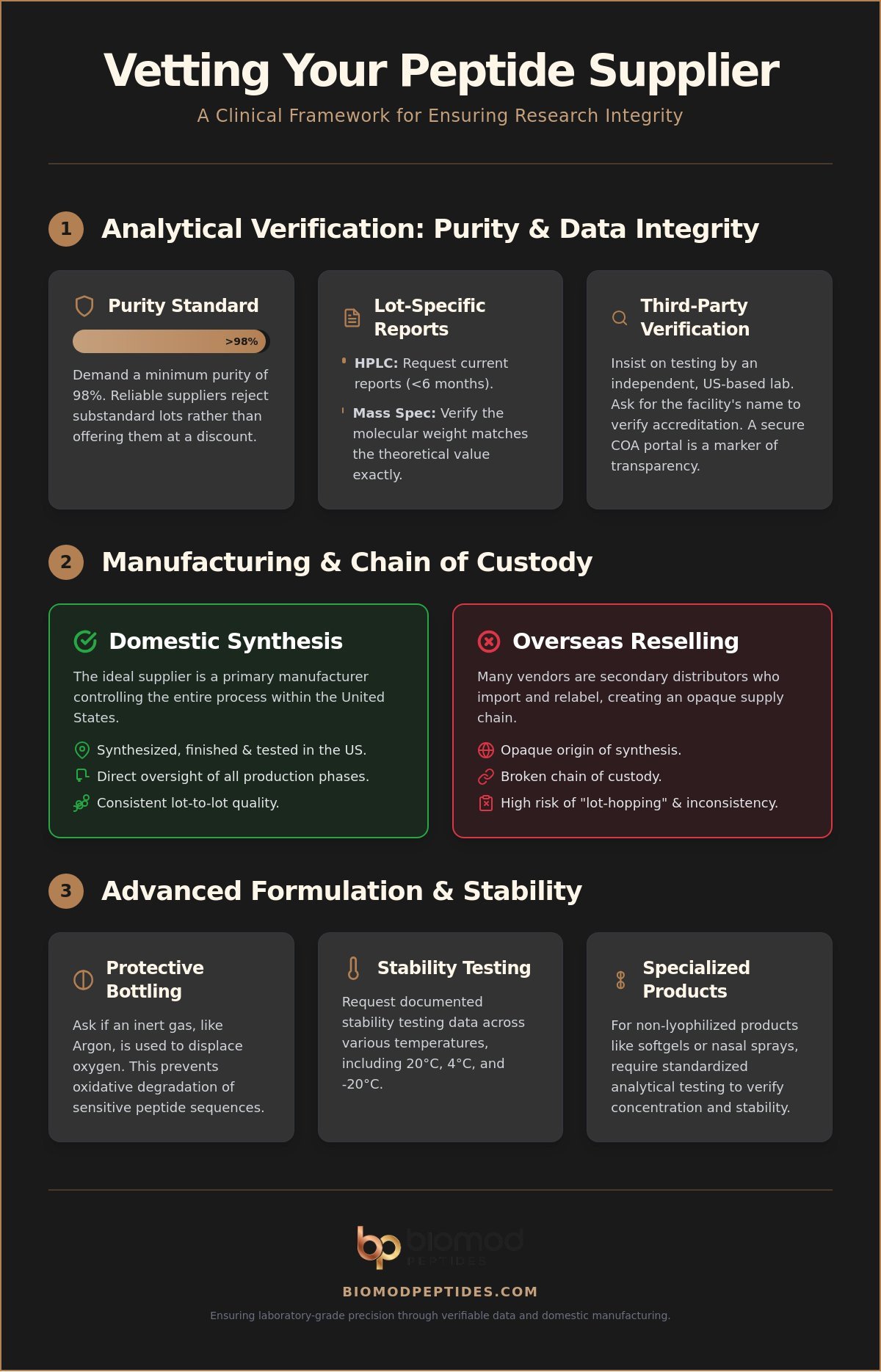
Request lot-specific High-Performance Liquid Chromatography (HPLC) and Mass Spectrometry (MS) reports for every individual product. General COAs are insufficient. You must ensure the data reflects the current batch in your possession rather than a “representative” sample from a previous year. Ask how the vendor prevents the reuse of outdated or cherry-picked COAs. A transparent supplier will maintain a secure COA verification portal. This allows researchers to cross-reference analytical data against an immutable digital record. It’s the only way to ensure the document in your hand matches the batch in the vial.
Define the purity threshold immediately. Most standardized research requires a minimum purity of 98%. Inquire about the protocol for batches that fall below this benchmark. Reliable providers reject substandard lots entirely rather than discounting them for clearance. This rigor is essential during the complex stages of peptide synthesis, where minor errors can lead to significant sequence impurities. Precision at the synthesis stage dictates the success of your downstream applications.
Interpreting HPLC and MS Reports
Don’t just look at the final percentage. Ask the supplier to explain the baseline noise and peak integration in their HPLC chromatograms. High noise levels can mask impurities. Request exact mass data. The MS report must confirm the peptide sequence matches the theoretical molecular weight with absolute precision. Finally, verify the analysis date. Reports must be current. Documentation older than six months may not reflect the stability or degradation profile of the current inventory.
Third-Party Accountability
Internal testing is a conflict of interest. Inquire if the testing laboratory is an independent, US-based facility. Ask for the specific name of the facility to verify their accreditation and industry reputation. External validation ensures that the results are objective and reproducible. If a vendor is hesitant to name their testing partner, it’s a red flag for data integrity. For a more technical breakdown of these requirements, consult The Protocol for Peptide Purity Verification.
Manufacturing Origin and Chain of Custody Protocols
Geographic origin is a primary indicator of quality control. A domestic shipping address isn’t proof of domestic manufacturing. Many vendors operate as secondary distributors, importing bulk sequences and merely relabeling them. This creates an opaque chain of custody. When evaluating the logistics of a procurement pipeline, the specific questions to ask a new peptide supplier must focus on the geographic origin of the synthesis process.
Inquire if the peptides are synthesized, finished, and tested within the United States. Ask about the source of the raw amino acids. These precursors must meet rigorous purity benchmarks before synthesis begins. Adhering to FDA guidance on synthetic peptides regarding impurity profiling is essential for maintaining laboratory standards. Biomod Peptides maintains structural integrity by finishing all products in the US. This ensures direct oversight of the final lyophilization and bottling phases. For bulk orders destined for Las Vegas laboratories, logistical transparency is mandatory to ensure reagents aren’t compromised by environmental exposure during transit.
Domestic Synthesis vs. Overseas Reselling
Determine if the supplier is a primary manufacturer or a secondary distributor. Secondary reselling often introduces “lot-hopping,” where different orders of the same peptide come from various international facilities. This inconsistency ruins research reproducibility. Direct manufacturers control the entire synthesis environment. This oversight is why researchers increasingly rely on Biomod Peptides for verifiable domestic production.
Storage and Stability Standards
Reagent stability depends on the environment within the vial. Ask if the supplier uses an inert gas, such as Argon, to displace oxygen during the bottling phase. This prevents oxidative degradation of sensitive sequences. Request documentation on stability testing across various temperatures, including 20°C, 4°C, and -20°C. Maintaining Peptide Science 2026 standards requires rigorous adherence to these storage protocols to prevent degradation during shipping and long-term storage.
Advanced Formulation and Bulk Procurement Capabilities
Research requirements are evolving. While lyophilized powders remain the industry standard, advanced delivery systems like softgels and sprays require a higher tier of analytical validation. Among the questions to ask a new peptide supplier, inquiries regarding formulation stability are paramount. You must verify that the concentration remains consistent throughout the shelf life of the reagent. This necessitates rigorous adherence to FDA guidance on peptide quality regarding impurity profiles and manufacturing standards. Integrity is not assumed; it’s proven through data.
Institutional compliance is equally critical. Ensure the supplier’s terms of sale are strictly limited to laboratory research. This protection is vital for maintaining the legal and ethical standing of your organization. A supplier that uses therapeutic marketing language is a liability. Focus on providers that prioritize data and empirical proof over retail-style promotion.
Softgel and Spray Product Integrity
Ask about the specific carrier agents used in peptide softgels. These agents must be chemically inert. They shouldn’t interfere with the peptide sequence or its intended bioavailability in a laboratory setting. For peptide spray products, request testing data regarding microbial purity and dosage accuracy. The formulation process must maintain the structural integrity of the peptide chain without introducing contaminants.
Lot Consistency for Long-Term Studies
Large-scale procurement demands uniformity. Inquire about the protocol for ensuring lot-to-lot consistency across multiple production runs. Ask if you can reserve a specific lot number for the duration of a multi-month study. This prevents data skew caused by minor variances in sequence concentration or purity. Understanding the variance tolerance is a critical step in maintaining analytical grade standards. Researchers should learn more about Biomod’s standards for consistent, high-tier supply chain management.
Implementing a Data-Driven Vetting Protocol
Precision in research is non-negotiable. The landscape of peptide procurement is shifting toward a model of absolute transparency and empirical proof. By utilizing the specific questions to ask a new peptide supplier outlined in this checklist, you move beyond marketing claims into the realm of verifiable data. Consistency is achieved through lot-specific HPLC reports, US-based synthesis, and rigorous stability testing for advanced formulations like softgels and sprays. These benchmarks aren’t just preferences; they’re the requirements for reproducible results in an increasingly complex regulatory environment.
Accountability is the hallmark of a professional reagent provider. We invite you to review our verified analytical standards and US-manufactured catalog at Biomod Peptides. Our commitment to research integrity includes independent third-party HPLC/MS testing for every lot and a secure COA verification portal designed for modern institutional requirements. Your methodology deserves a foundation of uncompromising quality. Build your next study on a supply chain that prioritizes structural integrity and logistical transparency.
Frequently Asked Questions
How do I verify a peptide supplier’s Certificate of Analysis (COA)?
Verification requires cross-referencing the report’s batch number with an independent laboratory’s digital database. A legitimate COA must be lot-specific and dated within the last six months. Static or “representative” reports are insufficient for analytical work. Researchers should prioritize vendors that offer a secure COA verification portal. This digital trail ensures the data in the report matches the physical inventory in the lab, preventing the use of falsified or cherry-picked documentation.
Why is US-based manufacturing critical for research peptide quality?
Domestic manufacturing ensures direct oversight of the synthesis and finishing processes under rigorous quality benchmarks. US-based facilities minimize the risk of peptide degradation during extended international shipping. It also eliminates the “lot-hopping” associated with overseas resellers. Identifying the manufacturing origin is one of the primary questions to ask a new peptide supplier to maintain a secure chain of custody and ensure reproducible research outcomes.
What is the difference between HPLC and Mass Spectrometry in peptide testing?
HPLC and Mass Spectrometry serve distinct analytical functions. High-Performance Liquid Chromatography (HPLC) determines the purity percentage by separating the target molecule from impurities. Mass Spectrometry (MS) verifies the identity of the peptide by measuring its molecular weight against the theoretical sequence. A high purity percentage is meaningless if the molecular weight is incorrect. Both tests are essential to confirm that the reagent is both pure and correctly identified.
What are the red flags of a ‘grey-market’ peptide vendor?
Primary red flags include the use of therapeutic language, the absence of batch-specific COAs, and pricing significantly below market averages. Vendors that fail to provide a verifiable US address or lack a secure verification portal should be avoided. Legitimate suppliers maintain institutional compliance by labeling products strictly for laboratory research. Opaque manufacturing origins and the reuse of outdated analytical data are common indicators of substandard, grey-market operations.
Disclaimer
BIOMOD products are sold strictly for laboratory, analytical, and scientific research use only. They are not intended for human or animal consumption, administration, application, ingestion, injection, or any therapeutic, diagnostic, or cosmetic use.
The statements made on this website have not been evaluated by the United States Food and Drug Administration. BIOMOD products are not intended to diagnose, treat, cure, mitigate, or prevent any disease or medical condition.
BIOMOD is a research chemical supplier. BIOMOD is not a compounding pharmacy or chemical compounding facility as defined under Section 503A of the Federal Food, Drug, and Cosmetic Act. BIOMOD is not an outsourcing facility as defined under Section 503B of the Federal Food, Drug, and Cosmetic Act.
By accessing this site, you confirm you are at least 21 years of age and that you have read and accepted the BIOMOD Terms of Sale, Privacy Policy, and Research Use Only Policy. BIOMOD does not provide dosing, medical, therapeutic, diagnostic, veterinary, or use guidance under any channel.