
A 99% purity rating on a certificate of analysis is no guarantee of a clean experiment. While high-performance liquid chromatography effectively identifies chemical impurities, it frequently overlooks the presence of bacterial fragments. For scientists requiring low endotoxin peptides for research, these hidden contaminants can trigger unexpected cytokine release and compromise sensitive cellular assays. You’ve likely encountered the frustration of inconsistent data despite using premium reagents. These biological variables often stem from hidden toxins that traditional purity metrics ignore.
This article provides a rigorous framework for moving beyond standard purity claims. You’ll learn why Lipopolysaccharide verification is critical for laboratory results and how to establish a reliable procurement protocol. We examine the technical necessity of independent testing and the role of transparent documentation in eliminating experimental noise. This guide outlines the steps required to verify supplier claims through objective, data-driven methodology and institutional accountability.
Key Takeaways
- Understand the critical distinction between chemical purity and biological inertness. Standard HPLC testing cannot detect the bacterial fragments that compromise experimental data.
- Identify the specific thresholds required for low endotoxin peptides for research. Learn to interpret Endotoxin Units (EU) to ensure your reagents meet the <0.01 EU/μg standard.
- Evaluate the structural advantages of a US-based supply chain. Domestic manufacturing and finishing reduce the contamination risks often introduced during international transit.
- Establish a protocol for institutional accountability through independent verification. Discover how to use third-party testing and COA portals to validate supplier claims before starting an assay.
Understanding Endotoxins: Why HPLC Purity is Not Enough
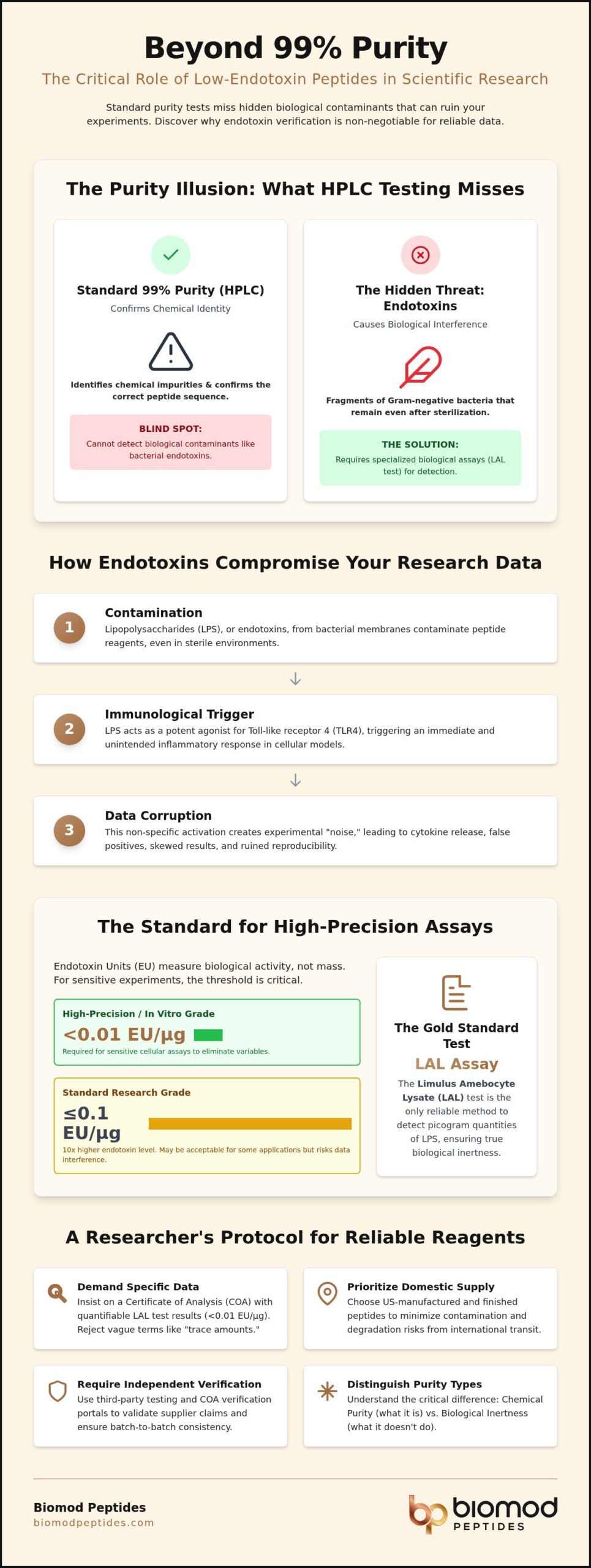
A Certificate of Analysis (COA) citing 99% purity refers strictly to chemical composition. It doesn’t account for biological contaminants. Endotoxins are lipopolysaccharides (LPS) derived from the outer membrane of Gram-negative bacteria. Understanding Endotoxins requires recognizing their persistence. They’re heat-stable and resistant to standard sterilization. High-Performance Liquid Chromatography (HPLC) fails to detect these fragments. They exist at concentrations far below the UV absorbance threshold. HPLC confirms the peptide sequence is correct; it remains blind to the bacterial remnants that compromise data.
Bacterial growth isn’t limited to non-sterile environments. Many species thrive in common laboratory media, saline, and buffers. Even if the bacteria are filtered out, the shed LPS remains. High-precision assays demand low endotoxin peptides for research to avoid non-specific activation. This makes secondary verification essential. Specialized assays, such as the Limulus Amebocyte Lysate (LAL) test, ensure the reagent is truly inert. Without this, your baseline is compromised before the experiment begins.
The Mechanism of Immunological Interference in Research
LPS acts as a potent agonist for Toll-like receptor 4 (TLR4). When these contaminants enter a cellular model, they trigger an immediate inflammatory response. This activation results in unintended cytokine release. It creates significant “noise” in in vitro assays. This interference often leads to false positives or skewed results. Beyond cytokines, LPS induces free radical production. This oxidative stress damages cell membranes and alters protein expression. For high-precision studies, this lack of control ruins experimental reproducibility and wastes institutional resources.
Standards for Low Endotoxin Peptides: Units and Thresholds
The Endotoxin Unit (EU) serves as the primary metric for quantifying biological activity rather than physical mass. One EU correlates to the pyrogenicity of approximately 0.1 ng of E. coli LPS. Establishing rigorous Standards for Low Endotoxin Peptides is essential for modern reproducibility. While standard research grades often tolerate up to 0.1 EU/μg, high-precision assays require low endotoxin peptides for research with thresholds strictly below 0.01 EU/μg. Procuring low endotoxin peptides for research ensures that experimental variables are restricted to the intended peptide sequence.
The Limulus Amebocyte Lysate (LAL) test remains the gold standard for detection. It utilizes a specific coagulation cascade sensitive to even picogram quantities of LPS. This biological sensitivity is unmatched by traditional chemical analysis. For comprehensive quality control, researchers must integrate these results with a robust peptide purity verification protocol. This tiered approach confirms both chemical identity and biological cleanliness.
Interpreting the Certificate of Analysis (COA)
Analytical reports typically list endotoxin data in the “Biological Impurities” or “Quality Control” section. You’ll find specific EU/mg or EU/μg values here. It’s critical to differentiate between quantifiable EU levels and vague “trace amounts.” Vague terminology often signals a lack of rigorous testing. Authentic data provides a clear numerical benchmark for institutional accountability. To confirm the integrity of these reports, researchers can utilize the Biomod COA Verification Portal. This tool ensures that batch-specific data hasn’t been altered or recycled from previous lots. Maintaining a transparent verification chain is the only way to safeguard cellular models from immunological noise.
Procurement Protocols for High-Precision Research Reagents
Reliable experimental outcomes start with a secure, transparent supply chain. Prioritize US-manufactured and finished peptides to ensure tighter regulatory oversight. Domestic production minimizes the degradation and contamination risks inherent in international transit and customs processing. Independent third-party testing remains non-negotiable for maintaining laboratory accountability. Every lot must undergo stringent verification to confirm it meets the criteria for low endotoxin peptides for research. Specialized formats, such as peptide softgels for research, offer enhanced stability and protection against environmental factors. For Las Vegas laboratories seeking peptide reagents for labs, a rigorous vendor checklist is mandatory:
- Verification of batch-specific, independent Certificates of Analysis.
- Confirmation of US-based manufacturing and finishing processes.
- Documented endotoxin levels strictly below 0.01 EU/μg.
- Direct access to a third-party COA verification portal for institutional transparency.
Integrating Verified Peptides into Laboratory Workflows
Procuring clean reagents is the foundational step. Strict protocols must govern the handling of lyophilized peptides to prevent post-procurement contamination. Use pyrogen-free glassware and certified endotoxin-free water for all reconstitution steps. When improving peptide solubility, ensure that necessary pH adjustments don’t introduce new bacterial fragments or chemical noise. Every step must be executed with laboratory-grade precision to maintain the reagent’s biological status.
Maintaining a sterile environment during every aliquot stage is vital for data integrity. To understand the structural advantages of a disciplined, US-based supply chain, researchers should review the Biomod About page. This level of logistical transparency ensures that the reagent’s biological integrity matches the rigor of the scientific inquiry. It’s the only way to eliminate the immunological variables that compromise modern low endotoxin peptides for research and the resulting laboratory data.
Advancing Experimental Integrity Through Verified Reagents
Chemical purity is a baseline, not a ceiling. Ensuring your laboratory work remains free from immunological noise requires a move toward rigorous biological validation. You’ve seen why standard HPLC metrics fail to detect the lipopolysaccharides that skew cellular assays. By prioritizing low endotoxin peptides for research with thresholds below 0.01 EU/μg, you eliminate critical variables that compromise reproducibility. The transition to US-manufactured reagents with independent third-party verification provides the structural integrity your data demands. Meticulous procurement isn’t just about quality; it’s about institutional accountability.
Biomod Peptides maintains these benchmarks through a disciplined supply chain and a dedicated COA verification portal. This transparency allows you to validate every batch before it enters your workflow. Secure High-Purity Reagents for Your Research at Biomod Peptides to ensure your findings are based on peptide activity rather than bacterial contaminants. Precise science requires precise materials.
Frequently Asked Questions
What is the acceptable endotoxin level for in vitro research?
Acceptable levels depend on the sensitivity of the assay; however, most high-precision cellular models require thresholds below 0.1 EU/mg. For highly sensitive immunological studies, researchers often demand low endotoxin peptides for research with levels strictly under 0.01 EU/μg. These benchmarks prevent non-specific activation of Toll-like receptors. Failing to meet these standards introduces significant biological noise into your data.
How does endotoxin contamination occur during peptide synthesis?
Contamination typically enters the workflow through non-pyrogen-free reagents, solvents, or water used during synthesis and purification. Gram-negative bacteria can survive in nutrient-poor media, shedding lipopolysaccharides into the product. Even if the bacteria are removed via filtration, the heat-stable endotoxins remain. Maintaining a sterile, US-based supply chain is essential for mitigating these risks at every manufacturing and finishing stage.
Does high HPLC purity mean a peptide is endotoxin-free?
High HPLC purity doesn’t guarantee the absence of endotoxins. HPLC measures the chemical identity of the peptide sequence; it cannot detect bacterial fragments at picogram concentrations. These contaminants are invisible to standard UV detectors used in chromatography. Comprehensive verification requires a secondary biological assay, such as the LAL test, to ensure biological cleanliness. This secondary step confirms the reagent is truly inert.
Why is US manufacturing important for endotoxin control in research peptides?
US manufacturing ensures tighter regulatory oversight and a secure logistics chain. Domestic finishing reduces the risk of contamination associated with international transit and prolonged customs inspections. By procuring low endotoxin peptides for research from a domestic source, laboratories benefit from transparent documentation. This proximity allows for more rigorous quality control and direct accountability for every batch produced within a controlled environment.
Disclaimer
BIOMOD products are sold strictly for laboratory, analytical, and scientific research use only. They are not intended for human or animal consumption, administration, application, ingestion, injection, or any therapeutic, diagnostic, or cosmetic use.
The statements made on this website have not been evaluated by the United States Food and Drug Administration. BIOMOD products are not intended to diagnose, treat, cure, mitigate, or prevent any disease or medical condition.
BIOMOD is a research chemical supplier. BIOMOD is not a compounding pharmacy or chemical compounding facility as defined under Section 503A of the Federal Food, Drug, and Cosmetic Act. BIOMOD is not an outsourcing facility as defined under Section 503B of the Federal Food, Drug, and Cosmetic Act.
By accessing this site, you confirm you are at least 21 years of age and that you have read and accepted the BIOMOD Terms of Sale, Privacy Policy, and Research Use Only Policy. BIOMOD does not provide dosing, medical, therapeutic, diagnostic, veterinary, or use guidance under any channel.