
Approximately 98% of small-molecule drugs fail to penetrate the blood-brain barrier. This reality makes the choice of administration route a decisive factor in experimental success. Researchers often struggle when comparing peptide delivery methods in animal models because rapid enzymatic degradation and poor absorption rates compromise data integrity. It’s a persistent challenge. You require precision to eliminate experimental noise. Inconsistent bioavailability in rodent models leads to skewed results. Even with the 2026 regulatory shifts following the FDA Modernization Act 2.0, animal models remain vital for validating novel delivery formats.
This analytical review provides a rigorous technical comparison of injectable, oral softgel, and intranasal delivery systems. You’ll learn how to optimize bioavailability and maintain peptide stability throughout the administration process. We’ll examine the specific pharmacokinetic advantages of each route. This includes bypassing first-pass metabolism and leveraging advanced permeation enhancers in oral formats. The objective remains focused. You must select a delivery method that meets high-purity standards and ensures research accuracy. We’ll also address how analytical verification through COA portals plays a critical role in validating these delivery protocols for metabolic and neurodegenerative research.
Key Takeaways
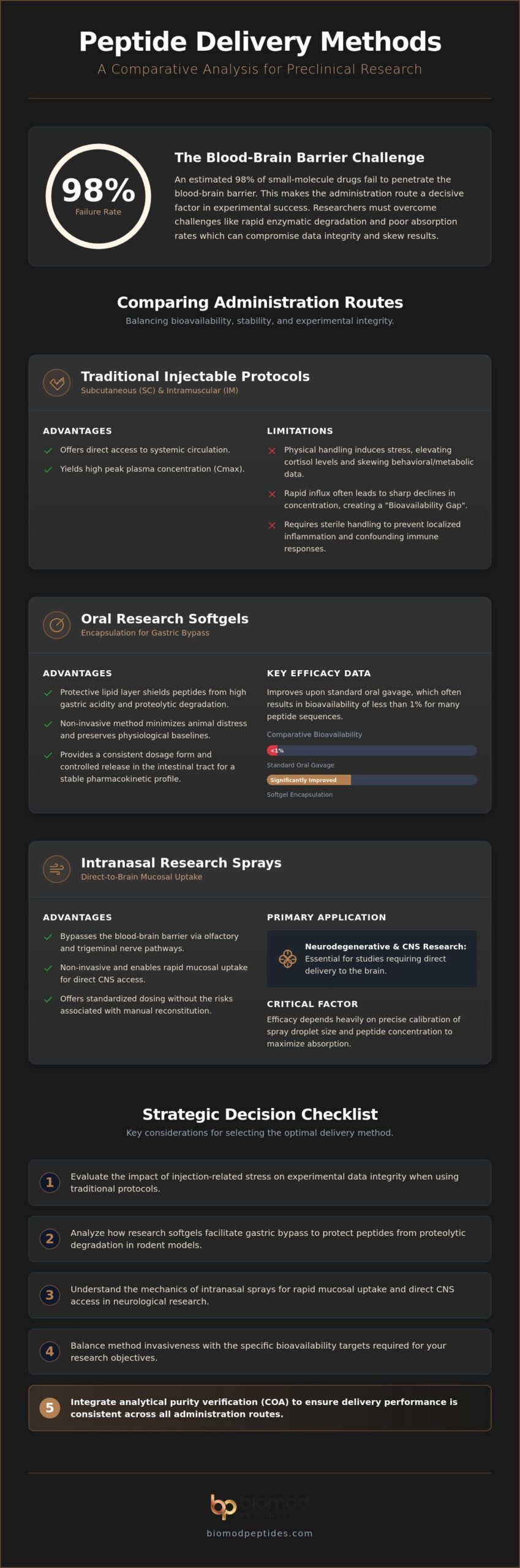
- Evaluate the impact of injection-related stress on experimental data integrity when utilizing traditional subcutaneous and intramuscular protocols.
- Analyze how research softgels facilitate gastric bypass to protect peptides from proteolytic degradation in rodent models.
- Understand the mechanics of intranasal sprays for rapid mucosal uptake and direct CNS bypass in neurological research applications.
- Utilize a strategic decision matrix for comparing peptide delivery methods in animal models to balance invasiveness with specific bioavailability targets.
- Integrate analytical purity verification through COA portals to ensure delivery performance remains consistent across all administration routes.
Traditional Injectable Protocols vs. Modern Delivery Systems
Subcutaneous (SC) and intramuscular (IM) injections remain the primary baselines for evaluating drug delivery methods in preclinical settings. These routes offer direct access to systemic circulation and typically yield a high peak plasma concentration (Cmax) shortly after administration. However, this rapid influx often leads to sharp declines in peptide concentration. It’s a persistent challenge for researchers seeking to maintain steady-state levels. The resulting “Bioavailability Gap” highlights the discrepancy between immediate systemic presence and long-term metabolic stability. When comparing peptide delivery methods in animal models, you must weigh these pharmacokinetic spikes against the physiological costs of the administration itself.
Limitations of Injection-Based Research
Injection-based protocols require strict sterile handling to prevent localized inflammation. Even minor site reactions can trigger immune responses that confound analytical results. Repeated dosing schedules present a significant challenge for longitudinal studies. The physical handling required for daily injections induces measurable stress in rodent models. This stress elevates cortisol levels and skews behavioral data. It alters metabolic baselines. These variables introduce experimental noise that often necessitates larger sample sizes to achieve statistical significance.
The Rise of Non-Invasive Delivery Formats
Modern research demands methods that minimize animal distress while maintaining reagent integrity. The development of peptide softgels for research represents a shift toward more disciplined methodology. Softgels provide a consistent oral dosage form that eliminates the need for repeated needle use. Similarly, peptide spray products utilize mucosal absorption to achieve systemic entry. These non-invasive formats support the refinement of experimental designs. They allow for more accurate data collection in metabolic and neurodegenerative studies by preserving the animal’s baseline physiological state.
Comparative Efficacy of Research Softgels and Intranasal Sprays
Selecting between encapsulation and mucosal absorption requires a deep understanding of reagent stability. When comparing peptide delivery methods in animal models, the primary objective is to bypass biological barriers without compromising structural integrity. Modern research utilizes modern peptide-based carriers to achieve this. These systems offer distinct advantages over crude administration. They ensure that the specific concentration reaching the target site is both predictable and reproducible. Rigorous data collection depends on this precision.
Mitigating Gastric Degradation with Softgel Encapsulation
Softgel formats utilize a protective lipid layer. This layer shields the peptide from high gastric acidity and proteolytic degradation in the stomach. Standard oral gavage often results in low bioavailability, frequently measured at less than 1% for many sequences. Peptide softgels improve this by facilitating a controlled release in the intestinal tract. This method minimizes the dosing variance common in manual gavage protocols. It provides a more stable pharmacokinetic profile across porcine and rodent cohorts. Stability remains consistent from manufacturing to administration.
Intranasal Delivery for Targeted Research Applications
Intranasal sprays offer a non-invasive direct-to-brain pathway. They bypass the blood-brain barrier via the olfactory and trigeminal nerves. This is essential for neurodegenerative research. The efficiency of this route depends heavily on droplet size and concentration. You must ensure precise calibration in intranasal peptide research sprays to maximize mucosal uptake. Stability requirements vary across these formats. Encapsulated softgels provide protection against environmental oxidation, while peptide spray products offer standardized dosing without the risks of manual reconstitution. This consistency is critical for comparing peptide delivery methods in animal models with high statistical power. For those establishing new laboratory protocols, utilizing verified research reagents ensures that the delivery method doesn’t become a source of experimental error.
Strategic Selection: Matching Delivery to Research Objectives
The final selection of an administration route depends on the specific pharmacokinetic targets of the study. When comparing peptide delivery methods in animal models, researchers must balance the physiological stress of invasive procedures against the potential for lower bioavailability in oral or nasal formats. A rigorous decision matrix prioritizes data stability. It accounts for the reagent’s structural integrity and the animal’s baseline metabolic state. Precision in this phase prevents the introduction of confounding variables that can undermine months of longitudinal observation.
The Impact of Purity on Delivery Outcomes
HPLC-verified purity ensures that an observed lack of efficacy in a trial is a result of the delivery method’s limitations rather than a failure of the underlying reagent. Researchers should utilize the Biomod verification portal for every batch to confirm molecular weight and sequence accuracy before administration. Integrating peptide purity verification into the experimental methodology eliminates a critical variable. It prevents the misinterpretation of pharmacokinetic data and ensures that the delivery system is evaluated on its technical merits alone.
Optimizing Protocols for Las Vegas Research Facilities
Facilities in high-temperature environments like Nevada face unique logistical challenges regarding reagent stability. Maintaining cold chain integrity is paramount during the procurement and storage phases. For Las Vegas laboratories, US-manufactured reliability ensures that reagents don’t degrade during transit. Bulk procurement is often necessary for long-term longitudinal animal studies to maintain batch consistency and reduce inter-trial variability. This disciplined approach to sourcing is essential for comparing peptide delivery methods in animal models with high statistical power.
Utilizing a specialized laboratory peptide supply allows researchers to secure large quantities of third-party tested materials. It ensures that every administration route remains consistent throughout the study’s duration. Documentation through certificates of analysis (COA) must be archived as a primary component of the research record. This commitment to transparency supports the refinement of methodology and ensures that every result is backed by empirical proof of reagent quality.
Advancing Preclinical Accuracy Through Methodological Refinement
Precision in administration is the cornerstone of reproducible data. Whether utilizing traditional injections or transitioning to modern systems like softgels and sprays, the primary objective is minimizing physiological interference. Comparing peptide delivery methods in animal models requires a disciplined evaluation of both the administration route and the reagent’s underlying purity. Standardizing these protocols ensures that metabolic and behavioral baselines remain intact throughout the duration of longitudinal studies. This methodology eliminates experimental noise and focuses results on objective biological responses.
Reliability starts with verification. Every batch must meet stringent laboratory standards to prevent reagent failure from masquerading as delivery failure. Biomod Peptides provides US-manufactured reagents that are third-party tested for analytical precision. Researchers can access a dedicated COA verification portal to validate the structural integrity of every sequence before beginning a trial. This commitment to transparency supports the advancement of high-tier research and the refinement of delivery technologies.
Explore High-Purity Research Peptides and Delivery Systems at Biomod Peptides. Secure the integrity of your next study with reagents optimized for sophisticated research environments.
Frequently Asked Questions
Which animal model is best for evaluating oral peptide delivery?
Dogs are the most widely used large animal model for oral peptide delivery because their gastrointestinal physiology offers unique translatability. However, rodent models remain the standard for initial high-throughput screening. When comparing peptide delivery methods in animal models, rats are often preferred over mice due to their larger blood volume. This facilitates serial sampling, which is necessary for accurate pharmacokinetic profiling and the determination of absorption kinetics.
How do peptide softgels improve bioavailability compared to oral liquids?
Peptide softgels improve bioavailability by providing a protective lipid barrier against gastric acidity and proteolytic degradation. Oral liquids are immediately exposed to stomach enzymes that rapidly dismantle peptide bonds. Encapsulation ensures the reagent reaches the intestinal tract intact for absorption. This method reduces the dosing variance often seen with manual gavage. It leads to more predictable systemic concentrations and a more stable pharmacokinetic profile in the research subject.
Can intranasal peptide sprays effectively bypass the blood-brain barrier in research?
Intranasal sprays bypass the blood-brain barrier by utilizing olfactory and trigeminal nerve pathways for direct access to the central nervous system. This route avoids the first-pass metabolism and systemic clearance that typically degrade peptides in the bloodstream. It’s a highly effective method for delivering reagents to the brain in neurodegenerative research. Precision in droplet size and concentration is required to maximize mucosal uptake and ensure consistent delivery to target tissues.
Why is third-party testing critical when comparing delivery methods?
Third-party testing is essential because it confirms the reagent’s purity and sequence, ensuring that manufacturing defects don’t skew experimental data. Without independent validation, it’s impossible to know if a delivery failure is actually a reagent failure. Utilizing a COA verification portal provides empirical proof of structural integrity. This transparency is vital when comparing peptide delivery methods in animal models to ensure that conclusions are based on technical merit.
Disclaimer
BIOMOD products are sold strictly for laboratory, analytical, and scientific research use only. They are not intended for human or animal consumption, administration, application, ingestion, injection, or any therapeutic, diagnostic, or cosmetic use.
The statements made on this website have not been evaluated by the United States Food and Drug Administration. BIOMOD products are not intended to diagnose, treat, cure, mitigate, or prevent any disease or medical condition.
BIOMOD is a research chemical supplier. BIOMOD is not a compounding pharmacy or chemical compounding facility as defined under Section 503A of the Federal Food, Drug, and Cosmetic Act. BIOMOD is not an outsourcing facility as defined under Section 503B of the Federal Food, Drug, and Cosmetic Act.
By accessing this site, you confirm you are at least 21 years of age and that you have read and accepted the BIOMOD Terms of Sale, Privacy Policy, and Research Use Only Policy. BIOMOD does not provide dosing, medical, therapeutic, diagnostic, veterinary, or use guidance under any channel.