
A static PDF isn’t a guarantee of chemical purity. It’s a claim that requires objective validation. In an industry where overseas suppliers often prioritize volume over precision, securing verified peptide certificates of analysis is the only way to mitigate the risk of forged data. A document that lacks an independent audit trail is a liability to your research.
You understand that batch-to-batch inconsistency is more than a logistical hurdle. It’s a fundamental threat to the integrity of your findings. This guide establishes a rigorous protocol for auditing your reagents. It provides the technical criteria required to evaluate HPLC and Mass Spectrometry reports with professional confidence. We will detail the specific markers of analytical-grade purity, the current USP <1503> quality attributes, and the transition toward cryptographic digital verification to ensure your materials meet the highest standards of structural integrity.
Key Takeaways
- Identify the essential components of verified peptide certificates of analysis to establish a rigorous baseline for research integrity.
- Execute a 4-step audit protocol to cross-reference batch numbers and analyze HPLC chromatograms for precise impurity profiles.
- Distinguish between authentic analytical data and fabricated reports by evaluating peak integration patterns and mass spectrometry signatures.
- Utilize the COA Verification Portal to access a live, cryptographic audit trail for every batch of research material.
- Validate reagent identity against USP <1503> quality attributes to ensure laboratory-grade purity and batch-to-batch consistency.
The Architecture of Verified Peptide Certificates of Analysis
A Certificate of Analysis (COA) is a batch-specific analytical record. It functions as the primary document for quality assurance in a sector where pharmaceutical-grade oversight is often absent. For laboratory researchers, verified peptide certificates of analysis are not optional. They represent the only empirical proof of chemical identity and structural integrity. Without them, data reproducibility is impossible.
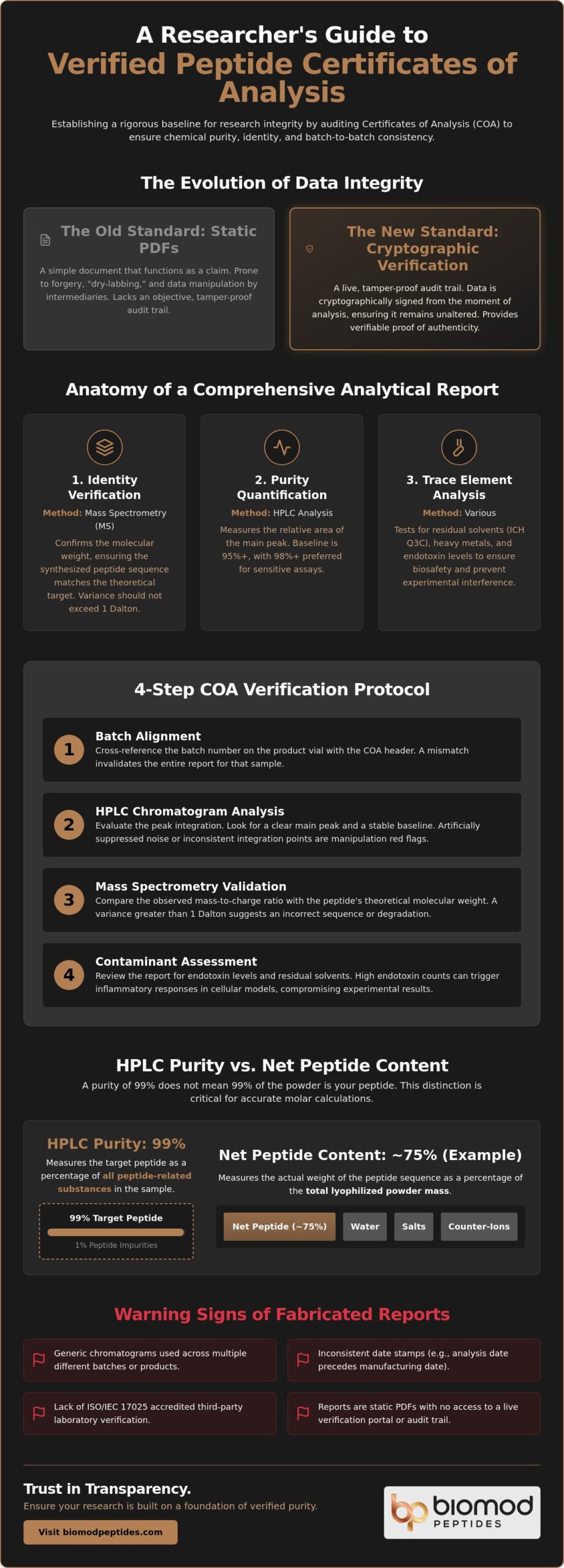
In 2026, the standard for verification has evolved. Static PDF documents are no longer sufficient for high-stakes research. The industry is moving toward cryptographically signed verification trails. This shift ensures that analytical data remains tamper-proof from the moment it leaves the laboratory. It eliminates the possibility of data manipulation by intermediaries.
Primary Components of an Analytical Report
Precision requires a multi-layered approach to testing. A comprehensive report must include:
- Identity Verification: Mass Spectrometry (MS) confirms the molecular weight. It ensures the synthesized sequence matches the theoretical target.
- Purity Quantification: High-Performance Liquid Chromatography (HPLC) measures the relative area of the main peak. For most research applications, a minimum purity of 95% is the baseline, while 98% or higher is preferred for sensitive assays.
- Trace Element Analysis: This includes testing for residual solvents according to ICH Q3C(R9) guidelines. It also covers heavy metals and endotoxin levels to ensure biosafety.
Third-Party vs. In-House Verification
In-house testing presents an inherent conflict of interest. It lacks the objective distance required for rigorous validation. Reliable research demands third-party laboratories that hold ISO/IEC 17025 accreditation. This external oversight is the only effective defense against “dry-labbing,” a fraudulent practice where suppliers generate reports without performing physical analysis. Independent verification ensures that the verified peptide certificates of analysis you review are grounded in actual laboratory data rather than marketing claims. At Biomod, we prioritize this transparency by anchoring our results in third-party validation.
How to Audit a Peptide COA: A 4-Step Verification Protocol
Auditing a report requires more than a cursory glance at the final purity percentage. A rigorous audit follows a reproducible sequence to ensure data validity. This protocol aligns with the FDA Good Manufacturing Practice Guidance regarding documentation and traceability for active ingredients.
- Step 1: Batch Alignment. Cross-reference the batch number on the physical product vial with the header of the verified peptide certificates of analysis. Any discrepancy here renders the entire report void for that specific sample.
- Step 2: HPLC Chromatogram Analysis. Evaluate the peak integration. Authentic reports show a clear main peak with a stable baseline. If the baseline noise appears artificially suppressed or the integration start and stop points are inconsistent, the purity data may be manipulated.
- Step 3: Mass Spectrometry Validation. Compare the observed mass-to-charge ratio with the theoretical molecular weight of the peptide. A variance exceeding 1 Dalton indicates an incorrect sequence or significant chemical degradation.
- Step 4: Contaminant Assessment. Review the report for endotoxin levels and residual solvents. High endotoxin counts can induce inflammatory responses in cellular models, which compromises the integrity of your experimental outcomes.
Interpreting HPLC Purity vs. Net Peptide Content
A purity rating of 99% does not indicate that 99% of the lyophilized powder is peptide. Lyophilized products naturally contain residual water, counter-ions like TFA, and various salts used during the synthesis and purification process. Net Peptide Content is the actual weight of the peptide sequence within the total mass. Understanding this distinction is vital for accurate molar calculations in your laboratory protocols. Sourcing analytical grade peptides that meet verified chemical standards ensures these nuances are clearly documented in every batch report. Using a reliable peptide provider ensures these nuances are clearly documented in every batch report.
Red Flags in Analytical Documentation
Template fraud is a persistent issue with overseas suppliers. Watch for generic chromatograms that appear identical across multiple different batches or products. Inconsistencies in date stamps, such as an analysis date that precedes the manufacturing date, are immediate indicators of “dry-labbing.” For high-output research facilities in Las Vegas, the demand for rapid, local verification is increasing to circumvent the risks associated with unverified international documentation. Professional confidence stems from an audit trail that is both transparent and chronologically logical. Implementing a structured peptide purity verification protocol is the most effective safeguard against these documentation failures.
Utilizing Digital Verification Portals for Data Integrity
Static PDF documents are no longer the gold standard for authentication. They are vulnerable to unauthorized modification. Live verification portals represent the next phase of research accountability. These platforms provide a real-time link between the physical reagent and the original third-party analytical data. For high-output procurement hubs like those in Las Vegas, this transparency is essential for maintaining institutional compliance and ensuring data reproducibility.
A digital audit trail simplifies the peer review process. It allows researchers to provide a cryptographic link to their material’s chemical integrity. This level of detail aligns with the standards defined in USP General Chapter <1080>, which establishes the baseline for data integrity in analytical reporting. Relying on verified peptide certificates of analysis through a centralized portal eliminates the ambiguity of manual document review.
Step-by-Step Portal Verification
Verification is an efficient, three-stage process. First, locate the unique batch ID or QR code found on Biomod Peptides packaging. Enter this identifier into the secure portal to retrieve the raw laboratory data directly from the source. This process ensures the verified peptide certificates of analysis you receive haven’t been tampered with during distribution. Always compare the portal-delivered chromatogram with any physical paperwork to confirm an exact match. Discrepancies should be reported immediately to ensure batch containment.
Integrating Verified Data into Lab Protocols
Modern laboratory management requires archiving these digital records within Electronic Lab Notebooks (ELNs). This practice is particularly vital for longitudinal studies involving intranasal peptide research sprays, where batch-to-batch consistency is paramount. For a comprehensive look at modern purity benchmarks, refer to our analysis on High Purity Research Peptides: Standards for Analytical Verification in 2026. By anchoring your research in verifiable data, you protect the validity of your scientific output and ensure your methodology remains beyond reproach.
Advancing Research Integrity through Analytical Rigor
Research integrity depends on the transition from passive document acceptance to active verification. Establishing a rigorous protocol for auditing HPLC and MS data ensures that every reagent meets specified molecular weight and purity benchmarks. Integrating these verified peptide certificates of analysis into your permanent laboratory records creates an immutable audit trail for future peer review. It’s the only way to ensure that your findings are built on a foundation of chemical accuracy.
Biomod eliminates the risks of data manipulation and batch inconsistency through a disciplined manufacturing framework. Our reagents are manufactured and finished in the United States; we subject every batch to independent, third-party testing. Our dedicated portal provides researchers with instant, transparent access to raw analytical data. Secure analytical-grade reagents through the Biomod Verification Portal to maintain total transparency in your chemical supply chain. Precision in the lab starts with accountability in the supply chain.
Frequently Asked Questions
What is the difference between HPLC and Mass Spectrometry in a peptide COA?
High-Performance Liquid Chromatography (HPLC) and Mass Spectrometry (MS) serve distinct analytical functions. HPLC measures the relative quantity of the target molecule against impurities to determine a purity percentage based on peak area integration. In contrast, Mass Spectrometry validates the molecular mass to confirm the chemical identity of the peptide sequence. Both are required to ensure the material is both pure and correctly identified.
Why is the purity level on my COA different from the net peptide content?
Purity indicates the percentage of the target peptide relative to other organic substances, but it doesn’t account for inorganic components. Lyophilized powders naturally contain residual water, salts, and counter-ions like TFA. Net peptide content represents the actual mass of the peptide sequence within the total weight of the powder. This distinction is critical for researchers performing precise molar calculations in laboratory protocols.
How can I tell if a peptide supplier’s COA is forged or manipulated?
Forged reports often exhibit “template” characteristics, where chromatograms appear identical across different batches or unrelated products. Look for inconsistencies in date stamps, such as analysis dates that precede manufacturing, or baseline noise that appears artificially suppressed. Accessing verified peptide certificates of analysis through a cryptographic digital portal is the most reliable method for detecting data manipulation and ensuring document authenticity.
Are third-party lab reports required for all research-grade peptides?
While not strictly mandated by a single regulatory body for materials in the research-grade “gray area,” third-party reports are essential for scientific integrity. They eliminate the conflict of interest inherent in in-house testing. Providing verified peptide certificates of analysis from an independent, ISO-accredited laboratory is often a prerequisite for peer-reviewed publication and ensures the reproducibility of your data.
Disclaimer
BIOMOD products are sold strictly for laboratory, analytical, and scientific research use only. They are not intended for human or animal consumption, administration, application, ingestion, injection, or any therapeutic, diagnostic, or cosmetic use.
The statements made on this website have not been evaluated by the United States Food and Drug Administration. BIOMOD products are not intended to diagnose, treat, cure, mitigate, or prevent any disease or medical condition.
BIOMOD is a research chemical supplier. BIOMOD is not a compounding pharmacy or chemical compounding facility as defined under Section 503A of the Federal Food, Drug, and Cosmetic Act. BIOMOD is not an outsourcing facility as defined under Section 503B of the Federal Food, Drug, and Cosmetic Act.
By accessing this site, you confirm you are at least 21 years of age and that you have read and accepted the BIOMOD Terms of Sale, Privacy Policy, and Research Use Only Policy. BIOMOD does not provide dosing, medical, therapeutic, diagnostic, veterinary, or use guidance under any channel.

2 Responses