
A peptide crash isn’t an irreversible failure. It’s a thermodynamic event triggered by sequence-specific hydrophobicity or suboptimal buffer conditions. You’ve likely experienced the frustration of watching a high-purity reagent transform into an unusable precipitate, leading to the urgent question: my peptide crashed out of solution what to do? The loss of expensive research reagents and the resulting delays in experimental timelines are significant setbacks for any laboratory. We recognize the gravity of maintaining sample integrity during recovery attempts. This guide outlines a disciplined, step-by-step protocol to re-solubilize crashed peptides using precise pH titration and strategic co-solvent application. You’ll learn how to navigate isoelectric points, utilize chaotropic agents like 6 M guanidine HCl, and implement preventive measures to ensure your research stays on track. Our methodology prioritizes analytical transparency and structural verification, transforming a potential loss into a repeatable laboratory standard. By utilizing analytical-grade reagents and following high-purity lyophilization standards, you can minimize these errors and maintain the rigorous benchmarks required for sophisticated research.
Key Takeaways
- Identify the thermodynamic triggers of precipitation, including concentration limits and buffer saturation points, to accurately diagnose why a solution has transitioned to a turbid suspension.
- Implement a systematic Solvent Titration Method to address the critical question of my peptide crashed out of solution what to do while maintaining the structural integrity of the reagent.
- Analyze peptide sequences for specific hydrophobic stretches, such as Leu, Ile, Val, and Phe, to predict aggregation risks and select appropriate co-solvents.
- Adopt the “Solubility First” protocol by testing small aliquots and utilizing deoxygenated solvents to prevent the irreversible oxidation of sensitive methionine or cysteine residues.
- Utilize US-manufactured, third-party verified peptides to ensure that solubility issues are sequence-dependent rather than the result of residual manufacturing impurities.
Immediate Assessment: Why Research Peptides Crash Out of Solution
“Crashing out” describes the rapid transition of research peptides from a clear, homogenous solution to a turbid or flocculent suspension. This physical state change signifies that the solute has exceeded its saturation point within a specific buffer system. If you’re currently asking “my peptide crashed out of solution what to do,” the first step is identifying the thermodynamic trigger. Precipitation often results from reaching strict concentration limits. While high-purity sequences from Biomod Peptides are lyophilized to minimize manufacturing impurities, residual salts like trifluoroacetate (TFA) can remain. These salts influence the initial solubility and local micro-environment upon reconstitution. Temperature also dictates aggregation kinetics. While lower temperatures generally stabilize sequences, they can also decrease the solubility constant, causing immediate precipitation upon refrigeration or during cold-chain handling.
The Isoelectric Point (pI) and pH Mismatch
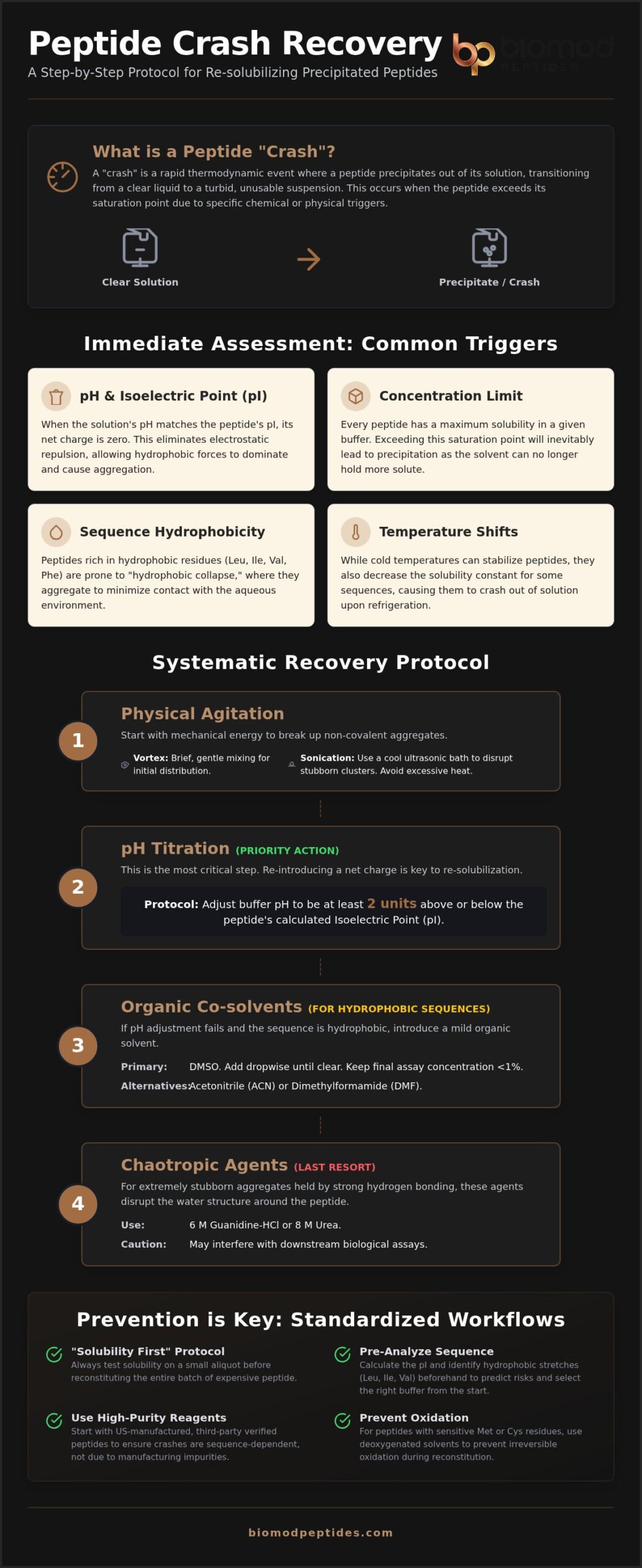
Peptides exhibit minimal solubility when the solution pH aligns with the peptide’s isoelectric point (pI). At this specific value, the molecule carries a net charge of zero. This lack of electrostatic repulsion allows hydrophobic interactions to dominate, leading to rapid aggregation. Researchers should calculate the theoretical pI by analyzing the ratio of acidic residues, such as Aspartate and Glutamate, to basic residues like Lysine, Arginine, and Histidine. To restore solubility, adjust the buffer pH to be at least two units above or below the calculated pI. This shift reintroduces a net charge, facilitating better interaction with the aqueous solvent and breaking the cycle of precipitation.
Physical Agitation: Sonication and Vortexing Protocols
Initial reconstitution often requires brief vortexing to ensure uniform distribution. Persistent particulates, however, require more intensive disruption through mechanical energy. Sonication is the use of sound energy to disrupt non-covalent peptide aggregates. This method is highly effective for breaking apart stubborn clusters that resist simple stirring. Use an ultrasonic water bath for controlled energy transfer rather than a probe sonicator to minimize sample loss. You must avoid prolonged exposure. Excessive heat generation during sonication can lead to peptide deamidation, particularly in sequences containing asparagine or glutamine. Maintain the water bath at a controlled, cool temperature to preserve the structural integrity of the sequence during the recovery process.
Advanced Recovery Protocols for Hydrophobic Sequences
Effective recovery requires a systematic hierarchy of intervention. Always prioritize pH adjustment before introducing organic co-solvents. If a sequence remains insoluble after titration, you must analyze the primary structure for hydrophobic stretches. Sequences containing clusters of Leucine (Leu), Isoleucine (Ile), Valine (Val), or Phenylalanine (Phe) are prone to hydrophobic collapse. The choice of counter-ion also dictates solubility. Basic peptides prepared as Trifluoroacetate (TFA) salts typically exhibit higher solubility in aqueous buffers than Acetate salts. When these biochemical factors align to cause a precipitate, the question of my peptide crashed out of solution what to do shifts from diagnosis to the Solvent Titration Method. This protocol minimizes the volume of organic modifiers to preserve the integrity of your downstream assays.
Utilizing Organic Co-solvents: DMSO and Acetonitrile
For sequences with high hydropathy scores, 100% DMSO is the most effective recovery agent. Add DMSO dropwise to the precipitate while swirling gently. Continue this process only until the solution achieves optical clarity. You must monitor the final concentration carefully; most laboratory assays require a final DMSO concentration of less than 1% to avoid cellular toxicity or enzymatic interference. If DMSO is incompatible with your protocol, Acetonitrile or DMF serve as viable alternatives for disrupting recalcitrant hydrophobic aggregates. Sourcing analytical grade peptides ensures that these recovery steps aren’t further complicated by residual manufacturing impurities.
Chaotropic Agents and Detergents
Strong intermolecular hydrogen bonding occasionally creates aggregates that resist standard organic solvents. In these instances, utilize chaotropic agents like 8 M Urea or 6 M Guanidine-HCl. These compounds disrupt the stabilized water structure around the peptide, forcing the aggregate to dissociate. For amphiphilic sequences, non-ionic detergents such as Tween-20 or Triton X-100 at concentrations of 0.01% to 0.1% can prevent surface adsorption and stabilize the solution. For more sequence-specific data, consult our technical guide on Improving Peptide Solubility: Analytical Protocols.
Stability and Prevention: Standardized Reconstitution Workflows
Preventing peptide aggregation begins with a “Solubility First” protocol. Before committing an entire lot to a buffer system, you must test a small 1 mg aliquot. This pilot test identifies potential incompatibilities without risking the bulk of your reagent. If you are currently troubleshooting why my peptide crashed out of solution what to do, your next step is refining the solvent environment. Use only sterile, deoxygenated solvents to prevent the oxidation of sensitive residues like methionine or cysteine. Las Vegas laboratories must account for extreme local aridity and temperature fluctuations during reagent handling. High ambient heat can accelerate solvent evaporation, inadvertently increasing peptide concentration beyond the saturation point and triggering immediate precipitation.
The Role of Lyophilization Quality in Solubility
The physical structure of the lyophilized product dictates its wetting kinetics. High-purity research peptides manufactured by Biomod Peptides in the US are processed to create a high surface-area “cake.” This porous structure allows for rapid and uniform solvent penetration. In contrast, a “collapsed” cake indicates moisture intrusion or thermal stress during the sublimation process. Collapsed cakes possess significantly lower surface area, often leading to poor solubility and the formation of insoluble “clumps” that eventually crash out. Researchers should always verify batch-specific analytical data through the COA Verification Portal to ensure the structural integrity of the lyophilized reagent before reconstitution.
Long-term Storage to Prevent Secondary Precipitation
Once you have successfully solubilized a peptide, maintaining that state requires disciplined storage. Avoid repeated freeze-thaw cycles. These cycles create localized concentration gradients and temperature shifts that promote irreversible aggregation. Recovered solutions should be aliquoted into single-use volumes immediately after clarity is achieved. Store these aliquots at -20°C or -80°C to preserve the solubilized state. For peptides prone to oxidation, consider an argon or nitrogen overlay before sealing the vials. For a comprehensive framework on validating your stored samples, refer to the Protocol for Peptide Purity Verification. This systematic approach ensures that your research reagents remain stable, predictable, and analytically valid throughout the duration of your study.
Standardizing Reconstitution for Analytical Success
Precision in the laboratory requires a disciplined approach to solubility management. The protocols outlined here offer a rigorous path to address the question: my peptide crashed out of solution what to do? By utilizing systematic pH titration and strategic co-solvent application, you can reverse precipitation while maintaining the structural integrity of your research reagents. Successful recovery hinges on identifying hydrophobic stretches and understanding the thermodynamic triggers specific to your sequence. High-purity lyophilization and US-based manufacturing provide the necessary foundation for predictable reconstitution. Our methodology emphasizes analytical transparency and standardized storage to eliminate secondary precipitation risks. Institutional verification remains the primary justification for reagent selection to ensure experimental reproducibility.
Secure High-Purity Reagents for Your Next Study at Biomod Peptides. Our products are US-manufactured and finished. Every lot undergoes independent third-party testing. We provide full analytical transparency through our COA verification portal. This commitment to quality control minimizes unexpected lab errors and supports the advancement of your research niche. Maintain professional confidence in your data by choosing reagents backed by empirical proof. Your next breakthrough depends on the integrity of your materials.
Frequently Asked Questions
Is a peptide still viable after it has crashed out of solution?
Yes, a peptide typically remains chemically viable after precipitation because “crashing out” is a reversible physical event. This process involves non-covalent aggregation rather than the degradation of the primary amino acid sequence. If you’re currently asking my peptide crashed out of solution what to do, your priority is re-solubilization through the systematic titration protocols. Peptide integrity is maintained as long as you avoid harsh reagents or excessive mechanical stress during the recovery phase.
Can I use heat to help my research peptide dissolve?
Heat is generally contraindicated for dissolving research peptides due to the risk of thermal degradation. While increased temperatures can improve solubility constants, they also accelerate deamidation of asparagine residues and oxidation of methionine. Instead of heat, utilize mechanical disruption via an ultrasonic water bath. This method breaks intermolecular aggregates without the structural risks associated with high thermal energy. If you must use heat, never exceed 37°C and limit exposure to brief intervals.
How does the choice of buffer (PBS vs. Saline) affect peptide solubility?
Buffer choice dictates the ionic strength and pH stability of the solution, which directly impacts the peptide’s saturation point. Phosphate Buffered Saline (PBS) maintains a physiological pH of 7.4; this may be too close to the isoelectric point of specific sequences. Standard saline lacks buffering capacity, allowing the peptide’s own chemical properties to shift the final pH. High salt concentrations in either buffer can also cause “salting out,” where ions compete for hydration, leading to precipitation.
What should I do if my peptide forms a gel instead of a precipitate?
Gelation indicates the formation of an organized fibrillar network, which is common in amphiphilic or highly hydrophobic sequences. If this occurs, the question of my peptide crashed out of solution what to do requires disrupting the secondary structure. Use chaotropic agents like 6 M Guanidine-HCl or implement a significant pH shift to break the hydrogen bonding network. Dilution is also effective, as gelation is highly concentration-dependent. Always verify the resulting solution’s clarity and analytical validity via a COA portal.
Disclaimer
BIOMOD products are sold strictly for laboratory, analytical, and scientific research use only. They are not intended for human or animal consumption, administration, application, ingestion, injection, or any therapeutic, diagnostic, or cosmetic use.
The statements made on this website have not been evaluated by the United States Food and Drug Administration. BIOMOD products are not intended to diagnose, treat, cure, mitigate, or prevent any disease or medical condition.
BIOMOD is a research chemical supplier. BIOMOD is not a compounding pharmacy or chemical compounding facility as defined under Section 503A of the Federal Food, Drug, and Cosmetic Act. BIOMOD is not an outsourcing facility as defined under Section 503B of the Federal Food, Drug, and Cosmetic Act.
By accessing this site, you confirm you are at least 21 years of age and that you have read and accepted the BIOMOD Terms of Sale, Privacy Policy, and Research Use Only Policy. BIOMOD does not provide dosing, medical, therapeutic, diagnostic, veterinary, or use guidance under any channel.