
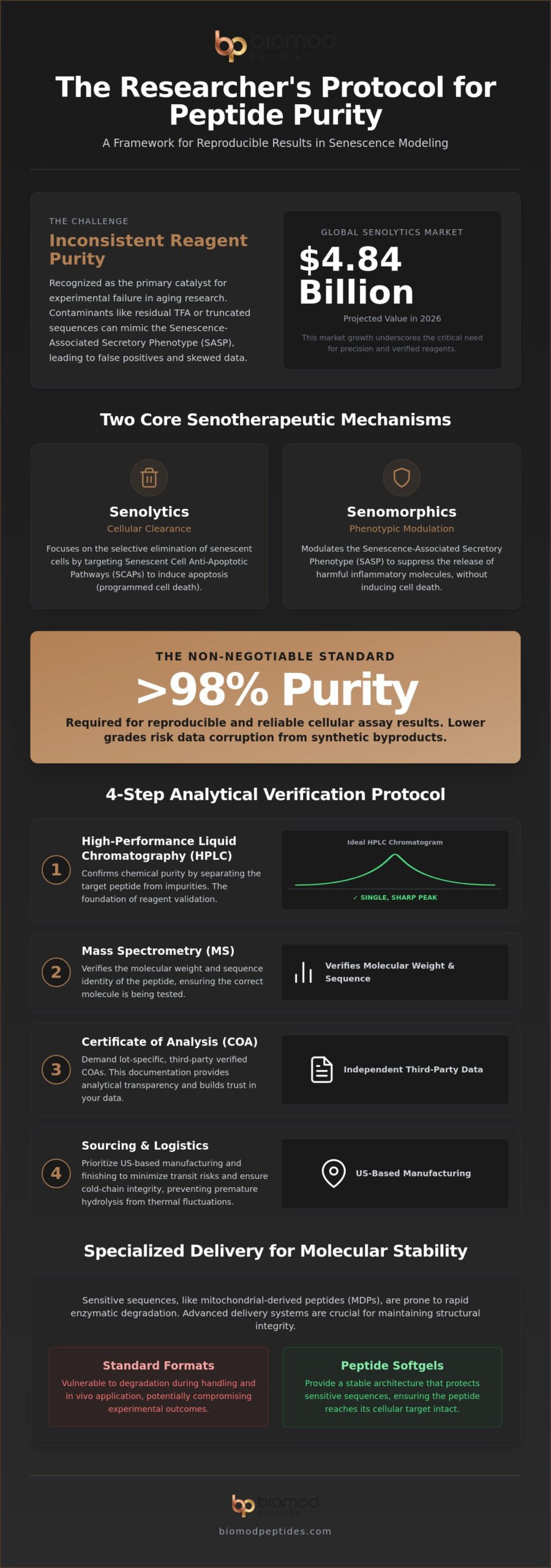
Reproducible results in senotherapeutic modeling depend less on the peptide sequence itself and more on the integrity of the delivery architecture and the rigor of the verification protocol. Researchers recognize that inconsistent reagent purity is the primary catalyst for experimental failure in aging research. With the global senolytics market valued at USD 4.84 billion in 2026, the demand for precision isn’t just a preference; it’s a requirement. Utilizing high-quality peptides for cellular senescence studies requires more than a simple procurement process. It demands a systematic approach to validation and chemical stability.
This technical guide provides researchers with a framework for selecting and verifying laboratory reagents that withstand the rigors of modern senolytic modeling. We’ll analyze the benefits of specialized delivery systems like softgels for maintaining molecular stability and detail how to establish a robust verification protocol using third-party HPLC and Mass Spec reports. By aligning your procurement with established analytical standards, you ensure that your data reflects biological reality. Accurate results. Verified purity. Structural integrity.
Key Takeaways
- Distinguish between senolytic and senomorphic mechanisms to refine targeting of the Senescence-Associated Secretory Phenotype (SASP).
- Identify the technical requirements for high-purity reagents, focusing on the necessity of >98% purity for reproducible cellular assays.
- Evaluate the stability and metabolic advantages of specialized delivery formats when selecting peptides for cellular senescence studies.
- Establish a verification protocol utilizing independent HPLC and Mass Spectrometry reports to ensure analytical transparency.
- Recognize the importance of transparent COA documentation and US-based manufacturing in maintaining laboratory-grade standards.
Mechanisms of Peptide-Based Senescence Modulation
Peptides function as precise modulators in cellular senescence research. They act by disrupting the molecular pathways that maintain senescent cell viability or by suppressing their pro-inflammatory output. These senotherapeutic agents are categorized based on their functional outcome: clearance or phenotypic modulation. Utilizing peptides for cellular senescence studies allows for the targeted disruption of protein-protein interactions that traditional small molecules often fail to address with equal specificity.
The modulation of Bcl-2 family proteins and p53 pathways represents a primary research focus. Synthetic peptides often mimic evolutionarily conserved sequences to act as competitive inhibitors. For example, peptides designed to interfere with the FOXO4-p53 interaction can selectively trigger apoptosis in senescent cells while sparing healthy tissue. This precision is vital for establishing reliable senotherapeutic models. By mimicking the binding interface of these proteins, researchers can bypass the broader toxicity associated with non-specific reagents.
Senolytics vs. Senomorphics in Laboratory Models
Senolytics focus on the selective clearance of senescent cells by targeting Senescent Cell Anti-Apoptotic Pathways (SCAPs). They lower the apoptotic threshold, forcing senescent cells into programmed death. Senomorphics take a different path. They modulate the Senescence-Associated Secretory Phenotype (SASP) without inducing cell death. This suppresses the secretion of interleukins and proteases that damage neighboring healthy cells. Researchers must choose between these mechanisms based on whether their model requires absolute cell removal or simply the mitigation of paracrine signaling.
Small Open Reading Frame (sORF) Peptides
Emerging research highlights mitochondrial-derived peptides (MDPs) as critical regulators of the aging process. These sORF-encoded sequences modulate metabolic stress and mitochondrial integrity during cellular decline. However, synthesizing high-purity sORF analogues presents significant technical hurdles. Minor sequence deviations can lead to a complete loss of function in biological assays. To combat the rapid enzymatic degradation common in vivo, researchers are shifting toward specialized delivery formats. Utilizing peptide softgels provides a stable architecture for these sensitive sequences, ensuring the peptide reaches its cellular target without premature breakdown.
Analytical Standards for Peptides in Senescence Studies
Precision in senescence modeling begins with analytical purity. For researchers investigating senotherapeutic peptide treatment, a purity threshold of >98% is non-negotiable. Lower grades often contain residual trifluoroacetic acid (TFA) or truncated sequences. These contaminants skew data. They trigger pro-inflammatory responses that mimic the SASP, leading to false positives in cellular assays. High-purity peptides for cellular senescence studies ensure that observed phenotypic changes result from the peptide itself, not synthetic byproducts. Structural integrity is the foundation of reproducibility.
High-Performance Liquid Chromatography (HPLC) and Mass Spectrometry (MS) provide the empirical proof of this integrity. HPLC confirms the chemical purity by separating the target peptide from impurities. MS verifies the molecular weight and sequence identity. Without these documents, a reagent is just an unverified powder. Researchers should implement a strict peptide purity verification protocol to maintain rigorous laboratory standards. Validation isn’t optional; it’s a requirement for high-impact research.
Interpreting HPLC and MS Reports
HPLC chromatograms must show a single, sharp peak. Broad peaks or secondary shoulders indicate degradation or synthesis failure. These impurities often interfere with Bcl-2 or p53 binding assays, leading to inconsistent results. Biomod provides lot-specific transparency through a COA verification portal. This allows labs to cross-reference every batch against independent third-party data before commencing an experiment. Verification builds trust in the data.
Procurement for Las Vegas Research Facilities
US-based manufacturing and finishing offer logistical security. For Las Vegas research facilities, localized supply chains minimize the risks associated with international transit. Cold-chain integrity is paramount. Peptides are sensitive to thermal fluctuations during the final mile of delivery. Maintaining a stable environment from the laboratory to the bench prevents premature hydrolysis. You can secure verified research reagents through US-manufactured sources to ensure structural consistency and rapid delivery times.
Comparative Analysis of Peptide Delivery Systems
Analytical purity is irrelevant if the reagent degrades before reaching the cellular target. While lyophilized powders remain the industry standard for storage, they require reconstitution protocols that introduce risks of contamination and thermal instability. Modern research requires advanced peptide delivery systems to ensure that peptides for cellular senescence studies maintain their structural integrity throughout the experiment. Selecting a delivery format depends on the required bioavailability and the specific tissue being modeled.
Traditional administration methods often struggle with rapid enzymatic hydrolysis. This is particularly problematic in systemic aging models where the peptide must survive complex metabolic environments. Specialized formats, such as softgels and intranasal sprays, provide a stable architecture that protects the peptide sequence from premature breakdown. These systems allow for more precise dosing and improved reproducibility compared to standard aqueous solutions.
Peptide Softgels: Enhancing Stability and Precision
Softgel encapsulation provides a protective barrier against oxidative stress and enzymatic degradation. This technology is essential for metabolic studies where oral administration is required. Utilizing peptide softgels for research ensures that the peptide remains stable until it reaches the intended site of absorption. This format standardizes the dosage across multiple cohorts, eliminating the variability often found in manual reconstitution and pipetting. It’s a disciplined approach to in vivo stability.
Research Sprays for Targeted Delivery
Neuro-senescence models require delivery methods that can bypass the blood-brain barrier (BBB). Intranasal pathways offer a direct route to the central nervous system, making intranasal peptide research sprays a primary tool for studying aging in neural tissues. Precision is the priority here. High-throughput research depends on the mechanical consistency of the spray nozzle. Every actuation must deliver a verified volume to ensure data integrity. Reliable delivery. Verified concentrations. Objective results.
Advancing Analytical Rigor in Senotherapeutic Modeling
The integrity of senotherapeutic models depends on the synergy between chemical purity and delivery architecture. High-purity peptides for cellular senescence studies are only as effective as the verification protocols supporting them. Researchers must prioritize reagents that exceed the 98% purity threshold to eliminate off-target pro-inflammatory responses and ensure data reproducibility. The transition from lyophilized powders to specialized formats like softgels and sprays represents a critical leap in maintaining molecular stability during complex administration protocols. These advancements allow for targeted delivery that reflects biological reality.
Biomod Peptides maintains a standard of absolute transparency for the research community. Every lot is US-manufactured and finished; it undergoes rigorous independent third-party testing to validate sequence integrity. Our online COA verification portal provides immediate access to HPLC and Mass Spec reports, allowing you to proceed with confidence in your internal laboratory benchmarks. By aligning your procurement with standardized analytical evidence, you secure the foundation of your experimental outcomes.
Explore Analytical Grade Peptides for Senescence Research
Precision is the only path to progress in cellular aging research. We’re committed to providing the structural integrity your methodology demands.
Frequently Asked Questions
Why is peptide purity critical for cellular senescence studies?
High purity prevents artifacts that interfere with cellular assays. Impurities such as truncated sequences or residual TFA can induce pro-inflammatory responses, leading to false positives in peptides for cellular senescence studies. Reproducibility depends on a purity threshold of >98%. This ensures that observed phenotypic changes result solely from the target peptide interaction rather than synthetic byproducts or chemical contaminants.
How do senotherapeutic peptides differ from traditional small molecule senolytics?
Senotherapeutic peptides provide superior target specificity compared to traditional small molecules. They function by disrupting precise protein-protein interactions, such as the FOXO4-p53 interface, which are often inaccessible to broader agents. This targeted approach reduces non-specific toxicity in healthy cells. While traditional senolytics may affect general pathways, peptides mimic evolutionarily conserved sequences for surgical-grade modulation of senescent cell anti-apoptotic pathways.
What are the benefits of using peptide softgels in research models?
Peptide softgels offer a stable architecture that protects sensitive sequences from enzymatic hydrolysis. This delivery format is essential for researchers requiring standardized dosing in oral metabolic models. Encapsulation prevents the rapid oxidation and degradation common with aqueous solutions. It provides a disciplined method for maintaining structural integrity from administration to cellular absorption, ensuring that the peptide reaches its target intact.
How can I verify the quality of research peptides in Las Vegas?
Quality verification is achieved through lot-specific documentation and independent third-party testing. Researchers in Las Vegas can utilize the Biomod COA verification portal to cross-reference HPLC and Mass Spec reports for every reagent batch. This system ensures analytical transparency and sequence integrity. Relying on US-manufactured and finished supplies provides a layer of logistical accountability and shipping reliability that international sources often lack.
Disclaimer
BIOMOD products are sold strictly for laboratory, analytical, and scientific research use only. They are not intended for human or animal consumption, administration, application, ingestion, injection, or any therapeutic, diagnostic, or cosmetic use.
The statements made on this website have not been evaluated by the United States Food and Drug Administration. BIOMOD products are not intended to diagnose, treat, cure, mitigate, or prevent any disease or medical condition.
BIOMOD is a research chemical supplier. BIOMOD is not a compounding pharmacy or chemical compounding facility as defined under Section 503A of the Federal Food, Drug, and Cosmetic Act. BIOMOD is not an outsourcing facility as defined under Section 503B of the Federal Food, Drug, and Cosmetic Act.
By accessing this site, you confirm you are at least 21 years of age and that you have read and accepted the BIOMOD Terms of Sale, Privacy Policy, and Research Use Only Policy. BIOMOD does not provide dosing, medical, therapeutic, diagnostic, veterinary, or use guidance under any channel.