
A single backorder shouldn’t be the death knell for a research project. Yet, with the unregulated peptide market estimated at up to $10 billion, urgency often leads to the acquisition of impure reagents. You’ve likely felt the frustration of stalled laboratory timelines while facing the risk of unverified vendors. Knowing what to do if your primary supplier is backordered is critical for maintaining the structural integrity of your data.
Transitioning to a secondary source requires more than a simple search; it demands a rigorous vetting process. This guide provides a clinical protocol for evaluating new suppliers, focusing on independent HPLC/MS testing and lot-specific COA verification. You’ll learn how to maintain cold-chain standards and match specialized formulations like softgels or sprays. This approach ensures that Las Vegas research projects minimize downtime while upholding laboratory-grade purity.
Key Takeaways
- Establish a reagent burn rate audit to determine exact depletion timelines and prioritize experiments based on project criticality.
- Identify what to do if your primary supplier is backordered by implementing a vetting protocol that requires lot-specific HPLC and Mass Spectrometry reports.
- Mitigate logistical risks and international customs delays by prioritizing US-manufactured and finished research reagents for your secondary supply chain.
- Ensure research continuity across diverse delivery methods, including specialized softgel and spray formats, without compromising analytical purity.
- Utilize dedicated COA verification portals to bridge the trust gap during supplier transitions and maintain strict laboratory-grade benchmarks.
Immediate Protocol for Backordered Research Reagents
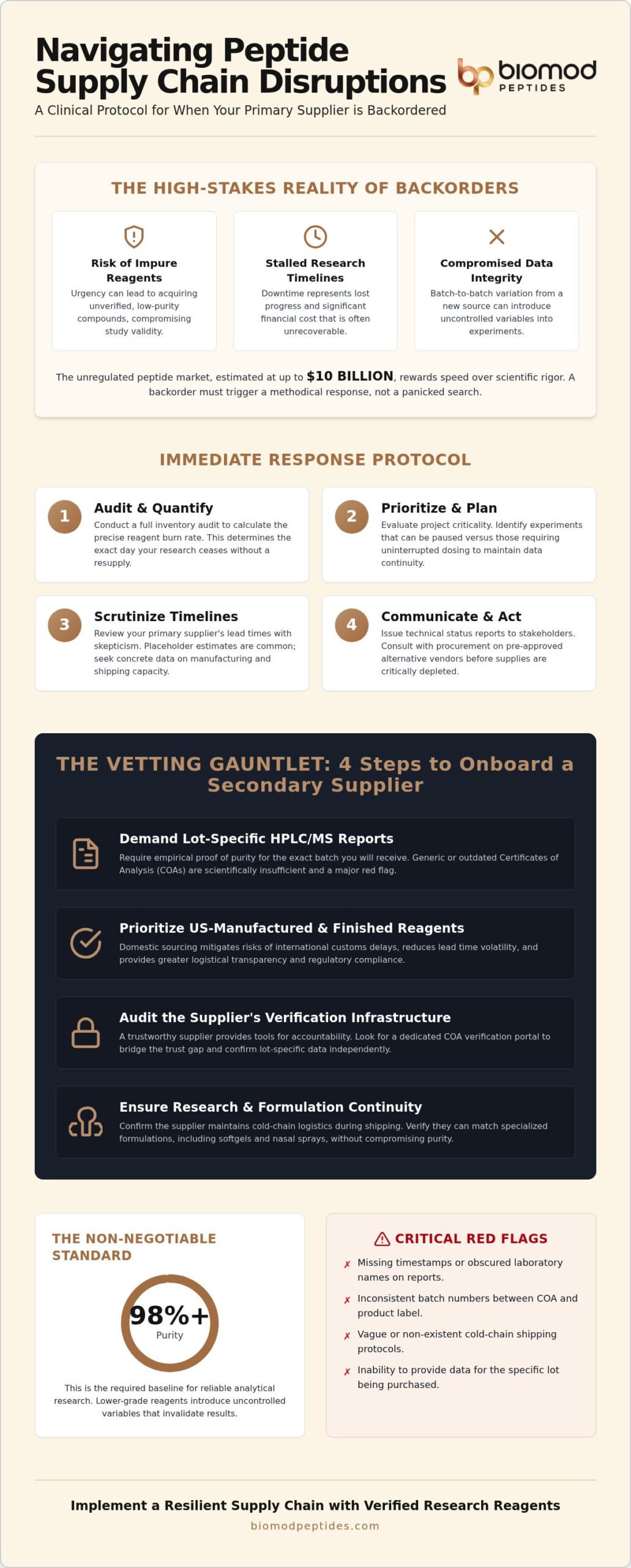
A backorder notification is a logistical failure that demands an immediate analytical response. Conduct an inventory audit to calculate the precise burn rate of remaining reagents. This metric determines the exact day your research ceases. Understanding what to do if your primary supplier is backordered starts with objective quantification. Determining what to do if your primary supplier is backordered involves more than finding a new vendor; it requires a systematic assessment of your current reagent status. Evaluate project criticality. Identify which experiments permit a temporary pause and which require uninterrupted dosing to maintain steady-state concentrations.
Review existing supplier lead times with skepticism. Vendors often provide placeholder estimates to prevent order cancellation. These dates lack the precision required for high-stakes research. A resilient supply chain requires verifying these windows against current customs data and manufacturing capacity. Assess the risks of batch-to-batch variation. Integrating a new lot of lyophilized peptides mid-study introduces biological variables. If you’re forced to switch vendors, the analytical purity of the new reagent must match your baseline lot to ensure data continuity.
Quantifying Laboratory Downtime and Project Impact
Calculate the temporal and financial cost of a research halt. Laboratory downtime represents lost progress that often cannot be recovered. Document the specific lot numbers currently in use. This documentation is essential for future comparison data if a transition to a secondary supplier occurs. High-throughput research requires constant verification of reagent integrity during these transitions.
Initial Communication with Procurement and Stakeholders
Issue technical status reports to principal investigators regarding potential timeline shifts. Transparency is a procedural requirement for maintaining accountability. Consult with procurement officers to review pre-approved alternative vendor lists. Act before the existing reagent supply reaches critical depletion. Early intervention prevents the acquisition of substandard reagents under duress.
Evaluating and Vetting Secondary Peptide Suppliers
Urgency is the enemy of analytical rigor. When determining what to do if your primary supplier is backordered, don’t bypass established safety protocols. High-purity research reagents require empirical proof of quality before laboratory integration. Vetting a secondary partner involves more than checking stock levels. It requires a systematic review of manufacturing transparency and analytical validation. Following a structured approach like the one outlined by NIST for Evaluating and Vetting Secondary Peptide Suppliers ensures your data remains untainted by substandard materials.
- Step 1: Demand lot-specific HPLC and Mass Spectrometry reports. Generic or outdated certificates are scientifically insufficient.
- Step 2: Verify manufacturing origin. Prioritize US-manufactured peptides to avoid international customs delays and logistical opacity.
- Step 3: Audit the supplier’s verification infrastructure. A dedicated COA verification portal provides the necessary transparency for lot-specific data.
- Step 4: Confirm cold-chain logistics. Stability protocols must remain intact during shipping to Las Vegas or regional research facilities.
Analyzing Analytical Grade Standards and Purity
A 98%+ purity level is the baseline for reliable analytical research. Contaminants in lower-grade reagents introduce uncontrolled variables into your study. Identify red flags in third-party reports. Missing timestamps, obscured laboratory names, or inconsistent batch numbers signal a lack of accountability. For a deeper technical breakdown, consult The Protocol for Peptide Purity Verification. Researchers looking for consistent lot-specific data can review verified research reagents to secure their supply chain before depletion occurs.
The Importance of US-Based Manufacturing and Finishing
Domestic production offers transparency benefits for regulatory compliance. US-finished products reduce the lead time volatility common with overseas suppliers. Customs interceptions are a frequent cause of project delays. By choosing a domestic source, you eliminate these bottlenecks. This logistical stability is vital when deciding what to do if your primary supplier is backordered mid-experiment. Analytical integrity depends on a predictable, verified supply chain.
Implementing a Resilient Supply Chain with Biomod Peptides
Backorders expose the fragility of single-source procurement. Establishing a dual-source strategy is the professional standard for mitigating these risks. Transitioning to Biomod Peptides provides access to US-manufactured research reagents that undergo independent third-party HPLC/MS testing. This transition isn’t just a stopgap; it’s a structural upgrade to your laboratory’s supply chain. By integrating a secondary provider before a crisis occurs, you ensure that your research methodology remains disciplined and uninterrupted.
The Biomod COA Verification Portal eliminates the trust gap when onboarding a new vendor. Researchers can validate lot-specific data immediately, ensuring analytical continuity. For Las Vegas-based laboratories, Biomod offers a distinct geographic advantage. Regional proximity enables rapid fulfillment and reduces the variables associated with long-distance logistics. When considering what to do if your primary supplier is backordered, regional stability is a critical factor for minimizing downtime. Localized finishing processes ensure that reagents move from the laboratory to your facility with minimal friction.
Specialized Formats: Softgels and Spray Products
Maintaining research continuity requires flexibility in delivery methods. Biomod provides specialized formats including Peptide Softgels and Spray Products. Softgels offer specific comparative benefits in analytical delivery research. They provide enhanced dosage precision and stability in non-lyophilized environments. These specialized formats allow for sophisticated experimental designs that traditional vials may not support, ensuring your project advances despite market shortages.
Securing Long-Term Analytical Grade Supply
Insulate your laboratory from market fluctuations through bulk lot reservations. This proactive approach secures a consistent batch for long-term studies, eliminating the risk of batch-to-batch variation. For a comprehensive overview of maintaining these benchmarks, refer to the Laboratory Peptide Supply Guide. Knowing what to do if your primary supplier is backordered is a reactive skill; securing a resilient, dual-sourced supply chain is a strategic necessity for any serious research institution.
Securing Analytical Continuity Through Strategic Procurement
Maintaining research momentum requires a shift from reactive purchasing to proactive supply chain management. By conducting immediate inventory audits and implementing a dual-source strategy, laboratories can insulate their data from market volatility. Rigorous vetting remains non-negotiable. Every secondary reagent must meet 98%+ purity benchmarks verified by independent third-party HPLC/MS testing. Knowing what to do if your primary supplier is backordered ensures that logistical failures don’t become analytical failures.
Reliability is built on transparency and regional stability. Biomod Peptides provides US-manufactured reagents with a dedicated COA verification portal to streamline laboratory onboarding. For regional facilities, Las Vegas-based fulfillment offers a critical advantage in speed and consistency. Don’t let a single-point failure compromise your study’s timeline or structural integrity. You can secure your research continuity with US-manufactured peptides from Biomod today. Precision in procurement leads to precision in results.
Frequently Asked Questions
How can I verify the purity of a secondary peptide supplier?
Verify purity by requesting independent, lot-specific High-Performance Liquid Chromatography (HPLC) and Mass Spectrometry (MS) reports. These documents provide empirical proof of the reagent’s identity and analytical purity. Cross-reference the data through a dedicated verification portal to ensure authenticity. This protocol is essential when determining what to do if your primary supplier is backordered to avoid compromising your research data with substandard materials.
Is it safe to switch peptide suppliers in the middle of a research project?
Switching suppliers mid-project is a calculated risk that requires rigorous lot-to-lot comparison. Reagents from a new source must match the baseline purity and salt content of your original supply. Discrepancies in these metrics can introduce uncontrolled variables into your study. Document all lot numbers and conduct small-scale validation before full integration to maintain experimental integrity. This step is a critical component of what to do if your primary supplier is backordered.
What are the risks of using peptides that are not US-manufactured?
Non-US-manufactured peptides often involve opaque supply chains and high lead-time volatility. International shipments are subject to customs interceptions and temperature fluctuations that can degrade lyophilized products. Domestic finishing ensures better cold-chain oversight and transparency. Utilizing US-manufactured reagents reduces the risk of receiving impure batches that haven’t undergone standardized third-party validation. This logistical security is vital for maintaining high-throughput laboratory timelines.
What should I look for in a Certificate of Analysis (COA) for research peptides?
A legitimate Certificate of Analysis must contain a lot-specific HPLC chromatogram and a Mass Spectrometry report. Verify that the document includes a recent timestamp, the specific lot number, and the name of the independent testing laboratory. Purity should meet or exceed the 98% threshold. Obscured laboratory names or missing molecular weight data are signs of administrative tampering. Meticulous COA review is the final barrier against analytical contamination.
Disclaimer
BIOMOD products are sold strictly for laboratory, analytical, and scientific research use only. They are not intended for human or animal consumption, administration, application, ingestion, injection, or any therapeutic, diagnostic, or cosmetic use.
The statements made on this website have not been evaluated by the United States Food and Drug Administration. BIOMOD products are not intended to diagnose, treat, cure, mitigate, or prevent any disease or medical condition.
BIOMOD is a research chemical supplier. BIOMOD is not a compounding pharmacy or chemical compounding facility as defined under Section 503A of the Federal Food, Drug, and Cosmetic Act. BIOMOD is not an outsourcing facility as defined under Section 503B of the Federal Food, Drug, and Cosmetic Act.
By accessing this site, you confirm you are at least 21 years of age and that you have read and accepted the BIOMOD Terms of Sale, Privacy Policy, and Research Use Only Policy. BIOMOD does not provide dosing, medical, therapeutic, diagnostic, veterinary, or use guidance under any channel.