
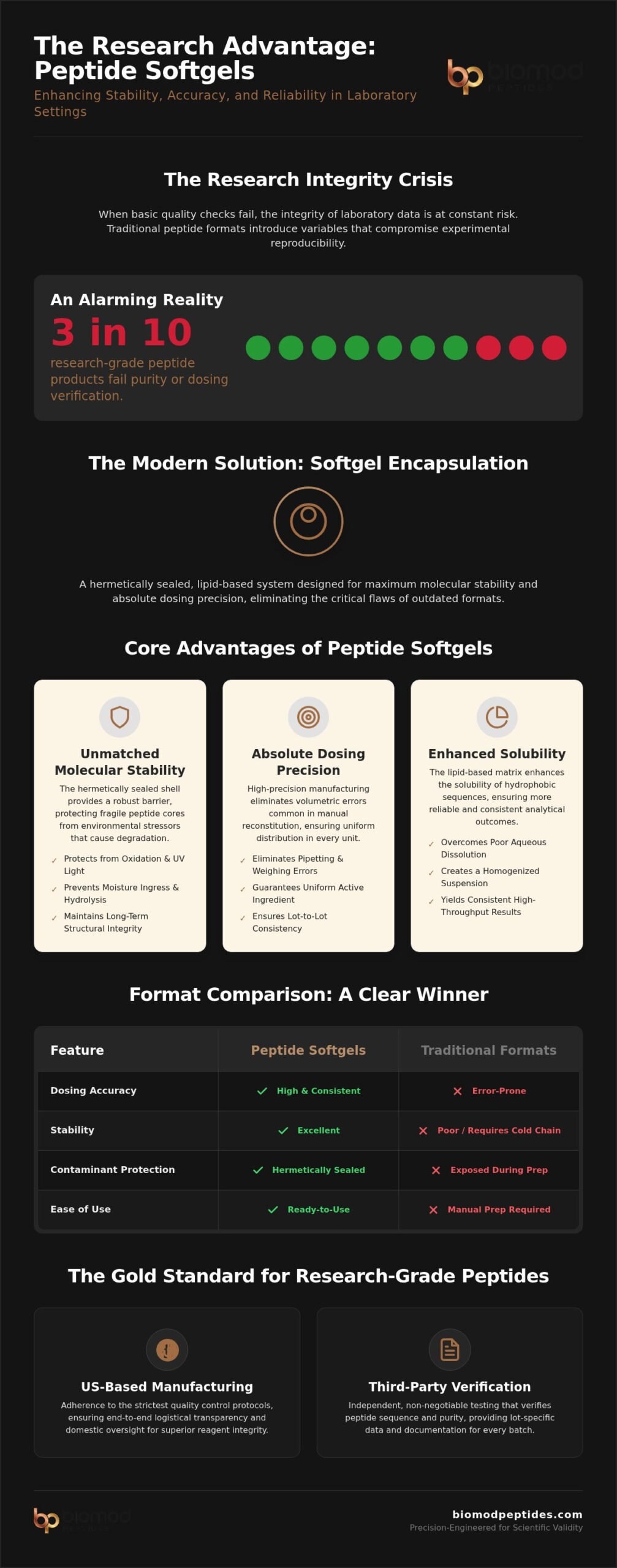
When approximately 3 in 10 research-grade peptide products fail basic quality checks for purity or dosing, the integrity of your laboratory data is at constant risk. Understanding the specific advantages of peptide softgels in research is critical for modernizing laboratory protocols. Traditional lyophilized formats often lead to inconsistent manual reconstitution. Rapid degradation during storage is a persistent threat. These variables introduce noise into sensitive experiments and compromise reproducibility. You require a format that prioritizes structural integrity and absolute precision.
This article details how specialized softgel encapsulation enhances molecular stability, ensures dosing accuracy, and provides the analytical reliability required for high-tier validation. We’ll examine the technical benefits of this delivery system and the essential role of lot-specific verification in maintaining rigorous standards. Discover how these advancements secure the purity and stability of your research peptides in every laboratory setting.
Key Takeaways
- Learn how hermetic sealing protects fragile peptide cores from oxidation and UV-induced degradation to maintain long-term structural integrity.
- Analyze the specific advantages of peptide softgels in research for achieving high-precision dosing and uniform distribution across all laboratory samples.
- Discover how lipid-based matrices within the softgel format enhance the solubility of hydrophobic peptide sequences to ensure more reliable analytical outcomes.
- Identify the critical necessity of third-party verification and US-based manufacturing protocols for maintaining rigorous lot-to-lot consistency and purity documentation.
Enhancing Peptide Stability and Bioavailability in Research Environments
Peptides are inherently susceptible to enzymatic degradation and oxidation in laboratory settings. Maintaining their structural integrity is a primary challenge for researchers. Peptide stability is the retention of structural integrity under varying laboratory conditions. Without a protective barrier, fragile amino acid chains succumb to environmental stressors. Softgel encapsulation provides a hermetically sealed environment. This architecture shields the peptide core from UV light and oxygen. It’s one of the primary advantages of peptide softgels in research. This format effectively optimizes the bioavailability of the reagent during experimental protocols. It prevents premature breakdown before the peptide reaches the intended site of action in the study model.
Addressing the Limitations of Traditional Oral Research Formats
Traditional formats often fail to meet the rigorous demands of modern laboratory environments. Hard-shell capsules are frequently prone to moisture ingress. This exposure leads to the hydrolytic degradation of the peptide sequence. Liquid reagents present even higher risks. They face rapid degradation if cold chain protocols are even slightly compromised during transit or storage. These inconsistencies threaten the validity of longitudinal data. In contrast, the lipid-based matrix of a softgel provides a stable, non-reactive suspension. This technical shift is detailed in Peptide Science 2026: Current Trends in Synthesis, Delivery, and Verification. Researchers now prioritize these formats to mitigate the risks associated with manual reconstitution and environmental exposure.
The structural advantages of peptide softgels in research extend beyond simple protection. They provide a standardized delivery vehicle that minimizes lot-to-lot variance. By eliminating the need for benchtop mixing, labs reduce the potential for contamination. The result is a more reliable analytical baseline. Precision starts with the delivery format. Softgels represent the next tier in laboratory reagent management.
Structural Advantages of Softgel Encapsulation for Analytical Use
Structural integrity defines the utility of a research reagent. Beyond environmental protection, the physical architecture of the delivery system ensures analytical precision. Softgels are manufactured using high-precision filling equipment to guarantee a uniform distribution of the active ingredient. This process eliminates the volumetric errors common in manual pipetting or bulk weighing. For laboratories requiring absolute dosing uniformity, this format offers a significant leap over traditional powders.
Solubility remains a bottleneck in peptide research. Many advanced sequences are hydrophobic and resist standard aqueous dissolution. The lipid-based matrix within the softgel shell can enhance the solubility of these sequences. By Optimizing Softgel Formulations, researchers achieve a homogenized environment that yields consistent results in high-throughput screening. This standardization is a core component of the advantages of peptide softgels in research.
Precision Dosing and Consistency in Laboratory Reagents
Manual reconstitution of lyophilized powders introduces unacceptable human error. Slight variations in solvent volume or mixing intensity alter the final concentration. Softgels eliminate these variables entirely. Every unit serves as a pre-measured, standardized reagent ready for immediate application. Mass spectrometry is used to verify the exact dosage within a single softgel unit, providing an empirical baseline for every lot. This level of verification ensures that experimental reproducibility is never compromised by preparation mechanics. For Las Vegas laboratories, local procurement of these standardized formats ensures faster turnaround for time-sensitive experiments. You can secure the technical merit of your data by sourcing precision-engineered research peptides from verified domestic facilities.
Selecting Research-Grade Softgels: Verification and Quality Standards
Scientific validity depends on the quality of the starting materials. US-based manufacturing ensures adherence to strict quality control protocols and logistical transparency. This domestic oversight is one of the primary advantages of peptide softgels in research. Researchers must prioritize vendors who provide lot-specific data for every unit. This accountability ensures that the reagents used in complex experiments meet the highest tier of structural integrity.
Third-party testing is non-negotiable for identifying impurity profiles. It verifies the peptide sequence and confirms the absence of contaminants. This empirical verification prevents the inclusion of sub-purity reagents in sensitive studies. For a comprehensive look at analytical standards and HPLC testing, consult The Protocol for Peptide Purity Verification: Analytical Standards for Research. Relying on unverified sources introduces unacceptable noise into experimental data.
Utilizing COA Verification for US-Manufactured Peptide Softgels
The Biomod Peptides verification portal enables researchers to cross-reference lot numbers with HPLC and Mass Spectrometry reports. This system provides immediate access to the analytical data required for institutional reporting. Biomod Peptides finished products are strictly for laboratory use in Las Vegas and across the United States. They aren’t intended for human consumption or clinical use. Maintaining a local supply chain minimizes the risk of molecular degradation during long-distance transit.
Scientific integrity requires uncompromising standards for every lot. Professional confidence stems from objective data rather than marketing claims. You can review our specific commitment to these protocols and our US-based finishing processes on the About Biomod page. Ensuring the purity of your research peptides is the first step toward reproducible laboratory results.
Advancing Laboratory Standards with Precision Encapsulation
The transition from traditional lyophilized reagents to encapsulated formats represents a significant leap in laboratory methodology. Softgel technology addresses the core vulnerabilities of research peptides; specifically environmental degradation and dosing variance. It’s a system designed for precision. By utilizing a hermetically sealed lipid matrix, these units maintain structural integrity while ensuring absolute uniformity across high-throughput experiments. These technical advantages of peptide softgels in research are reinforced by rigorous verification protocols. US-based laboratory manufacturing and independent third-party HPLC testing provide the empirical proof required for high-tier validation. Accessing our verified COA portal allows for total logistical transparency and lot-specific documentation. Securing the reliability of your data starts with the selection of stabilized reagents. You can browse analytical grade peptide softgels to integrate these advanced standards into your next study. Reliability remains the benchmark of scientific progress.
Frequently Asked Questions
How do peptide softgels compare to lyophilized powder for long-term storage?
Softgels provide a superior barrier against hygroscopic degradation and oxidation compared to traditional powders. While lyophilized peptides are stable in a vacuum, they degrade rapidly once exposed to moisture during manual reconstitution. One of the primary advantages of peptide softgels in research is the hermetic seal. This architecture prevents atmospheric interaction and maintains molecular stability for longer durations under standard laboratory conditions.
Are softgel delivery systems suitable for all types of research peptides?
Softgel systems are highly versatile but their utility depends on the peptide sequence and hydrophobicity. They’re particularly effective for hydrophobic sequences that require lipid-based carriers to achieve uniform solubility. Most common research peptides are well-suited for this stabilized, pre-measured format. This ensures that the active ingredient remains homogenized throughout the study, which is critical for achieving reproducible results in diverse study models.
What specific testing is performed to verify the purity of peptide softgels?
We utilize a multi-stage analytical approach to ensure every lot meets rigorous standards. This includes High-Performance Liquid Chromatography (HPLC) to confirm purity levels and Mass Spectrometry (MS) to verify the specific amino acid sequence. Independent third-party laboratories conduct these tests to ensure objective validation. Researchers can cross-reference their lot numbers through our on-site COA verification portal to review these analytical reports before initiating protocols.
Why is US manufacturing important for research-grade peptide softgels?
US-based manufacturing ensures adherence to stringent quality control protocols and logistical transparency. It eliminates the risks of molecular degradation often associated with international transit and unverified customs environments. Local production in facilities across the United States allows for better oversight of the finishing process. This geographic proximity is essential for maintaining the high-precision advantages of peptide softgels in research and ensuring lot-to-lot consistency.
Disclaimer
BIOMOD products are sold strictly for laboratory, analytical, and scientific research use only. They are not intended for human or animal consumption, administration, application, ingestion, injection, or any therapeutic, diagnostic, or cosmetic use.
The statements made on this website have not been evaluated by the United States Food and Drug Administration. BIOMOD products are not intended to diagnose, treat, cure, mitigate, or prevent any disease or medical condition.
BIOMOD is a research chemical supplier. BIOMOD is not a compounding pharmacy or chemical compounding facility as defined under Section 503A of the Federal Food, Drug, and Cosmetic Act. BIOMOD is not an outsourcing facility as defined under Section 503B of the Federal Food, Drug, and Cosmetic Act.
By accessing this site, you confirm you are at least 21 years of age and that you have read and accepted the BIOMOD Terms of Sale, Privacy Policy, and Research Use Only Policy. BIOMOD does not provide dosing, medical, therapeutic, diagnostic, veterinary, or use guidance under any channel.