
A laboratory supply chain isn’t just a logistics pathway. It’s a fundamental component of the scientific method. When a reagent fails, your entire dataset is compromised. You likely agree that inconsistent batch quality and a lack of transparency in sub-tier manufacturing are the primary enemies of reproducible research. Relying on a standard invoice is no longer sufficient for modern precision standards.
This article provides the rigorous framework you need to master how to audit your lab’s supply chain for maximum analytical integrity. You’ll learn to verify third-party testing protocols and implement a standardized audit checklist that eliminates the risk of contamination. We’ll preview the critical steps for validating HPLC purity reports and the importance of US-based finishing to ensure your research reagents meet the most demanding benchmarks of professional accountability.
Key Takeaways
- Shift from standard logistics to a “Chain of Custody” approach that prioritizes the molecular integrity of every reagent in your inventory.
- Master the technical protocol for how to audit your lab’s supply chain, including the documentation of sub-tier manufacturing locations for full geographic transparency.
- Establish rigorous verification benchmarks for Certificates of Analysis (COA) by auditing supplier Quality Management Systems and ISO compliance.
- Minimize analytical drift and logistical risk by prioritizing US-based manufacturing and specialized formats like peptide spray products for enhanced stability.
Defining the Scope: Analytical Integrity vs. Simple Logistics
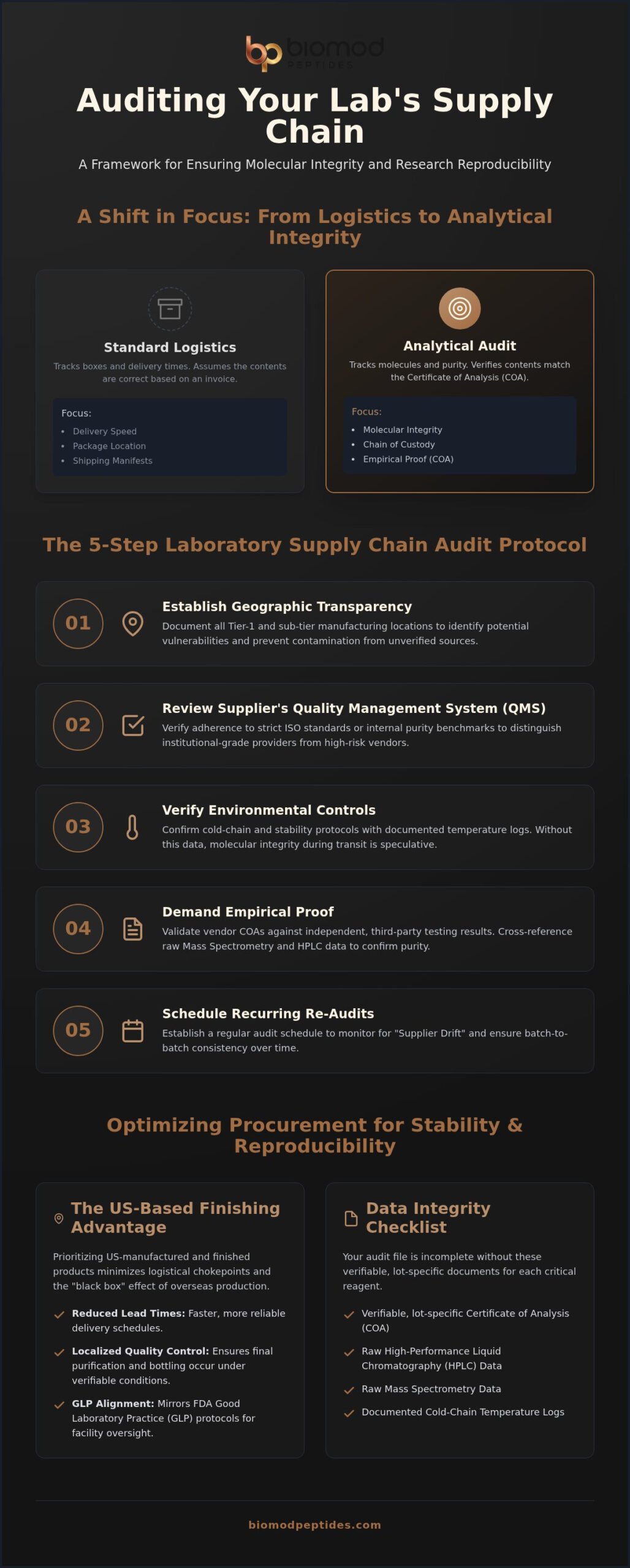
Logistics audits typically track boxes. Analytical audits track molecules. Understanding how to audit your lab’s supply chain requires shifting focus from delivery speed to a dedicated “Chain of Custody” for molecular integrity. A standard audit might confirm a package arrived on time, but a scientific audit confirms the reagent inside matches its Certificate of Analysis (COA) exactly. The primary objective is the elimination of analytical drift before a sample ever touches a pipette.
Standard logistics frameworks often fail because they don’t account for sub-tier manufacturing changes. A vendor might switch a precursor source or a purification method without updating the end-user documentation. These hidden shifts introduce impurities that compromise research reproducibility. By applying fundamental quality audit principles, laboratories move beyond shipping manifests to verify chemical conformance and structural stability. It’s the difference between knowing where a vial is and knowing what is actually in it.
Critical Reagent Mapping and Risk Assessment
Effective oversight begins with categorization. Not every supply carries equal weight in the experimental workflow. You must differentiate between primary reagents, which directly influence data, and disposables like centrifuge tubes. High-impact materials require a deeper dive into “Supplier Drift,” where batch-to-batch consistency degrades due to unannounced manufacturing pivots. For those managing a laboratory peptide supply, establishing a baseline via US-based facilities, such as those in Las Vegas, ensures localized oversight. This geographic transparency is vital when learning how to audit your lab’s supply chain to prevent sub-tier contamination.
The 5-Step Laboratory Supply Chain Audit Protocol
Step 1 focuses on geographic transparency. You must document both Tier-1 and sub-tier manufacturing locations to identify potential vulnerabilities. It’s the first pillar of how to audit your lab’s supply chain. Step 2 requires a rigorous review of the supplier’s Quality Management System (QMS). You should look for strict adherence to ISO standards or internal purity benchmarks. These procurement and compliance standards distinguish institutional-grade providers from high-risk, unverified vendors.
Step 3 addresses environmental variables. Cold-chain and stability protocols must be verified to prevent peptide degradation during transit. Without documented temperature logs, molecular integrity is speculative. Step 4 is the shift to empirical proof. You must validate vendor COAs against independent third-party testing results. Mastering how to audit your lab’s supply chain requires this empirical bridge to reveal discrepancies that internal documentation might omit. Step 5 involves establishing a recurring re-audit schedule to account for manufacturing drift over time.
Verification of 3rd Party Testing and COA Authenticity
A COA verification portal serves as the primary tool for ensuring data integrity by providing direct access to unedited laboratory results. Every audit file must contain raw Mass Spectrometry and HPLC data to confirm both chemical identity and purity levels. You should evaluate these results against established peptide purity verification protocols to identify common impurity red flags. If a vendor can’t provide verifiable, lot-specific data, the supply chain is compromised. For those seeking reagents backed by rigorous documentation, exploring a verified research supply is a necessary step in maintaining your protocol.
Optimizing Procurement for Stability and Reproducibility
International shipping introduces variables that compromise molecular stability. You should prioritize US-manufactured and finished products to minimize these chokepoints. This is a vital step in how to audit your lab’s supply chain for maximum reliability. Beyond location, evaluate specialized delivery formats. For example, peptide spray products offer distinct stability advantages in specific research environments where traditional lyophilized vials might face handling risks. Domestic finishing ensures that the final stages of purification and bottling occur under controlled, verifiable conditions.
Strategic Partnering with US-Based Manufacturers
Domestic finishing provides immediate benefits for laboratories, particularly those in hubs like Las Vegas. Reduced lead times and localized quality control prevent the “black box” effect of overseas production. This alignment mirrors the FDA Good Laboratory Practice (GLP) inspection protocol, which emphasizes facility oversight and material handling. Biomod Peptides maintains this level of accountability through a dedicated COA verification portal, ensuring every lot is traceable and empirically validated. By removing international customs delays, you eliminate temperature fluctuations that often degrade sensitive research compounds.
Your final objective when learning how to audit your lab’s supply chain is the creation of a “preferred vendor” list. This isn’t a subjective directory. It’s a database built on third-party testing results, geographic transparency, and historical batch consistency. Long-term partnerships with vendors who provide transparent analytical-grade data reduce the administrative burden of constant re-verification. You move from reactive troubleshooting to proactive scientific advancement. Data transparency becomes the foundation of your procurement strategy, ensuring that every reagent contributes to, rather than detracts from, your research integrity.
Advancing Research Through Empirical Oversight
Analytical integrity isn’t a passive state. It’s the result of active, rigorous verification. By implementing these protocols, you transition from blind trust to data-driven confidence. Mastering how to audit your lab’s supply chain ensures that your reagents never become the variable that invalidates your results. Focus on three pillars: geographic transparency, third-party validation, and documented cold-chain stability. These steps transform procurement from a clerical task into a critical component of the scientific method.
Accountability requires empirical proof. Biomod Peptides supports this standard through independent third-party testing on all lots and a dedicated COA verification portal. Our US-based manufacturing and finishing processes eliminate the ambiguities of international logistics. Secure your research with US-manufactured, verified peptides from Biomod. Precision in the supply chain leads to precision in the results. Start your next phase with absolute analytical certainty.
Frequently Asked Questions
What are the most common risks in a laboratory supply chain?
Primary risks include molecular degradation during transit, batch-to-batch inconsistency, and unverified sub-tier manufacturing shifts. Impurities often enter the chain when precursors are sourced from unregulated regions without oversight. These vulnerabilities compromise research reproducibility. It’s essential to implement a rigorous protocol for how to audit your lab’s supply chain to mitigate these analytical threats effectively and ensure data precision.
How often should a research lab conduct a full supply chain audit?
Labs should perform a comprehensive audit annually or whenever a supplier changes their manufacturing location. High-volume research facilities often implement quarterly spot-checks on specific lots to maintain constant oversight. This frequency ensures that any “Supplier Drift” is identified before it impacts longitudinal data. Consistency in auditing is as vital as the initial verification of a vendor’s internal quality management system.
Is third-party testing mandatory for research-grade peptides?
While not legally mandated by a single regulatory body, independent third-party testing is a scientific necessity for analytical integrity. Vendor-provided COAs can be self-reported and may lack objective validation. Independent HPLC and Mass Spectrometry results provide the empirical proof required for reproducible research. Relying solely on internal vendor data introduces unacceptable risk into the experimental workflow and the broader supply chain.
What is the difference between a Tier-1 and a sub-tier supplier in a lab context?
A Tier-1 supplier is the direct vendor providing the finished reagent to your facility. Sub-tier suppliers include the manufacturers of raw precursors or the secondary facilities used for finishing and bottling. Understanding how to audit your lab’s supply chain requires mapping both levels. Transparency at the sub-tier level prevents hidden impurities from entering the final product during complex or international manufacturing cycles.
Disclaimer
BIOMOD products are sold strictly for laboratory, analytical, and scientific research use only. They are not intended for human or animal consumption, administration, application, ingestion, injection, or any therapeutic, diagnostic, or cosmetic use.
The statements made on this website have not been evaluated by the United States Food and Drug Administration. BIOMOD products are not intended to diagnose, treat, cure, mitigate, or prevent any disease or medical condition.
BIOMOD is a research chemical supplier. BIOMOD is not a compounding pharmacy or chemical compounding facility as defined under Section 503A of the Federal Food, Drug, and Cosmetic Act. BIOMOD is not an outsourcing facility as defined under Section 503B of the Federal Food, Drug, and Cosmetic Act.
By accessing this site, you confirm you are at least 21 years of age and that you have read and accepted the BIOMOD Terms of Sale, Privacy Policy, and Research Use Only Policy. BIOMOD does not provide dosing, medical, therapeutic, diagnostic, veterinary, or use guidance under any channel.