
The assumption that any sterile liquid serves as a suitable medium for lyophilized reagents is a frequent cause of experimental failure. A peptide’s primary sequence dictates its solubility. Selecting the wrong solvent often leads to irreversible precipitation or rapid degradation. In a research landscape where BPC-157 stockout rates reached 44.8% in August 2026, researchers cannot afford to compromise material through improper handling. Incomplete dissolution and sequence degradation remain significant barriers to precise data collection.
This guide to peptide reconstitution solvents provides the technical framework to ensure structural integrity and experimental reproducibility. We examine the chemical distinctions between USP-grade bacteriostatic water, sterile water, and specialized buffers. You will learn to navigate the requirements of hydrophobic sequences and the preservative standards necessary for extended shelf-life. This overview prioritizes analytical precision to support your laboratory’s internal benchmarks and verification protocols.
Key Takeaways
- Distinguish between bacteriostatic and sterile water to balance preservation needs with analytical assay requirements.
- Identify how primary sequences dictate solvent choice, including the application of acetic acid to facilitate the dissolution of basic peptides.
- Follow this guide to peptide reconstitution solvents to implement standardized protocols that prevent precipitation and extend reagent shelf-life.
- Apply thermal equilibration and aseptic handling techniques to protect lyophilized structures from condensation and environmental contamination.
- Integrate COA verification data into your preparation methodology to ensure solvent compatibility with specific lot variations.
Selecting the Primary Solvent: Bacteriostatic vs. Sterile Water
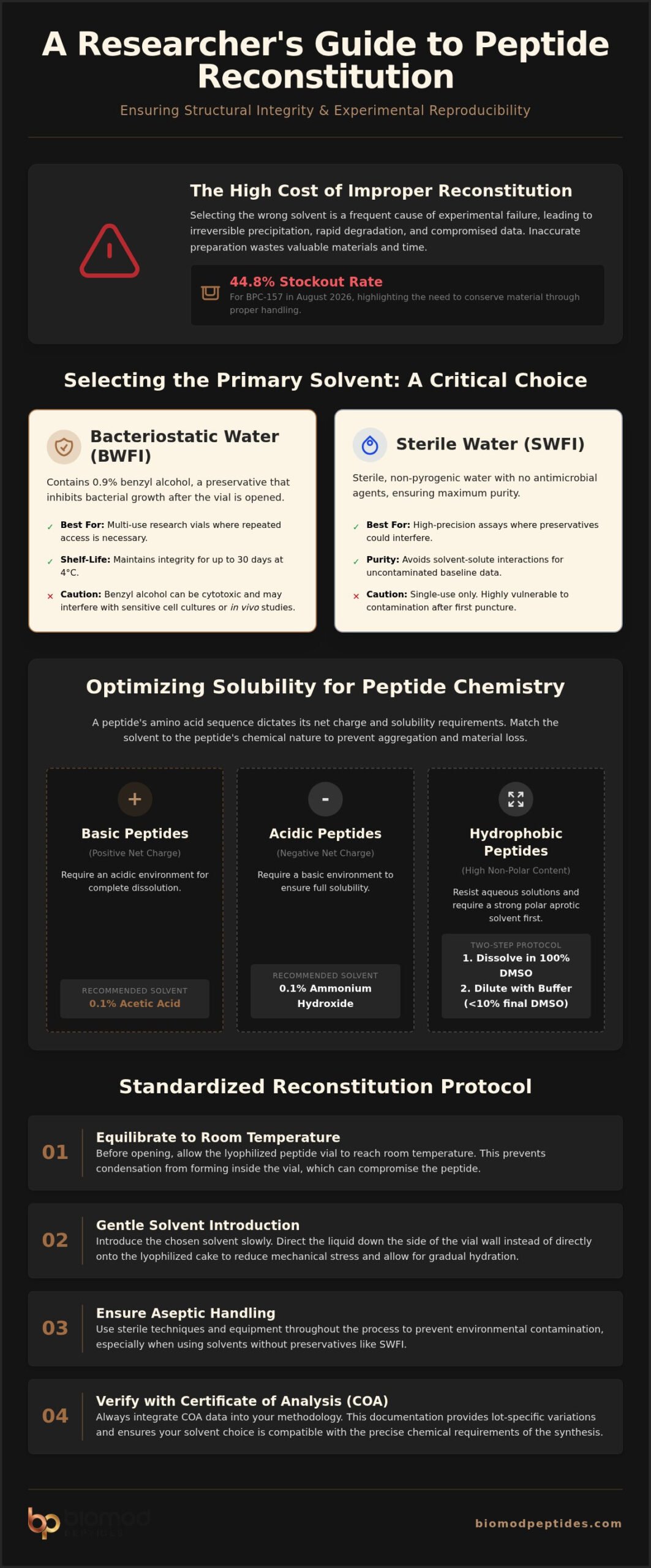
Reconstitution is the process of returning a lyophilized cake to a liquid state for laboratory analysis. This step is a chemical transition, not a mere dilution. Solvent purity is paramount. Impurities or incorrect pH levels trigger peptide hydrolysis and facilitate enzymatic degradation. This guide to peptide reconstitution solvents emphasizes that the selection between bacteriostatic and sterile water depends entirely on the intended analytical application and the required duration of the study.
Bacteriostatic Water for Multi-Use Research
Bacteriostatic Water for Injection (BWFI) contains 0.9% benzyl alcohol as a preservative. This additive inhibits bacterial proliferation by disrupting metabolic processes within the vial. It’s the industry standard for multi-use research vials where repeated access is necessary. When stored at 4°C, peptides reconstituted in BWFI typically maintain structural integrity for up to 30 days. However, researchers must account for the cytotoxicity of benzyl alcohol. Its presence can interfere with specific cell culture models or sensitive in vivo research where metabolic neutrality is a requirement.
Sterile Water and Deionized Water Standards
Sterile Water for Injection (SWFI) is sterile, non-pyrogenic water that lacks antimicrobial agents. Researchers prioritize SWFI when benzyl alcohol might alter peptide solubility characteristics or skew sensitive analytical assays. High-precision laboratory environments require pyrogen-free solvents to ensure baseline data remains uncontaminated by bacterial endotoxins. Key considerations for SWFI include:
- Single-Use Only: Lack of preservatives makes the solution vulnerable to contamination after the first puncture.
- Storage Limitations: Reconstituted solutions without antimicrobial agents have significantly shorter shelf-lives at 4°C.
- Assay Compatibility: SWFI avoids solvent-solute interactions that can occur with alcohol-based additives.
Analytical verification via a COA portal is essential when determining if a peptide’s specific lot requires the absence of additives for maximum stability. Without a bacteriostatic agent, bacterial growth can occur within hours if aseptic techniques are compromised.
Optimizing Solubility for Acidic, Basic, and Hydrophobic Peptides
Solubility is a function of the peptide’s amino acid composition. The primary sequence determines the net charge at physiological pH. This guide to peptide reconstitution solvents recognizes that a single aqueous solution cannot accommodate every molecular structure. Basic peptides, characterized by a positive net charge, require an acidic environment for complete dissolution. Researchers should utilize 0.1% Acetic Acid to facilitate this process. Conversely, acidic peptides with a negative net charge require 0.1% Ammonium Hydroxide to ensure full solubility. Failure to match the solvent pH to the peptide’s charge profile results in incomplete recovery and lost material.
To prevent immediate peptide aggregation, introduce the chosen solvent using a drop-wise method. Direct the liquid down the side of the vial wall rather than directly onto the lyophilized cake. This technique allows for gradual hydration and reduces the mechanical stress on the molecular structure.
The Role of DMSO in Hydrophobic Sequence Dissolution
Hydrophobic peptides contain a high concentration of non-polar amino acids such as Leucine (Leu), Isoleucine (Ile), Valine (Val), and Phenylalanine (Phe). These sequences often resist aqueous buffers and form insoluble precipitates. Dimethyl Sulfoxide (DMSO) is a powerful polar aprotic solvent used to overcome this resistance. The protocol requires dissolving the peptide in 100% DMSO first. Once the solution is clear, dilute it with your primary aqueous buffer. Researchers must keep the final DMSO concentration below 10% to prevent denaturing the peptide or interfering with biological assays.
pH Management and Buffer Selection
Phosphate Buffered Saline (PBS) is a common laboratory reagent, but it can induce precipitation in specific sequences due to its salt content and buffering capacity. Shifting pH levels too rapidly during reconstitution risks irreversible aggregation. Stability depends on gradual equilibration. Precise reagent preparation is the foundation of reliable peptide research. Always verify the sequence characteristics via analytical documentation before selecting a buffer system. Analytical lot verification ensures your methodology aligns with the specific chemical requirements of the synthesis.
Reconstitution Protocols and Long-Term Stability Standards
Precision in reconstitution extends beyond solvent choice. It requires strict adherence to physical handling protocols. Lyophilized vials must reach room temperature before the introduction of any liquid. This step prevents atmospheric moisture from condensing within the vial. Condensation introduces uncontrolled water molecules that can trigger premature hydrolysis. This guide to peptide reconstitution solvents emphasizes that environmental control is as critical as the chemical medium itself.
Aseptic technique is non-negotiable. Swab the vial septum with 70% isopropyl alcohol before every puncture. Use graduated syringes to ensure volume precision. When mixing, avoid vortexing at all costs. High-speed mechanical agitation creates shear forces that can permanently damage delicate peptide chains. A gentle swirl is the only approved method for facilitating dissolution. Biomod Peptides recommends COA verification for every lot to confirm specific solubility notes and ensure the reagent meets internal benchmarks.
Temperature Management for Reconstituted Reagents
Reconstituted peptides are inherently less stable than their lyophilized counterparts. Storage at 4°C is suitable for short-term usage within a 30-day window. For mid-term requirements, solutions should be stored at -20°C. Avoid repeated freeze-thaw cycles. These cycles cause ice crystal formation that physically shears peptide bonds and reduces purity. For a deep-dive into environmental variables, see Peptide Stability for Research: Cold Chain Protocols.
Verification of Purity Post-Reconstitution
Visual inspection is the final validation step. The solution must remain clear and free of particulates. Cloudiness or precipitation suggests a mismatch between the peptide sequence and the solvent pH. Researchers should utilize the Biomod COA Portal to cross-reference lot-specific purity data. Implementing Improving Peptide Solubility: Analytical Protocols ensures that your laboratory maintains the highest standards of experimental reproducibility and data integrity.
Advancing Analytical Precision through Standardized Reconstitution
Successful research depends on the structural integrity of your reagents. This guide to peptide reconstitution solvents has detailed the necessity of matching chemical mediums to primary sequences. Precise pH adjustment for acidic or basic peptides prevents irreversible precipitation. Strict adherence to thermal equilibration and aseptic handling protects against degradation and environmental contamination. These protocols are the foundation of experimental reproducibility and long-term stability. It’s the meticulous attention to detail during reconstitution that preserves molecular value.
Biomod Peptides remains a leader in the Las Vegas regional laboratory supply market by prioritizing objective verification above all else. Every lot is US-manufactured and finished to the highest industry standards. We provide comprehensive third-party HPLC/MS testing data to ensure your laboratory operates with absolute professional confidence. High-purity research requires high-purity preparation. Browse High-Purity Research Peptides at Biomod Peptides to secure the reagents your methodology demands. Your commitment to these rigorous standards ensures the validity and impact of your future data.
Frequently Asked Questions
Can I use tap water or bottled water for peptide reconstitution?
Tap and bottled water are entirely unsuitable for laboratory reconstitution. These sources contain minerals, metal ions, and microbial contaminants that facilitate rapid peptide hydrolysis and unpredictable precipitation. They lack the sterile, non-pyrogenic standards required for analytical integrity. Utilizing non-laboratory grade liquids introduces uncontrolled variables that compromise experimental reproducibility. Only USP-grade bacteriostatic or sterile water should be used to maintain the structural stability of the research reagent.
How long do peptides remain stable after being dissolved in Bacteriostatic Water?
Reconstituted peptides typically maintain stability for up to 30 days when stored at 4°C in bacteriostatic water. The 0.9% benzyl alcohol preservative inhibits bacterial growth throughout this duration. However, stability is sequence-dependent. Some delicate sequences may degrade faster. Consult the specific lot’s analytical data for precise stability windows. Following this guide to peptide reconstitution solvents ensures you maximize the shelf-life of your research materials through proper environmental control.
What should I do if my peptide does not fully dissolve in Sterile Water?
Incomplete dissolution suggests a mismatch between the peptide’s net charge and the solvent pH. If a basic peptide fails to dissolve, introduce 0.1% acetic acid drop-wise to the solution. For acidic sequences, 0.1% ammonium hydroxide is required to reach the necessary solubility threshold. Hydrophobic sequences may require a small volume of 100% DMSO before dilution with sterile water. Never use mechanical vortexing to force dissolution; instead, apply gentle swirling to minimize molecular shear stress.
Is it safe to freeze peptides after they have been reconstituted?
Freezing reconstituted peptides at -20°C is acceptable for mid-term storage, but repeated freeze-thaw cycles must be avoided. The formation of ice crystals during the freezing process can physically shear peptide bonds, leading to a significant loss of purity. To preserve integrity, divide the solution into single-use aliquots before the initial freeze. This protocol ensures that each sample undergoes only one transition from a frozen to a liquid state, maintaining the reagent’s analytical standards.
Disclaimer
BIOMOD products are sold strictly for laboratory, analytical, and scientific research use only. They are not intended for human or animal consumption, administration, application, ingestion, injection, or any therapeutic, diagnostic, or cosmetic use.
The statements made on this website have not been evaluated by the United States Food and Drug Administration. BIOMOD products are not intended to diagnose, treat, cure, mitigate, or prevent any disease or medical condition.
BIOMOD is a research chemical supplier. BIOMOD is not a compounding pharmacy or chemical compounding facility as defined under Section 503A of the Federal Food, Drug, and Cosmetic Act. BIOMOD is not an outsourcing facility as defined under Section 503B of the Federal Food, Drug, and Cosmetic Act.
By accessing this site, you confirm you are at least 21 years of age and that you have read and accepted the BIOMOD Terms of Sale, Privacy Policy, and Research Use Only Policy. BIOMOD does not provide dosing, medical, therapeutic, diagnostic, veterinary, or use guidance under any channel.