
Standard oral bioavailability for most peptides remains below 2% due to aggressive gastric degradation. This reality forces researchers to confront a difficult trade-off between experimental convenience and sequence integrity. You understand that rapid enzymatic breakdown and first-pass metabolism often compromise the very data you aim to collect. Achieving consistent results requires a precise understanding of peptide stability in different delivery systems to ensure that your molecules reach their target intact.
This research analysis offers a rigorous technical comparison of how specialized delivery systems protect peptide integrity and influence bioavailability. We’ll evaluate the structural protections offered by advanced softgel and spray formats compared to traditional liquid reconstitutions. By examining verified analytical standards and current HPLC/Mass Spec protocols, this guide identifies which systems maximize peptide half-life. You’ll gain the empirical proof needed to optimize experimental results in animal models while maintaining uncompromising structural verification. We prioritize data over hype. Our focus remains on the acts of validation, creation, and methodological progression.
Key Takeaways
- Identify the specific enzymatic and chemical pathways, such as deamidation and oxidation, that compromise peptide sequence integrity in research environments.
- Evaluate the protective mechanisms of advanced sequestration technologies to optimize peptide stability in different delivery systems compared to traditional liquid formats.
- Understand how specialized delivery methods like softgels and sprays can mitigate the effects of first-pass metabolism and systemic proteolysis in animal models.
- Implement a rigorous verification protocol using independent COA portals and HPLC standards to ensure experimental reproducibility and structural accuracy.
- Leverage US-based manufacturing and finishing standards to maintain tighter environmental control and minimize lot-to-lot variability in sensitive laboratory studies.
Mechanisms of Peptide Degradation in In Vivo Research Environments
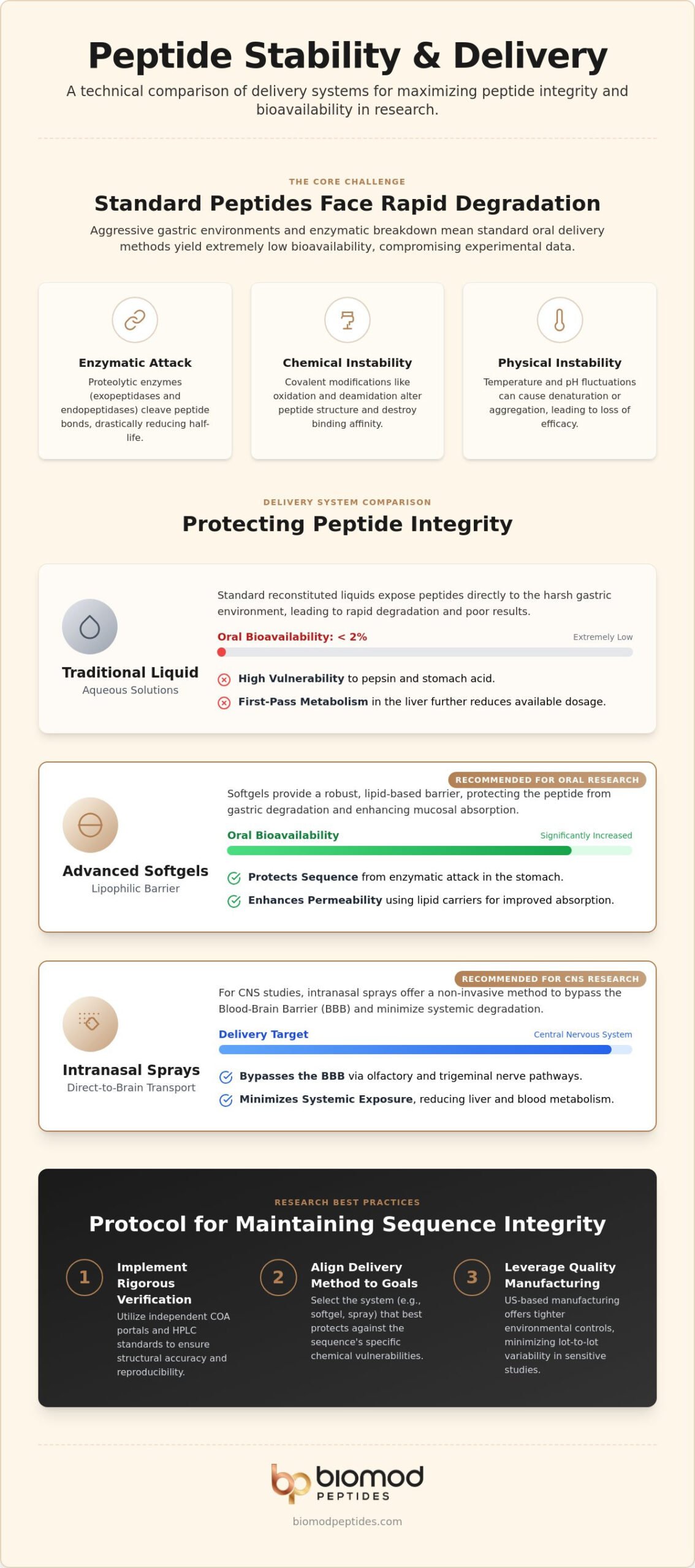
Peptides are intrinsically susceptible to rapid degradation by proteolytic enzymes in animal models. This vulnerability remains the central challenge in peptide therapeutics development. Chemical instability involves covalent modifications like deamidation, oxidation, and disulfide exchange. Deamidation of asparagine or glutamine residues often shifts the peptide’s charge. Oxidation of methionine can destroy binding affinity. They’re irreversible alterations that compromise experimental data and lead to false negatives in bioactivity assays.
Physical instability involves denaturation or aggregation. These events are frequently triggered by temperature fluctuations or rapid pH shifts during experimental handling. Aggregated peptides lose efficacy and can induce unwanted immunogenic responses in test subjects. Enzymatic proteolysis is the primary barrier to peptide half-life in laboratory research. It’s essential to understand peptide stability in different delivery systems to maintain sequence integrity from reconstitution to administration.
Proteolytic Vulnerability and Metabolic Clearance
In vivo research environments utilize a complex network of exopeptidases and endopeptidases to recycle proteins. Exopeptidases target the N or C-terminal ends of the sequence. Endopeptidases target specific internal amino acid sequences. This dual cleavage mechanism ensures that unprotected peptides have half-lives measured in minutes. First-pass metabolism in the liver further reduces the bioavailability of oral liquid formats. Researchers often utilize peptide softgels to bypass these degradative gastric environments and preserve the intended dosage.
Environmental Stressors in Laboratory Settings
Peptide secondary and tertiary structures are highly sensitive to pH variations. Deviations from physiological pH can cause unfolding or irreversible precipitation. Maintaining thermodynamic stability is a requirement for bioactivity during rigorous experimental cycles. Precise control over these variables is the only way to ensure peptide stability in different delivery systems across multiple laboratory locations. US-based finishing standards help mitigate these risks by enforcing tighter environmental controls during the manufacturing phase.
Comparing Peptide Delivery Methods in Animal Models
Traditional subcutaneous injections offer high bioavailability. They also expose peptides to immediate systemic proteolysis. This creates a data paradox. You achieve high initial concentrations but suffer rapid degradation. Advanced systems solve this by sequestering the molecule. Implementing effective formulation strategies for peptide stability focuses on shielding the peptide until it reaches the target site. Selection must align with the sequence’s specific chemical vulnerabilities to optimize peptide stability in different delivery systems.
Oral Delivery: Softgels vs. Aqueous Solutions
Aqueous solutions are highly vulnerable to pepsin and gastric acid. They typically result in bioavailability below 2%. In contrast, peptide softgels for research provide a robust lipophilic barrier. This barrier protects the sequence from enzymatic attack in the stomach. Softgels also enhance mucosal permeability by utilizing lipid-based carriers. This improves absorption rates in oral research models. It’s a critical factor for maintaining peptide stability in different delivery systems while ensuring reproducible pharmacokinetics.
Intranasal Sprays: Bypassing the Blood-Brain Barrier
CNS-focused research requires bypassing the blood-brain barrier (BBB). intranasal peptide research sprays achieve this via direct-to-brain transport. They utilize olfactory and trigeminal nerve pathways. This method minimizes systemic exposure. It also reduces metabolic breakdown in the liver and blood. Liquid spray formulations offer stability advantages by maintaining consistent dosing. This precision is vital for long-term CNS studies. You should consult verified analytical standards to ensure your delivery method matches your research objectives.
Protocol for Maintaining Sequence Integrity in Laboratory Settings
Stability begins at the point of manufacture. US-based finishing ensures tighter control over environmental variables compared to overseas production. This logistical transparency is vital for researchers who require absolute data reproducibility. Achieving consistent peptide stability in different delivery systems requires a foundational commitment to precision synthesis and atmospheric regulation. You must verify the purity and sequence of every lot before initiating animal model studies. Lot-to-lot variability remains a primary cause of experimental failure.
Analytical Verification and COA Analysis
High-performance liquid chromatography (HPLC) and Mass Spectrometry are the industry standards for confirmation. These methods confirm 99%+ purity levels and verify the exact molecular mass of the sequence. Leading Las Vegas laboratories utilize these purity verification protocols to eliminate batch-to-batch variability. You can use the Biomod verification portal to cross-reference batch-specific data instantly. This level of accountability ensures that your peptide stability in different delivery systems is backed by empirical proof. Verification is the only path to professional confidence in your results.
Storage and Handling for Long-Term Stability
Cold chain protocols are essential for both lyophilized and liquid formats. Thermal degradation can occur within hours if temperature thresholds are exceeded. This is especially critical for peptides in aqueous solutions. Reconstitution requires a delicate approach to avoid mechanical stress. Mechanical agitation can lead to denaturation or irreversible aggregation.
- Store lyophilized powder at -20°C for long-term preservation.
- Avoid repeated freeze-thaw cycles that trigger structural degradation.
- Use gentle swirling rather than high-speed vortexing during reconstitution.
Utilizing US-manufactured high-purity research peptides provides the necessary logistical transparency for high-stakes research. Proper handling maintains the structural integrity of the molecule from the laboratory to the final administration. It’s the final step in ensuring your research model remains uncompromised by degradative stressors.
Advancing Experimental Accuracy Through Delivery Optimization
Selecting an appropriate delivery framework is a decisive factor in research success. It’s the primary defense against rapid enzymatic proteolysis and chemical deamidation. This analysis has demonstrated that peptide stability in different delivery systems is a function of structural sequestration. Whether utilizing softgels to navigate gastric acid or intranasal sprays for direct CNS access, the objective remains the same: sequence integrity. You can’t leave these variables to chance when experimental reproducibility is at stake.
Biomod Peptides maintains a rigorous standard by providing US-manufactured and finished products. Every lot undergoes independent third-party testing to ensure it meets strict analytical benchmarks. Our COA verification portal offers the logistical transparency required to validate your findings with professional confidence. These protocols represent a leap beyond traditional industry norms, prioritizing data over marketing aesthetics. Every step in our process focuses on the acts of validation and progression.
Explore High-Purity Research Peptides and Specialized Delivery Systems to optimize your laboratory outcomes. Securing your data starts with securing your molecules. We’re committed to supporting your pursuit of uncompromising scientific discovery.
Frequently Asked Questions
How does a softgel delivery system improve peptide stability compared to liquid?
Softgels provide a lipophilic barrier that shields peptides from gastric acid and proteolytic enzymes. Liquids are immediately exposed to the low pH of the stomach; this leads to rapid denaturation. The softgel format ensures the sequence remains sequestered until it reaches the intestinal mucosa. This sequestration is vital for maintaining the structural integrity of sensitive research molecules. It’s a proven method for enhancing peptide stability in different delivery systems.
What are the primary causes of peptide degradation in animal models?
Peptide degradation in animal models is primarily driven by enzymatic proteolysis and chemical instability. Exopeptidases and endopeptidases cleave peptide bonds. Chemical stressors lead to deamidation, oxidation, and disulfide exchange. Environmental factors like pH shifts and temperature fluctuations also trigger physical denaturation or aggregation. These combined stressors can reduce the half-life of unprotected peptides to mere minutes. You can’t achieve reproducible results without addressing these degradative pathways.
Can intranasal sprays prevent first-pass metabolism in research peptides?
Intranasal sprays bypass first-pass metabolism by delivering peptides directly into the systemic circulation or the central nervous system. This route utilizes olfactory and trigeminal nerve pathways. It avoids the portal vein and hepatic processing that degrades oral liquid formats. By utilizing this pathway, researchers achieve higher bioavailability and more consistent dosing in CNS-focused studies. This delivery method is a strategic tool for maintaining peptide stability in different delivery systems while targeting specific tissues.
Why is third-party testing critical for verifying peptide stability?
Third-party testing provides objective verification of purity, sequence integrity, and the absence of contaminants. Independent HPLC and Mass Spectrometry analysis confirm that a product meets its stated specifications. This verification is the only way to ensure that experimental results aren’t skewed by degraded reagents. Accountability depends on empirical proof rather than manufacturer claims. It’s the gold standard for maintaining laboratory precision and professional confidence.
Disclaimer
BIOMOD products are sold strictly for laboratory, analytical, and scientific research use only. They are not intended for human or animal consumption, administration, application, ingestion, injection, or any therapeutic, diagnostic, or cosmetic use.
The statements made on this website have not been evaluated by the United States Food and Drug Administration. BIOMOD products are not intended to diagnose, treat, cure, mitigate, or prevent any disease or medical condition.
BIOMOD is a research chemical supplier. BIOMOD is not a compounding pharmacy or chemical compounding facility as defined under Section 503A of the Federal Food, Drug, and Cosmetic Act. BIOMOD is not an outsourcing facility as defined under Section 503B of the Federal Food, Drug, and Cosmetic Act.
By accessing this site, you confirm you are at least 21 years of age and that you have read and accepted the BIOMOD Terms of Sale, Privacy Policy, and Research Use Only Policy. BIOMOD does not provide dosing, medical, therapeutic, diagnostic, veterinary, or use guidance under any channel.