
Relying on a single vendor for research materials in 2026 is no longer a logistical oversight; it’s a direct threat to the reproducibility of your data. With the global peptide market projected to reach $163.98 billion this year, the pressure on supply chains has reached a breaking point. You understand the frustration of batch-to-batch variability and the sudden silence of vendors facing increased FDA scrutiny. Implementing a robust secondary sourcing strategy for critical peptides is the only way to protect your laboratory from single-source failures and the opaque purity reporting of the gray market.
This article establishes a clinical protocol for creating a resilient, analytically verified supply chain. You’ll learn to qualify backup providers using third-party HPLC and mass spectrometry data to ensure absolute continuity. We provide a documented framework for achieving analytical parity, ensuring your research remains focused on results rather than procurement crises. This represents a necessary shift toward institutional research integrity and structural redundancy.
Key Takeaways
- Identify “Single Points of Failure” within your procurement model to prevent supply chain disruptions from jeopardizing long-term research data.
- Implement a formal secondary sourcing strategy for critical peptides to maintain analytical consistency between primary and backup vendors.
- Execute a 4-step qualification protocol focusing on manufacturing standards and HPLC/MS impurity profile cross-verification.
- Leverage US-based finishing and dedicated COA verification portals to bypass the quality drift common in unregulated markets.
- Establish documented benchmarks for purity and batch traceability to ensure seamless transitions between qualified peptide sources.
The Strategic Imperative for Secondary Peptide Sourcing in 2026
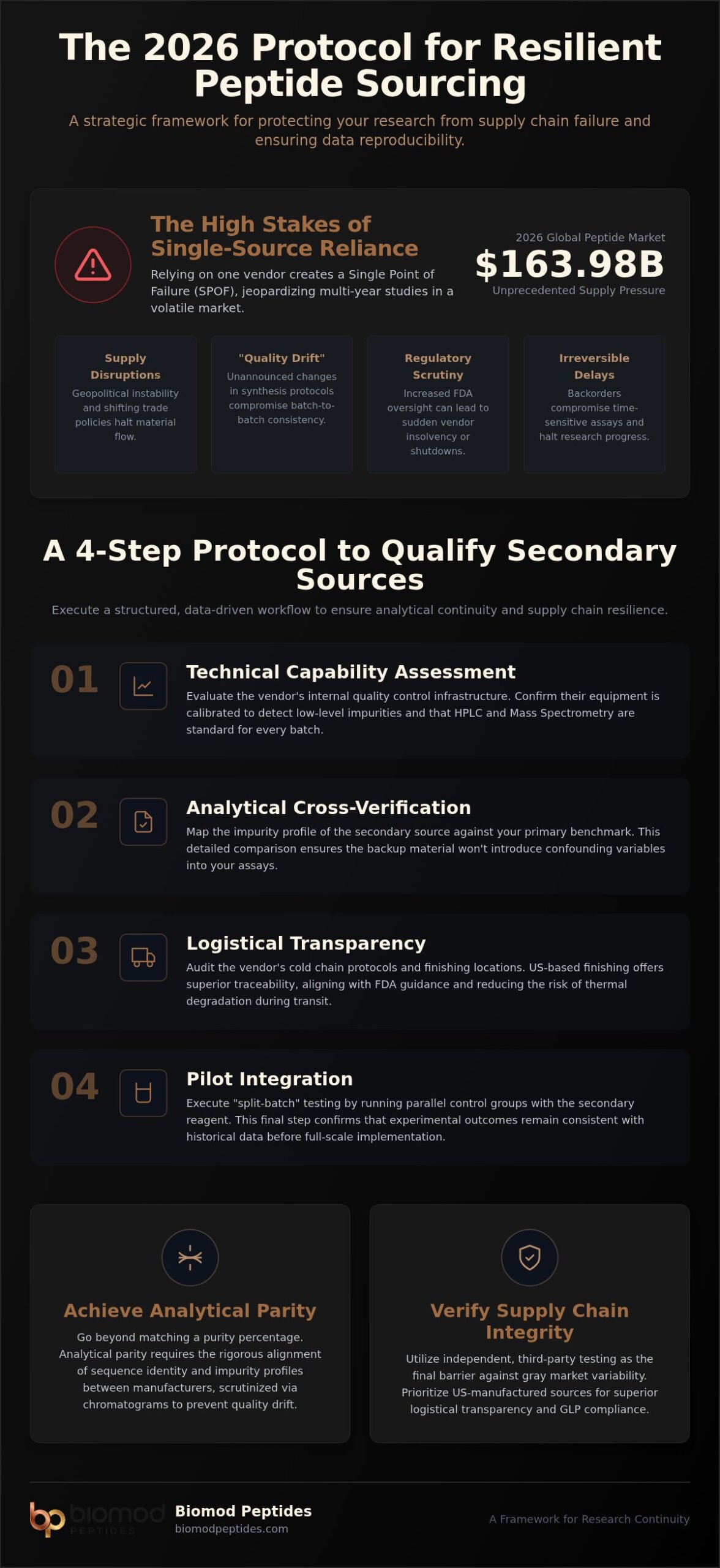
Secondary sourcing is the procedural qualification of an alternative vendor for high-purity research reagents. It isn’t just a backup plan. It’s a risk mitigation necessity. In 2026, the global peptide therapeutics market has reached an estimated $163.98 billion. This scale creates immense pressure on raw material availability. Relying on a single manufacturer creates a Single Point of Failure (SPOF) that can jeopardize multi-year longitudinal studies. If your primary source fails, your research stops. A defined secondary sourcing strategy for critical peptides ensures that your project remains viable despite vendor insolvency or supply chain collapse.
Geopolitical instability in 2026 has further complicated the acquisition of specialized precursors. Regional conflicts and shifting trade policies frequently disrupt the flow of essential raw materials. Even when supply remains steady, quality drift poses a significant threat. Primary vendors may alter their Peptide synthesis protocols or source different starting materials without notice. A secondary source acts as an analytical benchmark. It allows you to verify purity levels and impurity profiles against a known standard, preventing subtle variations from skewing your experimental results.
Risk Mitigation Beyond Supply Continuity
The scientific cost of study delays is often irreversible. Backordered reagents don’t just pause progress; they can compromise the window for time-sensitive biological assays. Maintaining high experimental velocity requires a redundant laboratory peptide supply. This redundancy protects your data from the volatility of the 2026 market. It ensures that your secondary sourcing strategy for critical peptides is active and verified before a crisis occurs.
Regulatory and Compliance Drivers
Regulatory landscapes are tightening. In July 2026, the FDA issued revised draft guidances for generic injectable peptides, emphasizing impurity thresholds and structure assessment. Aligning with GLP (Good Laboratory Practice) standards now requires documented supply chain resilience. Utilizing US-manufactured and finished sources provides a layer of logistical transparency that offshore vendors cannot match. It ensures your sourcing meets the rigorous accountability standards demanded by modern institutional oversight.
A 4-Step Protocol to Qualify Secondary Peptide Sources
A robust secondary sourcing strategy for critical peptides relies on empirical validation rather than vendor promises. Qualifying a backup supplier requires a structured, four-step technical workflow to maintain analytical continuity across your research projects. This protocol ensures that any transition between vendors is data-driven and scientifically sound.
- Technical Capability Assessment: Evaluate the vendor’s internal quality control infrastructure. High-Performance Liquid Chromatography (HPLC) and Mass Spectrometry (MS) must be standard for every batch. Confirm that their equipment is calibrated to detect low-level impurities.
- Analytical Cross-Verification: Map the impurity profile of the secondary source against your primary benchmark. Identifying specific related substances ensures that the backup material won’t introduce confounding variables into your biological assays.
- Logistical Transparency: Audit the vendor’s cold chain protocols and finishing locations. This process should align with the FDA Guidance on Standardized Numerical Identification to ensure lot traceability and supply chain security.
- Pilot Integration: Execute “split-batch” testing. Run parallel control groups using the secondary reagent to confirm that experimental outcomes remain consistent with historical data before full-scale implementation.
Establishing Analytical Parity
Analytical parity is the alignment of sequence identity and purity levels between two distinct manufacturers. Achieving this requires more than matching a percentage on a page. Researchers must utilize peptide purity verification protocols to scrutinize chromatograms for baseline noise and secondary peaks. This rigorous comparison prevents quality drift when switching sources.
Verifying Supply Chain Integrity
Independent third-party testing is the final barrier against gray market variability. For Las Vegas laboratories, US-manufactured research peptides offer superior logistical transparency and faster transit times under controlled temperatures. This geographic proximity reduces the risk of thermal degradation during shipping. If you need a stability partner to secure your research, prioritize sources that provide transparent, batch-specific documentation through accessible verification portals.
Stabilizing Research Supply Chains with US-Based Verification
US-based manufacturing and finishing serve as the ultimate safeguard for a secondary sourcing strategy for critical peptides. International logistics are increasingly susceptible to customs delays and sudden regulatory shifts. Domestic finishing ensures that the final product meets stringent purity benchmarks before it reaches the laboratory. This proximity allows for immediate verification of batch integrity and reduces the risk of thermal degradation during extended transit. It creates a transparent logistical chain that offshore vendors cannot replicate.
Accountability requires transparency. Utilizing the COA Verification Portal provides instant access to third-party analytical data. This infrastructure eliminates the uncertainty common in the gray market. It allows procurement officers to validate identity and purity by HPLC/MS in real-time. This level of data accessibility is vital when qualifying a secondary source. It ensures that the backup material meets the same rigorous standards as your primary supply.
Diverse research applications require varied delivery systems. Integrating peptide softgels and spray products into your portfolio ensures that your secondary source can support specific experimental designs. A resilient reagent portfolio balances these specialized formats across multiple qualified vendors. This diversification protects your experimental velocity from vendor-specific manufacturing bottlenecks.
Case Study: The Cost of Sourcing Failures
A 30-day supply disruption in longitudinal cellular research can be catastrophic. It often results in the loss of synchronized cell cultures and months of baseline data. In studies involving metabolic signaling, even a brief pause can invalidate a year of work. A qualified secondary source prevents this facility downtime. It maintains the continuity of the study when the primary vendor faces unexpected stockouts or quality failures.
Next Steps for Laboratory Procurement
Transitioning to a resilient model requires a Master Service Agreement (MSA) for secondary supply. This formalizes the relationship and sets clear expectations for analytical parity. Biomod Peptides provides specialized support for bulk procurement and logistical planning. Research facilities in Las Vegas can consult with our technical team to establish a secure, US-verified supply chain that meets the 2026 research protocol standards.
Securing the Future of Analytical Research Integrity
Data integrity is the cornerstone of laboratory success. We’ve established that supply chain redundancy is a scientific requirement, not a logistical option. A defined secondary sourcing strategy for critical peptides protects multi-year data from vendor volatility and the risks of quality drift. Cross-verifying impurity profiles ensures that your research remains consistent across batch transitions. It’s the only way to maintain experimental velocity in an increasingly unpredictable global market.
Biomod Peptides provides the infrastructure required for immediate source qualification. Our products are US-manufactured and finished to ensure maximum logistical transparency. Every lot undergoes independent third-party testing to verify purity and identity. Our COA Verification Portal provides the empirical proof your institution demands. Don’t let a single point of failure compromise your project’s timeline.
Establish your secondary sourcing anchor with Biomod Peptides today. Protecting your research starts with a commitment to analytical verification and domestic reliability. Your data deserves a resilient foundation.
Frequently Asked Questions
What is the difference between a secondary supplier and a backup vendor?
A secondary supplier is a qualified partner actively integrated into your procurement cycle to maintain a secondary sourcing strategy for critical peptides. Unlike a reactive backup vendor, a secondary source undergoes the same rigorous analytical validation as your primary provider. This active status allows for immediate volume shifting without the need for emergency qualification during a supply crisis. It ensures that procurement remains a proactive scientific process rather than a desperate logistical reaction.
How do I ensure a secondary peptide source has the same purity profile as my primary?
Ensuring profile alignment requires mapping the specific related substances and impurity peaks found in HPLC chromatograms. You must compare the secondary source’s third-party mass spectrometry data against your primary benchmark. Identifying these impurities prevents the introduction of new variables into your research. Analytical parity is only achieved when both manufacturers provide batch-specific documentation that confirms identical sequence identity and comparable purity thresholds above 98%.
Why should research laboratories prioritize US-manufactured peptides for secondary sourcing?
US-manufactured research peptides offer superior logistical transparency and protection against international customs volatility. Domestic finishing allows for tighter control over cold chain protocols and batch traceability. This proximity is essential for facilities needing reliable lead times and verified handling. Utilizing a domestic provider ensures that your secondary sourcing strategy for critical peptides isn’t compromised by geopolitical instability or the opaque reporting standards often found in overseas gray markets.
How often should I re-verify my secondary peptide source?
Re-verification should occur with every unique production lot to mitigate the risk of quality drift. Even established vendors may alter their synthesis precursors or finishing protocols without notice. Laboratories should utilize a COA verification portal to scrutinize batch-specific data for every acquisition. Consistent lot-by-lot testing ensures that your secondary source remains analytically synchronized with your primary benchmark over the entire duration of a longitudinal study.
Disclaimer
BIOMOD products are sold strictly for laboratory, analytical, and scientific research use only. They are not intended for human or animal consumption, administration, application, ingestion, injection, or any therapeutic, diagnostic, or cosmetic use.
The statements made on this website have not been evaluated by the United States Food and Drug Administration. BIOMOD products are not intended to diagnose, treat, cure, mitigate, or prevent any disease or medical condition.
BIOMOD is a research chemical supplier. BIOMOD is not a compounding pharmacy or chemical compounding facility as defined under Section 503A of the Federal Food, Drug, and Cosmetic Act. BIOMOD is not an outsourcing facility as defined under Section 503B of the Federal Food, Drug, and Cosmetic Act.
By accessing this site, you confirm you are at least 21 years of age and that you have read and accepted the BIOMOD Terms of Sale, Privacy Policy, and Research Use Only Policy. BIOMOD does not provide dosing, medical, therapeutic, diagnostic, veterinary, or use guidance under any channel.