
A high purity rating is not a guarantee of experimental success. It’s the baseline. Even with a verified sequence, the physical reality of peptide loss due to precipitation can invalidate weeks of laboratory research. You’ve likely encountered the frustration of aggregation during high-throughput screening or discovered that inaccurate experimental concentrations have skewed your data. These hurdles often stem from a fundamental disconnect between sequence design and solvent interaction.
We recognize that consistent results depend on absolute control over your reagents. This article provides the technical protocols required for improving peptide solubility, moving beyond trial and error toward a methodical approach to reconstitution. You’ll master specific chemical strategies for solvent selection and gain a deeper understanding of sequence-solubility relationships. We’ll also examine how utilizing third-party COA verification and specialized formats like research softgels or sprays can mitigate common analytical failures. This guide ensures your laboratory analysis remains precise, accountable, and reproducible.
Key Takeaways
- Identify hydrophobic residues using the hydropathy index and avoid the Isoelectric Point (pI) to prevent spontaneous precipitation.
- Implement a micro-scale solubility test to conserve research material before escalating through a logical solvent hierarchy starting with sterile buffers.
- Master technical protocols for improving peptide solubility by utilizing high-purity, US-manufactured standards that minimize interference from residual manufacturing salts.
- Leverage innovative formats like research softgels and sprays to bypass traditional aqueous solubility hurdles for notoriously hydrophobic sequences.
- Utilize third-party COA verification to confirm sequence integrity and purity, establishing the analytical foundation required for successful reconstitution.
The Molecular Fundamentals of Peptide Solubility
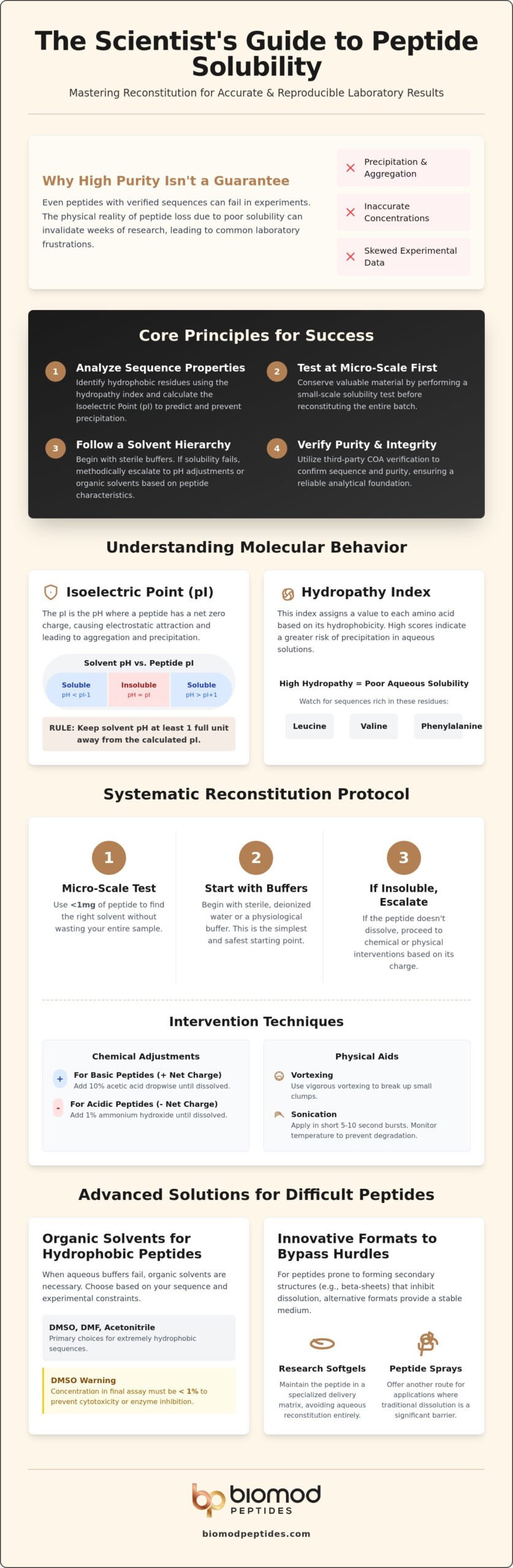
Solubility isn’t a binary state; it’s a thermodynamic balance. The hydropathy index provides a quantitative framework for this balance by assigning values to individual amino acids based on their hydrophobicity. Sequences with a high density of residues like Leucine, Valine, and Phenylalanine exhibit elevated hydropathy scores. These scores serve as a primary indicator of potential precipitation in aqueous environments. Identifying these hydrophobic regions early is essential for improving peptide solubility before laboratory work begins.
The Isoelectric Point (pI) represents the pH at which a peptide carries a net zero charge. At this specific point, the lack of electrostatic repulsion between molecules leads to immediate aggregation. Reliable analytical protocols dictate that the solvent pH remains at least one full unit away from the calculated pI. This ensures that the molecules maintain a net charge, utilizing electrostatic repulsion to prevent the formation of insoluble clusters. Precision in pH selection is the difference between a clear solution and a wasted sample.
Sequence Composition and Net Charge
Calculating the net charge at physiological pH is a prerequisite for predicting aqueous compatibility. Basic residues such as Lysine (Lys) and Arginine (Arg) contribute positive charges, while acidic residues like Glutamic Acid (Glu) and Aspartic Acid (Asp) provide negative charges. Peptides containing a high ratio of basic amino acids generally require acidic solvent environments to remain protonated and soluble. Modifications like N-terminal acetylation or C-terminal amidation also impact this balance by neutralizing terminal charges. Even the simplest Dipeptide solubility analysis confirms that terminal modifications significantly alter the molecule’s interaction with polar solvents.
Secondary Structure and Aggregation Risk
Peptide length and the propensity for beta-sheet formation create physical barriers to dissolution. Hydrophobic patches within a sequence can trigger intermolecular hydrogen bonding, leading to the development of insoluble fibrils. This risk is amplified in lyophilized research peptides during high-concentration protocols. For sequences where secondary structures inhibit traditional reconstitution, utilizing peptide spray products or softgels can provide a stable medium that bypasses these aqueous solubility hurdles by maintaining the peptide in a specialized delivery matrix.
Practical Protocols for Improving Peptide Solubility
Success in the laboratory begins with resource conservation. Before attempting full-scale reconstitution, always conduct a micro-scale solubility test using less than 1 mg of material. This preliminary step prevents the irreversible loss of an entire batch due to improper solvent selection. Systematic testing follows a strict hierarchy. Begin with sterile, deionized water or physiological buffers. If the peptide remains insoluble, move toward organic modifiers or pH adjustments based on the sequence’s net charge.
Effective protocols for improving peptide solubility often require precise chemical intervention. For basic peptides possessing a net positive charge, add 10% acetic acid dropwise until the powder dissolves. Conversely, acidic sequences with a net negative charge typically respond to 1% ammonium hydroxide. Physical aids provide the necessary kinetic energy to disrupt intermolecular bonds. Start with vigorous vortexing. If aggregates persist, utilize controlled sonication in short, 5 to 10 second bursts. Monitor the sample temperature closely; excessive heat from sonication can trigger peptide degradation or unintended conformational changes.
Solvent Selection for Hydrophobic Peptides
When aqueous buffers fail, organic solvents like DMSO, DMF, or Acetonitrile become necessary. DMSO is the primary choice for extremely hydrophobic sequences, though its concentration in the final assay must remain below 1% to prevent cytotoxicity or enzyme inhibition. The choice of counter-ion also dictates success. While TFA-salts are standard, acetate-salts often provide superior dissolution profiles for sensitive biological applications. Selecting high-purity research peptides ensures that residual manufacturing byproducts don’t interfere with these organic solvent interactions.
Reconstitution Best Practices for Las Vegas Labs
Environmental variables significantly impact solubility kinetics. In Las Vegas laboratory settings, maintaining a strict cold chain during the dissolution phase is non-negotiable. High ambient temperatures can accelerate aggregation or lead to the rapid oxidation of Cys or Met residues. Work on ice whenever possible. For a detailed breakdown of storage and preparation, refer to our guide on Lyophilized research peptides handling to ensure your samples remain viable throughout the analytical process.
The Link Between Purity, Verification, and Solubility
Analytical precision relies on the absence of molecular interference. Residual impurities, including trifluoroacetic acid (TFA) salts and truncated sequences, directly inhibit successful solubilization by altering the local pH or promoting non-specific aggregation. High-purity standards are mandatory for reproducible data. Utilizing US-manufactured peptides ensures that batch-to-batch solubility variance is minimized through rigorous, domestic quality control. Researchers must verify these metrics using established peptide purity verification protocols to correlate sequence data with observed physical behavior.
Our COA Verification Portal provides the necessary transparency for this correlation. By accessing independent third-party testing data, you can confirm that the peptide purity meets the specific threshold required for efficient dissolution. Improving peptide solubility becomes a data-driven process rather than a series of laboratory assumptions. When purity levels are verified and documented, the risk of unexpected precipitation during high-throughput screening decreases. This institutional approach to verification establishes a baseline of trust in the structural integrity of the reagent.
Verifying Certificates of Analysis (COA)
A Certificate of Analysis is a critical diagnostic tool. When reviewing an HPLC report, identify secondary peaks that indicate residual salts or synthesis byproducts. These disruptors often lower the solubility threshold of the primary sequence, leading to inaccurate experimental concentrations. Understanding how to read a peptide COA allows you to identify these potential solubility disruptors before they compromise your research timeline.
Advanced Delivery Systems: Softgels and Sprays
Certain sequences remain notoriously difficult to dissolve in standard aqueous buffers despite high purity levels. In these instances, advanced delivery formats provide a disciplined solution. Exploring peptide softgels for research allows for the utilization of hydrophobic reagents in a stable, pre-solubilized matrix. Similarly, intranasal peptide research sprays bypass the limitations of traditional aqueous solubility in vivo. These formats represent a technical advancement, maintaining peptide stability and bioavailability in environments where standard lyophilized powders often fail.
Advancing Analytical Precision through Standardized Protocols
Mastering the technical strategies for improving peptide solubility is a prerequisite for reproducible laboratory research. Success depends on a rigorous understanding of molecular hydropathy, the disciplined application of solvent hierarchies, and the uncompromising verification of reagent purity. By moving beyond trial and error, you ensure that every micro-scale test and pH adjustment contributes to a stable, clear solution ready for precise analysis. These protocols eliminate the risk of peptide loss and protect the integrity of your experimental data.
Biomod Peptides supports this level of precision with US-manufactured standards processed in our Las Vegas facilities. Every batch undergoes independent third-party testing to ensure analytical accuracy; direct access is provided through our COA verification portal. This transparency allows you to correlate sequence data with physical behavior with absolute confidence. Whether you require lyophilized powders or specialized delivery formats, our commitment to quality control remains absolute. Secure High-Purity Research Peptides from Biomod Peptides to establish a new benchmark for your laboratory results. We look forward to supporting your next breakthrough with reagents that meet the highest technical standards.
Frequently Asked Questions
What is the best solvent for highly hydrophobic peptides?
DMSO is the primary solvent for sequences with high hydropathy scores. It effectively disrupts the hydrophobic interactions that lead to molecular aggregation. This remains a standard protocol for improving peptide solubility while maintaining final DMSO concentrations below 1% to avoid assay interference. Initial dissolution should occur in a minimal volume of 100% DMSO before slow dilution with aqueous buffers.
How does pH affect peptide solubility during reconstitution?
Improving peptide solubility requires moving the solvent pH at least one full unit away from the peptide’s calculated Isoelectric Point (pI). The pH level directly dictates the ionization state of acidic and basic side chains. Acidic peptides respond to basic environments like 1% ammonium hydroxide. Basic peptides require acidic conditions, such as 10% acetic acid, to achieve the necessary electrostatic repulsion for dissolution.
Can sonication damage research peptides during the dissolution process?
Prolonged sonication poses a risk of chemical degradation and conformational changes. High-energy ultrasonic waves generate localized heat and cavitation that can oxidize sensitive residues like Cysteine or Methionine. Analytical protocols recommend using a chilled water bath and limiting exposure to 5 or 10 second intervals. You should verify the structural integrity of sonicated samples through the COA verification portal to ensure no degradation occurred during the process.
Why is my peptide forming a gel instead of dissolving?
Gelation indicates the formation of extensive intermolecular hydrogen bonds, typically resulting in organized beta-sheet fibrils. This physical state occurs when the peptide concentration exceeds its solubility limit or when the solvent environment favors aggregation over monomeric dispersion. If dilution fails to reverse the gel, the sequence may require specialized formats like research softgels or sprays that bypass traditional aqueous reconstitution hurdles.
Disclaimer
BIOMOD products are sold strictly for laboratory, analytical, and scientific research use only. They are not intended for human or animal consumption, administration, application, ingestion, injection, or any therapeutic, diagnostic, or cosmetic use.
The statements made on this website have not been evaluated by the United States Food and Drug Administration. BIOMOD products are not intended to diagnose, treat, cure, mitigate, or prevent any disease or medical condition.
BIOMOD is a research chemical supplier. BIOMOD is not a compounding pharmacy or chemical compounding facility as defined under Section 503A of the Federal Food, Drug, and Cosmetic Act. BIOMOD is not an outsourcing facility as defined under Section 503B of the Federal Food, Drug, and Cosmetic Act.
By accessing this site, you confirm you are at least 21 years of age and that you have read and accepted the BIOMOD Terms of Sale, Privacy Policy, and Research Use Only Policy. BIOMOD does not provide dosing, medical, therapeutic, diagnostic, veterinary, or use guidance under any channel.

27 Responses