
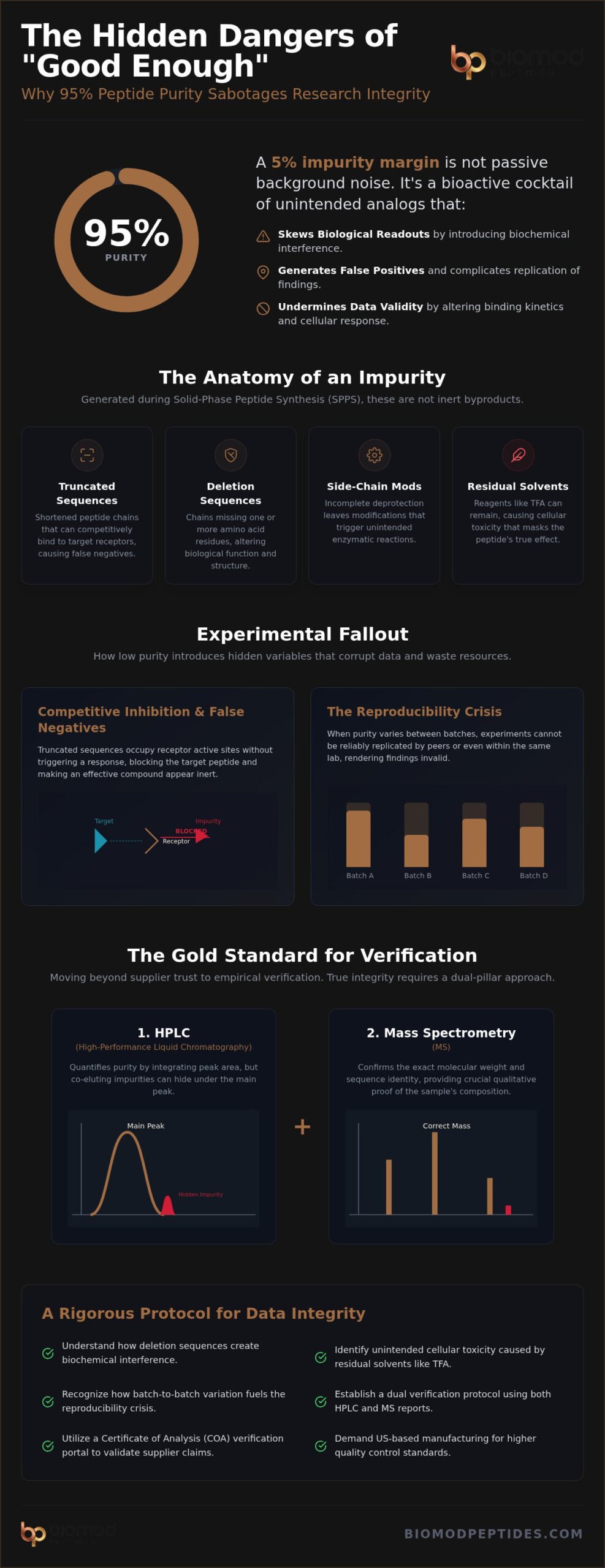
A 5% impurity margin is not passive background noise. It is an active variable that fundamentally alters binding kinetics and biological readouts. You’ve likely experienced the frustration of inconsistent results across batches or unexplained cellular toxicity in sensitive assays. These setbacks often stem from a lack of molecular integrity. The consequences of low purity peptides in research extend far beyond a single failed experiment. They compromise the foundational validity of your data. They drain critical laboratory resources. They undermine the credibility of your findings. In an industry where a 98% purity level is the baseline requirement, even minor deviations introduce biochemical interference that skews every subsequent conclusion.
Rigorous science requires moving beyond supplier trust and toward empirical verification. Discover how sub-standard purity generates false positives and complicates the replication of published findings. This analysis explores the specific risks associated with truncated sequences and residual salts. We’ll establish a protocol for verifying supplier claims through High-Performance Liquid Chromatography and Mass Spectrometry. You’ll gain the technical insight necessary to safeguard your methodology and ensure the long-term reproducibility of your laboratory data.
Key Takeaways
- Understand how deletion sequences during solid-phase peptide synthesis create biochemical interference that skews biological readouts.
- Identify the specific consequences of low purity peptides in research, including the role of residual solvents like TFA in inducing unintended cellular toxicity.
- Learn how batch-to-batch variation contributes to the reproducibility crisis and complicates the process of peer-review validation.
- Establish a rigorous verification protocol utilizing HPLC/MS reports and US-based manufacturing to ensure long-term data integrity.
- Utilize a COA verification portal to validate supplier claims and eliminate the structural uncertainty of sub-standard reagents.
The Biochemical Mechanism of Impurity Interference in Peptides
Purity in a research context is the percentage of the target peptide sequence relative to the total detected material. It’s not merely a statistical figure. It represents the structural integrity of your reagent. Most synthetic peptides are produced via Solid-phase peptide synthesis (SPPS). During this iterative process, amino acids are coupled sequentially to an insoluble resin. If a coupling step fails, “deletion sequences” emerge. These are truncated chains missing one or more residues. Incomplete deprotection of side-chain protecting groups adds further complexity. These side-chain modified impurities often possess chemical properties nearly identical to the target. They’re difficult to detect. They’re difficult to remove.
A 95% purity rating sounds sufficient. It often isn’t. That remaining 5% margin frequently contains highly bioactive, unintended analogs. These contaminants aren’t inert. They can actively interfere with experimental outcomes by interacting with the same biological pathways as your target. The consequences of low purity peptides in research are often masked by these subtle molecular deviations. Consider the specific risks of a 5% impurity margin:
- Competitive receptor binding from truncated sequences.
- Unintended enzymatic reactions triggered by side-chain modifications.
- Aggregation that alters solubility and bioavailability.
- Cellular toxicity from residual synthesis reagents.
HPLC and Mass Spectrometry: The Dual Pillars of Verification
Relying on a single analytical method is a risk. HPLC is the standard for quantifying purity via peak area integration. However, HPLC alone is insufficient. Co-eluting impurities often hide under the main peak because they share similar retention times. Mass Spectrometry is the necessary second pillar. It confirms the exact molecular weight and sequence identity. Without MS, you’re guessing at the structural composition of your sample. Verification requires both quantitative and qualitative proof.
The Problem with Truncated Sequences and Deletion Peptides
Truncated sequences are particularly dangerous in receptor-ligand studies. These peptides, missing a single residue, can competitively bind to target receptors. They occupy active sites without triggering the intended biological response. This creates a high risk of “false negatives.” Your data might suggest a lack of efficacy when the issue is actually competitive inhibition by a synthesis error. These deletion peptides turn clean assays into noisy, uninterpretable data sets.
Experimental Fallout: Reproducibility Crisis and False Readouts
The reproducibility crisis isn’t a theoretical concern; it’s a structural failure in data integrity. When purity varies between lots, peer-review validation becomes impossible. One of the primary reasons Why Peptide Purity Matters is that it eliminates hidden variables that skew statistical significance. If the effective concentration of your peptide is unknown, your binding affinity (Kd) and kinetic studies are inherently flawed. You’re measuring a response without an accurate denominator. This lack of precision is a major driver of the consequences of low purity peptides in research.
False positives present an equally dangerous risk. Byproducts from synthesis can trigger signaling pathways that mimic or inhibit the target’s activity. These “dirty” readouts lead researchers down unproductive paths. You waste time. You waste grant money. Establishing baseline integrity through verifying your research materials is the only way to ensure your biological readouts are genuine. Precision in the lab starts with the chemical fidelity of your reagents.
TFA Contamination and Cellular Toxicity
Trifluoroacetic acid (TFA) is a standard counter-ion used during peptide synthesis and HPLC purification. While it’s necessary for the process, it’s often toxic in biological systems. TFA can drastically alter the pH of delicate cell culture media, inducing unintended cellular toxicity that masks the peptide’s true effect. For sensitive in vitro research, such as studies involving primary cell lines or neurons, you should opt for TFA-removal protocols. Replacing TFA with acetate or hydrochloride salts ensures that observed effects are peptide-driven, not solvent-induced.
Oxidation and Degradation During Storage
Peptides containing methionine or cysteine residues are highly prone to oxidation. This chemical shift alters their folding patterns and binding capabilities, potentially turning an agonist into an antagonist. Maintaining peptide stability for research requires rigorous cold-chain handling and oxygen-free storage. Without these safeguards, a high-purity sample can degrade into a mixture of inactive sulfoxides before it ever reaches the assay, rendering your data sets inconsistent and unreliable.
Mitigating Risks through Rigorous Analytical Standards
Establishing a rigorous laboratory protocol for incoming reagent verification is the only defense against structural uncertainty. Researchers must demand total transparency. This means moving beyond simple summary statements. You should require full HPLC/MS chromatograms for every lot. US-based manufacturing is a critical component of this strategy. International shipping introduces stability risks due to temperature fluctuations and extended transit times. By prioritizing domestic production and finishing, you minimize the risk of degradation before the product enters your workflow.
The technical challenges of peptide synthesis and purity are well-documented and require orthogonal testing methods. Third-party testing provides an objective layer of accountability that internal reports cannot match. It validates that a purity rating isn’t just a marketing claim but an empirical fact. The Biomod Peptides verification portal serves as a standard for transparent research, allowing scientists to access batch-specific HPLC and MS reports instantly. This level of documentation is essential for mitigating the consequences of low purity peptides in research.
Sourcing Strategy for Las Vegas Research Facilities
Local supply chains offer distinct advantages for Las Vegas research facilities and national labs. Reducing transit distance preserves the chemical fidelity of sensitive sequences. Demand more than a “pass/fail” grade. A detailed chromatogram reveals the presence of co-eluting impurities that summary sheets often omit. Precision requires visibility into the raw data. It’s the only way to ensure batch-to-batch consistency in long-term studies.
The Long-term ROI of High-Purity Reagents
High-purity reagents represent a strategic investment in data integrity. Calculate the “cost of failure” when assessing your procurement budget. The price difference between 95% and 98% purity is negligible compared to the cost of lost lab hours and wasted consumables. If an assay fails due to a contaminated lot, you’ve lost weeks of progress. Quality-first procurement ensures that your future publications stand up to peer-review scrutiny. It protects the structural foundation of your findings.
Advancing Research Integrity Through Molecular Precision
Molecular integrity is the bedrock of reproducible science. Deletion sequences and residual solvents aren’t just statistical outliers; they’re active variables that distort biological readouts and invalidate kinetic studies. High-purity reagents prevent the significant resource drain associated with troubleshooting failed assays. They ensure your data sets remain robust for peer review. Understanding the consequences of low purity peptides in research is the first step toward establishing a reliable laboratory protocol that prioritizes structural fidelity over procurement convenience.
Precision requires accountability. Biomod Peptides bridges the gap between supplier claims and empirical proof through independent third-party verification and US-based manufacturing. Our Las Vegas-based logistics ensure stability by minimizing transit-related degradation. Every lot is documented within our COA verification portal, providing you with the transparency necessary for high-stakes research. Explore our US-manufactured, HPLC-verified research peptides to anchor your next study in objective data. Secure the future of your findings with reagents built for the highest standards of modern science.
Frequently Asked Questions
How does 95% peptide purity differ from 98% purity in actual lab results?
A 3% difference in purity represents a significant increase in potentially bioactive contaminants that can skew binding assays and kinetic readouts. While 95% is often marketed as a baseline, the 5% impurity margin frequently contains truncated sequences that competitively bind to target receptors. This structural uncertainty is one of the primary consequences of low purity peptides in research, leading to noisy data and unreliable statistical significance.
What are the most common impurities found in research-grade peptides?
The most frequent impurities include truncated sequences, deletion peptides, and residual solvents such as Trifluoroacetic acid (TFA). During the synthesis process, amino acids may fail to couple, resulting in shorter chains that lack specific residues. Other common contaminants include side-chain modified analogs and residual salts, both of which can interfere with intended biochemical interactions or induce unintended cellular responses in sensitive models.
Can I use HPLC to detect all impurities in a peptide sample?
No, HPLC alone cannot detect every impurity because co-eluting contaminants often hide under the primary peak if they share similar retention times. While HPLC is the standard for quantifying purity via peak area integration, it doesn’t confirm molecular identity. Mass Spectrometry is required to verify the exact molecular weight and sequence. Using both orthogonal methods is essential to avoid the consequences of low purity peptides in research caused by undetected structural variants.
Why is TFA removal important for certain types of research?
TFA removal is critical for in vitro studies where cell viability and pH stability are paramount. As a strong acid used in purification, residual TFA can lower the pH of culture media, causing cellular toxicity that masks the peptide’s true biological effect. Opting for acetate or hydrochloride salt exchanges ensures that observed cellular readouts are purely a result of the peptide’s activity rather than solvent-induced stress.
How does shipping and storage affect the purity of my peptides over time?
Environmental exposure during long-haul shipping can trigger oxidation and degradation, particularly in peptides containing cysteine or methionine. Temperature fluctuations during international transit often compromise structural integrity before the reagent reaches the laboratory. Maintaining a strict cold chain and utilizing US-based manufacturing helps preserve purity levels and ensures that the peptide remains stable throughout the duration of the research project.
What should I look for in a Certificate of Analysis (COA)?
A comprehensive COA must include batch-specific HPLC and Mass Spectrometry chromatograms rather than simple summary statements. Look for clear peak integration data and a mass spectrum that matches the target’s theoretical molecular weight. Verification through a dedicated portal, like those provided for US-manufactured lots, adds a necessary layer of accountability to ensure the reagent meets the stated benchmarks for purity and identity.
Disclaimer
BIOMOD products are sold strictly for laboratory, analytical, and scientific research use only. They are not intended for human or animal consumption, administration, application, ingestion, injection, or any therapeutic, diagnostic, or cosmetic use.
The statements made on this website have not been evaluated by the United States Food and Drug Administration. BIOMOD products are not intended to diagnose, treat, cure, mitigate, or prevent any disease or medical condition.
BIOMOD is a research chemical supplier. BIOMOD is not a compounding pharmacy or chemical compounding facility as defined under Section 503A of the Federal Food, Drug, and Cosmetic Act. BIOMOD is not an outsourcing facility as defined under Section 503B of the Federal Food, Drug, and Cosmetic Act.
By accessing this site, you confirm you are at least 21 years of age and that you have read and accepted the BIOMOD Terms of Sale, Privacy Policy, and Research Use Only Policy. BIOMOD does not provide dosing, medical, therapeutic, diagnostic, veterinary, or use guidance under any channel.