
The integrity of a laboratory’s data is only as robust as the reagents it employs. In the current regulatory environment of July 2026, the margin for analytical error has disappeared. For Nevada researchers, the Klow blend peptide represents a complex multi-pathway tool. Its utility depends entirely on molecular precision and verified purity. Professional researchers recognize that a research-only designation isn’t a loophole. It’s a mandate for higher standards.
Inconsistent batch quality and international import delays shouldn’t compromise your experimental timeline. This article provides a rigorous technical analysis of the Klow peptide blend. It details the molecular components and the analytical verification standards required for experimental reproducibility. We’ll examine the HPLC-verified protocols that ensure high-purity reagents and the logistical advantages of a reliable domestic supply chain. This review serves as a framework for maintaining data integrity in Las Vegas research facilities.
Key Takeaways
- Analyze the synergistic biological pathways of the four-peptide complex, including BPC-157, TB-500, GHK-Cu, and KPV.
- Establish rigorous analytical benchmarks for the Klow blend peptide using HPLC verification to secure experimental reproducibility.
- Implement verifiable documentation protocols through independent third-party testing and centralized COA access portals.
- Reduce experimental variables by sourcing reagents finished in the United States to ensure strict cold-chain integrity.
- Enhance procurement efficiency for Las Vegas facilities by utilizing domestic supply chains that bypass international import delays.
Understanding the Klow Blend: A Four-Peptide Research Complex
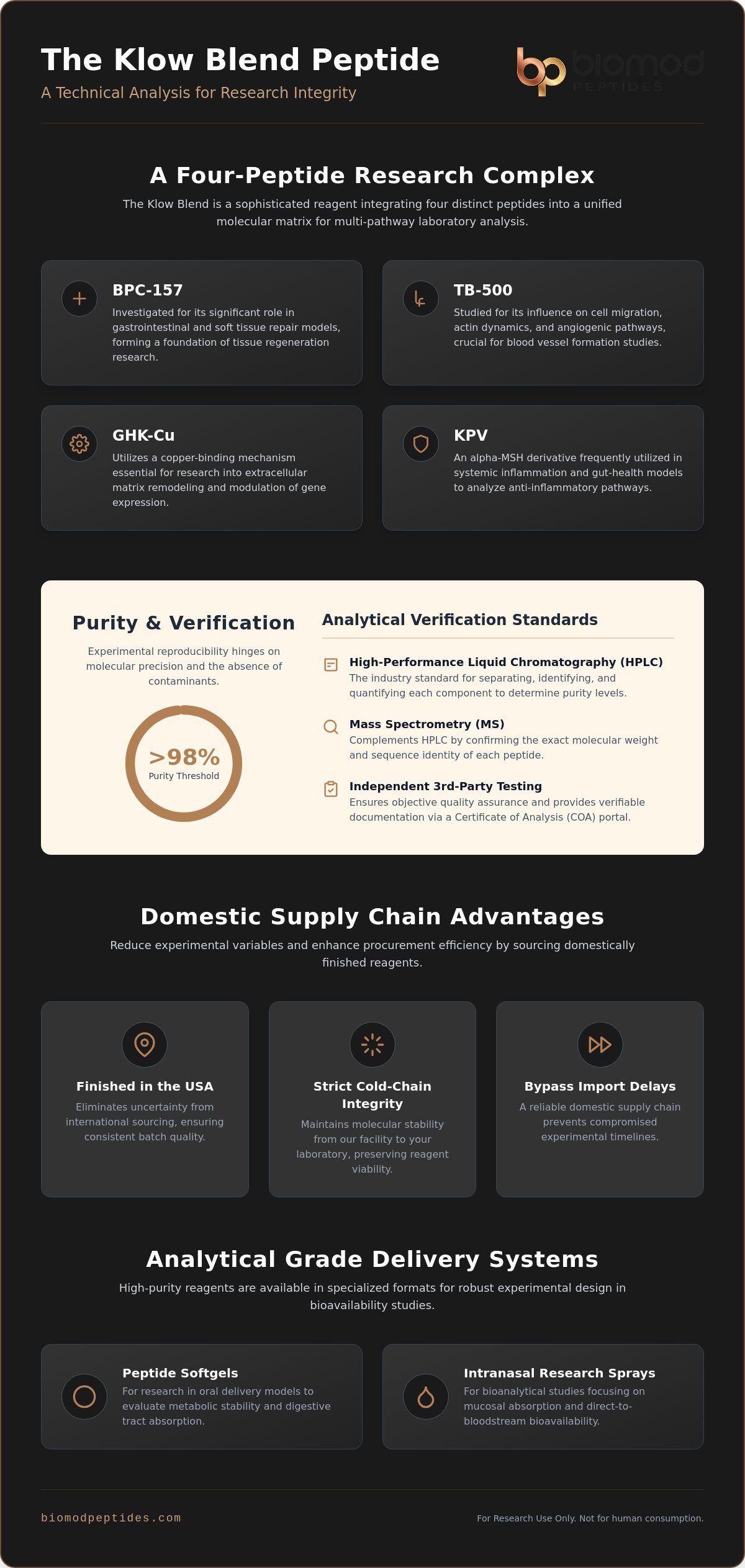
The Klow blend peptide is a 4-peptide complex designed for multi-pathway laboratory analysis. It functions as a sophisticated research reagent, integrating BPC-157, TB-500, GHK-Cu, and KPV into a unified molecular matrix. Each component targets distinct biological pathways. These include tissue repair, cell migration, copper-mediated gene expression, and systemic inflammation control. This specific configuration allows for a more comprehensive analysis of biological systems than individual peptide isolates.
Research indicates that multi-peptide blends may offer synergistic effects not observed in isolated peptide studies. By combining these sequences, labs can observe how concurrent signaling pathways interact. This is vital for advanced research models that require a broader physiological context. Precision in the ratio of these components is non-negotiable. It’s the difference between reproducible data and experimental failure. Professional laboratories prioritize these blends to evaluate cross-functional cellular responses.
The Synergy of BPC-157, TB-500, GHK-Cu, and KPV
The individual constituents of the Klow blend provide a multifaceted analytical profile. BPC-157 and TB-500 are extensively studied for their roles in musculoskeletal and angiogenic pathways. While BPC-157 focuses on gastrointestinal and soft tissue repair models, TB-500 is investigated for its influence on cell migration and blood vessel formation. These two peptides often form the foundation of tissue regeneration research.
GHK-Cu adds a layer of complexity through its copper-binding mechanism. This interaction is essential for research regarding extracellular matrix remodeling and the modulation of gene expression. Finally, KPV (Lysine-Proline-Valine) acts as an alpha-MSH derivative. It’s frequently utilized in systemic inflammation and gut-health models. For labs requiring specific delivery vectors, these blends are often studied in specialized formats like peptide spray products or peptide softgels to evaluate bioavailability in different experimental contexts. This combination ensures that the research environment reflects the complexity of biological systems.
Analytical Profiles and Purity Verification for Experimental Integrity
Experimental reproducibility hinges on the precision of the peptide sequence and the total absence of contaminants. For the Klow blend peptide, maintaining a purity threshold, typically exceeding 98%, is critical for valid laboratory outcomes. High-Performance Liquid Chromatography (HPLC) serves as the industry standard for determining these purity levels by separating chemical components within the mixture. Mass Spectrometry (MS) complements this by confirming the exact molecular weight and sequence identity of each peptide. The Klow blend peptide requires this level of scrutiny to ensure that synergistic effects observed are not the result of residual solvents or truncated sequences.
Biomod Peptides utilizes independent third-party testing to ensure objective quality assurance for all research reagents. This rigorous approach addresses the FDA safety risks for compounded peptides which often arise from unverified sourcing and poor quality control in non-research settings. By prioritizing analytical grade reagents, laboratories can eliminate variables that compromise study results.
Utilizing the COA Verification Portal
Researchers can access batch-specific Certificates of Analysis through a dedicated verification portal. These protocols ensure that the Klow blend meets the strict analytical grade standards required for publication-quality research. Transparency remains paramount in modern science. You can learn more about our verification protocols at Biomod Peptides to understand our internal benchmarks for data integrity. It’s a system designed to provide objective validation of every reagent before it enters your experimental workflow.
Analytical Grade Delivery Systems: Softgels and Sprays
Delivery format research often requires specialized vehicles like softgels or liquid sprays. Scientists can explore how peptide softgels for research are utilized in oral delivery models to evaluate metabolic stability. Similarly, the role of intranasal peptide research sprays is vital in bioanalytical studies focusing on mucosal absorption. For laboratories seeking high-purity reagents in these specialized formats, reviewing our current laboratory-grade inventory provides a baseline for robust experimental design.
Procurement and Handling for Las Vegas Research Facilities
Domestic manufacturing and finishing in the United States mitigate the risks associated with international shipping. For Las Vegas research facilities, regional supply chains are essential to avoid the extreme thermal fluctuations of the Mojave Desert. Biomod Peptides serves as a primary laboratory peptide supply for regional institutions. This proximity ensures that the Klow blend peptide maintains its structural integrity from finishing to delivery. Reducing lead times isn’t just a convenience; it’s a safeguard against environmental exposure during transit.
Lyophilized peptides are inherently stable but remain sensitive to environmental stressors. Cold-chain protocols are mandatory for maintaining the molecular stability of the complex. Storing reagents at –20°C or –80°C prevents peptide degradation and maintains the validity of longitudinal studies. Precision in handling is as vital as the initial purity of the reagent. Any deviation in storage temperature can lead to sequence cleavage, rendering the Klow blend peptide ineffective for analytical research.
Optimizing Peptide Stability in Experimental Applications
Proper handling of the Klow blend involves understanding the distinct solubility profiles of BPC-157, TB-500, GHK-Cu, and KPV. Each sequence responds differently to specific solvents. Researchers should consult established data on improving peptide solubility to determine the optimal reconstitution media for their specific assay. For example, foundational BPC-157 research highlights the importance of pH-neutral environments to preserve molecular stability during reconstitution.
Adherence to Analytical Standards
Long-term shelf life depends on rigorous storage hygiene. Ensure all laboratory storage follows the peptide purity verification guidelines. This prevents moisture ingress and oxidation, which are primary drivers of degradation in multi-peptide complexes. By maintaining these standards, Las Vegas laboratories can ensure that their experimental data remains reproducible and defensible in peer-reviewed contexts. Accountability in procurement is the first step toward scientific excellence.
Advancing Analytical Standards for Nevada Research
Securing experimental reproducibility requires an uncompromising approach to reagent quality. The Klow blend peptide serves as a sophisticated instrument for multi-pathway analysis, but its utility is defined by its analytical verification. Every batch must undergo independent third-party testing to confirm sequence identity and purity thresholds. By prioritizing reagents finished in the United States, Las Vegas laboratories can bypass the logistical risks of international transit and maintain strict cold-chain stability.
Biomod Peptides provides the technical infrastructure necessary for high-stakes research. Our commitment to transparency includes a dedicated COA verification portal; this ensures every researcher has immediate access to batch-specific data. This rigorous standard eliminates the variables that lead to inconsistent data and experimental failure. It’s a system built for researchers who prioritize empirical proof over market speculation.
Procure Verified Klow Blend Peptides for Laboratory Research to secure the integrity of your next study. High-purity reagents are the foundation of defensible scientific advancement.
Frequently Asked Questions
What is the exact composition of the Klow blend peptide?
The Klow blend peptide consists of four distinct research sequences: BPC-157, TB-500, GHK-Cu, and KPV. Each component is present in a standardized ratio to facilitate multi-pathway laboratory analysis. This specific combination allows researchers to evaluate concurrent biological processes, such as angiogenic signaling and inflammation modulation, within a single experimental model.
How is the purity of the Klow blend verified for research purposes?
Purity is verified through High-Performance Liquid Chromatography (HPLC) and Mass Spectrometry (MS) conducted by independent third-party laboratories. These analytical methods confirm the presence of the correct peptide sequences and the absence of residual contaminants or solvents. Every batch includes a Certificate of Analysis (COA) accessible through our verification portal; this ensures that reagents meet the >98% purity standard required for rigorous scientific inquiry.
Why is the Klow blend preferred over individual BPC-157 or TB-500 research?
The blend is preferred for studies requiring the observation of synergistic biological interactions. While individual research on BPC-157 or TB-500 focuses on isolated mechanisms, the blend allows for the analysis of cross-functional cellular responses. This is particularly useful in complex tissue repair models where multiple signaling pathways, such as copper-mediated gene expression and actin sequestration, operate simultaneously. It provides a more comprehensive analytical framework for advanced bioanalytical studies.
What are the storage requirements for the Klow blend to maintain stability?
Lyophilized Klow blend peptide reagents must be stored in a temperature-controlled environment, ideally at –20°C or –80°C, to prevent molecular degradation. Once reconstituted, the stability of the peptide complex decreases significantly. It’s essential to use sterile bacteriostatic water and maintain a consistent cold chain. Avoid repeated freeze-thaw cycles and exposure to light to ensure the structural integrity of the sequences remains intact throughout the experimental timeline.
Disclaimer
BIOMOD products are sold strictly for laboratory, analytical, and scientific research use only. They are not intended for human or animal consumption, administration, application, ingestion, injection, or any therapeutic, diagnostic, or cosmetic use.
The statements made on this website have not been evaluated by the United States Food and Drug Administration. BIOMOD products are not intended to diagnose, treat, cure, mitigate, or prevent any disease or medical condition.
BIOMOD is a research chemical supplier. BIOMOD is not a compounding pharmacy or chemical compounding facility as defined under Section 503A of the Federal Food, Drug, and Cosmetic Act. BIOMOD is not an outsourcing facility as defined under Section 503B of the Federal Food, Drug, and Cosmetic Act.
By accessing this site, you confirm you are at least 21 years of age and that you have read and accepted the BIOMOD Terms of Sale, Privacy Policy, and Research Use Only Policy. BIOMOD does not provide dosing, medical, therapeutic, diagnostic, veterinary, or use guidance under any channel.