
The integrity of a longitudinal study often collapses not at the hypothesis stage, but at the point of procurement. For laboratory managers, the volatility of batch-to-batch consistency remains the primary barrier to reproducible results in peptides for cellular senescence research. You understand that even a minor deviation in a peptide sequence or the presence of heavy metal contaminants can skew analytical data and waste critical funding. Precise experimentation requires more than just a supplier; it demands a transparent manufacturing lineage and verifiable structural integrity.
We recognize the frustration of ambiguous manufacturing origins and the risk of peptide degradation during transit. This 2026 lab guide provides a technical framework to evaluate and source high-purity research peptides with absolute confidence. We’ll detail the necessity of independent third-party HPLC reports for every batch and outline stable delivery systems designed for rigorous experimental protocols. From verifying US-based manufacturing to utilizing dedicated COA portals, this guide ensures your laboratory maintains the highest standards of analytical precision.
Key Takeaways
- Establish a 99% purity baseline as the mandatory standard for ensuring reproducible data in peptides for cellular senescence research.
- Evaluate the stability advantages of specialized research softgels compared to traditional lyophilized powders for specific experimental protocols.
- Mitigate the risk of temperature-sensitive degradation by leveraging US-based manufacturing and Las Vegas-based logistical hubs for accelerated transit.
- Implement a rigorous verification protocol using dedicated COA portals to audit batch-specific HPLC and mass spectrometry reports.
- Identify the critical biomarkers required to validate the efficacy of senotherapeutic reagents in high-fidelity laboratory models.
Analytical Standards for Cellular Senescence Research Peptides
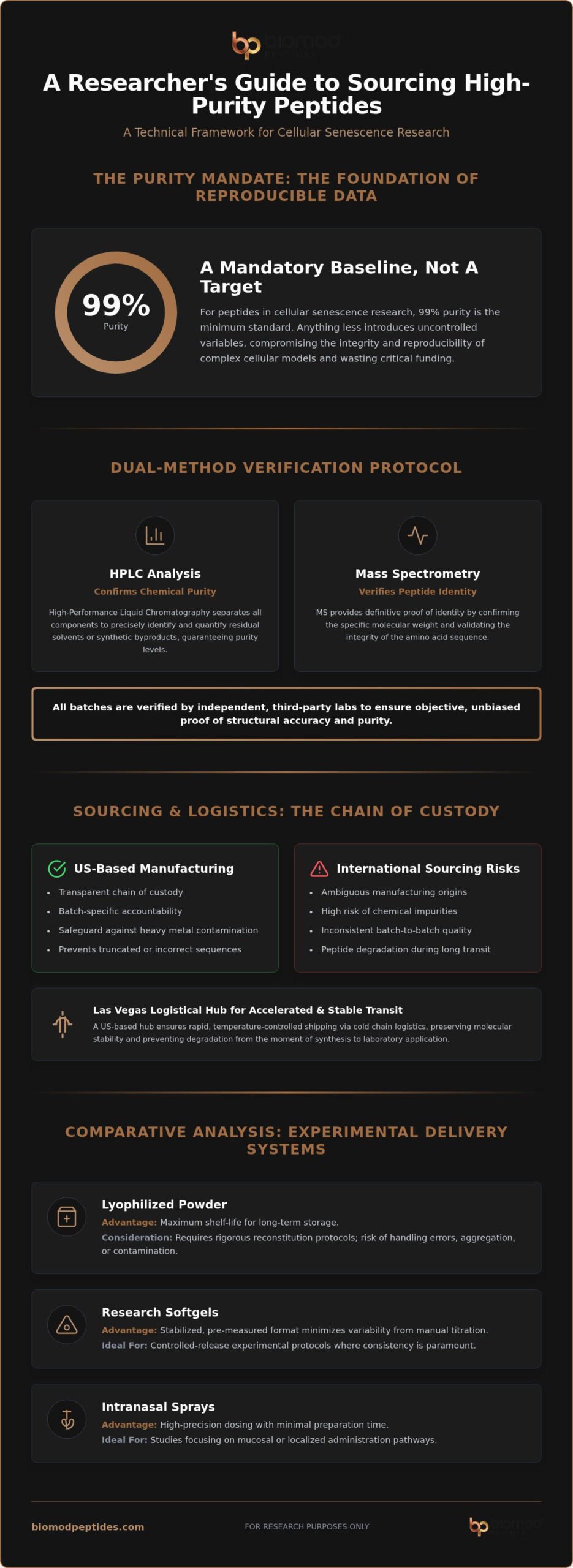
Peptides utilized in cellular senescence studies function as high-purity biochemical reagents. These compounds allow investigators to isolate and study growth-arrested cells and specific biological age markers. Precision is the primary requirement for these materials. For peptides for cellular senescence research, 99% purity isn’t an aspirational target; it’s the mandatory baseline. Substandard reagents introduce uncontrolled variables that compromise the reproducibility of complex cellular models. Analytical-grade research requirements must be strictly decoupled from consumer-grade marketing claims. The latter often lacks the rigorous documentation necessary for institutional verification.
US-based manufacturing remains the most effective safeguard against sequence errors and chemical impurities. International sourcing frequently leads to issues with heavy metal contamination or truncated sequences that go undetected without domestic oversight. Sourcing from a domestic facility ensures a transparent chain of custody. It allows for batch-specific accountability that international brokers cannot provide. This structural integrity is essential for maintaining the fidelity of longitudinal senescence studies.
HPLC and Mass Spectrometry in Purity Verification
High-Performance Liquid Chromatography (HPLC) is the standard for determining chemical purity. This process separates peptide components to identify residual solvents or synthetic byproducts. While HPLC confirms purity levels, Mass Spectrometry (MS) provides the definitive verification of identity. It confirms the specific molecular weight and validates the amino acid sequence integrity. Biomod Peptides utilizes independent third-party testing to ensure every batch meets these exacting standards. This rigorous approach eliminates the risks associated with internal reporting and provides objective proof of structural accuracy.
Identifying Reliable Molecular Markers
Successful experimentation depends on precise sequence verification for peptides targeting senescence hallmarks. Even a minor deviation in the peptide structure can alter binding affinity or metabolic pathways. This makes the verification of the molecular marker’s identity as critical as the purity level itself. Researchers should consult the Protocol for Peptide Purity Verification for a comprehensive framework on analytical standards. Establishing these benchmarks early prevents the loss of critical experimental data due to reagent failure.
Comparative Analysis: Experimental Peptide Delivery Systems
Selecting the correct delivery vehicle is a critical step when utilizing peptides for cellular senescence research. While lyophilized powders remain the industry standard for long-term storage, specialized delivery formats offer distinct advantages in specific laboratory environments. Precision matters. Analytical outcomes rely on the stability of the compound from the moment of synthesis to the point of assay application. Researchers don’t have room for error when measuring biological age markers in sensitive cellular models.
Lyophilized Powder vs. Stabilized Formats
Lyophilized powders provide the longest shelf-life but necessitate rigorous reconstitution protocols. Handling errors during this phase can introduce contaminants or lead to peptide aggregation. In contrast, peptide softgels for research provide a stabilized, pre-measured format ideal for controlled-release experimental protocols. These formats minimize the variability associated with manual titration. For investigators focusing on mucosal or localized pathways, intranasal peptide research sprays ensure high-precision dosing with minimal preparation time.
Cold chain logistics are a non-negotiable factor in this process. Structural integrity often degrades if temperature thresholds are exceeded during transit. Utilizing a supplier with a domestic hub, such as our Las Vegas facility, ensures rapid, temperature-controlled shipping that preserves molecular stability. This logistical transparency is essential for maintaining the fidelity of your experimental data.
Solubility and Formulation for Senescence Studies
Solubility remains a frequent hurdle in cellular assays. Hydrophobic sequences often require specific buffer adjustments to prevent precipitation and ensure uniform distribution. Current senotherapeutic peptide research demonstrates that the efficacy of compounds depends heavily on the formulation’s ability to maintain bioavailability within the target model. Researchers can find detailed technical guidance on improving peptide solubility to optimize their experimental designs. Maintaining these rigorous standards is why many institutions choose to source high-purity reagents from verified US manufacturers.
Institutional Procurement: Sourcing Reliable US Research Peptides
Institutional procurement for peptides for cellular senescence research requires strict adherence to “Research Use Only” (RUO) classifications. This designation isn’t a mere formality. It defines the legal and ethical boundaries for laboratory acquisition. Compliance departments require clear documentation that reagents are intended solely for in vitro or animal models. Establishing this boundary early ensures the procurement process remains aligned with institutional oversight and federal guidelines. It’s a critical step in maintaining the integrity of the research facility.
Verification is the cornerstone of professional procurement. A dedicated COA verification portal serves as the gold standard for laboratory transparency. It prevents the use of fraudulent or outdated analytical reports that often circulate in the secondary market. By providing direct access to batch-specific HPLC and mass spectrometry data, researchers can audit the structural integrity of their reagents before starting an experiment. This level of accountability is essential for maintaining the high-fidelity standards required in modern senescence studies.
Navigating Research-Only Terms of Sale
Standard institutional procurement orders require specific documentation to validate the intended use of high-purity peptides. This includes a clear statement of research intent and acknowledgment of the RUO status. These terms of sale protect the integrity of the scientific community. They ensure that analytical-grade compounds remain within controlled laboratory environments. Procurement managers must verify that every supplier provides a transparent chain of custody and rigorous finishing processes. Accurate documentation is the only way to ensure batch accountability.
Logistics and Quality Control in Las Vegas
Logistical speed is a critical variable in peptide stability. Our Las Vegas location serves as a strategic hub for temperature-controlled domestic shipping. Regional proximity minimizes transit times; this reduces the risk of thermal degradation for sensitive research reagents. Fast, reliable delivery ensures that peptides arrive with their structural integrity intact. Researchers who prioritize American manufacturing standards can learn more about Biomod Peptides and our commitment to logistical transparency. Our methodology combines US finishing with independent validation to support advanced cellular research. We focus on the data so you can focus on the discovery.
Advancing Analytical Precision in Senescence Studies
Reproducible data in peptides for cellular senescence research depends on the absolute elimination of synthetic variables. This guide established that 99% purity is the only acceptable baseline for institutional protocols. You’ve seen how US-based manufacturing and localized logistics in Las Vegas mitigate the risks of thermal degradation and sequence errors. By utilizing specialized delivery formats and secure COA portals, laboratories can maintain structural integrity throughout the experimental lifecycle. Professional procurement is no longer just about sourcing; it’s about verifying the molecular identity of every reagent used in your assays.
Biomod Peptides provides the technical infrastructure required for high-fidelity research. Every batch undergoes independent third-party HPLC testing to ensure it meets our rigorous internal benchmarks. Our US-manufactured and finished reagents are backed by a secure COA verification portal; this gives your team the empirical proof needed for complex longitudinal studies. We prioritize the data so your laboratory can focus on groundbreaking discoveries. Browse Analytical Grade Research Peptides to secure the reagents your next protocol requires. We look forward to supporting your progress with uncompromising quality standards.
Frequently Asked Questions
What is the standard purity level required for peptides in senescence research?
The mandatory purity baseline for peptides for cellular senescence research is 99% or higher. Lower purity levels introduce synthetic impurities and residual solvents that can skew analytical results in sensitive cellular models. Reproducibility in senescence studies depends on minimizing these uncontrolled variables. Institutional standards typically reject reagents that don’t meet this specific threshold. Maintaining this standard is critical for isolating specific biological age markers without biochemical interference.
How do I verify a peptide Certificate of Analysis (COA) using a verification portal?
Verification is completed by entering the batch-specific identification number into the secure COA verification portal. This system provides direct access to independent, third-party HPLC and mass spectrometry reports for that specific lot. It ensures researchers are working with validated reagents rather than outdated or fraudulent documentation. This transparent process allows for immediate structural integrity audits before experimental commencement. It’s the most reliable method for ensuring batch-to-batch consistency.
Why is US-based manufacturing critical for research-grade peptides?
US-based manufacturing is essential for maintaining a transparent chain of custody and ensuring batch accountability. Domestic facilities operate under rigorous quality control standards that mitigate the risk of heavy metal contamination and sequence errors common in international sourcing. This proximity also enables faster, temperature-controlled logistics from hubs like Las Vegas. Sourcing domestically ensures that peptides for cellular senescence research maintain their structural fidelity from synthesis to final laboratory delivery.
How should research-grade peptide softgels be stored to maintain stability?
Research-grade peptide softgels should be stored in a cool, dry environment protected from direct light exposure to prevent oxidative degradation. For long-term stability, maintaining a temperature range between 2°C and 8°C is recommended. Avoid frequent temperature fluctuations that can compromise the integrity of the specialized delivery format. Proper storage ensures that the controlled-release properties remain consistent throughout the duration of the experimental protocol. Consistency in storage is vital for reproducible analytical outcomes.
Disclaimer
BIOMOD products are sold strictly for laboratory, analytical, and scientific research use only. They are not intended for human or animal consumption, administration, application, ingestion, injection, or any therapeutic, diagnostic, or cosmetic use.
The statements made on this website have not been evaluated by the United States Food and Drug Administration. BIOMOD products are not intended to diagnose, treat, cure, mitigate, or prevent any disease or medical condition.
BIOMOD is a research chemical supplier. BIOMOD is not a compounding pharmacy or chemical compounding facility as defined under Section 503A of the Federal Food, Drug, and Cosmetic Act. BIOMOD is not an outsourcing facility as defined under Section 503B of the Federal Food, Drug, and Cosmetic Act.
By accessing this site, you confirm you are at least 21 years of age and that you have read and accepted the BIOMOD Terms of Sale, Privacy Policy, and Research Use Only Policy. BIOMOD does not provide dosing, medical, therapeutic, diagnostic, veterinary, or use guidance under any channel.