
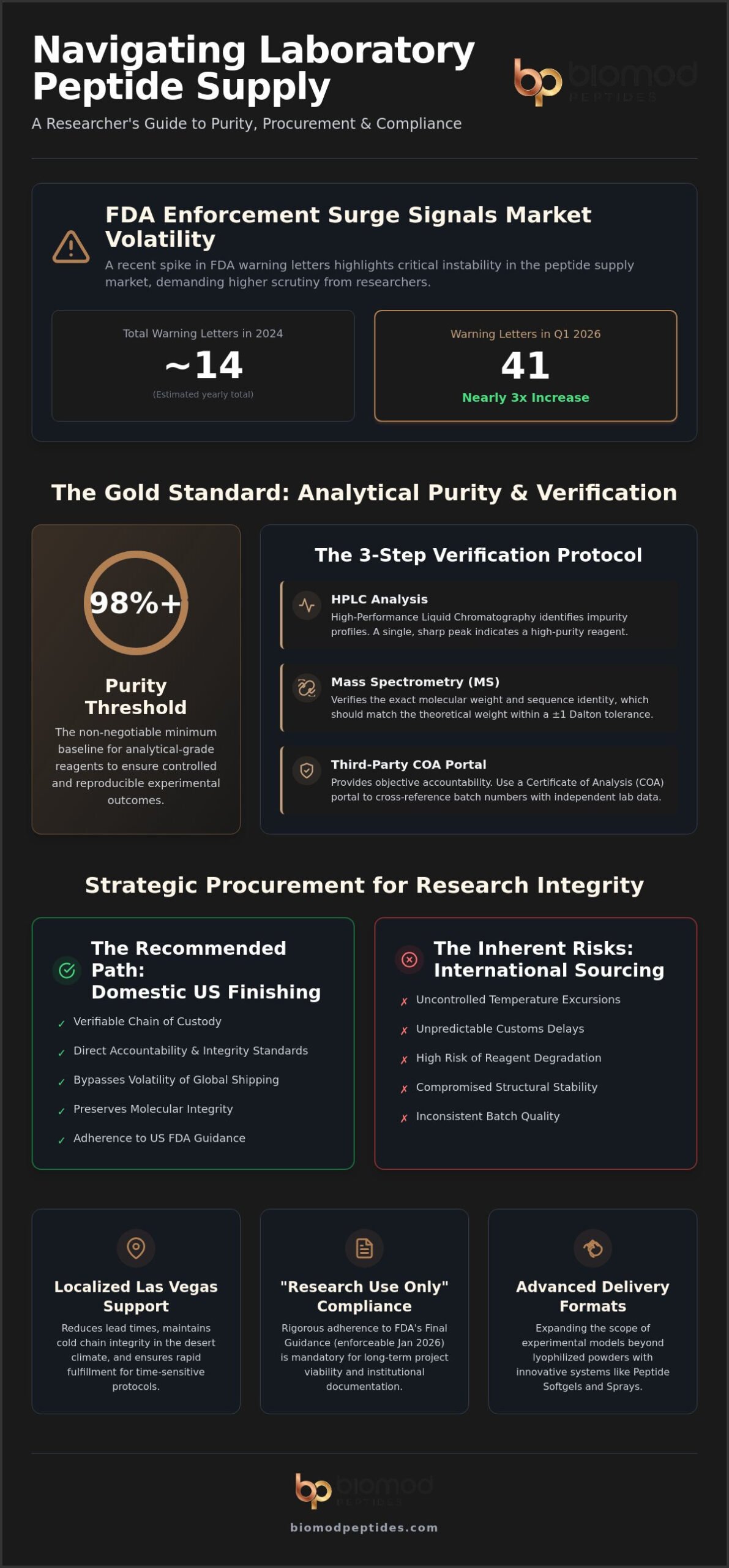
Between January and March 2026, the FDA issued 41 warning letters regarding research peptides; this is nearly triple the total from the entire 2024 calendar year. This surge in enforcement highlights a critical volatility in the current laboratory peptide supply market. You understand that unreliable purity levels and inconsistent batch stability aren’t just inconveniences. They’re technical variables that can compromise months of analytical progress. Securing high-purity reagents requires more than a standard catalog order. It demands a disciplined approach to supplier verification and objective data.
We’ve developed this guide to help researchers navigate the technical requirements of modern analytical standards. You’ll learn how to evaluate third-party HPLC data, utilize verification portals for real-time COA access, and select specialized delivery formats like peptide softgels or sprays. We’ll also cover the logistics of localized delivery in Las Vegas to ensure your chain of custody remains intact. This resource provides the structural integrity your research protocols require. It transitions your procurement from speculative sourcing to documented validation.
Key Takeaways
- Establish the 98% purity threshold as the minimum baseline for analytical-grade reagent selection.
- Identify the core requirements for a secure laboratory peptide supply, prioritizing domestic finishing and logistical transparency.
- Utilize a COA verification portal to access third-party HPLC data and ensure batch-to-batch consistency.
- Integrate advanced delivery formats like peptide softgels to expand the scope and precision of experimental models.
- Evaluate the “Research Use Only” regulatory landscape to maintain institutional compliance and documentation standards.
Evaluating Laboratory Peptide Supply: Analytical Standards and Purity Metrics
Laboratory peptide supply refers to the procurement of high-purity amino acid chains for in vitro and in vivo research applications. Analytical research demands a 98% purity minimum. It’s the only way to ensure experimental variables remain controlled and reproducible. High-Performance Liquid Chromatography (HPLC) serves as the primary tool for identifying impurity profiles. It separates the target molecule from secondary byproducts created during Peptide synthesis. Mass Spectrometry (MS) complements this by verifying the exact molecular weight and sequence identity. Together, these methods provide a definitive profile of the reagent’s structural integrity.
Interpreting HPLC and Mass Spectrometry Reports
Researchers must analyze the chromatogram for baseline stability and precise peak integration. A single, sharp peak indicates a high-purity reagent. Secondary peaks reveal common impurities like residual solvents, TFA, or truncated sequences. The ‘area under the curve’ (AUC) method calculates purity by comparing the integral of the main peak to the sum of all detected peaks. Mass Spectrometry data should match the theoretical molecular weight of the peptide within a tight tolerance, usually ±1 Dalton. Discrepancies here suggest incorrect sequence assembly or significant degradation.
The Role of Third-Party Verification in Research Integrity
Manufacturer claims are insufficient for rigorous scientific protocols. Independent lab testing provides an objective layer of accountability that internal data cannot replicate. Accessing a COA verification portal allows you to cross-reference batch numbers against third-party analytical data. This transparency mitigates the risk of using inconsistent reagents that could jeopardize study outcomes. For a detailed framework on these requirements, consult The Protocol for Peptide Purity Verification. These standards ensure your laboratory peptide supply meets the highest tiers of validation.
Strategic Procurement: Sourcing Research Peptides in the USA and Las Vegas
Procurement strategies for laboratory peptide supply must prioritize logistical transparency over catalog depth. International sourcing introduces uncontrolled variables. These include temperature excursions and unpredictable customs delays. Such factors degrade sensitive amino acid chains before they reach the laboratory bench. High-throughput facilities require a streamlined acquisition model that adheres to the FDA’s Final Guidance on Research-Grade Peptides. This guidance, fully enforceable as of January 2026, mandates strict labeling and documentation for institutional compliance. Maintaining the “Research Use Only” status requires rigorous adherence to these protocols to ensure long-term project viability.
Advantages of Domestic US Manufacturing and Finishing
Domestic finishing protocols provide a verifiable chain of custody that international alternatives lack. International transit risks include extended exposure to ambient temperatures and rough handling. These events compromise the structural stability of lyophilized powders. US-based providers offer direct accountability and adherence to rigorous business integrity standards. Identifying reliable peptide vendors USA researchers can audit through real-time analytical verification is now a foundational step in building a compliant procurement pipeline. You can read more about Biomod Peptides and our commitment to localized finishing processes. This approach ensures reagents bypass the volatility of global shipping lanes. It preserves the molecular integrity required for high-stakes analytical work.
Localized Distribution: Supporting Las Vegas Research Facilities
Las Vegas currently hosts a growing infrastructure of biotechnology resources, including ISO/IEC 17025 certified testing laboratories. Localized distribution centers significantly reduce lead times for time-sensitive experimental protocols. This proximity is vital for maintaining cold chain integrity during regional distribution. Rapid fulfillment minimizes the window for thermal degradation in the desert climate. For a deeper look at procurement standards, review our Scientific Laboratory Supplies: A Comprehensive Guide. Securing a reliable laboratory peptide supply within the region stabilizes your project timelines and ensures consistent batch delivery.
Advanced Delivery Formats: Beyond Lyophilized Powders
Peptide science is evolving toward innovative delivery systems that offer greater experimental diversity. While lyophilized solids remain a staple of the laboratory peptide supply, they aren’t the only format available for analytical research. Advanced formulations allow for more sophisticated in vivo modeling. These systems address specific challenges in bioavailability and molecular stability that traditional powders can’t always meet. Shifting toward specialized delivery formats represents a leap in methodology for researchers seeking to refine their experimental parameters.
Peptide Softgels for Analytical Consistency
Encapsulation provides a rigorous protective barrier against environmental factors such as light and oxidation. This format ensures precise dosing and structural stability in oral research models. It’s particularly effective in metabolic and pharmacokinetic studies where consistent gastric bypass is a technical requirement. Protecting the peptide within a lipid matrix prevents premature degradation before the reagent reaches the target site. Explore the Biomod Peptides softgel category for research options that meet these high-tier analytical standards.
Intranasal Research Sprays and Liquid Reagents
Mucosal delivery studies require bioanalytical grade solutions that maintain strict sterility and precise pH balance. Intranasal research sprays facilitate systemic and neurological peptide research; they provide a non-invasive route that bypasses certain first-pass metabolic hurdles. Maintaining the integrity of liquid formulations requires disciplined storage protocols to prevent hydrolytic degradation. See our peptide spray products for laboratory use to determine which delivery mechanism aligns with your protocol. Liquid reagents offer immediate utility, though they generally require more stringent cold-chain management than their lyophilized counterparts.
Advancing Analytical Precision through Validated Procurement
Analytical research depends on the absolute removal of technical variables. High-purity reagents and objective verification form the bedrock of reproducible data. Securing a reliable laboratory peptide supply requires a transition from speculative sourcing to documented validation. This approach ensures that every experimental model, whether utilizing lyophilized powders or advanced softgel formats, remains structurally sound. Integrating specialized delivery systems like intranasal sprays further expands the scope of pharmacokinetic studies while maintaining precise dosing parameters.
Biomod Peptides maintains these benchmarks through US-manufactured reagents and rigorous quality control. Every batch undergoes independent third-party HPLC and Mass Spectrometry testing to verify sequence identity and purity levels. Our secure COA verification portal provides the logistical transparency and empirical proof your institutional compliance requires. It’s about moving beyond traditional catalog orders to a model of clinical accountability. Secure your laboratory peptide supply at Biomod Peptides and stabilize your research infrastructure with reagents defined by professional integrity. We’re committed to the advancement of your analytical standards.
Frequently Asked Questions
How do I verify the purity of my laboratory peptide supply?
Verification requires cross-referencing batch numbers through a secure COA verification portal. Every high-purity reagent must be accompanied by third-party High-Performance Liquid Chromatography (HPLC) and Mass Spectrometry (MS) reports. These documents confirm the sequence identity and ensure the purity meets the 98% minimum threshold required for analytical research. Relying on manufacturer claims without independent validation compromises experimental integrity.
Are Biomod Peptides manufactured in the United States?
All reagents provided are manufactured and finished within the United States. This domestic production model ensures logistical transparency and strictly adheres to US regulatory standards for “Research Use Only” products. By maintaining finishing processes in the US, we eliminate the degradation risks associated with international transit and customs delays. This commitment to domestic oversight preserves the structural integrity of every peptide chain.
What is the difference between analytical grade and technical grade peptides?
Analytical grade peptides maintain a purity level of 98% or higher, which is necessary for sensitive in vitro and in vivo studies. Technical grade peptides often possess lower purity thresholds and are typically utilized for preliminary screening or non-critical applications. Selecting an analytical-grade laboratory peptide supply is essential for ensuring experimental reproducibility and minimizing interference from truncated sequences or residual solvents. Researchers looking to stay ahead of evolving industry benchmarks should also review the 2026 procurement guide for analytical-precision peptide reagents for labs, which addresses the updated 99% purity standard now shaping institutional compliance requirements.
Can I purchase research peptides for local pickup in Las Vegas?
We do not provide a physical storefront for local pickup, but we facilitate efficient local delivery throughout the Las Vegas region. This localized distribution model leverages regional supply hubs to minimize transit times and maintain cold chain integrity. Rapid fulfillment ensures that research institutions in Southern Nevada receive stable reagents without the thermal risks associated with long-distance shipping in desert climates.
Disclaimer
BIOMOD products are sold strictly for laboratory, analytical, and scientific research use only. They are not intended for human or animal consumption, administration, application, ingestion, injection, or any therapeutic, diagnostic, or cosmetic use.
The statements made on this website have not been evaluated by the United States Food and Drug Administration. BIOMOD products are not intended to diagnose, treat, cure, mitigate, or prevent any disease or medical condition.
BIOMOD is a research chemical supplier. BIOMOD is not a compounding pharmacy or chemical compounding facility as defined under Section 503A of the Federal Food, Drug, and Cosmetic Act. BIOMOD is not an outsourcing facility as defined under Section 503B of the Federal Food, Drug, and Cosmetic Act.
By accessing this site, you confirm you are at least 21 years of age and that you have read and accepted the BIOMOD Terms of Sale, Privacy Policy, and Research Use Only Policy. BIOMOD does not provide dosing, medical, therapeutic, diagnostic, veterinary, or use guidance under any channel.

49 Responses