
In 2026, the minimum purity standard for research-grade peptides has officially shifted to 99%. This benchmark reflects a critical need for analytical precision in an increasingly complex research landscape. You understand that batch-to-batch inconsistency isn’t just a nuisance. It’s a direct threat to experimental validity. Many researchers struggle with a lack of transparent documentation and opaque impurity profiles that compromise synthesis results.
This guide ensures you master the technical criteria for selecting high-purity peptide reagents for labs to guarantee reproducible results. We prioritize empirical verification over simple sequence claims. You’ll learn how to leverage batch-specific HPLC and mass spectrometry data to secure your methodology. We also analyze the logistical advantages of a reliable US-based supply chain and the role of specialized formats in modern delivery research. This is about moving beyond industry norms toward a higher tier of execution and professional accountability.
Key Takeaways
- Define the technical criteria for 99% HPLC purity to ensure experimental reproducibility and eliminate batch-to-batch inconsistency.
- Evaluate the role of mass spectrometry in confirming sequence accuracy and molecular weight for every reagent batch.
- Explore specialized research formats, including peptide softgels and sprays, to optimize oral bioavailability and stability protocols.
- Implement rigorous procurement protocols for peptide reagents for labs by utilizing third-party verification and batch-specific documentation.
- Access the COA Verification Portal to audit analytical reports and maintain a transparent, reliable supply chain for institutional research.
Technical Benchmarks for High-Purity Peptide Reagents
Analytical precision begins with stringent purity thresholds. For institutional research, 98% HPLC purity is no longer a suggestion; it is the standard. Substandard materials introduce impurities that skew data and invalidate months of work. High-quality Peptide synthesis requires rigorous post-production refinement to remove by-products. These by-products, often truncated sequences or deletion mutations, can compete for receptor sites and produce false-positive results. You must demand empirical proof of purity before integrating any material into your protocol.
HPLC and Mass Spectrometry Analysis
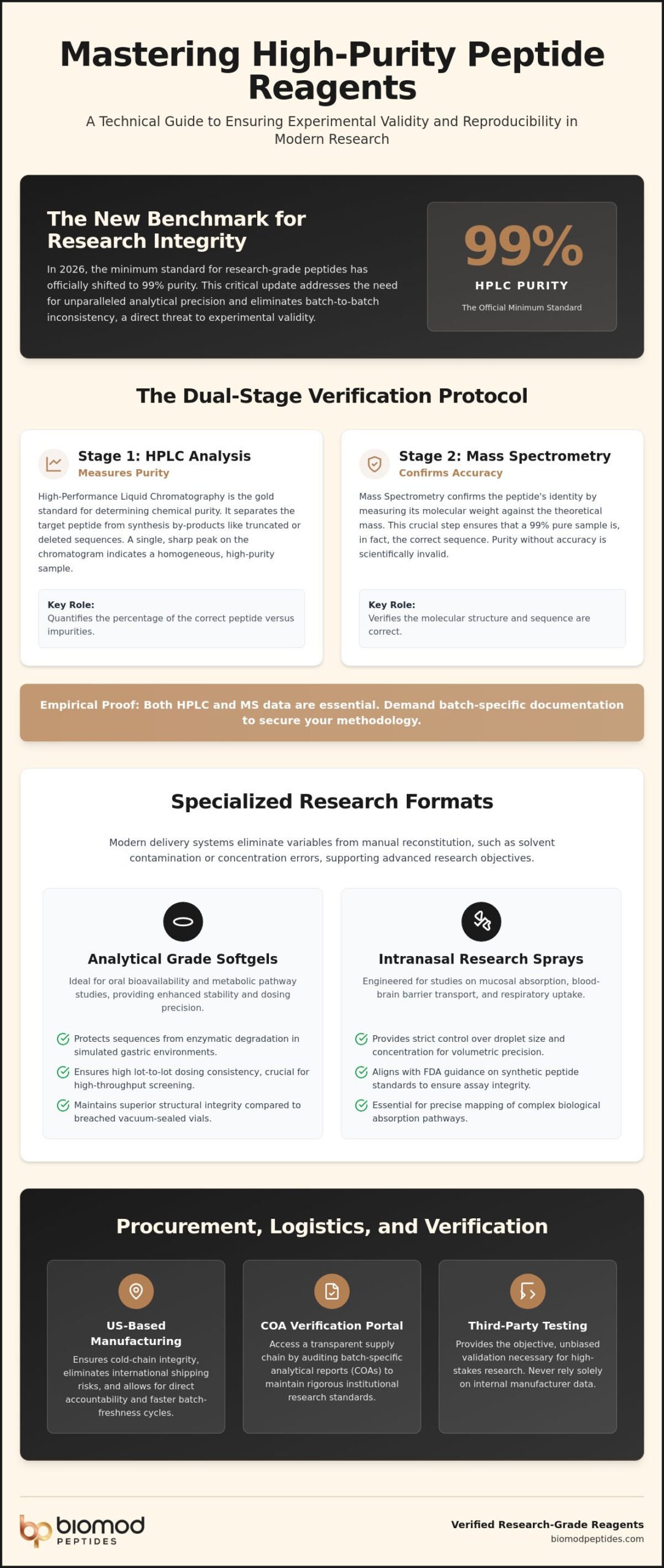
Verification requires a dual-stage approach. High-Performance Liquid Chromatography (HPLC) remains the gold standard for determining the chemical purity of peptide reagents by separating the target sequence from synthesis by-products. A single, sharp peak on the chromatogram indicates a homogeneous sample. However, purity alone is insufficient. Mass Spectrometry (MS) confirms sequence accuracy by measuring the molecular weight against the theoretical mass. Without MS, a 99% pure sample could still be the wrong sequence entirely. We also monitor residual trifluoroacetic acid (TFA). TFA is frequently used during cleavage but can interfere with cell culture viability. Identifying these levels ensures the integrity of your peptide reagents for labs.
US Manufacturing and Lab Accountability
Sourcing US-manufactured research peptides provides essential logistical oversight. Our facility in Las Vegas ensures that cold-chain integrity is never compromised by international shipping delays or customs holds. Domestic production allows for direct accountability and faster batch-freshness cycles. Every product is strictly designated for “Research Use Only” to maintain regulatory clarity. This boundary protects the institution and the researcher by ensuring the focus remains on objective data. Using verified peptide reagents for labs from a domestic source eliminates the opacity often found in global supply chains. It establishes a transparent link between the manufacturer and the laboratory bench. Institutions building a long-term procurement strategy should consult our reliable peptide vendors USA framework for 2026 laboratory procurement to understand how vendor evaluation criteria have evolved alongside regulatory shifts.
Specialized Research Formats: Softgels and Sprays in Experimental Design
Standard lyophilized powders require precise reconstitution. This step often introduces experimental variables like solvent contamination or concentration errors. Modern methodology now utilizes specialized delivery systems to eliminate these risks. These formats allow for direct application in oral or mucosal studies without the friction of manual preparation. When procuring peptide reagents for labs, researchers must evaluate if a pre-formulated delivery system better supports their specific research objectives.
Analytical Grade Softgel Applications
Softgel encapsulation provides a unique environment for stability. The lipid-based matrix protects sensitive sequences from enzymatic degradation in simulated gastric or intestinal environments. Utilizing peptide softgels for research ensures high lot-to-lot dosing consistency. This precision is vital for high-throughput screening where manual pipetting errors can compromise data integrity. These formats maintain structural integrity better than traditional vacuum-sealed vials once the primary seal is breached. For labs focused on metabolic pathways, this stability is a prerequisite for accurate modeling.
Intranasal Spray Research Parameters
Intranasal delivery research requires strict control over droplet size and concentration. Peptide spray products are engineered to meet these requirements. Protocols for intranasal peptide research sprays must account for mucosal absorption rates and volumetric precision. Every batch must align with rigorous FDA guidance on synthetic peptide standards to ensure that impurity profiles don’t interfere with biological assays. This level of verification is essential for researchers mapping the blood-brain barrier or respiratory uptake. You can explore our full range of research-grade formats to find the delivery system that matches your experimental parameters. Precision in format leads to precision in results.
Procurement Protocols: COA Verification and Supply Logistics
Procurement is the final safeguard for experimental integrity. Relying solely on internal manufacturer data is a procedural risk. Third-party testing provides the objective validation necessary for high-stakes research. You must verify every batch of peptide reagents for labs through independent analytical reports. This transparency ensures that the materials you receive match the technical benchmarks established in your protocol. Verification isn’t just about trust. It’s about data security.
The COA Verification Framework
Validating a Certificate of Analysis (COA) requires a methodical review of empirical data. You shouldn’t accept generic or undated documents. The Biomod COA Verification Portal allows researchers to audit batch-specific reports in real-time. Key data points include the purity percentage, which must meet the 99% threshold, and the Net Peptide Content (NPC). NPC is critical because it accounts for the actual weight of the peptide versus residual salts and water. Reviewing solubility profiles also ensures the reagent is compatible with your specific buffer systems. These steps move your procurement process beyond simple purchasing and into the realm of empirical proof.
Regional Supply and Distribution
Logistical stability is as important as chemical purity. Sourcing from reliable peptide vendors in the USA significantly reduces transit times. Short transit windows minimize the risk of thermal degradation, especially for sensitive sequences. At our Las Vegas facilities, we maintain strict cold chain storage protocols to preserve reagent stability from synthesis to delivery. For institutions conducting longitudinal studies, securing bulk research peptides ensures batch consistency over several months or years. Standardizing your procurement workflow with a domestic partner provides the accountability required for modern analytical research. Researchers navigating the current enforcement landscape should also consult our laboratory peptide supply resource guide for analytical research standards to understand how recent FDA activity is reshaping supplier verification requirements. High-quality peptide reagents for labs demand a supply chain that is as rigorous as the science itself.
Advancing Analytical Standards in Peptide Research
Precision in laboratory results is contingent upon the integrity of your chemical inputs. The transition to a 99% purity benchmark reflects a necessary evolution in experimental accountability. You’ve seen how HPLC and mass spectrometry provide the empirical proof required to eliminate synthesis variables. Beyond purity, specialized formats like softgels and sprays offer the stability and volumetric control essential for modern delivery research. This shift ensures that your methodology is grounded in data rather than assumptions.
Securing a reliable supply chain requires more than just a vendor; it requires a partner committed to objective validation. We prioritize independent third-party testing on every batch to maintain institutional standards. Our US-based manufacturing and finishing processes ensure cold-chain integrity and regulatory compliance. By utilizing our proprietary COA Verification Portal, you can audit batch-specific analytical reports with total transparency. It’s time to elevate your procurement protocols to match the complexity of your research.
Take the next step in securing your analytical precision. Access our Verification Portal and Browse High-Purity Reagents to ensure your peptide reagents for labs meet the highest tier of execution. Your research deserves the weight of empirical proof.
Frequently Asked Questions
What is the difference between analytical grade and synthesis grade peptide reagents?
Analytical grade reagents meet a minimum purity threshold of 98% to 99% and undergo rigorous verification via mass spectrometry. Synthesis grade materials are often crude or partially purified intermediates used as precursors during the assembly of longer sequences. For final biological assays, analytical grade peptide reagents for labs are required to prevent interference from truncated sequences or residual synthesis by-products that could skew receptor binding data.
How should I interpret an HPLC report when purchasing peptide reagents for my lab?
Focus on the chromatogram’s primary peak to ensure it is sharp and symmetrical. The area under the curve (AUC) for this peak represents the purity percentage, which should align with the Certificate of Analysis. You must examine the baseline for secondary peaks, as these signify impurities or deletion mutations. Confirm that the retention time aligns with the peptide’s known chemical properties and verify that the report is batch-specific.
Why is third-party testing critical for US-manufactured research peptides?
Third-party testing provides an essential layer of objective validation that eliminates manufacturer bias. Even with high-tier domestic manufacturing, independent verification ensures that every batch of peptide reagents for labs adheres to the 99% purity standard. This external audit confirms sequence accuracy and molecular weight. It provides researchers with the empirical proof necessary for high-stakes laboratory protocols and institutional accountability. For a deeper understanding of how to evaluate supplier credentials and maintain a compliant laboratory peptide supply chain, our analytical research standards guide outlines the key verification steps required in today’s regulatory environment.
Can peptide softgels be used for standard laboratory reconstitution protocols?
Peptide softgels aren’t intended for standard reconstitution protocols. These formats feature a specialized lipid-based matrix designed to protect the peptide from enzymatic degradation in oral bioavailability studies. They can’t be dissolved into traditional aqueous buffers like lyophilized powders. Researchers should utilize softgels specifically for experimental designs that require pre-formulated, stable delivery systems rather than manual preparation at the bench.
Disclaimer
BIOMOD products are sold strictly for laboratory, analytical, and scientific research use only. They are not intended for human or animal consumption, administration, application, ingestion, injection, or any therapeutic, diagnostic, or cosmetic use.
The statements made on this website have not been evaluated by the United States Food and Drug Administration. BIOMOD products are not intended to diagnose, treat, cure, mitigate, or prevent any disease or medical condition.
BIOMOD is a research chemical supplier. BIOMOD is not a compounding pharmacy or chemical compounding facility as defined under Section 503A of the Federal Food, Drug, and Cosmetic Act. BIOMOD is not an outsourcing facility as defined under Section 503B of the Federal Food, Drug, and Cosmetic Act.
By accessing this site, you confirm you are at least 21 years of age and that you have read and accepted the BIOMOD Terms of Sale, Privacy Policy, and Research Use Only Policy. BIOMOD does not provide dosing, medical, therapeutic, diagnostic, veterinary, or use guidance under any channel.

2 Responses