
A single compromised batch can invalidate months of longitudinal data and thousands of dollars in laboratory resources. You understand that precision isn’t a preference; it’s a requirement for reproducible results. When a shipment arrives with compromised cold chain indicators or analytical data that doesn’t align with your internal HPLC testing, the frustration is immediate. Delays in experimental timelines shouldn’t be the standard in professional research.
Learning how to report a problem with a peptide order through a formal, evidence-based protocol is the only way to secure a technical resolution. This guide provides a rigorous framework for documenting logistical or analytical discrepancies in procurement. We’ll examine the specific steps for logging shipping errors, verifying product purity via COA portals, and resolving discrepancies between internal lab results and provided HPLC reports. Follow these procedures to secure replacements and maintain the integrity of your research.
Key Takeaways
- Establish a rigorous baseline for discrepancy claims through immediate visual inspection of lyophilized samples and documentation of tamper-evident seals.
- Master how to report a problem with a peptide order by synthesizing physical documentation and analytical data into a single technical support request.
- Validate product purity by accessing the COA Verification Portal to compare internal observations with independent, third-party laboratory reports.
- Accelerate the resolution process by engaging directly with the Las Vegas-based laboratory support team through dedicated professional channels.
Protocols for Documenting Logistical and Physical Discrepancies
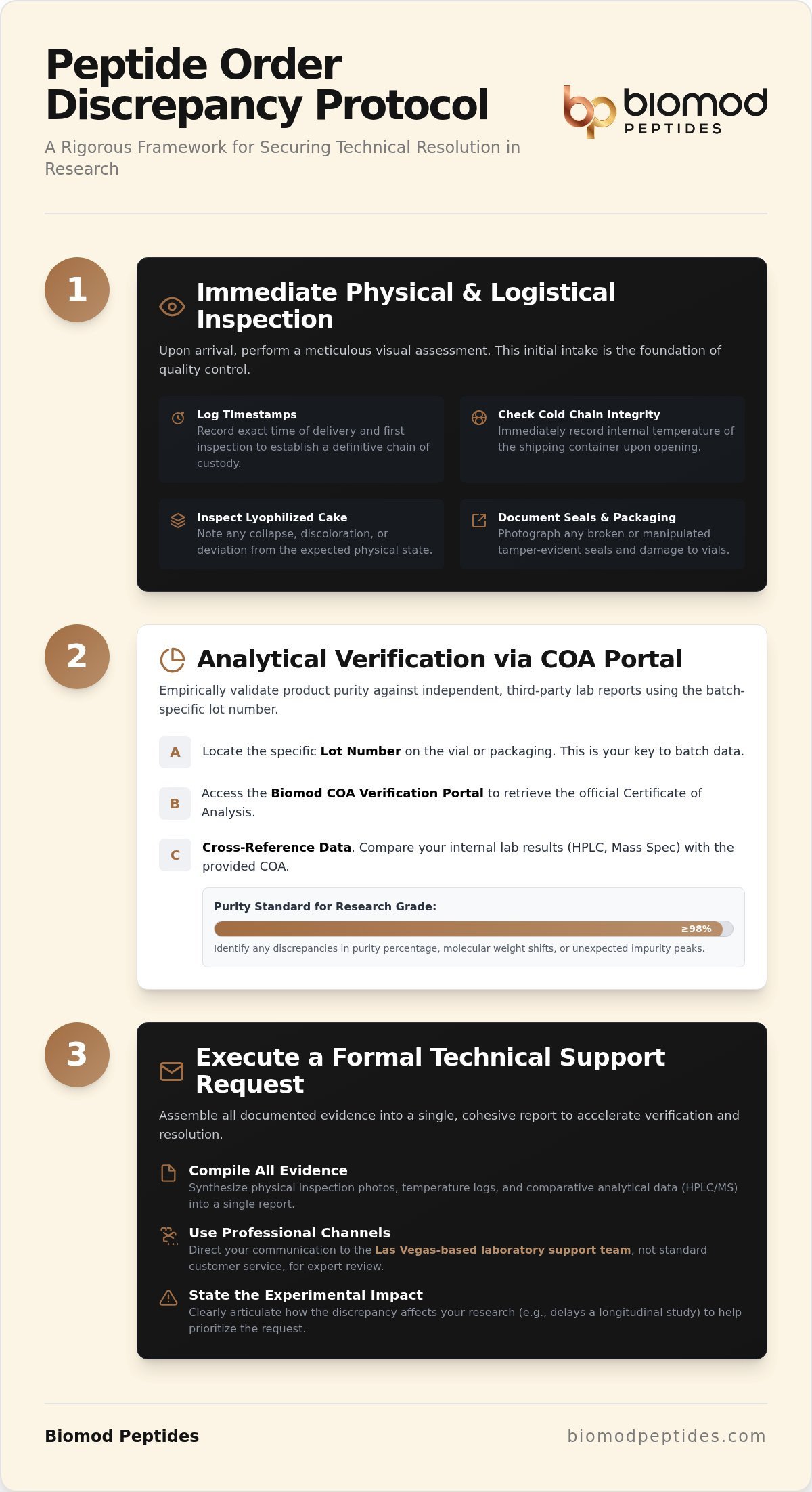
Accountability begins the moment a shipment enters the laboratory. Perform an immediate visual inspection of the lyophilized research peptides upon arrival. Any deviation in the physical state of the cake, such as collapse or discoloration, suggests a compromise in the lyophilization process or subsequent storage. Document the state of all tamper-evident seals and secondary packaging with meticulous detail. If seals are broken or manipulated, the chain of custody is void. This initial intake process is the foundation of institutional quality control.
Capturing high-resolution digital evidence of physical damage to vials or containers is mandatory. This visual data serves as the primary evidence when determining how to report a problem with a peptide order to the supplier. All claims must strictly adhere to the “Research Use Only” terms of sale to remain valid. If cold chain protocols were specified, record the internal temperature of the shipping container immediately upon opening. These observations must align with established quality control procedures to ensure data integrity and experimental reproducibility.
Assessing Shipping Integrity and Cold Chain Stability
Environmental factors can degrade sensitive sequences before research begins. Check for signs of moisture ingress or seal failure in peptide spray products. Verify the condition of desiccant packs included in the shipment; saturated packs indicate humidity control was compromised during transit. Establish a definitive timeline of custody by logging the exact time of delivery and the time of first inspection. This temporal data is critical for laboratory accountability. It ensures that storage requirements were met from the Las Vegas facility to your bench. Consistent documentation prevents the waste of high-value reagents and maintains the rigorous standards required for modern biochemical analysis.
Verifying Analytical Purity via the COA Verification Portal
Precision in research requires empirical verification. Locate the specific lot number on the vial or packaging of your research peptides before beginning any reconstitution. This unique identifier is the key to accessing batch-specific data through the Biomod COA Verification Portal. It’s the first step in understanding how to report a problem with a peptide order effectively. By comparing your received material against independent third-party reports, you establish a baseline for analytical accountability. Understanding peptide science standards is essential to ensure the chemical profile aligns with your specific experimental requirements.
If internal lab results suggest a variance, cross-reference your HPLC chromatograms with the provided standards to identify specific peaks of concern. A Certificate of Analysis acts as a primary drug quality document in a professional setting, providing the necessary metrics for validation. When discrepancies arise, knowing how to report a problem with a peptide order involves submitting these comparative data sets. This objective approach removes ambiguity from the resolution process. It’s a process that ensures technical failure is addressed through data rather than conjecture. For those requiring validated reagents, you can verify current batch purity through our centralized portal.
Interpreting HPLC and Mass Spectrometry Discrepancies
Analyze the purity percentage against the stated analytical grade standards for the specific sequence. Research-grade peptides typically require a minimum purity of 98% or higher to ensure experimental reproducibility. Identify potential impurities or baseline noise that may indicate degradation during transit. Document any variance in the mass spectrometry profile, as a shift in the molecular weight peak suggests a sequence synthesis error. These technical findings form the core of a formal support request. Meticulous documentation of these analytical gaps is the only pathway to securing a replacement of compromised research materials.
Executing a Formal Technical Support Request
Documentation is the bridge between a discrepancy and its resolution. Compile all physical and analytical evidence gathered in the previous steps into a single, cohesive technical report. This file serves as a definitive record of the variance. When you understand how to report a problem with a peptide order through professional channels, you bypass the friction of standard customer service. Direct your communication to the Las Vegas laboratory support team. Using the established procurement channel ensures your data reaches the technical personnel capable of interpreting HPLC peaks and mass spectrometry shifts.
Clarity accelerates the verification process. Clearly state the experimental impact of the discrepancy to help the support team prioritize your request. A delay in a longitudinal study carries more weight than a preliminary reagent check. Refer to the Laboratory Peptide Supply guide to align your expectations with standard industry resolution timelines. This professional approach maintains the integrity of the laboratory-supplier relationship. It avoids the unprofessional tactics seen in retail-tier environments, focusing instead on scientific accountability and data-driven proof.
Required Documentation for Laboratory-Grade Resolution
A complete submission minimizes back-and-forth communication. Your report must contain specific data points to facilitate a swift audit of the batch in question. Submit all high-resolution photographic evidence and internal lab reports as attachments directly to the Biomod Peptides support portal. This centralized system ensures your documentation is logged against internal quality control benchmarks. Essential data points include:
- The original order number and batch-specific lot number.
- Date of internal analytical verification and receipt.
- A concise summary of the discrepancy, such as “HPLC purity variance >2%.”
The Las Vegas team utilizes this information to verify the chain of custody and cross-reference internal retention samples. This protocol ensures that every discrepancy is resolved with the technical gravity it requires. By following this rigorous guide, you maintain the momentum of your research while ensuring product purity standards are upheld.
Securing Research Integrity Through Analytical Accountability
Scientific progress relies on the absolute reliability of your reagents. Mastering how to report a problem with a peptide order is not merely an administrative task; it’s a vital safeguard for your longitudinal data. By integrating immediate physical documentation with batch-specific verification, you maintain a rigorous chain of custody. Every order from Biomod Peptides is US-manufactured and finished in Las Vegas, supported by independent third-party lab testing to ensure maximum precision. Utilizing the analytical grade verification portal allows you to cross-reference lot numbers with empirical data before your research begins. This commitment to transparency ensures that discrepancies are resolved through data rather than conjecture. Maintain the momentum of your laboratory work by prioritizing verified quality at every stage of procurement. Access the COA Verification Portal for Order Analysis today to validate your current batch.
Frequently Asked Questions
What is the timeframe for reporting a damaged research peptide shipment?
Physical damage or logistical errors must be reported within 72 hours of delivery to maintain carrier liability. For analytical discrepancies, such as purity variances, researchers should initiate a claim within 14 days of receipt. Adhering to these windows ensures that the chain of custody remains verifiable and prevents environmental degradation post-delivery from complicating the resolution process.
How do I use the COA Verification Portal to report a batch discrepancy?
Input the batch lot number directly into the portal to retrieve the independent third-party testing data. Compare the peak integration and mass spectrometry results against your internal laboratory findings. If a significant variance is identified, download the verified report to include in your technical submission. This objective evidence is critical when learning how to report a problem with a peptide order effectively.
Can I return research peptides if the purity does not meet my lab standards?
Returns are generally authorized only when empirical data proves the product fails to meet the 98% purity threshold required for research-grade reagents. Because these materials are for laboratory use, opened vials cannot be returned for subjective reasons. You must provide comparative HPLC chromatograms to justify a replacement of compromised materials under the professional procurement protocol.
What happens if my peptide softgels arrive with compromised seals?
Compromised seals on peptide softgels indicate a breach in the primary containment and invalidate the integrity of the research material. Do not utilize the product for experimental purposes if the tamper-evident packaging is broken. Document the specific state of the seals with high-resolution photography and contact the Las Vegas support team immediately to initiate a formal replacement request.
Disclaimer
BIOMOD products are sold strictly for laboratory, analytical, and scientific research use only. They are not intended for human or animal consumption, administration, application, ingestion, injection, or any therapeutic, diagnostic, or cosmetic use.
The statements made on this website have not been evaluated by the United States Food and Drug Administration. BIOMOD products are not intended to diagnose, treat, cure, mitigate, or prevent any disease or medical condition.
BIOMOD is a research chemical supplier. BIOMOD is not a compounding pharmacy or chemical compounding facility as defined under Section 503A of the Federal Food, Drug, and Cosmetic Act. BIOMOD is not an outsourcing facility as defined under Section 503B of the Federal Food, Drug, and Cosmetic Act.
By accessing this site, you confirm you are at least 21 years of age and that you have read and accepted the BIOMOD Terms of Sale, Privacy Policy, and Research Use Only Policy. BIOMOD does not provide dosing, medical, therapeutic, diagnostic, veterinary, or use guidance under any channel.