
Traditional lyophilized powders introduce a margin of error that modern longitudinal studies can no longer afford. Researchers often face significant variability during reconstitution, leading to inconsistent dosing and concerns over matrix stability. These technical hurdles consume valuable laboratory hours and threaten the reproducibility of your data. Utilizing high-purity peptide softgels for laboratory research offers a standardized alternative that eliminates manual preparation errors.
This guide outlines the technical protocols for integrating these precision tools into your workflow while ensuring absolute analytical rigor. You’ll master the transition from raw powders to verified, pre-dosed formats that align with >98% HPLC purity standards. We will detail the implementation of standardized research protocols, the role of third-party verification, and strategies to streamline your laboratory operations through superior structural integrity.
Key Takeaways
- Eliminate manual reconstitution errors by transitioning from lyophilized powders to standardized softgel formats for improved intra-assay consistency.
- Ensure analytical rigor by utilizing peptide softgels for laboratory research that meet >98% HPLC purity standards and offer superior matrix stability.
- Validate batch-level integrity through transparent COA verification portals and US-based manufacturing processes to maintain structural accountability.
- Establish standardized operating procedures for integrating pre-dosed softgels into multi-week longitudinal studies to reduce preparation time and solvent contamination risks.
Transitioning from Lyophilized Powders to Peptide Softgels in Research
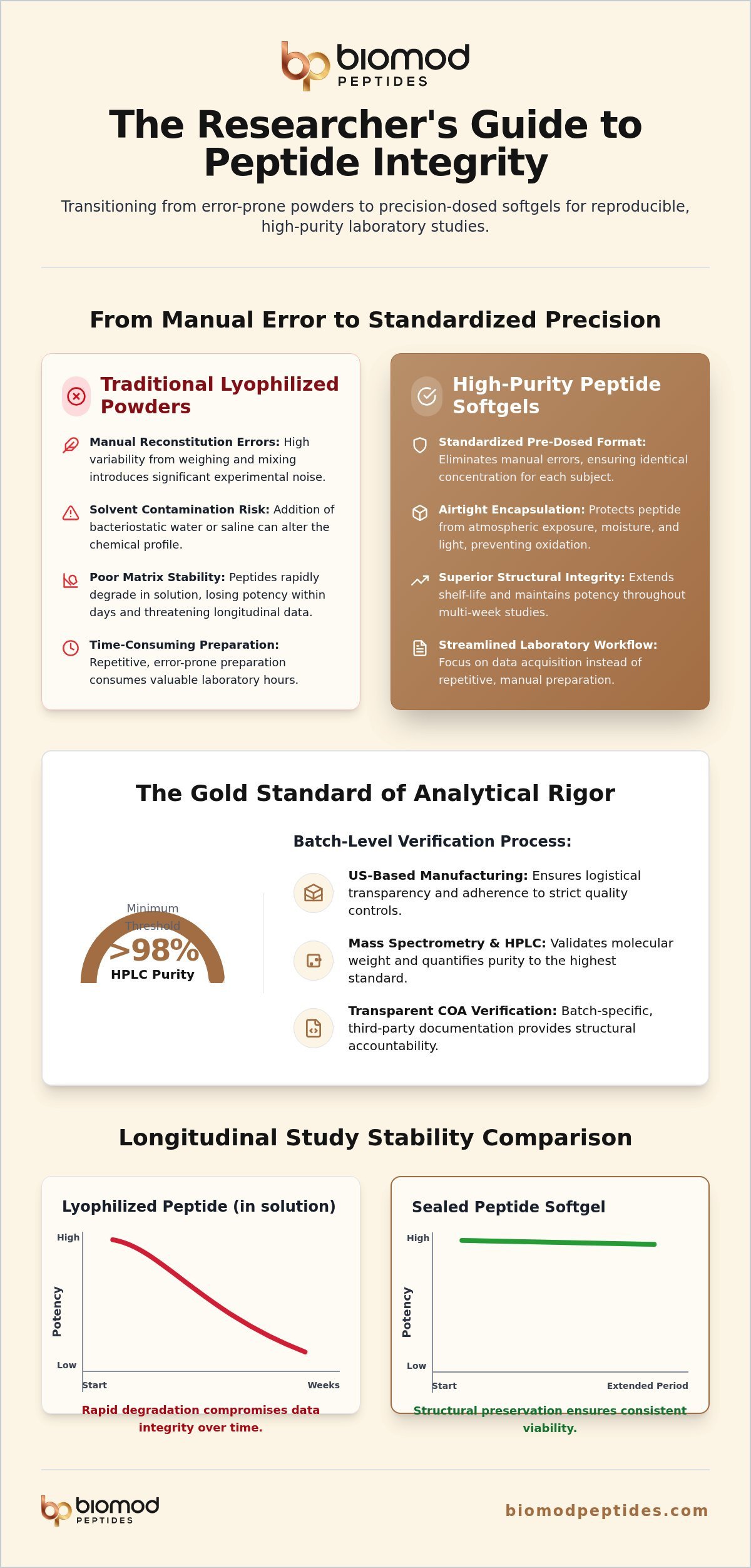
Manual reconstitution remains a primary source of experimental noise. Precision matters. Weighing milligram-level lyophilized powders requires high-precision balances often sensitive to environmental fluctuations. Even minor weighing errors propagate through the reconstitution process, leading to inconsistent molar concentrations. Solvent contamination during the addition of bacteriostatic water or saline further complicates the chemical profile. Transitioning to peptide softgels eliminates these manual preparation risks by providing a standardized, pre-measured unit.
It’s a shift that is critical for reducing intra-assay variability in multi-week studies. When researchers use this oral dosage form, they ensure that each subject receives an identical concentration of the analyte. In metabolic modeling, this consistency is vital for isolating the peptide’s effects from dosing fluctuations. Softgels provide a controlled matrix that maintains the structural integrity of the compound throughout the study duration. This reliability is why many facilities now prioritize peptide softgels for laboratory research over traditional vials.
Advantages of Pre-Measured Softgel Formats for Analytical Consistency
Automated encapsulation offers a level of precision that manual pipette measurements can’t match. Industrial-grade filling systems in US-based facilities achieve volume accuracy within fractions of a percent, maintaining the >98% HPLC purity standards required for high-stakes research. This precision is particularly beneficial for sensitive sequences prone to oxidation. By sealing the peptide within an airtight shell, softgels prevent atmospheric exposure during handling. Many stable sequences also bypass the need for cold-chain reconstitution, simplifying laboratory logistics. Utilizing peptide softgels for laboratory research ensures that the focus remains on data acquisition rather than repetitive, error-prone preparation.
Evaluating Softgel Integrity: Purity, Stability, and Matrix Analysis
Analytical rigor requires a minimum threshold of >98% HPLC purity for all research reagents. Achieving this standard within a softgel matrix necessitates sophisticated manufacturing controls. Unlike lyophilized vials that require immediate use post-reconstitution, peptide softgels maintain their chemical profile over extended periods. Lyophilized peptides often exhibit rapid degradation once in solution, typically losing potency within days or weeks depending on the sequence. Softgels protect the peptide from moisture and light, extending shelf-life under standard laboratory storage conditions.
This stability is essential for longitudinal studies where baseline consistency is mandatory. Research into Peptide-Based Supramolecular Hydrogels highlights how formulation affects release kinetics and molecular integrity. By utilizing peptide softgels for laboratory research, investigators minimize the risk of spontaneous hydrolysis that plagues aqueous solutions. This structural preservation ensures that the analyte remains viable throughout the entire experimental timeline without the need for repetitive, fresh reconstitutions.
Interpreting HPLC and Mass Spectrometry for Softgel Reagents
Verifying the contents of a softgel requires precise extraction protocols. The peptide analyte must be isolated from the gelatinous matrix without inducing thermal or chemical degradation. Once extracted, mass spectrometry peaks are analyzed to identify potential impurities, truncated sequences, or secondary metabolites. Any deviation from the target molecular weight indicates a compromise in structural integrity. HPLC purity remains the primary benchmark for research reagent quality, providing a quantifiable measure of molecular precision. Reputable providers ensure that peptide softgels for laboratory research are accompanied by batch-specific documentation to validate these metrics through transparent third-party testing.
Sourcing and Verifying Research-Grade Softgels
Sourcing high-purity analytes requires a rigorous vetting process. Reliable vendors distinguish themselves through US-based manufacturing and comprehensive documentation. When acquiring peptide softgels for laboratory research, the facility’s location and finishing processes provide essential logistical transparency. Establishing a standard operating procedure (SOP) for batch-level verification before commencing experiments is a non-negotiable requirement for maintaining analytical integrity. This practice protects laboratory funding by ensuring that every data point is supported by verified purity metrics.
Third-party accountability serves as the primary defense against experimental variability. Without independent validation, the risk of using sub-standard reagents increases, potentially compromising multi-week studies. Rigorous verification protocols are the industry standard for professional research institutions. Documentation must be exhaustive. It should reflect the structural identity and purity of the specific batch in use. Relying on verified data rather than marketing claims is what separates high-tier research from speculative studies.
Utilizing the Biomod COA Verification Portal for Batch Accountability
The Biomod COA Verification Portal provides a direct link to independent laboratory reports. To ensure batch accountability, researchers should follow this protocol:
- Locate the unique batch number on the product packaging.
- Enter the identifier into the portal to retrieve the corresponding Certificate of Analysis (COA).
- Cross-reference the HPLC and mass spectrometry results against the stated >98% purity benchmarks.
- Archive the digital COA for inclusion in peer-reviewed methodology sections to provide objective proof of reagent quality.
Understanding these quality benchmarks allows researchers to proceed with confidence. By integrating these verification steps into your laboratory workflow, you ensure that your use of peptide softgels for laboratory research meets the highest standards of scientific accountability. This systematic approach to sourcing ensures that your findings are reproducible and analytically sound.
Advancing Laboratory Precision with Standardized Analytes
Standardizing your laboratory workflow starts with the elimination of manual reconstitution variables. High-purity peptide softgels for laboratory research provide the structural integrity and dosing precision required for modern longitudinal studies. By prioritizing >98% HPLC purity and US-based laboratory finishing, you secure the analytical foundation of your data. Independent third-party verification remains the final safeguard for institutional accountability. Transitioning to pre-measured formats allows your team to focus on data acquisition rather than repetitive, error-prone preparation. It’s a shift toward a more disciplined and efficient methodology. Take the next step in refining your experimental protocols and procure high-purity peptide softgels for your laboratory today. Maintaining these rigorous standards ensures your research remains at the forefront of the field.
Frequently Asked Questions
Are peptide softgels as stable as lyophilized powders for long-term research?
Peptide softgels provide superior stability compared to reconstituted liquids but serve a different role than long-term lyophilized storage. While vacuum-sealed powders remain stable for years at -20°C, softgels protect analytes from oxidation and moisture during active study phases. This makes peptide softgels for laboratory research ideal for multi-week protocols where daily reconstitution is impractical. Biomod ensures structural integrity through climate-controlled finishing in our Las Vegas facility.
How do I verify the purity of a peptide softgel batch?
Researchers must cross-reference batch identifiers with independent laboratory reports to confirm purity. Biomod Peptides maintains a transparent COA Verification Portal where each lot is documented with HPLC and mass spectrometry data. Standard benchmarks require >98% purity to ensure experimental reproducibility. Verifying these metrics before commencing a study is a critical step in any professional laboratory SOP to maintain data accountability and structural transparency.
What excipients are typically used in research-grade softgel matrices?
Research-grade softgel matrices typically utilize USP-grade gelatin, glycerin, and purified water for the outer shell. The internal suspension often involves analytically neutral carrier oils, such as medium-chain triglycerides, to maintain the peptide’s structural integrity. These excipients are selected to minimize interference with the analyte during metabolic modeling. Every formulation undergoes US-based finishing to meet strict quality benchmarks and ensure consistent laboratory performance.
Can softgels be used in all types of laboratory research models?
Softgels are specifically designed for oral administration studies and gastrointestinal stability modeling. They aren’t suitable for research protocols requiring parenteral, intravenous, or subcutaneous delivery methods. When utilizing peptide softgels for laboratory research, investigators must ensure the model accounts for the encapsulation matrix. This format is increasingly preferred for metabolic studies in Las Vegas facilities where standardized, pre-measured dosing is essential for reducing intra-assay variability.
Disclaimer
BIOMOD products are sold strictly for laboratory, analytical, and scientific research use only. They are not intended for human or animal consumption, administration, application, ingestion, injection, or any therapeutic, diagnostic, or cosmetic use.
The statements made on this website have not been evaluated by the United States Food and Drug Administration. BIOMOD products are not intended to diagnose, treat, cure, mitigate, or prevent any disease or medical condition.
BIOMOD is a research chemical supplier. BIOMOD is not a compounding pharmacy or chemical compounding facility as defined under Section 503A of the Federal Food, Drug, and Cosmetic Act. BIOMOD is not an outsourcing facility as defined under Section 503B of the Federal Food, Drug, and Cosmetic Act.
By accessing this site, you confirm you are at least 21 years of age and that you have read and accepted the BIOMOD Terms of Sale, Privacy Policy, and Research Use Only Policy. BIOMOD does not provide dosing, medical, therapeutic, diagnostic, veterinary, or use guidance under any channel.