
The distinction between a failed dissolution and a compromised sample is often the difference between a successful study and a total loss of research materials. You’ve likely faced the ambiguity of a cloudy vial where the source of the turbidity remains unclear. It’s a critical moment for laboratory integrity. Troubleshooting contaminated peptide vials requires a forensic approach to distinguish between chemical degradation, physical compromise, and procedural handling errors. We recognize the frustration of inconsistent experimental data and the difficulty of separating poor solubility from biological growth.
This protocol provides a rigorous guide to identifying and resolving contamination issues to ensure absolute analytical precision. We’ll outline clear methods to isolate the source of a breach and confirm batch purity using high-resolution analytical methods like HPLC. You’ll learn to differentiate between biological growth and chemical impurities while establishing a framework to prevent future vial compromise. This methodical overview moves from initial identification to final verification, ensuring your research remains grounded in empirical proof.
Key Takeaways
- Distinguish between lyophilized cake irregularities and post-reconstitution turbidity to accurately diagnose sample compromise.
- Execute a rigorous protocol for troubleshooting contaminated peptide vials by validating solvent sterility and evaluating aseptic handling techniques.
- Identify specific analytical markers in HPLC and Mass Spectrometry to detect high background noise or unexpected impurity peaks.
- Utilize the COA Verification Portal to reconcile laboratory findings with official batch-specific purity and identity documentation.
- Establish a framework for definitive batch validation to ensure analytical precision and protect the integrity of experimental data.
Identifying Indicators of Peptide Vial Contamination
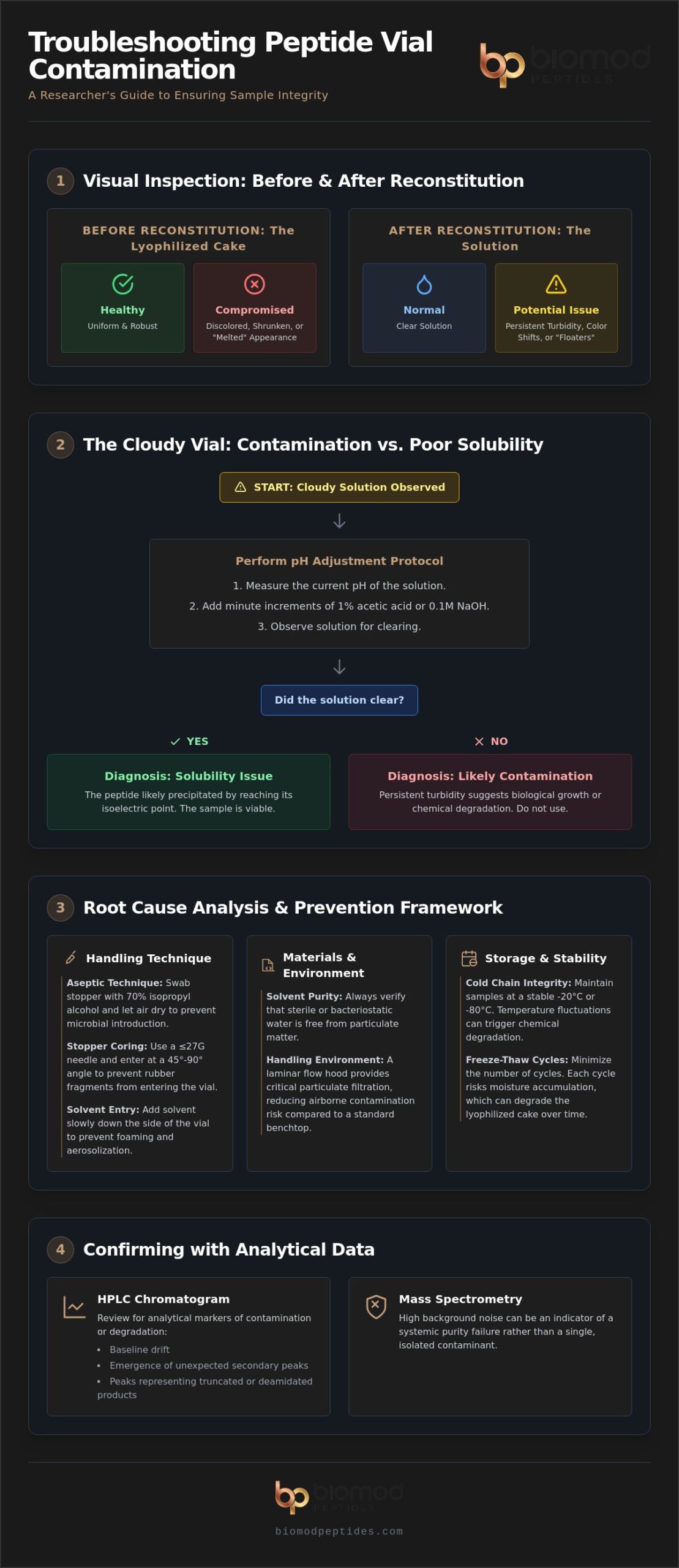
Precision in the laboratory begins with visual and analytical verification. Identifying a compromised sample requires a forensic eye. Before reconstitution, inspect the lyophilized cake. A healthy cake is uniform and robust. Discoloration, shrinkage, or a “melted” appearance often indicates moisture ingress or a breached vacuum seal. Once reconstituted, persistent turbidity is the most common indicator of a problem. However, cloudiness alone is not definitive proof of biological growth. Effective troubleshooting contaminated peptide vials requires distinguishing between microbial contamination and simple physical anomalies like rubber fragments from stopper coring.
Visual vs. Analytical Detection
Macroscopic changes provide the first line of defense. Document any color shifts or “floaters” immediately. If cloudiness persists after 24 hours of refrigeration, the risk of contamination increases. Analytical verification offers deeper insights. Review HPLC chromatograms for baseline drift or the emergence of secondary peaks not present in the original Certificate of Analysis. These peaks often represent truncated sequences or deamidated products. Understanding protein purification principles is essential here; it allows researchers to recognize when high background noise in Mass Spectrometry indicates a systemic purity failure rather than a single contaminant.
The Role of Solubility in Misdiagnosis
Researchers often misidentify poorly dissolved peptides as contaminated. This is a frequent error. A peptide may reach its isoelectric point in certain buffers, causing it to precipitate. This creates a cloudy solution that mimics microbial growth. Before discarding the sample, follow this pH adjustment protocol:
- Measure the current pH of the solution.
- Add minute increments of 1% acetic acid or 0.1M NaOH.
- Observe for clearing.
If the solution clears with a pH shift, the issue was solubility. If the turbidity remains or includes granular “pellets,” biological growth or chemical degradation is likely. Rigorous troubleshooting contaminated peptide vials demands this level of procedural differentiation to protect research integrity and avoid the unnecessary loss of expensive materials.
Systematic Troubleshooting of Reconstitution and Handling Protocols
Effective troubleshooting contaminated peptide vials requires an audit of the entire reconstitution workflow. Start with solvent purity. Sterile or bacteriostatic water must be verified as free from particulate matter. If the peptide batch is confirmed pure via external documentation, the solvent is the likely source of unexpected turbidity. Assess the handling environment. A standard benchtop lacks the particulate filtration of a laminar flow hood. Every exposure to ambient air increases the risk of microbial introduction.
Stopper integrity is a common point of failure. Coring occurs when the needle shears off rubber fragments during entry. Use a 27G needle or smaller to minimize this risk. Enter the stopper at a 45 to 90 degree angle. Straighten the needle only after the bevel has fully penetrated the rubber. Additionally, audit your cold-chain logs. Temperature fluctuations during storage can trigger chemical degradation that mimics biological contamination. For researchers requiring absolute consistency, our research peptides are finished to rigorous internal benchmarks.
Correcting Reconstitution Errors
Audit the pressure equalization process. If a vial maintains a high vacuum, solvent can enter too rapidly. This causes foaming and aerosolization, which may introduce external air into the sample. Maintain a controlled solvent-to-peptide ratio. Inadequate solvent volume can lead to oversaturation and precipitation. This physical state is often misidentified as biological growth. Ensure the solvent is added slowly down the side of the vial wall to prevent mechanical stress on the peptide structure.
Preventing Physical Compromise
Aseptic technique is non-negotiable. Swab the stopper with 70% isopropyl alcohol and allow it to air dry completely before entry. Proper storage protocols for lyophilized research peptides are critical for long-term stability. Keep samples in a dedicated laboratory freezer at -20°C or -80°C to maintain structural integrity. Minimize the number of freeze-thaw cycles. Repeated cycling can lead to moisture accumulation and subsequent degradation of the lyophilized cake.
Utilizing Verification Portals and Third-Party Data to Resolve Discrepancies
Forensic resolution of discrepancies requires access to raw analytical data. Use the COA Verification Portal to cross-reference your in-house findings with the original batch-specific chromatograms. This step is vital for troubleshooting contaminated peptide vials when visual inspection and solubility adjustments fail to provide clarity. High-resolution HPLC and MS reports allow researchers to rule out manufacturing impurities by verifying that the observed peaks align with the peptide’s theoretical mass and purity specifications. It’s the only way to confirm that a “cloudy” vial isn’t simply a result of high peptide concentration or buffer incompatibility.
Interpreting Certificates of Analysis (COA)
Precision demands a deep dive into the technical documentation. Start by cross-referencing batch numbers to ensure the material matches analytical grade standards. Identify the specific counter-ion, such as Trifluoroacetic Acid (TFA), listed in the report. TFA presence can influence the isoelectric point and solubility profile. Misinterpreting these chemical parameters often leads to false positives for contamination. If your HPLC results show a purity level below the 95% threshold established for research peptides, the discrepancy suggests a systemic batch issue rather than an isolated handling error.
Establishing Laboratory Accountability
Our US-based operations in Las Vegas provide logistical transparency and direct quality oversight. We implement internal quality control checks for every new lot received at our Las Vegas facilities. Maintaining a rigorous chain of custody for all research peptides USA sourced for high-stakes studies ensures data reproducibility. This institutional discipline is essential for troubleshooting contaminated peptide vials effectively. If a discrepancy persists across multiple vials from the same lot despite perfect aseptic technique, it indicates a systemic issue. Contact the supplier only after conducting this forensic audit to distinguish between isolated handling errors and legitimate manufacturing defects.
Ensuring Analytical Precision Through Empirical Validation
Maintaining research integrity requires a shift from reactive observation to proactive verification. You’ve established the forensic markers of contamination and audited your reconstitution protocols. These steps are fundamental. However, the final stage of troubleshooting contaminated peptide vials always returns to the raw data. Distinguishing between chemical solubility and biological growth is only possible when you have access to batch-specific standards and high-resolution HPLC chromatograms.
Every batch we provide undergoes independent third-party testing to ensure it meets our rigorous internal benchmarks. Our US-based manufacturing in Las Vegas provides the logistical transparency required for high-stakes studies. You don’t have to rely on guesswork. Use our dedicated resources to confirm your sample’s identity and purity. Verify your peptide purity via our COA Portal to secure your experimental outcomes. With a disciplined approach to laboratory protocol, you can protect your materials and advance your research with absolute confidence.
Frequently Asked Questions
What should I do if my peptide solution is cloudy after reconstitution?
Perform a solubility check before assuming contamination. Turbidity often stems from a peptide reaching its isoelectric point. Adjust the solution pH using 1% acetic acid or 0.1M NaOH in minute increments. If the cloudiness doesn’t resolve after these adjustments, the vial is likely compromised and should be discarded.
How can I tell if my peptide has degraded or if it is contaminated?
Analytical verification is the only definitive method for differentiation. Biological contamination typically results in rapid turbidity or the formation of granular pellets. Chemical degradation is often invisible to the naked eye. Troubleshooting contaminated peptide vials requires HPLC analysis to identify secondary peaks that indicate sequence breakdown or deamidation.
Does a compromised vacuum seal always mean the peptide is contaminated?
A failed vacuum seal indicates a breach in the vial’s environmental isolation. It allows for moisture ingress and atmospheric oxygen to enter the container. These elements catalyze oxidation and hydrolysis. Even if the sample appears clear, a compromised seal justifies sample rejection to maintain rigorous quality control standards.
Can I still use a peptide vial if I see small black particles inside?
Discard the vial immediately if black particulates are visible. These fragments are typically rubber from stopper coring. They introduce physical impurities that interfere with precise measurements and can block laboratory equipment. Maintaining research integrity requires using only samples that are free from visible foreign matter.
Disclaimer
BIOMOD products are sold strictly for laboratory, analytical, and scientific research use only. They are not intended for human or animal consumption, administration, application, ingestion, injection, or any therapeutic, diagnostic, or cosmetic use.
The statements made on this website have not been evaluated by the United States Food and Drug Administration. BIOMOD products are not intended to diagnose, treat, cure, mitigate, or prevent any disease or medical condition.
BIOMOD is a research chemical supplier. BIOMOD is not a compounding pharmacy or chemical compounding facility as defined under Section 503A of the Federal Food, Drug, and Cosmetic Act. BIOMOD is not an outsourcing facility as defined under Section 503B of the Federal Food, Drug, and Cosmetic Act.
By accessing this site, you confirm you are at least 21 years of age and that you have read and accepted the BIOMOD Terms of Sale, Privacy Policy, and Research Use Only Policy. BIOMOD does not provide dosing, medical, therapeutic, diagnostic, veterinary, or use guidance under any channel.