
A single unverified HPLC trace can dismantle years of laboratory progress in seconds. You’ve likely felt the tension of standing before a panel, knowing that a lack of purity documentation could invalidate your entire presentation. Presenting peptide data at a scientific conference requires more than just compelling results. It demands an ironclad analytical baseline. Verification. Documentation. Precision. Credibility depends on transparency, not just experimental outcomes.
Peer scrutiny at a podium is relentless. We’ve established a rigorous framework to help you master these standards and secure peer validation. This checklist provides a clear roadmap for data inclusion. It focuses on high-resolution visualization and strict reporting for novel delivery systems. You’ll learn how to transform complex HPLC/MS results into authoritative evidence that commands professional respect and ensures your research meets the highest analytical benchmarks.
Key Takeaways
- Standardize chromatogram displays to ensure baseline resolution and peak integration are transparent to peer reviewers.
- Document stability results under diverse temperature and pH conditions to provide a technical justification for your delivery systems.
- Master the rigorous standards for presenting peptide data at a scientific conference by integrating third-party verification and batch-specific documentation.
- Utilize digital verification portals and standardized MS data to confirm molecular weight and sequence integrity with laboratory-grade precision.
Validating Analytical Foundations: The Peptide Purity and HPLC Checklist
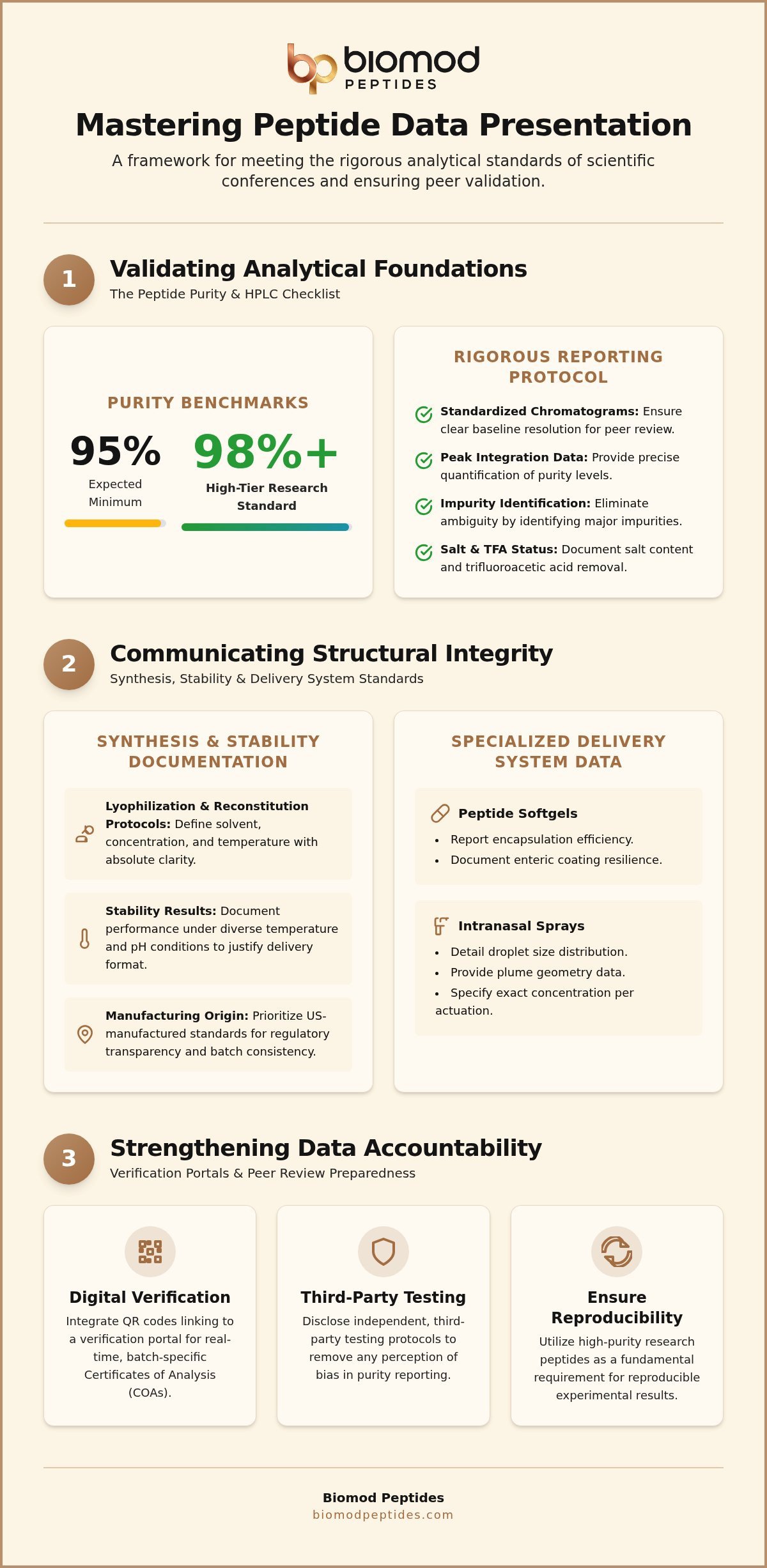
Credibility in peptide research rests on the transparency of your analytical baseline. When presenting peptide data at a scientific conference, you must move beyond simple claims of efficacy. You need raw, verifiable evidence. High-performance liquid chromatography (HPLC) serves as the industry standard for determining purity levels. For sensitive laboratory applications, a minimum purity of 95% is expected; however, 98% or higher is the standard benchmark for high-tier research. Reporting specific purity percentages is mandatory to ensure experimental reproducibility.
A rigorous reporting protocol includes:
- Standardized chromatogram displays showing baseline resolution.
- Detailed peak integration data to quantify purity precisely.
- Identification of major impurities to eliminate ambiguity in results.
- Documentation of salt content and TFA removal status.
Residual Trifluoroacetic acid (TFA) can significantly alter biological assays, potentially skewing your experimental results. Addressing these variables upfront demonstrates a commitment to laboratory-grade integrity and structural verification.
Standardizing HPLC and Mass Spectrometry Visuals
High-resolution HPLC overlays are necessary to demonstrate batch-to-batch consistency across different experimental phases. Mass Spectrometry (MS) provides the essential verification of the peptide’s primary structure and molecular weight. When preparing visuals, ensure all axes are clearly labeled with appropriate units and scales. Use distinct legends for complex peptide mixtures to avoid visual clutter during a presentation. Clear labeling prevents data dismissal and builds immediate trust with your audience. These visual standards ensure your research meets the rigorous expectations of the scientific community. Precision isn’t optional. It’s the requirement for professional validation and successful peer review.
Communicating Structural Integrity: Synthesis and Stability Presentation Standards
Synthesis and stability data establish the methodological backbone of your research. When presenting peptide data at a scientific conference, specify lyophilization standards and reconstitution protocols with absolute clarity. Vague descriptions like “reconstituted in saline” are insufficient for high-tier peer review. Define the solvent, concentration, and temperature used during preparation. Peer reviewers look for these parameters to verify that the peptide remained bioactive and structurally sound throughout the study duration.
Stability results under varying temperature and pH conditions justify your choice of delivery format. This documentation is a core component of peptide science 2026 trends. Detail the manufacturing origin. Prioritize US-manufactured standards to ensure maximum regulatory transparency and batch consistency. Utilizing precision-grade reagents minimizes the risk of batch variability and prevents the dismissal of your results due to suspected chemical degradation or impurity interference.
Documenting Specialized Delivery System Performance
Non-traditional delivery formats require specialized data sets to survive rigorous academic scrutiny. For peptide softgels, you must report encapsulation efficiency and enteric coating resilience. This data proves the peptide survives gastric transit without premature degradation. When presenting on intranasal peptide research sprays, document droplet size distribution, plume geometry, and exact concentration per actuation. Use comparative visualizations to contrast novel delivery pharmacokinetics against traditional subcutaneous injections. Clear line graphs showing serum concentration over time provide the empirical proof needed to validate advanced delivery methodologies.
Strengthening Data Accountability: Verification Portals and Peer Review
Accountability is the final pillar of a successful technical presentation. When presenting peptide data at a scientific conference, integrating a QR code or direct link to a verification portal allows for real-time access to batch-specific COAs. This digital transparency eliminates the ambiguity often associated with self-reported analytical data. You must disclose third-party testing protocols to remove any perception of bias in your purity reporting. Utilizing high purity research peptides is a fundamental requirement for ensuring that your experimental results remain reproducible across different laboratory environments. Always address the research-only status of your materials. This maintains institutional compliance and confirms that the study adheres to laboratory-grade standards rather than clinical applications.
Utilizing Third-Party Verification for Data Integrity
Biomod Peptides implements independent testing for every research lot to provide an objective layer of validation beyond the manufacturing floor. Transparent COA access during a conference Q&A session builds immediate peer trust by replacing verbal claims with verifiable documentation. This approach shifts the focus from questioning the material integrity to discussing the scientific implications of your results. Precision in sourcing leads to confidence in the podium.
Use this checklist for ethical reporting:
- Document the manufacturing origin and primary sourcing of all reagents.
- Include third-party purity verification for every batch used in the study.
- Maintain detailed storage and chain-of-custody logs to prove structural stability.
- Disclose analytical methods used for salt content and residual solvent detection.
Advancing Analytical Standards in Peptide Research
Successful data presentation requires a shift from simple result reporting to total analytical transparency. Standardizing HPLC visuals and documenting stability across diverse delivery systems provides the necessary structural proof. Verification portals act as the final layer of accountability, transforming raw data into peer-validated evidence. Mastering these protocols ensures that presenting peptide data at a scientific conference results in successful validation rather than skepticism. Precision in the lab leads directly to confidence at the podium.
We provide US-manufactured research peptides supported by independent 3rd-party HPLC testing to meet the most rigorous analytical grade purity standards. Secure the documentation your next presentation demands. Access the Biomod Verification Portal for your next research project to ensure your data meets every benchmark for peer-review excellence. Your research deserves an ironclad analytical foundation.
Frequently Asked Questions
What is the minimum peptide purity required for conference-level data?
Minimum purity for research-grade peptides is 95% as determined by HPLC. For sensitive applications or presenting peptide data at a scientific conference, 98% is the preferred benchmark. High-purity reagents ensure experimental reproducibility and prevent data dismissal. Our Las Vegas facility prioritizes these analytical grade standards to meet the rigorous peer-review benchmarks expected by the global scientific community.
Should I include the full HPLC chromatogram on my scientific poster?
Including a high-resolution chromatogram is essential for verifying peak integration and baseline resolution. While space is limited, providing a clear visual of the analytical baseline prevents skepticism regarding batch consistency. Many researchers include a QR code on their posters to link directly to a full Certificate of Analysis (COA), providing complete transparency without cluttering the visual layout.
How do I present stability data for peptides in softgel or spray formats?
Present stability by documenting degradation rates under specific temperature and pH variations. For softgels, report on enteric resilience and encapsulation efficiency. For spray formats, include data on plume geometry and actuation concentration. This level of detail justifies the choice of delivery format and proves the peptide remained structurally intact throughout the experimental phase, ensuring the integrity of the results.
Is it necessary to mention the manufacturer of research peptides at a conference?
Identifying the manufacturer is a standard practice for ensuring experimental reproducibility. Disclosing that you utilized US-manufactured, third-party tested reagents from a Las Vegas provider like Biomod Peptides demonstrates a commitment to quality control. It also clarifies the research-only status of the materials, which is vital for institutional compliance and ethical reporting during formal peer-review sessions.
Disclaimer
BIOMOD products are sold strictly for laboratory, analytical, and scientific research use only. They are not intended for human or animal consumption, administration, application, ingestion, injection, or any therapeutic, diagnostic, or cosmetic use.
The statements made on this website have not been evaluated by the United States Food and Drug Administration. BIOMOD products are not intended to diagnose, treat, cure, mitigate, or prevent any disease or medical condition.
BIOMOD is a research chemical supplier. BIOMOD is not a compounding pharmacy or chemical compounding facility as defined under Section 503A of the Federal Food, Drug, and Cosmetic Act. BIOMOD is not an outsourcing facility as defined under Section 503B of the Federal Food, Drug, and Cosmetic Act.
By accessing this site, you confirm you are at least 21 years of age and that you have read and accepted the BIOMOD Terms of Sale, Privacy Policy, and Research Use Only Policy. BIOMOD does not provide dosing, medical, therapeutic, diagnostic, veterinary, or use guidance under any channel.