
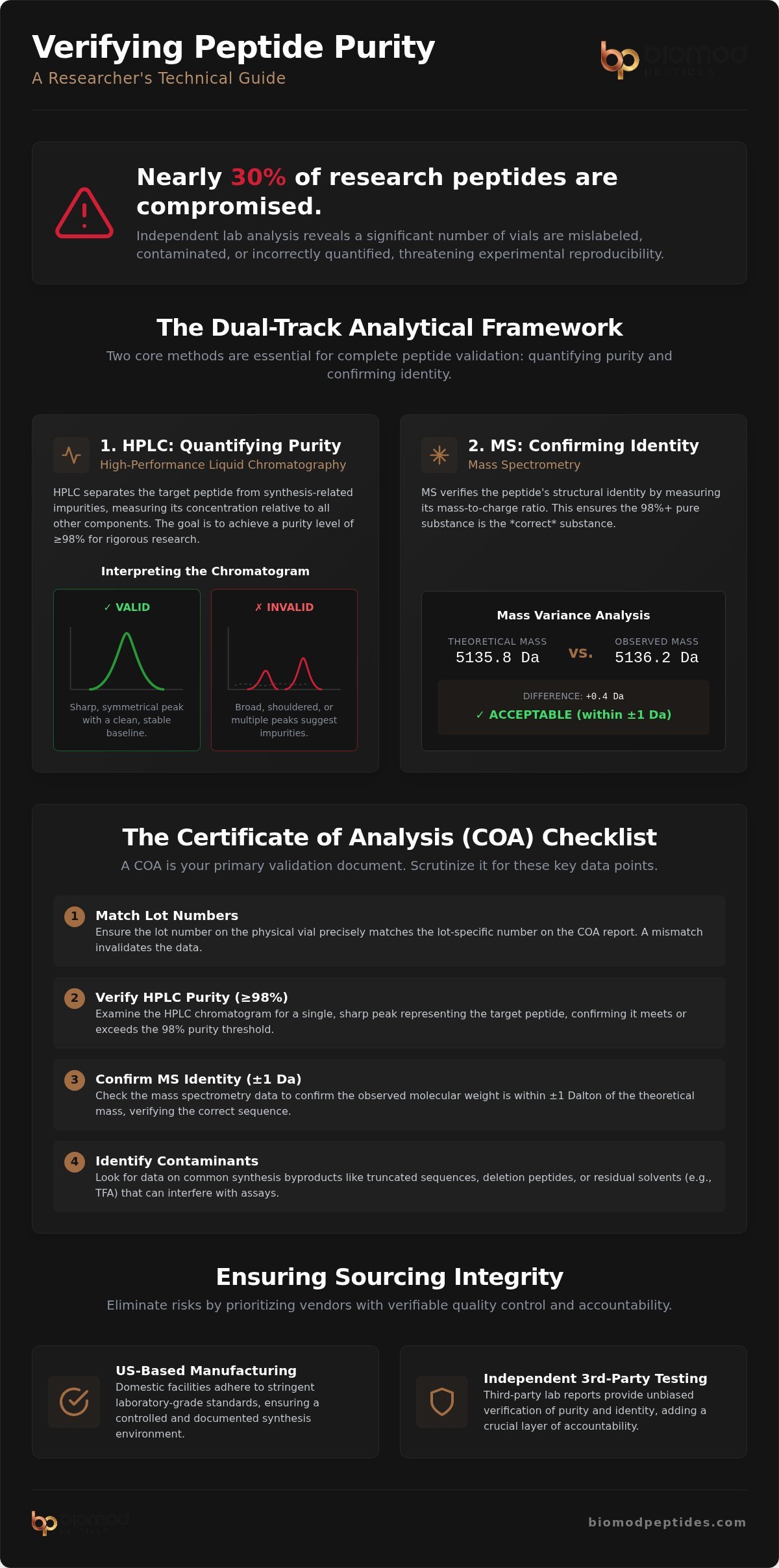
Close to 30% of peptide vials analyzed by independent labs in 2026 were found to be mislabeled, contaminated, or incorrectly quantified. You understand that in a market saturated with overseas vendors and opaque certificates of analysis, the burden of proof rests entirely on the researcher. Structural integrity is the bedrock of any credible study. Validating research peptide purity is no longer a luxury; it’s a procedural necessity for experimental reproducibility. Inconsistent batch quality can compromise months of data and introduce variables that invalidate your results.
This guide provides the technical protocols and analytical benchmarks required to verify peptide integrity. You’ll master the nuances of interpreting HPLC and Mass Spectrometry data while establishing a reliable procurement workflow. We’ll examine how to confirm sequence accuracy and ensure every sample meets the ≥98% purity threshold required for rigorous scientific inquiry.
Key Takeaways
- Identify the critical role of High-Performance Liquid Chromatography (HPLC) in isolating target peptides from synthesis-related contaminants.
- Master the analytical checklist for validating research peptide purity, ensuring that lot-specific COA data aligns with the physical batch received.
- Compare observed molecular weight against theoretical sequence mass using mass spectrometry to guarantee sequence accuracy and experimental reproducibility.
- Leverage independent third-party testing and US-based manufacturing standards to eliminate the risks associated with inconsistent or undocumented reagent sources.
The Analytical Framework: HPLC and Mass Spectrometry in Peptide Validation
Purity in the laboratory context is defined as the percentage of the target peptide relative to the total UV-absorbing material. It’s a measure of chemical concentration. Validating research peptide purity requires a dual-track analytical approach. While High-performance liquid chromatography (HPLC) quantifies the absence of contaminants, mass spectrometry (MS) confirms the structural identity of the sequence. These protocols are critical even for specialized delivery formats like peptide softgels or peptide spray products. Impurities in these carriers can alter the expected experimental outcome or compromise stability.
HPLC provides the purity percentage by measuring the area under the curve at specific wavelengths, usually 214nm. MS completes the validation by comparing the observed molecular weight against the theoretical mass. Without MS, a 99% pure sample could theoretically be the wrong peptide entirely. Precision in these measurements is the only way to maintain rigorous scientific standards.
Identifying Impurities through Reverse-Phase HPLC
Reverse-phase HPLC utilizes hydrophobic interactions on a C18 stationary phase to separate the target sequence from synthesis-related byproducts. These impurities often include truncated sequences or deprotected fragments. Researchers must evaluate the chromatogram for baseline stability and peak symmetry. Sharp, resolved peaks indicate a high-purity reagent. Conversely, broad or shouldered signals suggest co-eluting impurities or degradation products.
For analytical grade peptides, a clean baseline is non-negotiable. It ensures that the reported purity isn’t artificially inflated by unresolved background noise. Every batch must undergo this scrutiny to ensure the integrity of your research. This level of oversight prevents the introduction of unknown variables that could invalidate longitudinal data.
Deciphering the Certificate of Analysis (COA): A Researcher’s Checklist
A Certificate of Analysis (COA) serves as the primary document for validating research peptide purity. However, a generic document is insufficient. You must verify that the lot number on the vial matches the lot-specific data on the report. Discrepancies here indicate a breakdown in the chain of custody. A rigorous review includes evaluating the HPLC chromatogram and the mass spectrometry report for identity. Learning How to Read a Peptide Certificate of Analysis is essential for spotting red flags like missing timestamps or inconsistent baselines.
Beyond purity, look for specific contaminants. Truncated sequences, deletion peptides, and residual solvents like Trifluoroacetic acid (TFA) are common byproducts. TFA is often used as a counter-ion during synthesis. High concentrations can interfere with sensitive biological assays. Maintaining a disciplined approach to validating research peptide purity ensures that your experimental data remains untainted by synthesis-related artifacts. Every lab should maintain a strict threshold for these impurities before commencing experiments.
Sequence Verification via Electrospray Ionization Mass Spectrometry (ESI-MS)
ESI-MS confirms the exact amino acid sequence by measuring the mass-to-charge (m/z) ratio. This method allows for the detection of multi-charged ions, which is vital for larger molecular structures. The standard for acceptable variance between theoretical and observed mass is typically ±1 Da. If the variance exceeds this threshold, the identity of the peptide is unverified. For a detailed breakdown of these analytical standards, refer to the protocol for peptide purity verification. Researchers seeking documented accountability should utilize a COA verification portal to cross-reference batch results in real-time.
Ensuring Integrity: US-Based Manufacturing and Third-Party Accountability
US-based manufacturing serves as the first line of defense in quality control. Domestic facilities adhere to laboratory-grade standards that overseas vendors often bypass. For facilities in research hubs like Las Vegas, procuring high-purity reagents requires more than a label claim; it demands a verifiable provenance. Domestic production ensures that the synthesis environment is controlled and documented. This geographic proximity simplifies the task of validating research peptide purity by reducing the risk of degradation during extended international transit. It’s about accountability at every stage of the lifecycle.
Specialized delivery systems, such as peptide softgels and peptide spray products, present unique analytical challenges. These formats must maintain stability and concentration levels throughout their shelf life. Third-party accountability ensures that the active peptide remains uncompromised by the carrier medium. Every batch requires independent validation to confirm that the formulation meets the specified benchmarks. This rigorous oversight prevents the introduction of unknown variables into your experimental environment.
Utilizing Real-Time Verification Portals for Batch Integrity
Digital transparency is the final step in a rigorous procurement workflow. A real-time COA portal allows you to cross-reference laboratory results with vendor claims instantaneously. This prevents the use of outdated or “representative” data that doesn’t reflect the material in your lab. You can verify the specific batch in your possession against independent laboratory findings with total confidence. If you require technical support or have specific batch inquiries, contact Biomod to consult with our specialists. This level of documentation is the gold standard for modern scientific research. It ensures that your data is built on a foundation of empirical proof.
Advancing Research Through Empirical Validation
Precision in the laboratory is non-negotiable. Validating research peptide purity requires a systematic approach that combines HPLC concentration data with mass spectrometry sequence confirmation. Relying on US-manufactured reagents ensures that your supply chain adheres to stringent laboratory standards from synthesis to finishing. This rigorous methodology protects your data from the variables introduced by inconsistent batch quality or undocumented impurities.
Accountability is the final step in the analytical process. Independent third-party testing for every batch eliminates the risk of contamination and secures experimental reproducibility. By utilizing transparent documentation, you protect the integrity of your longitudinal data and advance your research with professional confidence. Every study deserves a foundation of empirical proof. Access our COA Verification Portal and browse analytical grade peptides at Biomod Peptides to secure US-finished, third-party tested reagents for your facility.
Frequently Asked Questions
What is the minimum acceptable purity for research peptides?
The standard benchmark for analytical-grade research is a purity level of ≥98%. While some applications tolerate lower thresholds, rigorous scientific studies require this level to minimize the presence of truncated sequences or residual solvents. Validating research peptide purity at this standard ensures that observed biological responses are attributable to the target sequence rather than synthesis-related contaminants. This precision is essential for experimental reproducibility.
How does mass spectrometry differ from HPLC in peptide testing?
HPLC and mass spectrometry serve distinct, complementary roles in the laboratory. HPLC utilizes chromatography to separate the target peptide from impurities, calculating chemical purity based on UV absorbance. Mass spectrometry measures the mass-to-charge ratio to confirm the molecular weight. You need HPLC to determine the concentration of the sample, but mass spectrometry is required to prove the sample is the correct sequence.
Why are US-manufactured peptides preferred for analytical research?
US-manufactured peptides are subject to stringent domestic laboratory oversight and finishing protocols. Geographic proximity reduces the risk of thermal degradation during international transit. Domestic production also ensures researchers have direct access to lot-specific data, which is vital for validating research peptide purity. This transparency is often absent in overseas supply chains where batch records may be generic, outdated, or completely unverified by third parties.
What should I do if a COA does not match my received lot number?
If the lot number on your vial doesn’t match the COA, you must quarantine the material immediately. Using reagents without verified documentation invalidates your experimental results and compromises the chain of custody. Contact your provider to request the specific batch records. Reliable vendors maintain a digital portal where you can cross-reference lot numbers with third-party laboratory results to ensure absolute data transparency.
Disclaimer
BIOMOD products are sold strictly for laboratory, analytical, and scientific research use only. They are not intended for human or animal consumption, administration, application, ingestion, injection, or any therapeutic, diagnostic, or cosmetic use.
The statements made on this website have not been evaluated by the United States Food and Drug Administration. BIOMOD products are not intended to diagnose, treat, cure, mitigate, or prevent any disease or medical condition.
BIOMOD is a research chemical supplier. BIOMOD is not a compounding pharmacy or chemical compounding facility as defined under Section 503A of the Federal Food, Drug, and Cosmetic Act. BIOMOD is not an outsourcing facility as defined under Section 503B of the Federal Food, Drug, and Cosmetic Act.
By accessing this site, you confirm you are at least 21 years of age and that you have read and accepted the BIOMOD Terms of Sale, Privacy Policy, and Research Use Only Policy. BIOMOD does not provide dosing, medical, therapeutic, diagnostic, veterinary, or use guidance under any channel.