
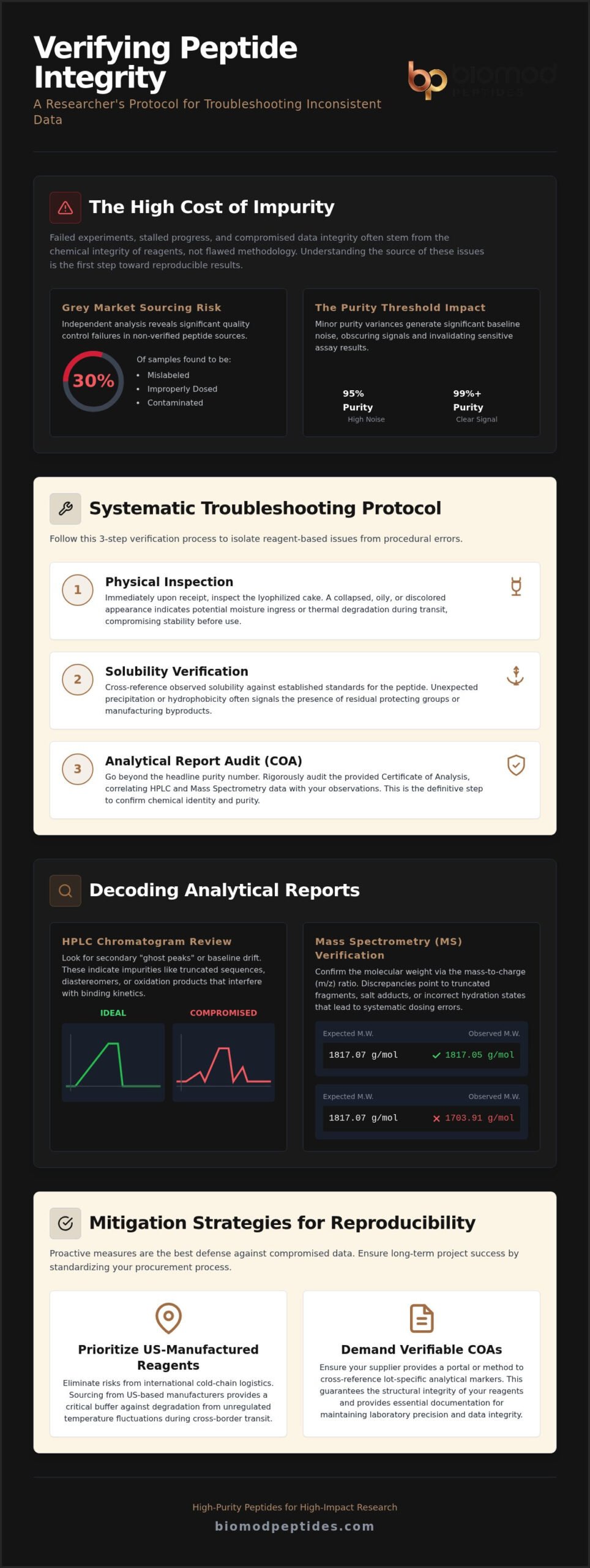
Independent analysis has identified mislabeling, improper dosing, or contamination in approximately 30% of peptide samples sourced from the grey market. When experiments fail, troubleshooting research results due to peptide quality becomes the only path toward data integrity. You’ve spent months calibrating your protocol, yet your results remain irreconcilable with previous findings. The frustration of stalled progress and the threat to your project’s credibility are professional burdens no researcher should carry. If your methodology is sound, the failure likely lies in the chemical integrity of your reagents.
Systematic verification requires a shift from assumption to analytical rigor. This guide provides a definitive protocol to identify peptide degradation and impurity. You’ll learn to audit Certificates of Analysis (COA) using HPLC and Mass Spectrometry correlation to ensure reagents meet ISO/IEC 17025:2017 standards. We will establish the criteria for selecting US-manufactured materials that ensure long-term reproducibility and laboratory precision.
Key Takeaways
- Identify how minor purity variances between 95% and 99% generate significant baseline noise that can invalidate sensitive assay results.
- Implement a systematic protocol for troubleshooting research results due to peptide quality through visual inspection and solubility verification.
- Utilize a COA verification portal to cross-reference lot-specific analytical markers and ensure the structural integrity of your reagents.
- Minimize experimental variables by selecting US-manufactured reagents to eliminate degradation risks associated with international cold-chain logistics.
Identifying Anomalies: How Peptide Impurities Compromise Research Data
Failed experiments extract a heavy toll beyond the bench. Lost time, depleted budgets, and damaged institutional credibility are the real-world consequences of inconsistent data. When a project stalls, troubleshooting research results due to peptide quality is a critical first step in determining if the error is procedural or chemical. Minor purity variances, such as 95% versus 99%, aren’t just numbers on a page. In sensitive assays, that 4% difference manifests as significant baseline noise, obscuring target signals and yielding false negatives. Identifying these anomalies early prevents the compounding costs of a failed research project.
Residual solvents and Trifluoroacetic acid (TFA) further complicate the analytical landscape. TFA, commonly used in various Peptide Synthesis Methods, can alter local pH levels upon reconstitution. This shift often skews solubility results, leading to aggregation or unintended precipitation. These chemical artifacts frequently mimic protocol-induced errors, which is why troubleshooting research results due to peptide quality must include a review of the reagent’s salt content and counter-ion profile. Distinguishing between a flawed methodology and reagent-borne inconsistencies requires a rigorous examination of the chemical profile.
The Impact of Truncated Sequences and Diastereomers on Research Integrity
Incomplete synthesis often produces truncated sequences. These fragments may act as competitive inhibitors in receptor binding assays, producing confounding data that protocol adjustments cannot fix. D-amino acid contamination creates diastereomers that standard HPLC might overlook without specific chiral analysis. Such structural anomalies can lead to total project failure if not identified early. To mitigate these risks, Las Vegas laboratories rely on HPLC tested peptides to confirm both identity and structural purity. Rigorous verification is the only defense against the invisible variables that compromise research integrity.
A Systematic Protocol for Troubleshooting Inconsistent Experimental Outcomes
Effective troubleshooting research results due to peptide quality begins with a physical assessment of the reagent. Inspect the lyophilized cake immediately upon receipt. A collapsed or discolored cake indicates atmospheric moisture ingress or thermal degradation. These markers suggest compromised stability before the first aliquot is drawn. Cross-reference your observed solubility against peptide solubility for research standards. Unexpected hydrophobicity or precipitation often signals the presence of residual protecting groups or manufacturing byproducts.
Analytical verification must follow physical inspection. Audit the HPLC chromatogram for secondary peaks or baseline drift. These irregularities often indicate oxidation or deamidation products that emerged during storage or transit. While troubleshooting failed peptide synthesis focuses on identifying deletion sequences, the laboratory researcher must verify the mass-to-charge ratio (m/z) on the Mass Spectrometry report. Confirming the molecular mass ensures the identity matches the intended sequence, preventing the use of truncated fragments that mimic the target length but lack its functionality.
Correlating HPLC and MS Reports with Observed Variances
Identify “ghost peaks” in the HPLC report that correlate with inconsistent assay responses. These peaks represent impurities that interfere with binding kinetics even at low concentrations. Use MS data to detect salt adducts or varying hydration states. These factors alter the effective molar concentration of the reagent, leading to systematic dosing errors. In peptide softgel manufacturing research, variances in dissolution rates are frequently traced back to these subtle mass discrepancies. Rigorous documentation and a reliable COA verification portal are essential tools for maintaining laboratory precision.
Mitigation Strategies: Ensuring Reproducibility Through Rigorous Quality Assurance
US-based manufacturing provides a critical buffer against the degradation risks inherent in international logistics. Cross-border transit often exposes reagents to unregulated temperature fluctuations that compromise peptide stability for research. Domestic production ensures a shorter, more transparent supply chain. Once reagents arrive at Las Vegas facilities, researchers must implement immediate cold-chain storage protocols. Maintaining a consistent thermal environment prevents the structural breakdown that necessitates troubleshooting research results due to peptide quality later in the project lifecycle.
Verification is the second pillar of mitigation. Utilize the COA verification portal to confirm that the analytical report in your hand matches the specific lot in your laboratory. This digital audit trail eliminates the risk of mislabeled or outdated documentation. Precision requires accountability. For research requiring high-precision delivery, specialized formats like peptide spray products provide a consistent alternative to manual reconstitution. These formats reduce the potential for user-induced concentration variances.
Establishing Analytical Benchmarks for Future Procurement
Define clear purity thresholds before procurement. Structural biology and receptor-binding studies typically require a minimum purity standard of 98%+. Lower grades introduce too much chemical noise for sensitive assays. Third-party accountability remains the most reliable metric for a secure laboratory peptide supply. Independent testing validates internal manufacturer claims and provides objective proof of reagent integrity. The Biomod Standard defines excellence through the synthesis of US manufacturing and uncompromising independent verification.
Advancing Laboratory Precision Through Analytical Rigor
Data integrity is the foundation of scientific advancement. Effective troubleshooting research results due to peptide quality requires a shift from retroactive analysis to proactive reagent validation. By correlating HPLC chromatograms with Mass Spectrometry identity markers, you eliminate chemical variables that compromise reproducibility. Transitioning to US-manufactured reagents secures your methodology against international transit instabilities. Utilizing specialized spray and softgel formats ensures delivery consistency, while a lot-specific verification portal provides the transparency necessary for institutional credibility.
Uncompromising standards are the only defense against experimental drift. Don’t leave your data to chance. Ensure Research Integrity with Verified Peptides through US-manufactured analytical grade reagents and an independent 3rd party verification portal. Your findings deserve the stability of a disciplined supply chain. Secure your next milestone with reagents designed for precise laboratory performance.
Analytical Research FAQs
How can I tell if my research results are due to poor peptide quality?
Identifying inconsistent assay responses or unexpected solubility shifts is the primary diagnostic step. Troubleshooting research results due to peptide quality often reveals that “ghost peaks” in purity reports correlate with failed replications. If your methodology remains constant but outcomes fluctuate between batches, the reagent’s chemical integrity is the likely variable. Las Vegas researchers should verify physical markers like cake collapse before proceeding with reconstitution.
What are the most common impurities found in research-grade peptides?
Common impurities include truncated sequences and deletion products formed during synthesis. Residual solvents and Trifluoroacetic acid (TFA) salts frequently remain, which can alter local pH and binding kinetics. Diastereomers, often invisible to standard HPLC, represent another significant risk. Independent third-party testing is the only reliable method to detect these contaminants before they introduce systematic errors into your laboratory data.
Does peptide degradation occur during shipping to Las Vegas laboratories?
Thermal degradation is a high risk during the extended transit times associated with international shipping. Fluctuating temperatures during customs delays can trigger oxidation or deamidation in sensitive sequences. Biomod mitigates this by providing US-manufactured reagents, ensuring shorter transit windows to Las Vegas facilities. This logistical transparency preserves peptide stability and prevents the structural breakdown that often leads to irreproducible findings.
How do I verify a peptide Certificate of Analysis (COA) for authenticity?
Authenticity is confirmed by auditing the lot-specific HPLC and Mass Spectrometry data against a secure record. Researchers must verify that the peak on the chromatogram is singular and that the molecular mass matches the target sequence exactly. Biomod Peptides facilitates this through a publicly accessible COA verification portal. This tool allows for the immediate validation of third-party laboratory reports, ensuring reagent accountability.
Disclaimer
BIOMOD products are sold strictly for laboratory, analytical, and scientific research use only. They are not intended for human or animal consumption, administration, application, ingestion, injection, or any therapeutic, diagnostic, or cosmetic use.
The statements made on this website have not been evaluated by the United States Food and Drug Administration. BIOMOD products are not intended to diagnose, treat, cure, mitigate, or prevent any disease or medical condition.
BIOMOD is a research chemical supplier. BIOMOD is not a compounding pharmacy or chemical compounding facility as defined under Section 503A of the Federal Food, Drug, and Cosmetic Act. BIOMOD is not an outsourcing facility as defined under Section 503B of the Federal Food, Drug, and Cosmetic Act.
By accessing this site, you confirm you are at least 21 years of age and that you have read and accepted the BIOMOD Terms of Sale, Privacy Policy, and Research Use Only Policy. BIOMOD does not provide dosing, medical, therapeutic, diagnostic, veterinary, or use guidance under any channel.