
An unverified positive control isn’t a benchmark; it’s a liability. When setting up a positive control for peptide experiments, the integrity of your entire dataset depends on the precision of your reference standard. If your control lacks documented purity or verified biological activity, you risk false negatives that can derail months of research. Scientific rigor demands more than just a known sequence. It requires empirical proof that your experimental system is fully operational.
You’ve likely faced the frustration of inconsistent results stemming from low-purity standards or insufficient documentation. This technical protocol allows you to master the methodology required to establish authoritative controls that meet the highest peer-review standards. We’ll detail the selection of high-purity reference materials, the use of COA verification portals for quality assurance, and the specific procedures needed to validate your assay’s sensitivity. This guide provides a repeatable framework for ensuring experimental truth and establishing a definitive benchmark for biological activity.
Key Takeaways
- Differentiate between biological and analytical positive controls to establish a precise baseline for target interaction.
- Implement multi-point standard curves through serial dilution to validate assay sensitivity beyond single-point verification.
- Master the technical methodology for setting up a positive control for peptide experiments using standardized reconstitution and site-specific solvents.
- Utilize third-party COA verification to ensure lot-to-lot consistency and maintain rigorous documentation for peer-review standards.
- Account for environmental stressors, including low-humidity laboratory conditions, to preserve the structural integrity of your reference standards.
Fundamentals of Positive Controls in Peptide Research
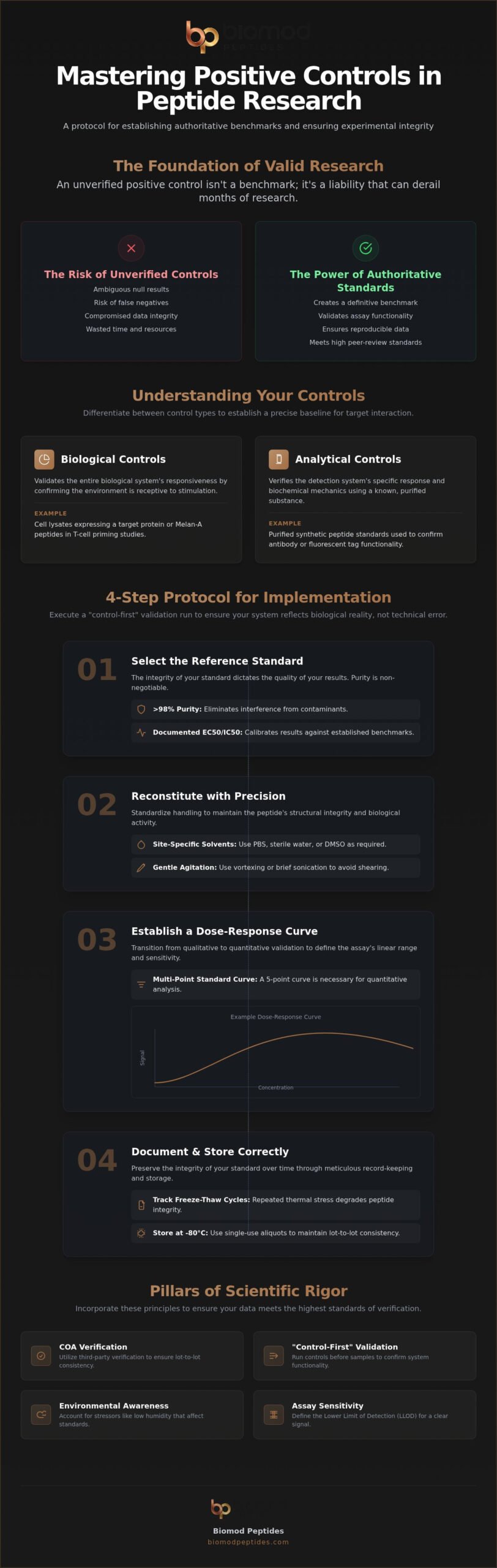
A positive control is a validated reference standard with known biological activity or specific receptor affinity. It functions as the primary evidence that your experimental system is capable of detecting a target interaction. Without this benchmark, a null result is ambiguous. You cannot determine if the peptide is inactive or if the assay itself failed due to reagent degradation or procedural error. Precision is the baseline for all subsequent data interpretation.
Researchers must distinguish between biological and analytical controls. Biological positive controls typically involve known active samples, such as cell lysates expressing a target protein. Analytical positive controls utilize purified synthetic peptide standards to verify the detection system’s specific response. For example, in T-cell priming studies, melan-A peptides serve as a positive control to confirm that the cellular environment is receptive to antigenic stimulation. This distinction ensures that you’re validating the assay’s biochemical mechanics, not just the presence of a sample.
Peptide-specific controls require a deep understanding of chemical behavior. Unlike small molecules, peptides possess complex secondary structures and distinct solubility profiles. If a control peptide aggregates in the chosen buffer, it won’t provide an accurate baseline for activity. Setting up a positive control for peptide experiments requires matching the control’s folding and solubility characteristics to the experimental targets. This prevents false negatives caused by physical incompatibility rather than biological inactivity.
Selecting the Appropriate Reference Standard
Select a peptide with a well-documented EC50 or IC50 value from peer-reviewed literature. This allows you to calibrate your results against established benchmarks. Purity is non-negotiable. Authoritative reference standards require >98% purity to eliminate the risk of contaminants interfering with binding kinetics. Using lower-grade materials introduces unwanted variables that compromise the integrity of the experimental record.
Validating Assay Sensitivity and Range
The positive control defines the lower limit of detection (LLOD) for your specific setup. By establishing a clear signal-to-noise ratio, you ensure that the system can distinguish subtle biological responses from background interference. A robust control signal confirms that the reagents, such as primary antibodies or fluorescent tags, are functioning at peak efficiency. This validation is the first step in ensuring your data meets the rigorous standards required for publication.
Step-by-Step Protocol for Peptide Control Implementation
Rigor begins at the bench. Before introducing experimental variables, execute a “control-first” validation run. This step confirms that the laboratory environment and reagents are functional. If the positive control doesn’t produce the expected signal, you must troubleshoot the assay before wasting precious experimental samples. Procedural consistency is the only way to ensure that your data reflects biological reality rather than technical error.
Reconstitution and Solubility Optimization
Lyophilized peptides require precise handling to maintain structural integrity. Standardize your reconstitution process using site-specific solvents like PBS, sterile water, or DMSO. For hydrophobic sequences, refer to established laboratory protocols for improving peptide solubility during control preparation. Adhering to peptide handling and quality control recommendations ensures that the reference standard remains monomeric and biologically active. Avoid aggressive agitation. Use gentle vortexing or brief sonication to ensure complete dissolution without shearing the peptide backbone.
Serial Dilution and Dose-Response Setup
Transition from qualitative to quantitative validation. Setting up a positive control for peptide experiments requires a multi-point standard curve rather than a single-point reference. A 5-point standard curve is necessary for quantitative peptide analysis to define the linear range of the assay. Calculate molarity with precision to establish a dose-response relationship that mirrors the expected biological activity. This approach identifies the exact point where assay sensitivity begins to plateau or fail.
Documentation is the final pillar of implementation. Track every freeze-thaw cycle of the control aliquot. Repeated thermal stress degrades peptide integrity and shifts the baseline. Store aliquots at -80°C in single-use volumes to maintain lot-to-lot consistency. For researchers requiring high-purity standards, Biomod Peptides provides the analytical verification necessary for these rigorous protocols.
Ensuring Scientific Rigor Through Verification and Local Standards
Scientific truth requires documentation. Setting up a positive control for peptide experiments is incomplete without a rigorous verification of the reagent’s pedigree. Trusting a label is a procedural risk that compromises reproducibility. Verification is a mandatory step in establishing an authoritative experimental record. High-purity, US-manufactured research peptides represent the gold standard for this process. They provide the analytical accountability and regulatory transparency required for high-impact publication.
Third-party verification of control reagents adds an essential layer of security. Independent testing confirms that the peptide meets the purity thresholds discussed in previous sections. This discipline ensures that your benchmark remains consistent across different lots and long-term studies. It eliminates the ambiguity of reagent-driven variance.
Utilizing COA Documentation for Control Selection
Every control lot must be accompanied by empirical evidence. Utilize the Biomod COA Verification Portal to confirm HPLC and MS data for your reference standards. Verify the peptide sequence and mass accuracy against theoretical values before designating a specific lot as your positive control. This step ensures that the chemical identity of your benchmark is indisputable. Discrepancies in mass or purity profiles must be identified and resolved before the assay begins.
Mitigating Environmental Variables in Las Vegas Facilities
Laboratory environments in Las Vegas present unique challenges for peptide integrity. The extreme low humidity and arid climate can accelerate the degradation of hygroscopic peptides if they aren’t handled with precision. Cold chain protocols are vital for maintaining peptide stability for research in these conditions. Lyophilized standards should be stored in desiccated environments and allowed to equilibrate to room temperature within a controlled atmosphere to prevent moisture condensation. These site-specific adjustments protect the structural integrity of your controls and ensure that your data remains accurate despite external environmental stressors.
Advancing Experimental Integrity Through Rigorous Control Protocols
Establishing a robust benchmark is the foundation of definitive research. By integrating high-purity reference standards and multi-point standard curves, you eliminate the ambiguity that often plagues complex assays. Master the methodology of setting up a positive control for peptide experiments to ensure every data point meets the highest standards of peer-review and analytical accountability. This discipline transforms raw data into authoritative evidence that withstands the scrutiny of the scientific community.
Reliable results depend on the quality of your reagents. Biomod Peptides supports your commitment to precision through US-manufactured standards and a dedicated COA verification portal. Every lot undergoes independent third-party HPLC/MS testing to guarantee sequence accuracy and structural integrity. Our Las Vegas regional distribution ensures that your laboratory receives high-quality reagents with minimal logistical friction. Procure Analytical Grade Peptides for Your Research Controls today and secure the validity of your next study. Precision in the control phase is the first step toward a successful discovery.
Frequently Asked Questions
What is the difference between a positive control and a loading control in peptide experiments?
A positive control validates specific biological activity or receptor affinity, while a loading control normalizes for equal sample distribution across an assay. Loading controls, such as GAPDH or actin in Western blots, confirm that quantitative variations aren’t due to pipetting errors. In contrast, the positive control proves the detection system is functional. Both are required for rigorous data validation, but they address distinct experimental variables.
Can I use a previously reconstituted peptide as a positive control after long-term storage?
Reconstituted peptides shouldn’t be used as positive controls after long-term storage because they’re highly susceptible to hydrolysis and aggregation in solution. Even at -20°C, solution-phase peptides degrade faster than lyophilized stocks. When setting up a positive control for peptide experiments, use single-use aliquots to prevent freeze-thaw cycles. This practice ensures that the control’s biological activity remains within the parameters defined by the original Certificate of Analysis.
How much purity is required for a peptide to serve as a reliable positive control?
Authoritative positive controls require a purity threshold of >98% to ensure analytical accuracy. Contaminants in lower-purity peptides, such as deletion sequences or residual trifluoroacetic acid (TFA), can interfere with binding kinetics. Using high-purity standards allows researchers to establish a definitive lower limit of detection. This level of precision is necessary to meet peer-review standards and ensure that the assay’s signal-to-noise ratio remains within acceptable limits.
What should I do if my positive control fails to produce a signal in the assay?
Signal failure in a positive control necessitates an immediate audit of reagent integrity and procedural execution. Check for reagent degradation, specifically regarding secondary antibodies or fluorescent probes, and verify that the buffer pH is optimized for the target peptide. Failure often indicates degraded reagents or procedural errors in setting up a positive control for peptide experiments. Always validate the assay system with a fresh, verified lot before reintroducing experimental variables.
Disclaimer
BIOMOD products are sold strictly for laboratory, analytical, and scientific research use only. They are not intended for human or animal consumption, administration, application, ingestion, injection, or any therapeutic, diagnostic, or cosmetic use.
The statements made on this website have not been evaluated by the United States Food and Drug Administration. BIOMOD products are not intended to diagnose, treat, cure, mitigate, or prevent any disease or medical condition.
BIOMOD is a research chemical supplier. BIOMOD is not a compounding pharmacy or chemical compounding facility as defined under Section 503A of the Federal Food, Drug, and Cosmetic Act. BIOMOD is not an outsourcing facility as defined under Section 503B of the Federal Food, Drug, and Cosmetic Act.
By accessing this site, you confirm you are at least 21 years of age and that you have read and accepted the BIOMOD Terms of Sale, Privacy Policy, and Research Use Only Policy. BIOMOD does not provide dosing, medical, therapeutic, diagnostic, veterinary, or use guidance under any channel.