
Up to 25% of peptide products fail quality benchmarks due to unresolved impurity profiles. You’ve likely encountered the frustration of drifting retention times or baseline noise that masks critical sequence variants. It’s a technical bottleneck that compromises data integrity. This article provides the protocols required to master reverse-phase HPLC for peptide analysis. We ensure your laboratory achieves the baseline resolution necessary for absolute verification. We examine the synergy between stationary phase selection and mobile phase optimization. You’ll learn how to align internal data with the July 2026 FDA draft guidances regarding impurity thresholds and higher-order structure assessment. By standardizing these analytical workflows, you transform HPLC from a routine check into a definitive diagnostic tool. We provide the technical roadmap to validate every lot with institutional precision. Precision is the only acceptable standard.
Key Takeaways
- Master the mechanics of hydrophobic partitioning to accurately predict how specific amino acid sequences influence elution profiles.
- Optimize reverse-phase HPLC for peptide analysis by selecting the exact pore size and organic modifier required for baseline resolution.
- Implement rigorous AUC analysis to identify critical impurities, including diastereomers and oxidation products, within complex mixtures.
- Standardize analytical workflows through US-based verification protocols to ensure the structural integrity of your research reagents.
The Mechanism of Reverse-Phase HPLC in Peptide Characterization
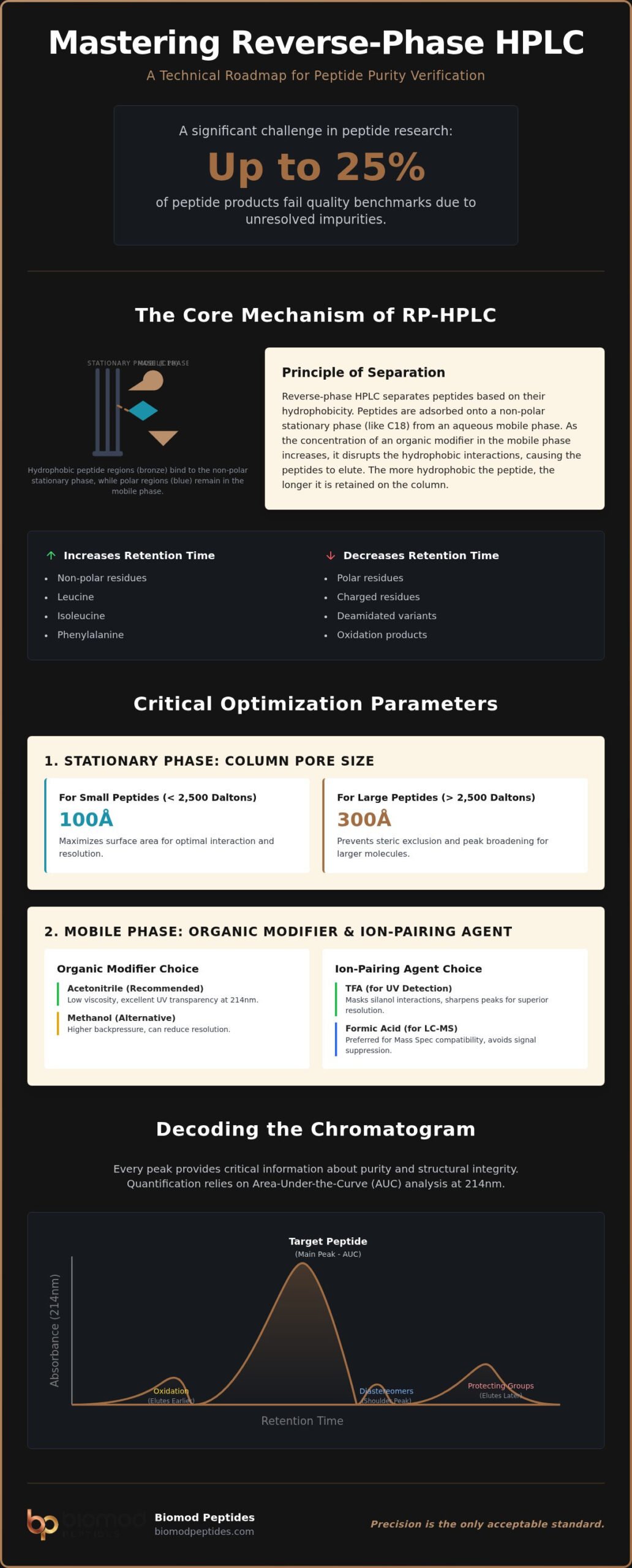
Reverse-phase HPLC for peptide analysis relies on the adsorption of solutes onto a non-polar stationary phase. This process involves the partitioning of hydrophobic amino acid side chains between the aqueous mobile phase and the alkyl ligands of the silica support. Most protocols utilize C18 (octadecylsilane) columns to maximize surface area interactions. Fundamental Reversed-phase chromatography principles dictate that elution occurs as the organic modifier concentration increases, disrupting the solvophobic effect. Precision in this mechanism is vital. It ensures that every lot meets the rigorous benchmarks required for laboratory research. There’s no room for ambiguity in structural validation.
Retention behavior is a direct function of a peptide’s primary sequence. Non-polar residues like Leucine, Isoleucine, and Phenylalanine increase retention times significantly. Conversely, polar or charged residues reduce interaction strength. This sensitivity makes reverse-phase HPLC for peptide analysis superior to size-exclusion or ion-exchange methods for identifying structural anomalies. It effectively resolves truncated sequences or deamidated variants that exhibit nearly identical molecular weights but distinct hydrophobic signatures. Using US-manufactured reagents further stabilizes these retention times. This consistency prevents the batch-to-batch drift that often plagues imported materials.
Hydrophobicity and Retention Dynamics
Peptide length and secondary structure dictate the orientation of the molecule at the stationary phase interface. Large peptides often adopt conformations that shield hydrophobic residues, altering expected elution orders. The ‘hydrophobic foot’ model defines peptide retention as the interaction of a specific, localized hydrophobic contact area with the stationary phase surface rather than the entire molecule. This localized binding allows for the separation of closely related isomers that differ by only a single residue orientation. Precise control over these dynamics is the foundation of structural integrity verification. It transforms raw data into actionable proof of purity.
Optimizing Mobile Phases and Column Selection for Peptide Mapping
Selection of the stationary phase architecture is the first step in optimizing reverse-phase HPLC for peptide analysis. Pore size dictates the accessible surface area and prevents steric exclusion. Use 100Å columns for small peptides under 2,500 Daltons. Larger sequences require 300Å pores to ensure unrestricted diffusion and prevent deleterious peak broadening. This choice is a critical benchmark for structural integrity. It’s the difference between a clean chromatogram and a failed assay.
Organic modifier selection further refines the separation. Acetonitrile is the industry standard due to its low viscosity and excellent UV transparency at 214 nm. Methanol is an alternative but often results in higher backpressure and reduced resolution for complex mixtures. To achieve baseline separation, ion-pairing agents are mandatory. Trifluoroacetic acid (TFA) effectively masks residual silanol interactions and sharpens peaks by neutralizing charged residues. Mastery of these Basics of HPLC Peptide Analysis is essential for any high-precision laboratory. It’s about data clarity.
Gradient Elution and Buffering Strategies
Developing a linear gradient is the most effective method for profiling unknown impurities. A standard protocol involves a 5% to 65% organic increase over a 30-minute window. This broad range captures the majority of synthetic variants. When choosing a buffer, consider the detection method. TFA provides superior resolution for UV detectors but suppresses signal in Mass Spectrometry. Formic Acid is the preferred alternative for LC-MS compatibility despite a slight decrease in peak sharpness. At Biomod Peptides, we adhere to these exacting standards to guarantee lot-to-lot consistency. Our commitment to analytical precision allows researchers to verify reagent purity with absolute confidence. Reliability starts with standardized protocols.
Interpreting HPLC Data for Quality Assurance and Purity Verification
Raw chromatograms require rigorous interpretation to ensure structural integrity. Every peak in reverse-phase HPLC for peptide analysis represents a specific chemical entity. Diastereomers often appear as shoulder peaks or closely eluting doublets. Oxidation products, such as those involving Methionine, typically elute earlier due to increased polarity. Conversely, residual protecting groups increase hydrophobicity and elute later in the gradient. Identifying these variants is the primary objective of quality control. It’s the only way to guarantee a research-grade product.
Quantification through reverse-phase HPLC for peptide analysis relies on Area-Under-the-Curve (AUC) analysis. This method calculates the purity percentage by comparing the target peak’s area to the total integrated signal at 214 nm. It’s a precise metric. However, retention time is not a surrogate for identity. Definitive sequence confirmation requires correlating HPLC data with Mass Spectrometry. This dual-verification approach ensures the observed peak matches the theoretical molecular mass of the peptide. It eliminates the risk of misidentifying truncated sequences as the target analyte.
Integrating Mass Spectrometry and COA Verification
Researchers should utilize the Biomod verification portal to cross-reference laboratory results with independent third-party COAs. This step bridges the gap between raw data and documented proof. For further details on industry benchmarks, consult The Protocol for Peptide Purity Verification. Las Vegas laboratories conducting high-throughput research benefit specifically from US-manufactured standards. These reagents minimize batch variability and ensure that internal verification protocols remain consistent across complex studies. Precision is the baseline for credible science. We prioritize the gravity of quality control in every lot.
Advancing Analytical Precision in Peptide Research
Mastering reverse-phase HPLC for peptide analysis is a prerequisite for structural validation in 2026. You’ve explored the necessity of pore size optimization and the critical role of ion-pairing agents in sharpening resolution. These protocols ensure that impurities like diastereomers or oxidation products are identified with absolute certainty. Standardizing your workflow around US-manufactured reagents provides the consistency required for high-throughput research. Verification is the final, non-negotiable step in the analytical process.
Biomod Peptides supports your laboratory with institutional-grade standards. Every lot undergoes independent third-party HPLC/MS testing to confirm structural integrity. You can access these results directly through our proprietary COA verification portal. This transparency eliminates the ambiguity often found in imported reagents. Secure High-Purity Research Peptides for Your Laboratory to ensure your data remains irreproachable. Your commitment to rigorous methodology drives scientific progress. Precision is the only path forward.
Frequently Asked Questions
Why is reverse-phase HPLC the preferred method for peptide analysis?
RP-HPLC is the preferred standard because it provides exceptional resolution based on hydrophobic interactions. It allows researchers to distinguish between the target peptide and structural variants like truncated fragments or deamidated sequences. This level of sensitivity is unavailable in size-exclusion or ion-exchange chromatography. It ensures that every batch meets the stringent structural integrity requirements necessary for reproducible laboratory results.
How does mobile phase composition affect peptide resolution in RP-HPLC?
Mobile phase composition directly influences elution strength and peak symmetry. Acetonitrile is the primary organic modifier due to its low viscosity and UV transparency. The addition of ion-pairing agents like TFA is vital for masking silanol interactions and neutralizing peptide charges. When performing reverse-phase HPLC for peptide analysis, even minor deviations in the gradient slope can significantly alter the resolution of closely eluting impurities.
What is the difference between peptide mapping and purity verification?
Peptide mapping utilizes enzymatic digestion to verify the primary sequence through specific fragment fingerprints. Purity verification focuses on quantifying the target analyte relative to all other detected substances using AUC analysis. While mapping confirms that the sequence is correct, purity verification ensures the absence of synthesis byproducts. Both steps are essential for validating US-manufactured reagents before they enter high-throughput research environments.
How do I interpret a chromatogram for research-grade peptides?
Interpretation requires calculating the Area-Under-the-Curve for the primary peak against the total integrated signal. You must evaluate the baseline for shoulder peaks or late-eluting contaminants that indicate residual protecting groups. Implementing reverse-phase HPLC for peptide analysis enables the detection of subtle oxidation variants. Cross-referencing these chromatograms with third-party MS data via a verification portal provides the definitive proof required for structural validation.
Disclaimer
BIOMOD products are sold strictly for laboratory, analytical, and scientific research use only. They are not intended for human or animal consumption, administration, application, ingestion, injection, or any therapeutic, diagnostic, or cosmetic use.
The statements made on this website have not been evaluated by the United States Food and Drug Administration. BIOMOD products are not intended to diagnose, treat, cure, mitigate, or prevent any disease or medical condition.
BIOMOD is a research chemical supplier. BIOMOD is not a compounding pharmacy or chemical compounding facility as defined under Section 503A of the Federal Food, Drug, and Cosmetic Act. BIOMOD is not an outsourcing facility as defined under Section 503B of the Federal Food, Drug, and Cosmetic Act.
By accessing this site, you confirm you are at least 21 years of age and that you have read and accepted the BIOMOD Terms of Sale, Privacy Policy, and Research Use Only Policy. BIOMOD does not provide dosing, medical, therapeutic, diagnostic, veterinary, or use guidance under any channel.