
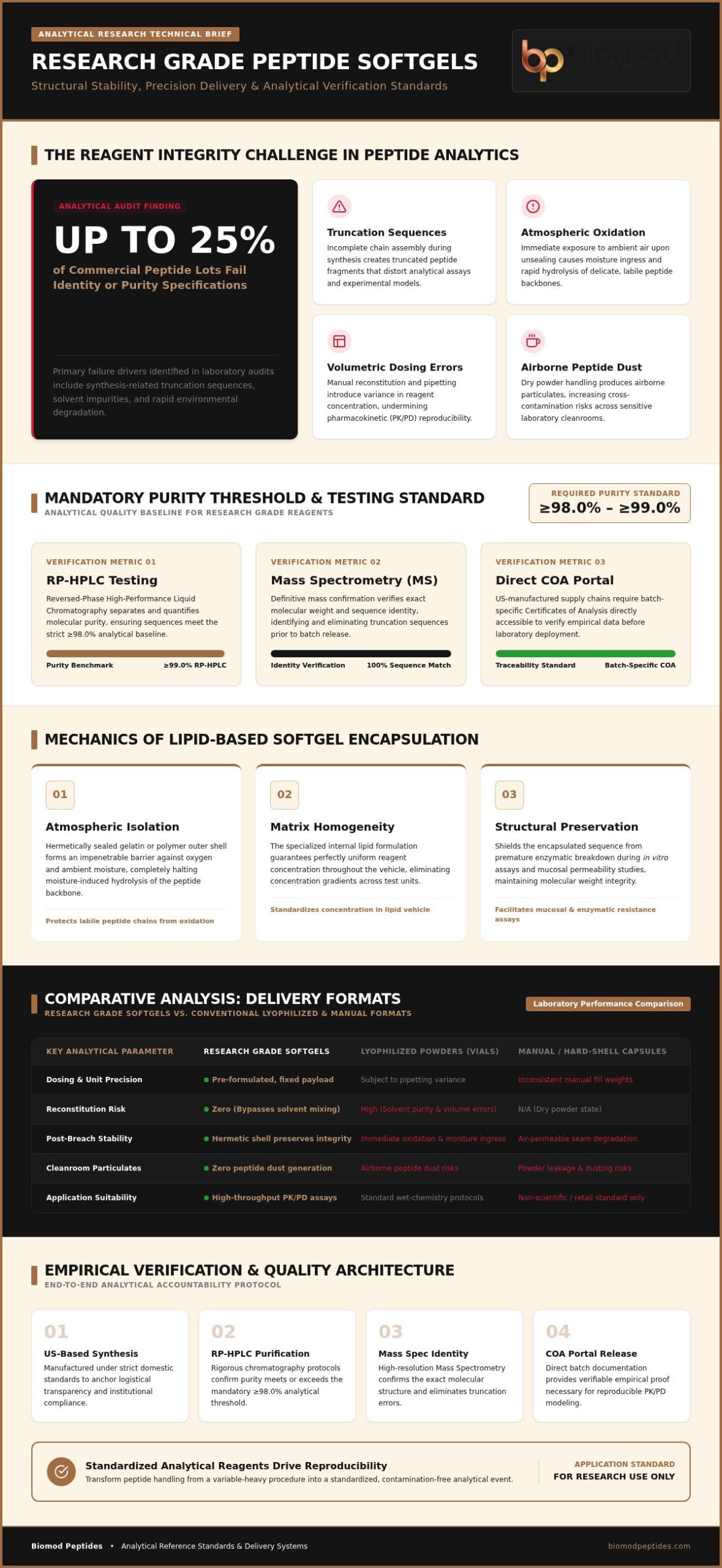
Independent analytical audits reveal that up to 25% of commercial peptide lots fail identity or purity specifications due to synthesis-related truncation sequences. It’s a reality that compromises the reliability of laboratory data. You likely recognize that manual encapsulation and environmental exposure frequently lead to the rapid degradation of delicate sequences. Utilizing research grade peptide softgels addresses these vulnerabilities through standardized delivery and enhanced structural protection.
This technical analysis details the role of softgel encapsulation as a precision delivery system for high-purity analytical studies. We’ll examine the structural advantages of lipid-based vehicles. We’ll discuss the necessity of US-manufactured quality standards and the rigorous HPLC/MS verification protocols required for batch-specific documentation. You’ll learn how these standards maintain peptide integrity. They provide the empirical proof necessary for disciplined research. Every batch requires verified transparency. Data drives the conclusion. Precise methodology is the only path to reproducible results.
Key Takeaways
- Analyze how lipid-based encapsulation shields labile peptide chains from environmental degradation in laboratory models.
- Evaluate the stability and dosing precision of research grade peptide softgels compared to standard lyophilized powders and manual formats.
- Master the verification protocols necessary to interpret third-party HPLC and Mass Spectrometry reports for every reagent batch.
- Secure experimental reproducibility by utilizing direct COA portals to confirm the purity and identity of US-manufactured sequences.
Understanding Research Grade Peptide Softgels in Analytical Applications
Research grade peptide softgels are specialized lipid-based delivery systems designed for high-precision laboratory reagents. These systems encapsulate purified sequences within a protective matrix to facilitate controlled investigation. Analytical laboratory settings demand a purity threshold of ≥98.0% to ≥99.0% via reversed-phase high-performance liquid chromatography (RP-HPLC). This level of refinement is mandatory to ensure experimental reproducibility and data accuracy. US-based manufacturing anchors the supply chain. It provides the logistical transparency and accountability required by Las Vegas laboratories and national research institutions. Standardizing research grade peptide softgels within a laboratory workflow ensures that environmental variables don’t compromise the reagent’s integrity.
Distinguishing these from retail-grade capsules is critical. Laboratory-grade softgels prioritize structural integrity and verified chemical purity over traditional marketing aesthetics. They’re strictly for research use only. They don’t include the fillers or inconsistent dosing common in non-scientific industries. Precision is the baseline requirement.
The Mechanics of Softgel Encapsulation for Peptide Stability
Peptide sequences are inherently labile. They’re susceptible to rapid degradation from oxidation and moisture. Utilizing softgel encapsulation technology creates a hermetically sealed barrier that protects the payload. The gelatin or polymer shell interacts with the internal lipid formulation to shield the peptide from premature enzymatic breakdown in in vitro assays. This methodology represents a significant evolution in peptide science, moving beyond standard lyophilized powders to more robust delivery models. Key attributes include:
- Atmospheric Isolation: Prevents moisture-induced hydrolysis of the peptide backbone.
- Matrix Homogeneity: Ensures consistent concentration within the lipid vehicle.
- Structural Preservation: Maintains molecular weight integrity against environmental stressors.
This technical approach facilitates the study of intestinal mucosal permeability and enzymatic resistance in sophisticated laboratory models. It’s a leap in methodology designed for researchers who value empirical proof over status quo formats.
Comparative Analysis: Research Grade Softgels vs. Conventional Formats
Research grade peptide softgels provide structural advantages that conventional lyophilized powders and hard-shell capsules often lack. Lyophilized formats require manual reconstitution. This process introduces variables such as solvent purity and volumetric measurement errors. Softgels bypass these risks. They offer a pre-formulated, hermetically sealed environment that isolates the peptide from atmospheric exposure. A common misconception suggests that lipid-based matrices are less stable than dry powders. However, once a lyophilized vial is breached, oxidation and moisture ingress occur immediately. Softgels maintain structural integrity throughout their shelf life in controlled laboratory settings. They also eliminate airborne particulates. This reduction in peptide dust is essential for maintaining the cleanliness of sensitive analytical environments. For Las Vegas research facilities, sourcing specialized laboratory peptide supplies ensures that procurement aligns with rigorous institutional standards.
Why Precision Labs Opt for Softgel Delivery Systems
Standardized pharmacokinetic (PK) and pharmacodynamic (PD) modeling depend on absolute dosing precision. Softgels provide pre-measured payloads that eliminate the variability inherent in manual encapsulation or pipette-based distribution. This consistency is vital for high-throughput research protocols where data reproducibility is the primary metric of success. Aligning methodology with FDA analytical method validation guidance reinforces the credibility of identity and potency testing. The softgel format transforms peptide handling from a variable-heavy procedure into a standardized analytical event. Researchers seeking to refine their delivery methodologies can explore verified peptide solutions to maintain professional standing and data integrity. Every unit represents a controlled data point. Precision isn’t an option; it’s a requirement.
Quality Assurance Protocols for Research Grade Peptide Procurement
Empirical proof is the only valid currency in analytical research. Every batch of research grade peptide softgels must undergo independent third-party verification to ensure structural fidelity and sequence accuracy. High-performance liquid chromatography (HPLC) provides the quantitative area percentage required to establish purity, while mass spectrometry (MS) confirms the molecular weight matches the theoretical sequence weight. These protocols align with established USP peptide reference standards for rigorous impurity profiling and identity confirmation. Maintaining a “Research Only” supply chain isn’t just a legal disclaimer; it’s a hallmark of professional legitimacy that protects experimental variables from retail-grade inconsistencies. This rigorous approach reflects the Biomod Peptides philosophy of applying clinical-grade precision and meticulous accountability to every laboratory reagent produced.
Utilizing the COA Verification Portal for Batch Integrity
Transparency requires direct, unmediated access to raw analytical data for every lot. Researchers can verify batch-specific results by inputting the lot number found on the physical packaging into a dedicated COA verification portal. This process ensures the material used in the laboratory matches the digital peptide purity verification record without discrepancy. US-based finishing and final testing serve as critical checkpoints for bioanalytical standards. They provide a level of logistical transparency that international suppliers rarely match. To ensure batch integrity, researchers should follow a standardized verification workflow:
- Locate the unique Lot Number on the softgel container.
- Access the digital portal for real-time data retrieval.
- Confirm the HPLC chromatogram shows the absence of co-eluting synthesis truncations.
- Verify the mass-to-charge ratio (m/z) falls within the required 5 ppm error window.
This multi-layered verification protocol ensures that every data point generated in the lab is supported by verified chemical integrity. Precise documentation is the final step in securing experimental reproducibility. It’s the standard that separates institutional research from speculative observation.
Advancing Analytical Precision with Standardized Peptide Delivery
Achieving reproducible data in peptide science requires the elimination of formulation variables. Utilizing research grade peptide softgels provides a hermetically sealed environment that preserves sequence integrity while ensuring pre-measured dosing accuracy. This methodology bypasses the risks associated with manual reconstitution and atmospheric exposure. It’s essential that professional supply chains prioritize objective verification through third-party HPLC and Mass Spectrometry testing. Every lot requires a transparent documentation trail to confirm identity and purity thresholds. By choosing reagents that are US-manufactured and finished, laboratories secure logistical transparency and clinical-grade precision. You can explore Biomod’s analytical grade peptide softgels to access lot-specific COA verification and maintain the highest standards of empirical proof. Precise methodology remains the most reliable path toward scientific advancement.
Frequently Asked Questions
What are research grade peptide softgels used for?
Research grade peptide softgels are specialized reagents used for in vitro assays, chromatographic reference standards, and preclinical investigation. Las Vegas laboratories utilize these lipid-based systems to evaluate intestinal mucosal permeability and enzymatic resistance in cell models. They provide a controlled alternative to powders for investigating oral delivery pathways. These reagents are strictly for research only; they aren’t for human consumption.
Are peptide softgels as stable as lyophilized powders for research?
Softgels offer superior stability compared to lyophilized powders once a container is opened in a lab. While dry powders are common, they’re susceptible to moisture ingress and oxidation during manual handling. Softgel matrices create a hermetic barrier that shields labile peptide chains from atmospheric degradation. This ensures structural integrity remains consistent throughout high-throughput research protocols in controlled Nevada laboratory environments.
How do I verify the purity of Biomod softgels?
Purity is verified for research grade peptide softgels through the Biomod COA Verification Portal using the lot-specific identifier. Researchers input the number found on the physical packaging to retrieve independent third-party HPLC and Mass Spectrometry reports. These documents confirm the quantitative purity threshold and molecular weight integrity. This digital transparency ensures the reagent matches the analytical standards required for reproducible data.
Why is US-based manufacturing important for research peptides?
US-based manufacturing provides the logistical transparency and accountability required by Las Vegas research institutions. Finishing and testing within the United States allows for rigorous oversight of quality control benchmarks that international suppliers often bypass. This geographic proximity facilitates faster batch verification and ensures every lot adheres to strict bioanalytical standards. It secures a reliable, verifiable supply chain for sensitive reagents.
Disclaimer
BIOMOD products are sold strictly for laboratory, analytical, and scientific research use only. They are not intended for human or animal consumption, administration, application, ingestion, injection, or any therapeutic, diagnostic, or cosmetic use.
The statements made on this website have not been evaluated by the United States Food and Drug Administration. BIOMOD products are not intended to diagnose, treat, cure, mitigate, or prevent any disease or medical condition.
BIOMOD is a research chemical supplier. BIOMOD is not a compounding pharmacy or chemical compounding facility as defined under Section 503A of the Federal Food, Drug, and Cosmetic Act. BIOMOD is not an outsourcing facility as defined under Section 503B of the Federal Food, Drug, and Cosmetic Act.
By accessing this site, you confirm you are at least 21 years of age and that you have read and accepted the BIOMOD Terms of Sale, Privacy Policy, and Research Use Only Policy. BIOMOD does not provide dosing, medical, therapeutic, diagnostic, veterinary, or use guidance under any channel.