
A single insoluble pellet often represents thousands of dollars in lost research material and months of stalled progress. Peptide aggregation isn’t a terminal failure; it’s a manageable chemical equilibrium. You’ve likely experienced the frustration of watching a high-purity sequence precipitate immediately upon reconstitution. This event compromises concentration accuracy and threatens the integrity of your entire dataset. This guide provides a rigorous framework for peptide aggregation troubleshooting to ensure experimental reproducibility across all laboratory protocols. You’ll master the systematic identification of hydrophobic clusters and implement validated methods for handling difficult sequences. We’ll analyze titration strategies, solvent polarity adjustments, and mechanical energy applications that restore solubility without risking chemical degradation. This article details the analytical steps necessary to salvage complex sequences and prevent future aggregation events in your research environment.
Key Takeaways
- Differentiate between amorphous precipitation and structured fibrillar aggregation to determine the most effective recovery strategy for your sequence.
- Execute a systematic peptide aggregation troubleshooting protocol by utilizing visual opalescence assessments and strategic pH titration relative to the isoelectric point.
- Leverage non-ionic surfactants and precise solvent polarity adjustments to mask hydrophobic patches and inhibit the nucleation of insoluble clusters.
- Enhance experimental reproducibility by maintaining strict concentration limits and utilizing high-purity research peptides to minimize impurity-seeded aggregation events.
Identifying the Mechanisms of Peptide Aggregation
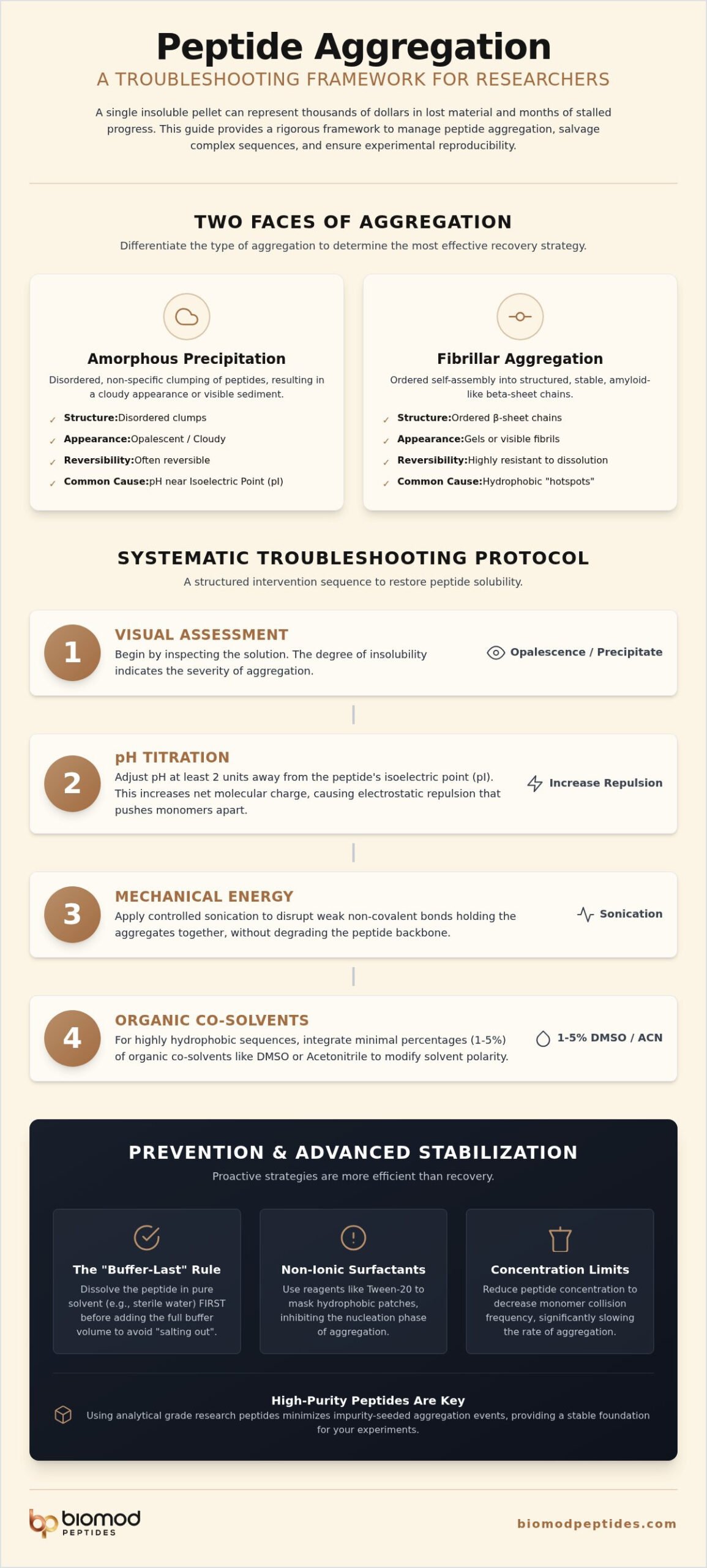
Peptide aggregation is the uncontrolled self-association of monomers into dimers, oligomers, or large insoluble fibrils. This process shifts the peptide from a biologically active, soluble state into a solid phase that compromises data integrity. Successful peptide aggregation troubleshooting begins with a precise characterization of the solid state. Amorphous precipitation involves disordered clumping, often reversible through pH adjustment. In contrast, fibrillar aggregation creates structured amyloid-like chains that are significantly more resistant to dissolution. These fibrils represent a lower energy state that the sequence “prefers” once nucleation begins.
The primary drivers of this instability are hydrophobic collapse and intermolecular hydrogen bonding. Sequence-specific “hotspots” act as nucleation points where aggregation is statistically more likely to occur. In research environments like Las Vegas laboratories, varying ambient conditions can fluctuate enough to trigger these sensitive nucleation events. Computational methods, including various protein aggregation prediction tools, allow researchers to identify these motifs during the design phase. Predicting these events is the first step toward preventing the loss of expensive research material.
Molecular Drivers: Hydrophobicity and Beta-Sheet Formation
Non-polar side chains drive rapid precipitation by seeking to minimize contact with aqueous solvents. As these residues cluster, they exclude water and form dense, insoluble cores. A primary failure point in peptide stability is the transition from alpha-helical or random coil structures into insoluble beta-sheet architectures. These beta-sheets provide a stable, repetitive framework for fibril growth. The accuracy of the initial sequence is paramount; even minor synthesis errors can drastically alter the folding landscape. High-purity standards ensure that impurities do not serve as templates for unwanted structural transitions. Maintaining analytical grade purity is a prerequisite for long-term stability in complex sequences.
Systematic Troubleshooting Protocol for Aggregated Solutions
Effective peptide aggregation troubleshooting requires a structured intervention sequence. Begin with a visual assessment. An opalescent or cloudy appearance indicates the presence of sub-visible particulates, while visible precipitates signal advanced nucleation. If the solution is unstable, initiate pH titration. Adjusting the pH at least two units away from the peptide’s isoelectric point (pI) increases net molecular charge. This electrostatic repulsion overcomes the mechanisms of peptide aggregation that drive self-association.
If pH adjustment fails, apply mechanical energy via controlled sonication. This disrupts weak non-covalent bonds without cleaving the peptide backbone. For highly hydrophobic sequences, integrate minimal percentages (1-5%) of organic co-solvents like DMSO or Acetonitrile. These reagents modify solvent polarity to favor the monomeric state. Utilizing analytical grade research peptides reduces the risk of impurity-seeded precipitation during these interventions.
Reconstitution Sequence: Preventing Aggregation Before It Starts
Prevention is more efficient than recovery. Follow the “buffer-last” rule: dissolve the peptide in a small volume of primary solvent, such as water or dilute acid, before adding the full buffer volume. This prevents the peptide from encountering high salt concentrations that trigger “salting out” effects. Implementing specific improving peptide solubility techniques during the initial wetting phase is critical. In Las Vegas research facilities, always use degassed, sterile water to prevent oxidative-induced aggregation. Oxygen removal minimizes the formation of unwanted disulfide bridges in cysteine-containing sequences.
Advanced Stabilization and Reagent Selection
Chemical stabilization provides a secondary layer of defense when physical interventions prove insufficient. Non-ionic surfactants, such as Tween-20 or Triton X-100, effectively mask hydrophobic patches on the peptide surface. This masking inhibits the initial nucleation phase, interfering with the fundamental mechanisms of peptide aggregation at the molecular level. Concentration management remains equally critical. In analytical assays, “less is more” is a functional rule. Reducing the peptide concentration decreases the collision frequency between monomers, significantly slowing the transition into insoluble oligomers.
For research sequences with persistent solubility barriers, specialized delivery formats offer a pre-stabilized alternative. Transitioning to peptide softgels or spray products allows researchers to work with formulations specifically engineered to maintain the monomeric state. These formats are designed to bypass the common failure points encountered during manual bench-top reconstitution, ensuring higher data integrity for sensitive assays.
Selecting Analytical Grade Reagents to Minimize Impurity-Induced Clumping
Purity is the primary defense against spontaneous precipitation. A purity level of 98% or higher is the baseline for professional laboratory settings. Lower-grade materials often contain truncation sequences or residual salts that act as “seeds” for rapid clumping. Biomod Peptides’ US-manufactured reagents undergo rigorous third-party verification to ensure structural integrity and minimal impurity profiles. Consult the Laboratory Peptide Supply guide for procurement standards that prioritize long-term stability. Comprehensive peptide aggregation troubleshooting begins with the selection of high-tier materials that lack the impurities responsible for catalytic nucleation.
Advancing Experimental Precision Through Analytical Control
Systematic troubleshooting transforms peptide aggregation from an experimental roadblock into a manageable variable. Success relies on identifying specific molecular drivers and applying precise physical or chemical interventions. By mastering titration, energy disruption, and concentration limits, researchers maintain the integrity of their analytical datasets. High-purity standards remain the most effective deterrent against unwanted nucleation events. Every sequence deserves a stable environment to yield reproducible results. Biomod Peptides supports these rigorous standards with analytical grade reagents that undergo independent third-party testing to ensure structural verification. Our US-manufactured products provide the baseline stability required for complex peptide aggregation troubleshooting. Explore High-Purity Research Peptides from Biomod to secure the precision your research demands. Maintain your momentum with verified analytical excellence.
Frequently Asked Questions
Why does my peptide solution turn cloudy upon refrigeration?
Refrigeration decreases the kinetic energy available to overcome hydrophobic interactions, reducing the solubility limit of many sequences. In Las Vegas research facilities, this temperature shift often triggers the transition from a clear solution to an opalescent state. This indicates the formation of sub-visible oligomers. Effective peptide aggregation troubleshooting requires warming the solution to room temperature or adjusting the pH to restore the monomeric state.
Can I still use a peptide solution if it has visible aggregates?
Using a solution with visible aggregates isn’t recommended for precise analytical assays. Precipitation reduces the effective concentration of the active peptide, leading to inconsistent results and compromised data integrity. If recovery protocols like sonication or pH adjustment don’t dissolve the particulates, the material should be discarded. Utilizing US-manufactured reagents with verified purity helps prevent these irreversible nucleation events.
Does sonication degrade research peptides during troubleshooting?
Controlled sonication doesn’t typically degrade the primary sequence of research peptides. The process utilizes ultrasonic waves to disrupt weak, non-covalent intermolecular bonds responsible for clumping. However, researchers must monitor temperature closely, as excessive heat can trigger chemical degradation. Brief, pulsed sonication cycles are the standard protocol for breaking up amorphous precipitates without compromising the structural integrity of the peptide backbone.
How does the isoelectric point (pI) affect peptide aggregation?
The isoelectric point (pI) is the specific pH where a peptide carries a net zero electrical charge. At this point, electrostatic repulsion between molecules is at its minimum, which dramatically increases the probability of self-association. Successful peptide aggregation troubleshooting involves titrating the solution at least two units away from the pI. This increases the net charge and creates the repulsion necessary to maintain a stable solution.
Disclaimer
BIOMOD products are sold strictly for laboratory, analytical, and scientific research use only. They are not intended for human or animal consumption, administration, application, ingestion, injection, or any therapeutic, diagnostic, or cosmetic use.
The statements made on this website have not been evaluated by the United States Food and Drug Administration. BIOMOD products are not intended to diagnose, treat, cure, mitigate, or prevent any disease or medical condition.
BIOMOD is a research chemical supplier. BIOMOD is not a compounding pharmacy or chemical compounding facility as defined under Section 503A of the Federal Food, Drug, and Cosmetic Act. BIOMOD is not an outsourcing facility as defined under Section 503B of the Federal Food, Drug, and Cosmetic Act.
By accessing this site, you confirm you are at least 21 years of age and that you have read and accepted the BIOMOD Terms of Sale, Privacy Policy, and Research Use Only Policy. BIOMOD does not provide dosing, medical, therapeutic, diagnostic, veterinary, or use guidance under any channel.