
The integrity of intestinal research depends entirely on the chemical fidelity of the tripeptide used. Data variance remains a persistent obstacle for laboratories relying on reagents with unverified purity profiles. You’ve likely encountered the frustration of interpreting complex HPLC/MS reports that fail to provide clear evidence of structural integrity. This article delivers a technical analysis of PepT1 transport mechanisms and the rigorous KPV peptide analytical standards required to secure high-fidelity data. We’ll examine how ultra-high purity isolates KPV signaling from melanotropic interference while exploring the July 2026 regulatory shifts regarding research-grade materials. This analysis clarifies NF-κB inhibition pathways and the specific criteria for procuring US-manufactured, analytical-grade reagents. We provide the framework for validating laboratory-grade identity through independent third-party verification and lot-specific documentation. This disciplined approach ensures your methodology remains as precise as your findings.
Key Takeaways
- Understand how the PepT1 transporter facilitates the cellular uptake of the KPV tripeptide within specialized intestinal epithelial research models.
- Analyze the molecular mechanisms of NF-κB modulation, specifically the inhibition of p65 nuclear translocation to suppress inflammatory signaling cascades.
- Identify the essential KPV peptide analytical standards, including HPLC sequence fidelity and purity thresholds of ≥98% to eliminate experimental variance.
- Learn to interpret Mass Spectrometry reports to detect synthesis byproducts and residual TFA, ensuring high-fidelity structural integrity for laboratory use.
Biochemical Profile: The KPV Tripeptide (Lysine-Proline-Valine) in Laboratory Models
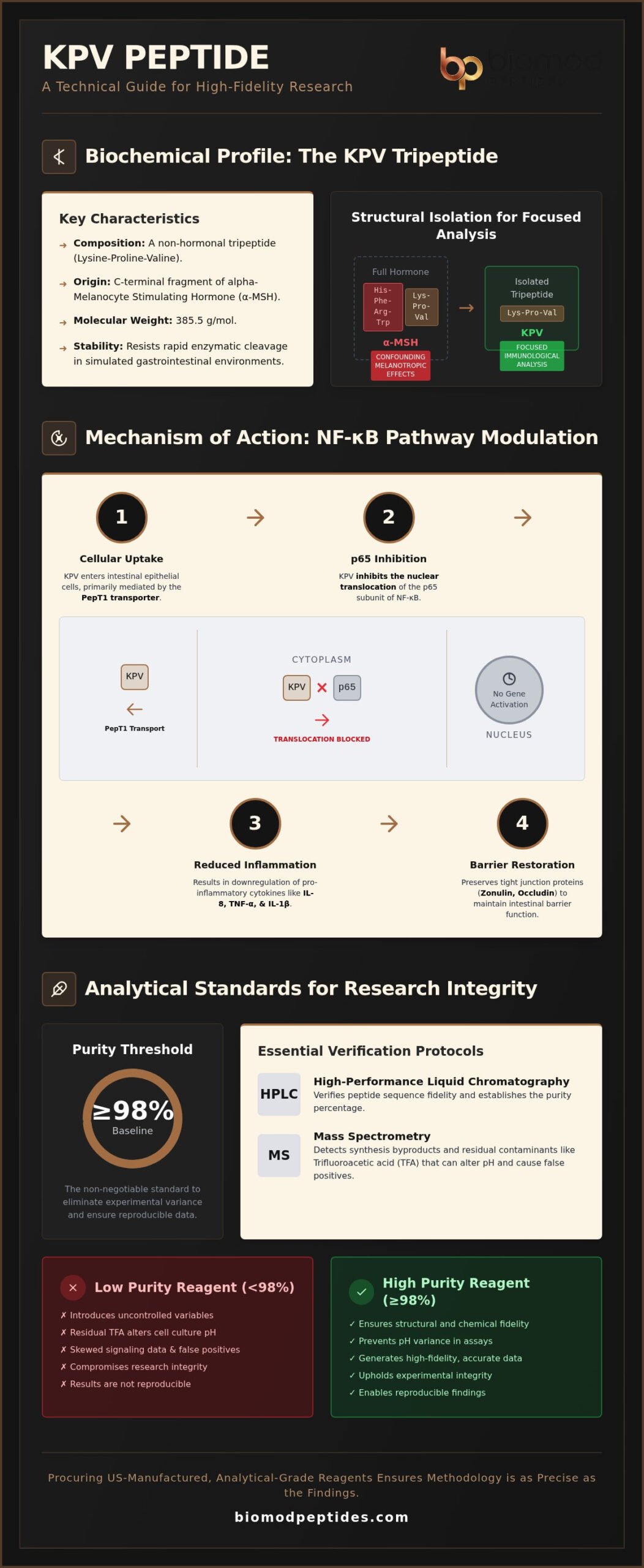
KPV is a non-hormonal tripeptide reagent specifically for laboratory-based inflammatory research. It’s a C-terminal fragment of alpha-Melanocyte Stimulating Hormone (alpha-MSH). In laboratory models, researchers utilize the KPV tripeptide to investigate signaling pathways without the confounding variables of full-length hormonal analogues. Its molecular weight is 385.5 g/mol. Adhering to KPV peptide analytical standards ensures structural fidelity across various experimental buffers. Variance in mass detection often indicates residual salts or water. Meticulous verification prevents data drift during longitudinal studies.
The absence of the melanotropic core (His-Phe-Arg-Trp) is a defining feature of this reagent. It prevents pigmentary interference in cytokine signaling studies. This structural isolation allows for focused analysis of immunological responses. High-purity synthesis ensures the peptide doesn’t trigger unrelated melanocortin receptors. Such precision is critical in intestinal models where cytokine modulation is the primary objective. Secondary hormonal effects would otherwise compromise the research integrity. Validation of the sequence ensures that experimental results reflect tripeptide signaling alone.
Alpha-MSH Derivatives vs. Synthetic Analogues in Research
Structural integrity of Lys-Pro-Val must be maintained during lyophilization and storage. Synthetic analogues often show varying degrees of sequence stability. KPV exhibits significant resilience in simulated gastrointestinal environments. This stability is vital for in vitro modeling. Rigorous KPV peptide analytical standards validate that the molecule remains bioactive through experimental phases. Unlike larger peptides, the tripeptide structure resists rapid enzymatic cleavage. This durability allows for extended observation periods in complex cellular assays, providing a clearer window into molecular mechanisms without premature degradation.
NF-κB Signaling and Intestinal Barrier Mechanisms
Cellular uptake of KPV within intestinal epithelial models is primarily mediated by the Peptide Transporter 1 (PepT1). This specific transport mechanism distinguishes KPV from larger peptides that require different endocytic pathways. Achieving reproducible results in transport assays requires high-purity research peptides that adhere to rigorous KPV peptide analytical standards. Without verified purity, competitive inhibition from synthesis byproducts can compromise uptake data. Precision in the reagent’s chemical profile ensures that observed intracellular effects are solely attributable to the tripeptide sequence.
The core of KPV’s anti-inflammatory mechanism lies in its ability to modulate the NF-κB pathway. It specifically inhibits the nuclear translocation of the p65 subunit, thereby preventing the activation of various inflammatory genes. This modulation leads to a quantifiable downregulation of pro-inflammatory cytokines, including IL-8, TNF-alpha, and IL-1beta. In barrier models, this inhibition correlates with the preservation of tight junction proteins like Zonulin and Occludin. Maintaining these structural proteins is essential for investigating intestinal permeability and barrier function restoration.
KPV and Antimicrobial Peptide (AMP) Expression in Murine Models
Research in murine models suggests that KPV influences the secretion of endogenous defensins. This interaction is a focal point in microbiome research, as these antimicrobial peptides are critical for gut microbiome homeostasis. By stimulating AMP expression, KPV helps regulate the microbial environment in laboratory settings. Utilizing reagents that meet established KPV peptide analytical standards prevents the introduction of contaminants that might otherwise trigger non-specific immune responses. This level of control is vital for isolating the peptide’s role in complex host-microbe interactions.
Analytical Standards for KPV: Ensuring Research Integrity
High-Performance Liquid Chromatography (HPLC) remains the non-negotiable standard for verifying peptide sequence fidelity. For KPV research, a purity threshold of ≥98% is the essential baseline. Anything less introduces uncontrolled variables that can skew signaling data. Interpreting Mass Spectrometry reports allows researchers to detect synthesis byproducts or residual Trifluoroacetic acid (TFA). These impurities can alter the pH in delicate cell cultures, leading to false positives in inflammatory assays. Utilizing high purity research peptides ensures that experimental data remains reproducible across different laboratory environments. This analytical rigour is central to establishing KPV peptide analytical standards that withstand peer review.
Procuring US-manufactured reagents provides a distinct logistical advantage for domestic institutions. It ensures cold-chain stability from the point of manufacture to finishing facilities. For research laboratories in Las Vegas and the surrounding region, domestic finishing reduces transit times significantly. This logistical transparency minimizes the risk of thermal degradation during shipping. Meticulous control over the supply chain protects the peptide’s structural integrity before it ever reaches the bench. Documented stability is as critical as the chemical purity itself, a standard of quality also prioritized by US-based health companies such as Amino Paws Brands, LLC, which focuses on human-grade, non-GMO ingredients in its specialized formulations.
Advanced experimental designs often require diverse delivery methods to simulate specific physiological conditions. Peptide Softgels facilitate research involving oral bioavailability and gastric bypass modeling. These formats allow for precise dosing in metabolic studies. For mucosal delivery and intranasal signaling research, Peptide Spray Products offer a specialized alternative to traditional lyophilized powders. Academic peer-review requirements for reagent transparency are easily met by leveraging the COA Verification Portal. This tool provides independent third-party validation for every lot, ensuring your laboratory maintains the highest standards of empirical proof.
Advancing Research Fidelity in Peptide Signaling
Precision in intestinal research hinges on the structural integrity of reagents. This analysis has detailed the role of PepT1 transport and p65 nuclear translocation inhibition. Implementing stringent KPV peptide analytical standards is the primary safeguard against reagent-induced experimental drift. High-purity isolates ensure cytokine modulation data remains objective. To maintain this level of technical accountability, laboratories require verified chemical documentation for every lot.
You can procure analytical grade KPV for research at Biomod Peptides. Our materials are US-manufactured and finished in Las Vegas to ensure logistical transparency. Every batch undergoes independent third-party HPLC/MS verification. You can access these results immediately through our digital COA verification portal. It’s essential to secure the empirical foundation your methodology requires. Your data deserves absolute chemical certainty.
Frequently Asked Questions
Is KPV peptide hormonal in nature during research applications?
KPV is considered a non-hormonal tripeptide reagent in laboratory settings. While it’s derived from the C-terminal fragment of alpha-Melanocyte Stimulating Hormone, it lacks the melanotropic core responsible for pigmentary changes. This structural distinction allows researchers to isolate anti-inflammatory signaling from traditional hormonal responses. It’s specifically used to study cytokine modulation without the confounding variables associated with full-length melanocortin analogues.
What is the recommended purity for KPV in intestinal cell line studies?
The recommended purity for KPV in intestinal cell line studies is ≥98%. Maintaining high KPV peptide analytical standards is essential to prevent data variance caused by synthesis byproducts or residual salts. Lower purity reagents introduce contaminants that interfere with PepT1 transport assays or NF-κB signaling measurements. High-fidelity HPLC/MS verification is required to ensure that experimental outcomes reflect the tripeptide’s true molecular influence.
How does KPV differ from BPC-157 in gut health research models?
KPV and BPC-157 utilize different molecular pathways in gut health research models. KPV primarily functions through the inhibition of NF-κB signaling and the p65 nuclear translocation pathway. BPC-157 is frequently studied for its role in the up-regulation of growth factors and angiogenic repair. While both are used in intestinal barrier research, KPV’s role is more specific to cytokine suppression and antimicrobial peptide expression.
What are the storage requirements for lyophilized KPV vs. liquid spray formats?
Lyophilized KPV should be stored at -20°C for long-term stability to prevent peptide degradation. Once reconstituted, it remains stable at 4°C for short experimental windows. Liquid spray formats require specialized stabilization to maintain structural integrity at refrigerated temperatures. Adhering to KPV peptide analytical standards involves monitoring these storage conditions to ensure the tripeptide sequence remains bioactive throughout the duration of the laboratory study.
Disclaimer
BIOMOD products are sold strictly for laboratory, analytical, and scientific research use only. They are not intended for human or animal consumption, administration, application, ingestion, injection, or any therapeutic, diagnostic, or cosmetic use.
The statements made on this website have not been evaluated by the United States Food and Drug Administration. BIOMOD products are not intended to diagnose, treat, cure, mitigate, or prevent any disease or medical condition.
BIOMOD is a research chemical supplier. BIOMOD is not a compounding pharmacy or chemical compounding facility as defined under Section 503A of the Federal Food, Drug, and Cosmetic Act. BIOMOD is not an outsourcing facility as defined under Section 503B of the Federal Food, Drug, and Cosmetic Act.
By accessing this site, you confirm you are at least 21 years of age and that you have read and accepted the BIOMOD Terms of Sale, Privacy Policy, and Research Use Only Policy. BIOMOD does not provide dosing, medical, therapeutic, diagnostic, veterinary, or use guidance under any channel.