
Up to 73% of research-grade peptide samples fail to match their original Certificates of Analysis upon independent auditing. This discrepancy isn’t just a clerical error. It’s a failure of analytical rigor. You require high-performance liquid chromatography to confirm that your reagents meet strict laboratory standards. Yet, without a protocol for interpreting peptide HPLC test results, a 98% purity claim often masks baseline noise, retention time shifts, or unresolved deletion sequences.
Mastering these analytical nuances is the only way to ensure your research rests on a foundation of chemical integrity. You must distinguish between legitimate signal and chromatographic artifacts. This guide details the technical protocols needed to validate peak symmetry, calculate resolution using USP <621> standards, and identify the impurity profiles that compromise batch consistency. We move beyond surface-level percentages to establish a framework for objective verification.
Key Takeaways
- Identify target peptide sequences by analyzing retention time and absorbance data on the chromatographic axes.
- Execute a precise protocol for interpreting peptide HPLC test results through systematic batch verification and AUC integration.
- Utilize dedicated COA verification portals to cross-reference third-party data and ensure the structural integrity of research materials.
- Leverage US-based manufacturing and specialized training to maintain cold chain stability and batch-to-batch consistency.
Anatomy of an HPLC Chromatogram for Peptide Analysis
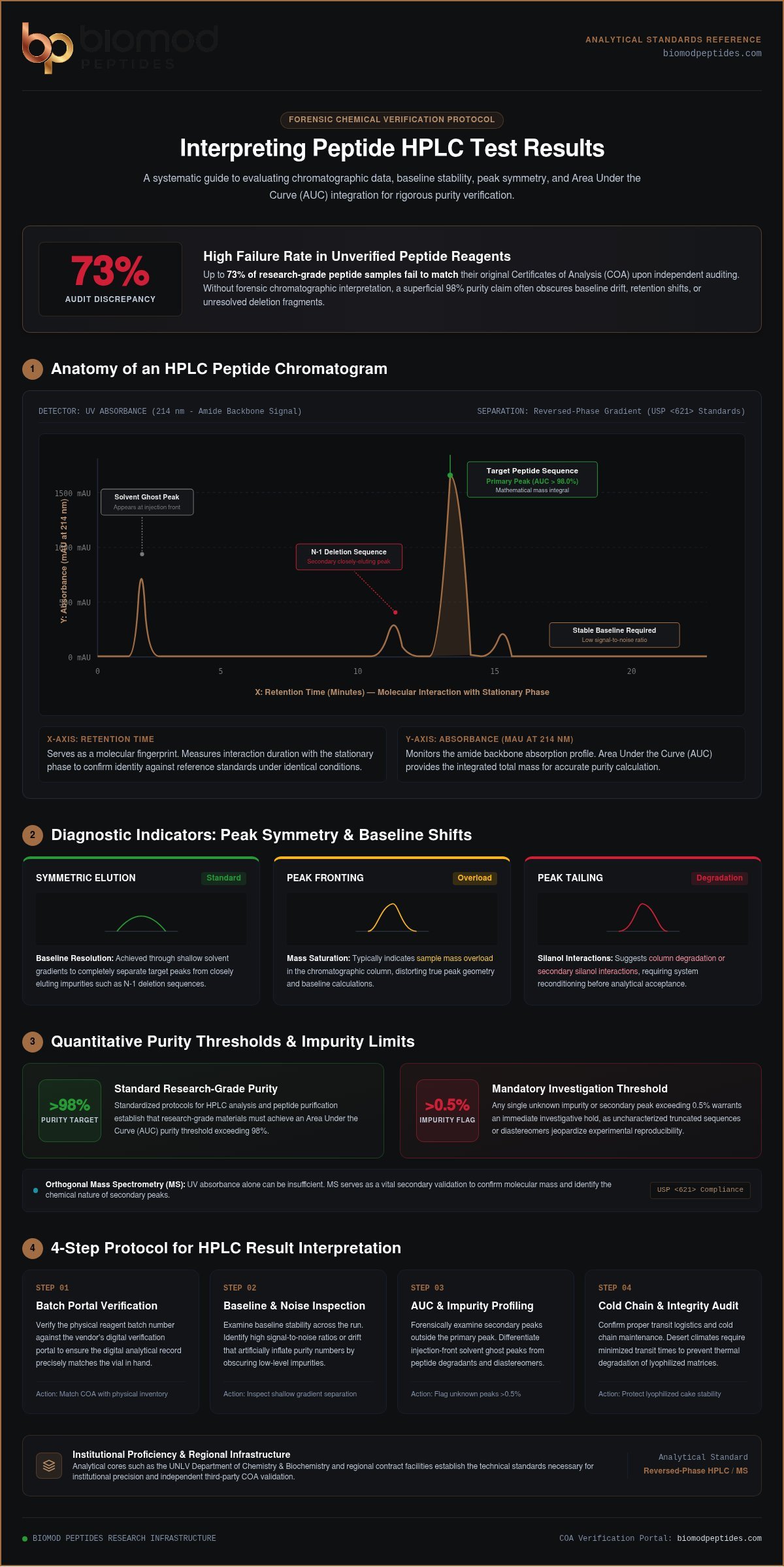
A peptide chromatogram is a forensic record of chemical separation. Interpreting peptide HPLC test results requires a stable baseline, as fluctuations or high signal-to-noise ratios compromise the accuracy of purity calculations by masking low-level impurities. The visual output is defined by two primary coordinates:
- X-axis (Retention Time): The duration a molecule interacts with the stationary phase.
- Y-axis (Absorbance): Measured in milli-absorbance units (mAU), typically at 214 nm to capture the amide backbone signal.
The primary peak represents the target peptide sequence; its magnitude relative to secondary peaks determines the purity profile. Area Under the Curve (AUC) is the integrated mathematical value representing the total mass of the detected substance, and it’s the primary metric for purity quantification.
Mastering the mechanics of high-performance liquid chromatography is essential for recognizing how mobile phase dynamics influence these visual outputs.
Decoding Retention Time and Peak Symmetry
Retention time serves as a molecular fingerprint. It confirms identity by matching the elution point against a validated reference standard under identical conditions. Significant shifts often signal structural variations or incorrect sequences. Peak symmetry provides immediate diagnostic data regarding the analytical run. Peak tailing suggests column degradation or silanol interactions, while peak fronting typically indicates sample mass overload. High-tier validation relies on shallow solvent gradients. These gradients ensure that closely eluting impurities, such as N-1 deletion sequences, achieve baseline resolution from the target peak. Precision in these metrics differentiates research-grade material from industrial-grade alternatives.
Protocol for Interpreting Peptide HPLC Test Results
Verification precedes analysis. First, verify the batch number against the vendor’s verification portal. This step ensures that the digital record matches the physical reagent in your laboratory. Next, assess the purity percentage calculated through Area Under the Curve (AUC) integration. While a high percentage is desirable, interpreting peptide HPLC test results requires a forensic examination of what lies outside the primary peak. Evaluate the impurity profile by scrutinizing secondary peaks, which often represent truncated sequences or diastereomers that compromise experimental reproducibility. For detailed standards, refer to The Protocol for Peptide Purity Verification.
Quantifying Impurities and Secondary Peaks
Distinguishing between solvent artifacts and actual peptide degradants is critical for data integrity. Solvent ghost peaks typically appear at the injection front, whereas peptide impurities elute closer to the target molecule. Relying solely on UV absorbance can be insufficient for complex sequences. Mass Spectrometry (MS) serves as a vital secondary validation to HPLC, confirming the molecular mass of the target peak and identifying the chemical nature of impurities. Standardized protocols for HPLC analysis and purification of peptides suggest that research-grade materials should maintain a purity threshold of >98%.
Any single unknown impurity exceeding 0.5% warrants immediate investigation. Precision in interpreting peptide HPLC test results ensures that your research findings are not skewed by chemical noise. Researchers should prioritize batch transparency by utilizing a COA verification portal to confirm third-party results before beginning any in vitro or in vivo protocols. This rigorous approach to validation establishes a baseline of accountability that traditional industry norms often ignore.
HPLC Training and Verified Peptide Sourcing in Las Vegas
Las Vegas serves as a critical nexus for analytical research and bioanalytical validation. Local laboratory staff can access specialized training through institutional cores like the UNLV Department of Chemistry & Biochemistry or regional contract testing facilities. These programs provide the technical proficiency required for interpreting peptide HPLC test results with institutional precision. Beyond training, the logistical advantage of local Las Vegas sourcing is significant. Desert climates necessitate minimal transit times to maintain cold chain integrity and prevent thermal degradation of lyophilized matrices.
Biomod Peptides supports regional laboratories by providing a dedicated COA Verification Portal. This infrastructure allows researchers to cross-reference batch-specific data against independent third-party results. For teams establishing new analytical benchmarks, our Laboratory Peptide Supply guide offers a framework for aligning internal protocols with modern industry standards.
Selecting Verified Reagents for Analytical Research
Analytical accountability depends on the traceability of raw materials. US-manufactured peptides offer superior oversight for Las Vegas facilities, ensuring that every batch undergoes rigorous validation before laboratory release. When interpreting peptide HPLC test results, researchers should ensure that documentation aligns with FDA bioanalytical method validation guidance to maintain high data integrity. Evaluating vendor accountability requires more than a surface-level review; it demands access to verifiable, third-party proof of purity and structural identity. Utilizing US-finished research peptides ensures that reagents meet the stringent requirements of 2026 instrumentation standards. This disciplined approach to procurement effectively eliminates the risks associated with batch-to-batch variability.
Elevating Laboratory Standards Through Analytical Rigor
Precision in the laboratory depends on the objective validation of every reagent. Mastery of interpreting peptide HPLC test results transforms raw data into actionable laboratory intelligence; it ensures that primary peaks align with target sequences while identifying the subtle secondary signals that indicate degradation or synthesis errors. By prioritizing analytical grade standards and US-finished manufacturing, researchers mitigate the risks of batch-to-batch variability. Verification is a prerequisite for experimental reproducibility. Biomod Peptides facilitates this transparency through independent third-party HPLC/MS testing and localized finishing in Las Vegas to protect chemical integrity. Accountability starts with accessible documentation and rigorous instrumentation. Secure the integrity of your next study by utilizing materials that withstand forensic scrutiny.
Access the Biomod Verification Portal for High-Purity Peptides
Your commitment to precise methodology ensures the continued advancement of your research goals.
Frequently Asked Questions
What is a good purity percentage for research peptides?
Research-grade peptides require a minimum chromatographic purity of 95.0% for general in vitro screening. For advanced preclinical research or in vivo applications, the standard rises to 98.0% or higher. Any single unknown impurity must remain below 1.0% to ensure experimental reproducibility. Our Las Vegas facility adheres to these benchmarks, providing analytical-grade materials that meet the stringent requirements of 2026 laboratory protocols.
How does HPLC differ from Mass Spectrometry in peptide testing?
HPLC measures chromatographic purity and relative peak area, essentially quantifying how much of the sample is the target compound. In contrast, Mass Spectrometry (MS) verifies the molecular weight and sequence identity. HPLC cannot distinguish between different molecules with identical retention times. Therefore, interpreting peptide HPLC test results effectively requires pairing them with MS data to confirm the chemical structure matches the intended sequence.
Can I trust a COA that does not include the raw chromatogram image?
A Certificate of Analysis (COA) without a raw chromatogram image lacks transparency and should be treated with skepticism. The visual plot allows you to inspect baseline stability and peak symmetry, which numerical percentages often obscure. Given that 73% of vendor COAs exhibit material discrepancies, researchers in the Las Vegas area should utilize a COA verification portal to cross-reference data against raw analytical evidence.
How often should I verify the HPLC results of my peptide reagents?
You should verify every batch of peptide reagents upon receipt, regardless of vendor history. Batch-to-batch consistency isn’t guaranteed in chemical synthesis. Regular verification is essential when interpreting peptide HPLC test results for long-term studies where purity shifts can invalidate months of data. Utilizing US-finished products with independent third-party testing provides a reliable baseline for these recurring quality control checks in the laboratory.
Disclaimer
BIOMOD products are sold strictly for laboratory, analytical, and scientific research use only. They are not intended for human or animal consumption, administration, application, ingestion, injection, or any therapeutic, diagnostic, or cosmetic use.
The statements made on this website have not been evaluated by the United States Food and Drug Administration. BIOMOD products are not intended to diagnose, treat, cure, mitigate, or prevent any disease or medical condition.
BIOMOD is a research chemical supplier. BIOMOD is not a compounding pharmacy or chemical compounding facility as defined under Section 503A of the Federal Food, Drug, and Cosmetic Act. BIOMOD is not an outsourcing facility as defined under Section 503B of the Federal Food, Drug, and Cosmetic Act.
By accessing this site, you confirm you are at least 21 years of age and that you have read and accepted the BIOMOD Terms of Sale, Privacy Policy, and Research Use Only Policy. BIOMOD does not provide dosing, medical, therapeutic, diagnostic, veterinary, or use guidance under any channel.