
A 99% purity claim on a product label is statistically meaningless without the raw analytical data to validate it. You recognize that in sensitive research, even a 0.5% variance in peptide-related impurities can compromise an entire experimental series. Relying on a summary table is a risk to your data integrity. Mastering the technical process of interpreting peptide COA documents is now a baseline requirement for laboratory accountability.
This guide provides the methodology to independently verify molecular weight and peak integration. You’ll ensure your reagents align with the latest 2026 regulatory thresholds. We will analyze the nuances of HPLC chromatograms and Mass Spectrometry reports to move beyond surface-level claims. You’ll gain the precision needed to identify subtle impurities and secure the structural integrity of your reagents.
Key Takeaways
- Analyze HPLC chromatograms to identify subtle impurities that aggregate purity percentages often fail to represent.
- Master the technical nuances of interpreting peptide coa reports to ensure observed [M+H]+ peaks match theoretical sequence designs.
- Establish a rigorous 4-step verification protocol to maintain reagent integrity and experimental reproducibility.
- Utilize dedicated verification portals to confirm the authenticity of third-party analytical data and manufacturing documentation.
Decoding the HPLC Chromatogram: Beyond the Purity Percentage
A Certificate of Analysis (COA) serves as the definitive record of a peptide’s chemical identity and purity. It’s the primary document used to validate that a batch meets pre-defined technical specifications. High-Performance Liquid Chromatography (HPLC) is the standard analytical method for determining these purity levels. It separates individual components within a mixture based on their chemical interactions with a stationary phase. Effective interpreting peptide coa data requires a granular look at the chromatogram rather than accepting a summary table at face value.
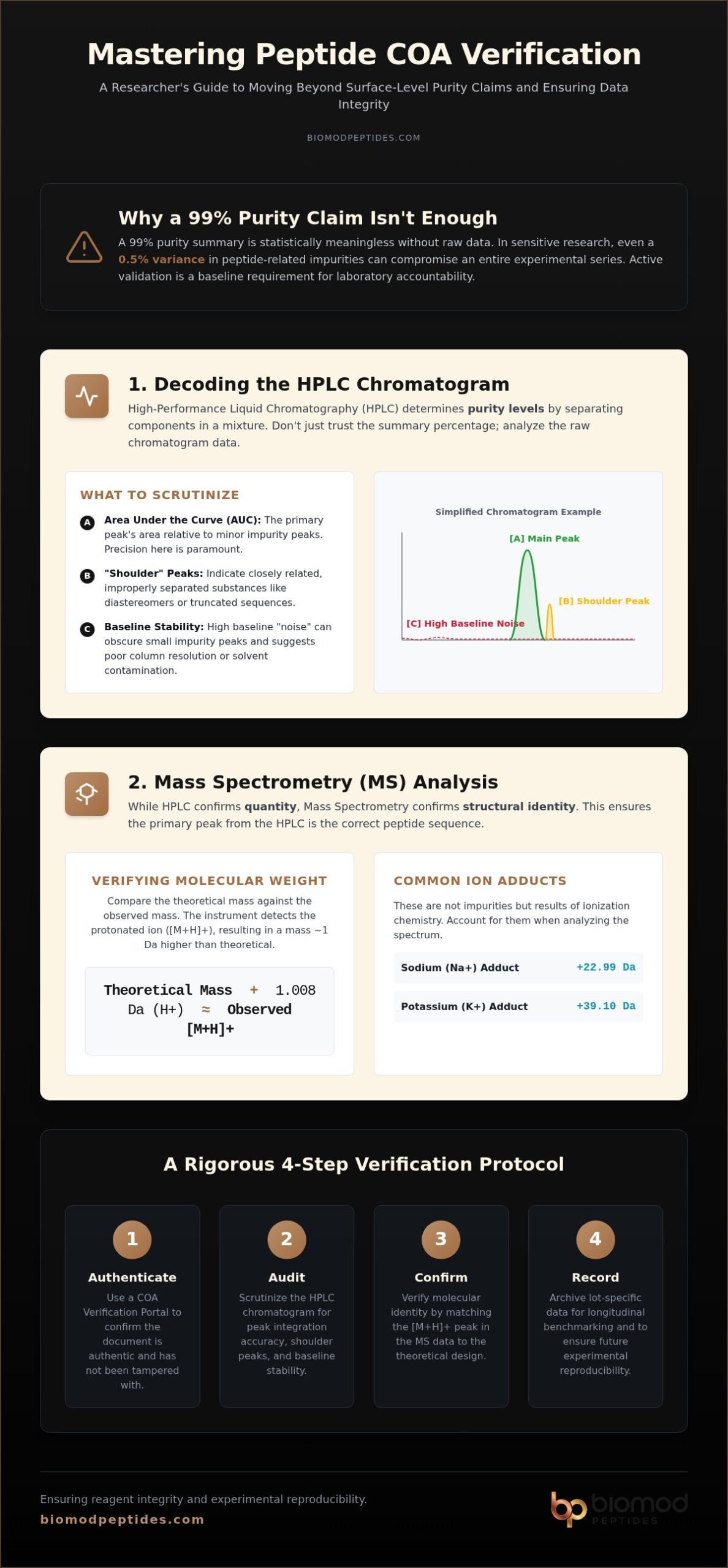
Researchers must scrutinize the Area Under the Curve (AUC) for the primary peak relative to minor impurity peaks. Small deviations in peak integration can mask significant contaminants. The integration parameters must be transparent. HPLC purity is the ratio of the target peptide peak area to the total integrated area of all detected peaks. Precision here is paramount.
Identifying Impurity Peaks and Baseline Stability
Vigilance is required when detecting “shoulder peaks” on the main chromatogram. These often indicate closely related substances, such as diastereomers or truncated sequences, that haven’t fully separated. High baseline noise further complicates this analysis by obscuring the signal-to-noise ratio. Excessive noise suggests poor column resolution or solvent contamination. Utilizing reagents from Biomod Peptides ensures access to US-manufactured standards that prioritize baseline stability and minimize these analytical artifacts. This level of precision is vital for interpreting peptide coa reports in sensitive research environments where structural integrity is non-negotiable. Meticulous peak integration ensures that the reported purity reflects the actual chemical composition of the reagent lot.
Mass Spectrometry Analysis: Verifying Molecular Identity
HPLC confirms the quantity of the target compound. Mass Spectrometry (MS) confirms its structural identity. While a chromatogram shows a single peak, MS data ensures that peak represents the correct peptide sequence. Comparing the theoretical molecular weight against the observed mass is the primary method for interpreting peptide coa identity claims. It prevents the use of mislabeled or incorrectly synthesized reagents.
Discrepancies often arise from the distinction between theoretical mass and the observed [M+H]+ peak. The theoretical weight is the sum of all atomic masses in the sequence. In Electrospray Ionization (ESI), the instrument typically detects the protonated ion. This results in an observed mass approximately 1 Da higher than the theoretical value. Minor variations are expected. These stem from isotopic distributions, primarily the presence of Carbon-13. Relying on verified peptide certificates of analysis is essential for maintaining experimental reproducibility across different reagent lots.
Interpreting the [M+H]+ Peak and Fragmentation Patterns
Locate the most intense signal in the spectrum to verify the primary molecular weight. This base peak should align with the calculated [M+H]+ or [M+2H]2+ values. Researchers should also account for common adducts. Sodium (Na+) or Potassium (K+) ions can bind to the peptide during ionization. These create peaks at +23 Da or +39 Da respectively. They don’t indicate impurity but rather ionization chemistry.
This analytical rigor applies to all formats, including peptide softgels for research, where sequence verification remains a critical quality benchmark. Identifying these patterns prevents the misidentification of truncated sequences. For researchers demanding high-tier reliability, our COA Verification Portal provides the transparency required to audit these raw data points independently.
Implementing a Verification Protocol for Laboratory Reagents
Accountability in the laboratory begins with a standardized intake workflow. Researchers must transition from passive acceptance to active validation upon the arrival of new materials. A 4-step protocol ensures reagent integrity:
- Authenticate the document using a COA Verification Portal to confirm it hasn’t been tampered with.
- Audit the HPLC chromatogram for peak integration accuracy and baseline stability.
- Confirm molecular identity by matching the [M+H]+ mass peak to the theoretical design.
- Record lot-specific data for longitudinal benchmarking and future comparison.
This systematic approach is the only way to ensure the document hasn’t been mislabeled or altered. US-based finishing standards provide a secure chain of custody that is often absent in international supply chains. This is particularly vital for Las Vegas laboratories conducting high-throughput analytical studies where precision is a baseline requirement. Mastering the process of interpreting peptide coa data prevents the introduction of unknown variables into sensitive experimental designs.
Establishing Lot-to-Lot Consistency in Long-Term Studies
Maintaining control over experimental variables requires rigorous lot-to-lot comparison. Researchers must compare current data against previous benchmarks to identify any drift in purity or impurity profiles. Utilizing high purity research peptides is the only method to avoid confounding data in multi-phase projects. Interpreting peptide coa reports across different batches allows for the early identification of subtle shifts in synthesis quality. For detailed insights into our internal quality control benchmarks, researchers can visit the Biomod About page. This level of technical transparency supports the advancement of specialized research and protects the integrity of the data produced.
Advancing Laboratory Accountability Through Analytical Precision
Data integrity in peptide research is not a passive outcome. It’s the result of rigorous analytical verification. Mastering the technical nuances of interpreting peptide coa data allows you to move beyond surface-level purity claims. By scrutinizing HPLC peak integration and verifying molecular identity through Mass Spectrometry, you eliminate the risk of batch-to-batch inconsistency. This disciplined approach ensures that your reagents meet the structural benchmarks required for sensitive experimental designs.
Biomod Peptides provides the infrastructure for this transparency. Every lot undergoes independent third-party validation and is supported by US-manufactured standards. To secure your research chain of custody, access the Biomod COA Verification Portal for lot-specific HPLC and MS reports. Precision is the baseline for experimental success. Implement these protocols today to ensure your laboratory reagents reflect the highest tier of analytical reliability.
Frequently Asked Questions
What is the difference between purity and identity in a peptide COA?
Purity measures the percentage of the target peptide relative to all other detected substances, typically determined by HPLC. Identity confirms that the chemical structure and sequence match the theoretical design via Mass Spectrometry. In Las Vegas analytical facilities, both metrics are required to validate a reagent. One confirms the quantity of the target, while the other verifies its molecular weight and structural signature.
Why does my peptide COA show a purity of 98% instead of 100%?
Achieving 100% purity is technically impossible due to residual moisture, counter-ions, and minor synthesis artifacts like truncated sequences. A 98% rating indicates that 2% of the sample consists of these non-target components. High-purity standards ensure these impurities don’t interfere with experimental outcomes. Researchers in Las Vegas prioritize batches where these minor peaks are clearly identified and integrated in the raw data.
How can I verify the authenticity of a Certificate of Analysis?
Authenticity verification involves cross-referencing the report with the issuing laboratory or using a dedicated COA Verification Portal. This process ensures the document hasn’t been altered or mislabeled. When interpreting peptide coa reports, Las Vegas researchers should look for lot-specific identifiers and verifiable third-party signatures. Biomod Peptides provides a secure portal to validate analytical data, ensuring every reagent lot maintains a transparent chain of custody.
What are common impurities found in research-grade peptides?
Common impurities include truncated sequences, deletion sequences, and residual solvents from the synthesis process. Diastereomers or oxidized variants may also appear as shoulder peaks on a chromatogram. Identifying these substances is a critical step in interpreting peptide coa data. US-manufactured reagents undergo rigorous finishing to minimize these artifacts, providing Las Vegas scientists with cleaner baselines for high-precision analytical studies.
Disclaimer
BIOMOD products are sold strictly for laboratory, analytical, and scientific research use only. They are not intended for human or animal consumption, administration, application, ingestion, injection, or any therapeutic, diagnostic, or cosmetic use.
The statements made on this website have not been evaluated by the United States Food and Drug Administration. BIOMOD products are not intended to diagnose, treat, cure, mitigate, or prevent any disease or medical condition.
BIOMOD is a research chemical supplier. BIOMOD is not a compounding pharmacy or chemical compounding facility as defined under Section 503A of the Federal Food, Drug, and Cosmetic Act. BIOMOD is not an outsourcing facility as defined under Section 503B of the Federal Food, Drug, and Cosmetic Act.
By accessing this site, you confirm you are at least 21 years of age and that you have read and accepted the BIOMOD Terms of Sale, Privacy Policy, and Research Use Only Policy. BIOMOD does not provide dosing, medical, therapeutic, diagnostic, veterinary, or use guidance under any channel.