
A single undocumented reconstitution variable can invalidate months of laboratory labor. You’ve likely experienced the frustration of a manuscript rejection triggered by insufficient purity data or inconsistent logging protocols. These gaps create a significant barrier between raw research and high-impact publication. Mastering how to document peptide experiments for publication is the only way to ensure your findings withstand rigorous peer review. You’ll learn to transform standard laboratory logs into transparent, reproducible records that meet modern institutional benchmarks.
This guide outlines a standardized checklist for peptide data reporting. We examine critical ICH characterization standards, USP safety assays, and the mandatory raw data deposition requirements mandated by journals like the Journal of Proteome Research as of late 2026. Prepare your data for the highest tier of scientific scrutiny.
Key Takeaways
- Establish reagent provenance by linking batch-specific lot numbers to experimental replicates to ensure longitudinal consistency.
- Standardize procedural logging by recording precise reconstitution variables, including solvent pH, concentration, and exact freeze-thaw cycles.
- Master how to document peptide experiments for publication by synthesizing raw HPLC chromatograms and MS spectra into reviewer-ready supplemental packages.
- Optimize the Materials and Methods section with detailed validation steps to satisfy the rigorous transparency requirements of modern peer-reviewed journals.
Foundational Data: Pre-Experimental Verification and Identity Standards
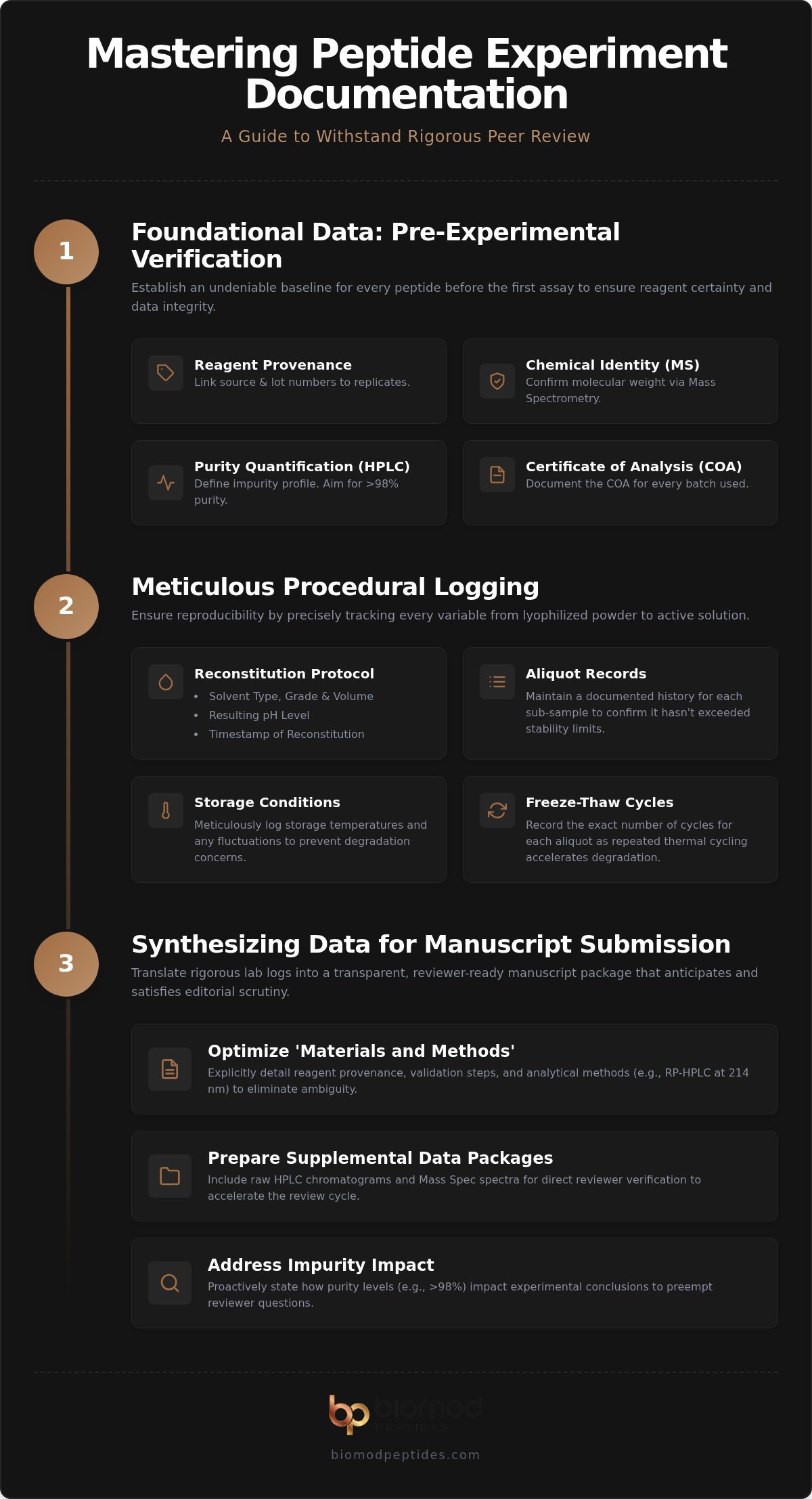
Scientific rigor begins with absolute reagent certainty. Researchers must establish a definitive baseline for every peptide before the first assay. This process requires identifying the primary source and specific lot number. These identifiers are essential for tracing reagent consistency across experimental replicates; a failure here renders longitudinal data comparisons invalid. Understanding the chemical nuances of Peptide Synthesis allows investigators to anticipate potential side products or sequence truncations that might influence biological outcomes.
Verification requires a dual analytical approach. First, confirm chemical identity via Mass Spectrometry (MS). The experimental molecular weight must align with the theoretical sequence to ensure identity. Second, quantify purity through High-Performance Liquid Chromatography (HPLC). This defines the impurity profile as a foundational variable. To meet submission standards, authors should document the Certificate of Analysis (COA) for every batch. Researchers often store digital copies from Biomod Peptides to streamline supplemental data submission and provide reviewer-facing verification.
Standardizing Reagent Identity for Academic Transparency
Precision in reporting eliminates ambiguity. Manuscripts should include a single sentence defining the peptide purity percentage and the specific analytical method used, such as RP-HPLC at 214 nm. Integrating this third-party validation data into the initial data management plan prevents retrospective gaps that often lead to manuscript rejection. Knowing how to document peptide experiments for publication requires treating reagent identity as an active experimental variable rather than a static assumption. This proactive documentation ensures that the structural integrity of your research reagents remains beyond reproach during peer review.
Procedural Logging: Tracking Reconstitution and Stability Variables
Reproducibility hinges on the transition from lyophilized powder to active solution. Researchers must record precise reconstitution protocols, including solvent type, total volume, and resulting pH levels to ensure complete solubility. Deviations in these parameters often lead to inconsistent assay results that reviewers will scrutinize. Referencing improving peptide solubility protocols provides a standardized framework for these handling techniques. Maintaining detailed aliquot records is equally vital. Each sub-sample used in the study requires a documented history to confirm it hasn’t exceeded stability limits.
Log storage conditions and freeze-thaw cycles meticulously. Tracking temperature fluctuations is critical, as repeated thermal cycling accelerates degradation. This level of detail is a prerequisite when learning how to document peptide experiments for publication. High-impact journals expect evidence that reagents maintained structural integrity throughout the study duration. For researchers seeking high-purity materials to ground their data, sourcing validated research peptides ensures a reliable starting point for these rigorous logging procedures.
Tracking Stability Variables in Laboratory Environments
Document the exact timestamp of reconstitution to establish the window of peak bioactivity. Investigators should note any observed precipitation or color changes during the dissolution process; these serve as critical qualitative data points for troubleshooting. Record the specific type of laboratory-grade water or buffer used. Include the manufacturer and the specific grade, such as LC-MS or ACS grade. This level of granularity eliminates ambiguity in the Materials and Methods section and reinforces the overall credibility of the experimental narrative.
Synthesizing Data for Manuscript Submission and Peer Review
The final phase of research involves translating laboratory logs into a cohesive manuscript. Precision in the Materials and Methods section is paramount for peer-review success. Authors must explicitly detail reagent provenance and validation steps to satisfy editorial scrutiny. Utilizing high purity research peptides establishes a baseline of quality that reviewers expect in modern proteomics. Transparency regarding the source material eliminates the ambiguity that often triggers technical queries during the evaluation process.
Prepare comprehensive supplemental data packages to support your primary findings. These packages should include raw HPLC chromatograms and Mass Spec spectra for direct reviewer verification. Transparency here prevents delays during the review cycle. Address potential impurity interference by stating how specific purity levels, typically exceeding 98%, impact experimental conclusions. This analytical honesty reinforces the structural integrity of the study. It demonstrates that the investigator has considered the potential for minor contaminants to influence biological activity.
Structuring the Materials and Methods Section
A standardized framework ensures all critical variables are reported consistently. Follow these steps to refine your documentation:
- Step 1: State the peptide name, sequence, and manufacturer, specifically Biomod Peptides, Las Vegas, NV.
- Step 2: Detail the verification method. Cite third-party HPLC/MS results and lot-specific purity percentages to anchor the reagent identity.
- Step 3: Describe the handling and reconstitution environment. Include specific storage temperatures and the exact buffers used for dissolution.
Mastering how to document peptide experiments for publication requires converting raw procedural data into a logical narrative. By providing a clear trail from the initial COA to the final assay, you demonstrate the accountability required for high-impact journals. This rigorous approach minimizes the risk of manuscript rejection due to technical ambiguity or insufficient characterization data.
Advancing Analytical Transparency in Peptide Research
Rigorous documentation is the bridge between laboratory observation and peer-reviewed validation. Success requires a meticulous record of reagent identity, stable handling protocols, and the synthesis of raw analytical spectra into reviewer-ready packages. Implementing these standards ensures you understand how to document peptide experiments for publication with the precision high-impact journals demand. Establishing this level of accountability protects the reproducibility of your work and streamlines the path toward successful manuscript acceptance.
Biomod Peptides supports these institutional benchmarks through US-manufactured reagents and a dedicated verification portal for analytical transparency. Our strict third-party testing protocols provide the empirical proof necessary for sophisticated research environments. Secure high-purity reagents for your next publication at Biomod Peptides and elevate the integrity of your experimental data. Precise documentation combined with verified reagents creates a foundation of high-tier reliability for your future contributions to the field.
Frequently Asked Questions
What is the minimum peptide purity required for most scientific publications?
High-impact scientific journals typically require a minimum peptide purity of 95% to 98% for standard biological assays. Quantitative studies or structural characterization often demand purity levels exceeding 98% to ensure trace contaminants don’t interfere with results. Researchers in Las Vegas and throughout the US must verify these levels using RP-HPLC to meet the rigorous standards expected by peer-review committees.
How should I cite a third-party certificate of analysis in my research paper?
Citing a third-party certificate of analysis involves listing the manufacturer, the specific lot number, and the analytical methods used for validation. State that the reagent underwent independent testing to establish baseline purity. When sourcing from Biomod Peptides, you may reference our COA verification portal. This provides reviewers with direct access to the raw analytical data, ensuring total accountability for reagent provenance.
Do I need to include raw HPLC data in the supplemental information?
Most high-tier journals require the deposition of raw HPLC chromatograms and Mass Spectrometry spectra within the supplemental data section. This transparency allows reviewers to verify the identity and purity of the research material. Learning how to document peptide experiments for publication effectively involves preparing these files as high-resolution PDFs or depositing them into public repositories to satisfy modern data deposition mandates.
How do I document the stability of peptides used in long-term studies?
Documenting stability requires a detailed log of storage temperatures, the exact number of freeze-thaw cycles, and reconstitution timestamps. This data confirms the peptide remained bioactive throughout the study. Our Las Vegas facility emphasizes these standards to help investigators maintain consistency. This level of detail is a critical component of how to document peptide experiments for publication to ensure longitudinal reproducibility across all replicates.
Disclaimer
BIOMOD products are sold strictly for laboratory, analytical, and scientific research use only. They are not intended for human or animal consumption, administration, application, ingestion, injection, or any therapeutic, diagnostic, or cosmetic use.
The statements made on this website have not been evaluated by the United States Food and Drug Administration. BIOMOD products are not intended to diagnose, treat, cure, mitigate, or prevent any disease or medical condition.
BIOMOD is a research chemical supplier. BIOMOD is not a compounding pharmacy or chemical compounding facility as defined under Section 503A of the Federal Food, Drug, and Cosmetic Act. BIOMOD is not an outsourcing facility as defined under Section 503B of the Federal Food, Drug, and Cosmetic Act.
By accessing this site, you confirm you are at least 21 years of age and that you have read and accepted the BIOMOD Terms of Sale, Privacy Policy, and Research Use Only Policy. BIOMOD does not provide dosing, medical, therapeutic, diagnostic, veterinary, or use guidance under any channel.